The movements of the furthest-left wing of the Democratic Party, including the DSA, have grown substantially in the recent primaries to decide who will run in the midterm elections this November. Photo: Conian Houston.
Guacamaya, August 5, 2026. There is a scene that repeats itself on every primary night of this midterm preliminary cycle: a crowd chanting the three letters “D-S-A” while a candidate who was little known until recently defeats an incumbent with decades of political machinery behind them.
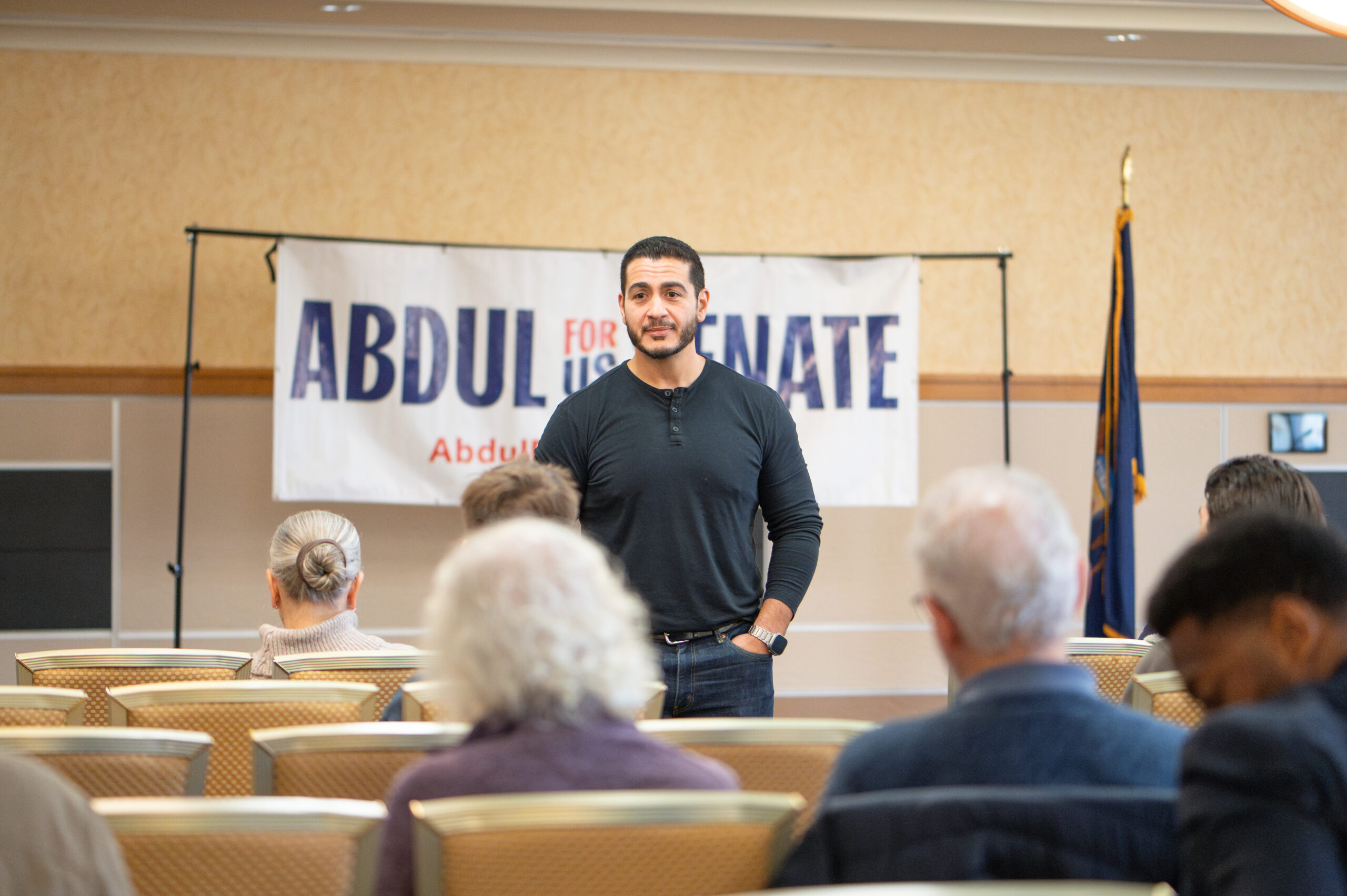
The wave is not limited to the DSA — the Democratic Socialists of America — but other candidates are also adopting a leftward turn, and winning. The latest emblematic case is Abdul El-Sayed’s victory in a Michigan Senate primary. Although he defines himself as a “capitalist,” he supports progressive slogans like universal health coverage, while also being critical of Israel.
In Michigan, in New York, in Washington D.C., the script is the same, and the Democratic Party — divided, aged, and without a unified message after the 2024 defeat — seems to have no answer. What began as a niche curiosity a decade ago is today perhaps the faction with the most momentum within the opposition party in the United States. And it brings with it, among other things, a stance on Venezuela that no Democratic presidential aspirant will be able to continue ignoring.
From “Outsider” to Machine: The Genealogy of the Victories
To understand the magnitude of the current moment, one must go back to June 2018, when a 28-year-old waitress named Alexandria Ocasio-Cortez defeated Congressman Joseph Crowley, the number four in the Democratic hierarchy in the House and a name mentioned as a possible successor to Nancy Pelosi. It was, according to analysts within the movement itself, the DSA’s first major federal victory, and it set a precedent that the Democrats’ left wing would be slow to repeat.
The pattern re-emerged with force in 2022, when Summer Lee won the primary in Pennsylvania’s 12th district and Greg Casar did the same in Texas’s 35th, both on explicitly socialist platforms and with DSA backing. In that cycle, the organization’s congressional caucus grew to more than half a dozen members, even though rival committees like Justice Democrats invested more than $11 million trying to shape the outcome in their favor.
But the real qualitative leap came in 2025 with Zohran Mamdani, then a 33-year-old state assemblyman, virtually unknown outside Queens. He defeated former Governor Andrew Cuomo in the Democratic primary for New York City mayor, with 56% of the ranked-choice vote. It was the first time the DSA had captured the executive post of a major U.S. city, and his election made him, overnight, the national face of democratic socialism.
That victory was also a dress rehearsal for the territorial machinery Mamdani built to win the mayoralty — grassroots volunteers, small-dollar fundraising, constant vertical video presence — the same one that, a year later, was deployed to elect three congressmen in New York and help decide a Senate race in Michigan.
This wave has not been without setbacks, something worth noting. In 2024, two of the most visible figures of the “Squad” — Jamaal Bowman in New York and Cori Bush in Missouri, both DSA members and frontal critics of the Israeli offensive in Gaza — lost their primaries to candidates massively backed by AIPAC, the influential pro-Israel lobby in the United States, in the most expensive campaigns ever waged against sitting congressmen.
However, those defeats, far from slowing the movement, ended up serving as campaign material: the DSA itself used them to argue that foreign lobby money had bought two seats, a narrative that its 2026 candidates exploited without nuance.
The 2026 Cycle: Michigan and New York as Laboratories
That is the backdrop against which the current cycle unfolds. In Michigan, Abdul El-Sayed, a physician and former public health official, won the Senate primary by a margin of just 1.8 points — 48.9% to 47.1% — against Haley Stevens, who had $60 million in outside spending, of which more than $30 million came from AIPAC and its affiliates: the organization’s largest-ever investment in a primary.
In the same state and on the same night, Donavan McKinney, also DSA-backed, defeated incumbent Congressman Shri Thanedar, who had distanced himself from the progressive movement after the October 7 attacks in Israel.
In New York, the sweep was cleaner. The three candidates backed by Mamdani — Darializa Ávila Chevalier, Claire Valdez, and Brad Lander — won their congressional primaries, unseating two incumbents and capturing an open seat.
Ávila Chevalier, a pro-Palestinian activist at Columbia University who had never held public office before, defeated Adriano Espaillat, then chairman of the Congressional Hispanic Caucus, after a campaign focused on denouncing the AIPAC funding received by her rival.
Those victories were added to that of Janeese Lewis George, a DSA member, in the Democratic primary for mayor of Washington D.C. — which, in practice, places DSA members on the verge of simultaneously governing the nation’s capital and its most populous city.
The most recent case, and the one that best summarizes the trajectory of the cycle, came in Colorado at the end of June: Melat Kiros, a 29-year-old socialist Democrat, defeated Representative Diana DeGette, who had represented the state’s first district since 1997.
It was, according to the DSA’s own tally, the organization’s 35th victory of the cycle so far — out of 150 endorsed candidates nationwide, 35 advanced or won unopposed, against 34 defeats, with results still pending in several races — and it was enough for the organization to go from having two lawmakers in Congress just a year ago to having at least five secured, with the November election still ahead. That number, beyond the symbolic, is what has led the DSA leadership itself to speak openly, for the first time, of a competitive presidential candidacy for 2028.
The Common Denominator: AIPAC as Declared Enemy
What unifies nearly all of these triumphs, from the original Squad to the Mamdani generation, is a mobilization narrative against money, with Israel as the symbolic epicenter. An establishment candidate receives funding from AIPAC; the DSA candidate turns it into the axis of their campaign, presenting themselves as the incorruptible alternative to a foreign lobby.
The formula has proven remarkably resilient, even against record spending: in Michigan, the $60 million, mostly invested by AIPAC, was not enough to save Stevens. Bernie Sanders, the discursive architect of much of this strategy, put it bluntly during the campaign: the real adversary was not the rival candidate, but the money behind her.
That axis inevitably intertwines with each candidate’s stance on Gaza. Brad Lander, who had broken with the DSA over differences on how the organization characterized the October 7 Hamas attacks, ended up winning his primary only after pivoting toward explicit criticism of Israel, even calling Joe Biden’s strategy toward Netanyahu a “catastrophic failure” that turned Washington into an accomplice to genocide.
The detail is not minor, when even candidates who distance themselves organically from the DSA end up adopting its vocabulary on Israel to survive in districts where that electorate has become decisive.
The Other Front: Confrontation with Technofeudalism
If countries like Israel and Venezuela define the foreign policy of this sector, there is a third axis that increasingly defines its domestic economic discourse, and which its own theorists have begun to name with a word that just five years ago sounded like academic jargon: “technofeudalism.”
The term, popularized by Greek economist Yanis Varoufakis and French sociologist Cédric Durand, describes a mutated capitalism in which a handful of platforms — Amazon, Meta, X, Google, Palantir — no longer compete in an open market, but extract rent through monopoly control of data, digital infrastructure, and artificial intelligence, in a logic that its critics compare, with nuances, to that of the feudal lord who collects tribute for mere access to land.
That language became political flesh in the so-called “Fighting Oligarchy” tour, which Sanders and Ocasio-Cortez took across the country, drawing tens of thousands of people — 36,000 in Los Angeles alone, at one of the most crowded rallies of the cycle — with a message that fuses old anti-monopoly vocabulary with a specific critique of the power of tech magnates turned political actors.
Sanders has not hidden who he is targeting. When Elon Musk accused him on social media of having talked about oligarchy for years, the senator replied without nuance that the difference was that he was no longer talking about a future threat, but a description of the present. The image that both lawmakers repeat at every rally — that a handful of billionaires decide, without being elected by anyone, issues that affect millions of people — is, in essence, the same thesis that Varoufakis and Durand describe, applied this time not to an academic treatise but to a campaign speech.
Migration: The Other Line of Confrontation with Trump
The second area where this sector has turned confrontation into government policy, not just rhetoric, is migration. Mamdani has made defending immigrant communities one of the central axes of his first year as mayor, in a direct and growing clash with the White House.
In February, he signed an executive order preventing ICE agents from entering municipal properties without a court-ordered warrant, and in July, after the deployment of an expanded federal operation in Queens and Long Island, his administration reiterated that it would not allow the city’s Haitian and Syrian communities to be “terrorized,” offering free legal assistance through the Mayor’s Office of Immigrant Affairs.
Mamdani has been a firm defender of TPS, to which some 600,000 Venezuelans have adhered. This immigration status has been under attack practically since Trump’s return to the White House, in his campaign to stigmatize the Venezuelan diaspora, linking it to criminal gangs, primarily the Tren de Aragua.
The speech Mamdani delivered on July 3, on the eve of the 250th anniversary of American independence and from George Washington’s own desk, summarized the tone that the entire sector has adopted: he accused “too many” of the country’s leaders of abandoning the idea of the United States as a refuge for the persecuted, and described ICE agents as a force that bursts into the city’s neighborhoods without asking “how long they have been living here or what documents they have.”
The tension has not been merely rhetorical: in May, an incident at a Bushwick hospital, where ICE agents detained an undocumented Nigerian immigrant and took him in handcuffs to receive medical treatment, led to protests by nearly 200 people and forced the mayor’s office to review its protocols for responding to immigration operations in municipal facilities.
This stance connects, once again, with the rest of the sector’s platform. Just as in Gaza and Venezuela the DSA denounces what it calls U.S. imperialism abroad, on migration it denounces what it describes as a punitive apparatus domestically, directed against the same populations — Central American, Caribbean, Middle Eastern — that its foreign policy claims to defend internationally. For its supporters, it is an ideological coherence that distinguishes this sector from the rest of the party; for its critics, it remains a coherence that stops, selectively, at the Caracas border.
What to Expect from This Leftward Turn for Venezuela?
The stance toward Venezuela was put to a dramatic test on January 3, 2026, when “Operation Absolute Resolution” extracted Nicolás Maduro and his wife, Cilia Flores, from Venezuelan territory. The DSA reacted within hours with a statement that called the action openly imperialist war aimed at delivering Venezuelan oil resources to U.S. companies, and demanded the withdrawal of military assets from the Caribbean, an end to sanctions, and the reopening of the embassy in Caracas.
Mamdani, already as mayor of New York, called the operation an act of war and a violation of international law. Ocasio-Cortez went further on the discursive front: she framed the arrest not as a drug trafficking matter but as one of oil control and regime change, and linked it to the coverage of the “Epstein case” and rising health care costs, in an exercise of message discipline that prioritized the domestic economy even in the face of an event of that geopolitical magnitude.
It can be expected that, as the left-wing caucus grows in January 2027, its members will directly challenge the oil companies and any other actor close to Trump benefiting from the new Venezuelan business. They could do this through letters from the House Oversight Committee, audit requests to the Government Accountability Office (GAO), and requests for executive appearances — the same repertoire this sector has already used against other industries — though the concrete details of those inquiries are, as of this analysis, still to be determined.
That combination of anti-imperialism toward Caracas and anti-oligarchy toward Washington is, probably, the terrain where the DSA will try to demonstrate that its critique of corporate power does not stop at the border, but connects both fronts in a single narrative of corporate capture of the state — with the predictable risk that the White House and its allies in Congress will denounce those inquiries as political instrumentalization rather than genuine oversight.
It is worth, however, being precise and not falling into the caricature of a monolithically silent bloc, because the facts are more nuanced than the usual critical reflex suggests. The three most visible figures of this cycle have indeed condemned, at different times, Chavismo as an authoritarian regime.
Mamdani has explicitly called both the Venezuelan and Cuban governments dictatorships, even while criticizing U.S. sanctions as an instrument of collective punishment.
Ocasio-Cortez, although she focused her reaction to Maduro’s capture on the oil backdrop of the operation, has not denied the repressive character of Chavismo. And Sanders settled the ambiguity several years ago when in 2019 he called Maduro a “tyrant” without using the word “dictator,” but by 2020 he was already calling him a “dictator” outright in televised interviews, describing Venezuela, Cuba, and Nicaragua as “authoritarian societies” that he “of course” does not support.
The national leadership of the movement, in other words, now holds a double-edged position. It condemns the, in its view, undemocratic character of Chavismo, but rejects with equal firmness any form of military intervention or regime change imposed from Washington.
That nuance, however, is not uniformly maintained across the movement’s grassroots. Local DSA chapters — such as those in Madison or Pinellas, cited in their statements after Maduro’s capture — have maintained a discourse much closer to unreserved defense of Chavismo as a resistance project against Washington, speaking of the “Bolivarian Revolution” and the “conquests” of the Chávez era with a tone that the DSA’s congressional leadership rarely replicates in public.
That gap between the visible leadership and the organic grassroots is, in itself, revealing: while Mamdani, Sanders, and Ocasio-Cortez weigh their words with a national electorate in mind that largely rejects Chavismo, local chapters without the same media exposure continue to operate with the more romantic — and less critical — vocabulary of the Third World solidarity of the 1970s and 1980s.
The most likely scenario for the coming years is that the DSA’s position in Congress will converge toward something like the model already rehearsed by Lula da Silva in Brazil, that is, neither empty condemnation nor uncritical endorsement, but a formula of calculated ambiguity that allows condemning authoritarianism without legitimizing intervention.
But the most lasting effect will probably not be measured in individual votes, but in the displacement of the debate’s center of gravity. For nearly two decades, bipartisan foreign policy toward Venezuela was, with nuances, uniformly hostile to Chavismo. That uniformity no longer entirely exists.
With Mamdani as mayor of the country’s most influential city, with Ocasio-Cortez mentioned with increasing insistence as a presidential aspirant for 2028, and with a structurally growing DSA caucus, the stance of “non-intervention, end of sanctions, reestablishment of relations” has ceased to be a niche oddity and become a real option within the foreign policy menu of a future Democratic presidential candidate. It is, without exaggeration, a change that just one electoral cycle ago would have been hard to imagine.
The Division of Venezuela in the Crosshairs
If there is one area where the critique of technofeudalism and the DSA’s historical position on Venezuela will collide directly with the White House in the coming months, it is the corporate carve-up of Venezuelan oil after Maduro’s fall.
The sequence is already visible: just six days after Operation Absolute Resolution, Trump convened executives from 17 oil companies at the White House, including Chevron, ExxonMobil, and ConocoPhillips — all three with pending arbitration litigation against the Venezuelan state over the 2007 nationalization — as well as Shell, Repsol, Eni, and service firms like Halliburton and SLB, promising them “complete security” if they invested in the country.
In May, Trump himself met again with the presidents of Chevron and ExxonMobil to discuss the progress of those investments, while publicly celebrating that the inflow of oil dollars had Venezuelans “very happy dancing in the streets.”
To that corporate map is added, with a different profile but equally sensitive for this sector, the entry of Elon Musk. Starlink offered free connectivity in Venezuela during the month following Maduro’s capture, in a gesture that the company itself framed as “support for the Venezuelan people” and which replicated the strategy SpaceX had already used in Ukraine; seven months later, in July, the telecommunications regulator of the Venezuelan Interim Government itself formalized with SpaceX executives the terms for operating the network on a regularized basis throughout the national territory, thus closing the loop between the initial humanitarian gesture and the consolidation of a long-term digital infrastructure business.
There is also the possible interest of Palantir and Peter Thiel in making Venezuela their next episode in Latin America, following “Próspera” in Honduras and the project in Argentina’s Patagonia. It is exactly the type of sequence — a magnate close to Trump, emergency aid presented as philanthropy, a commercial contract underneath — that the vocabulary of “technofeudalism” wielded by Sanders and Ocasio-Cortez is designed to name.