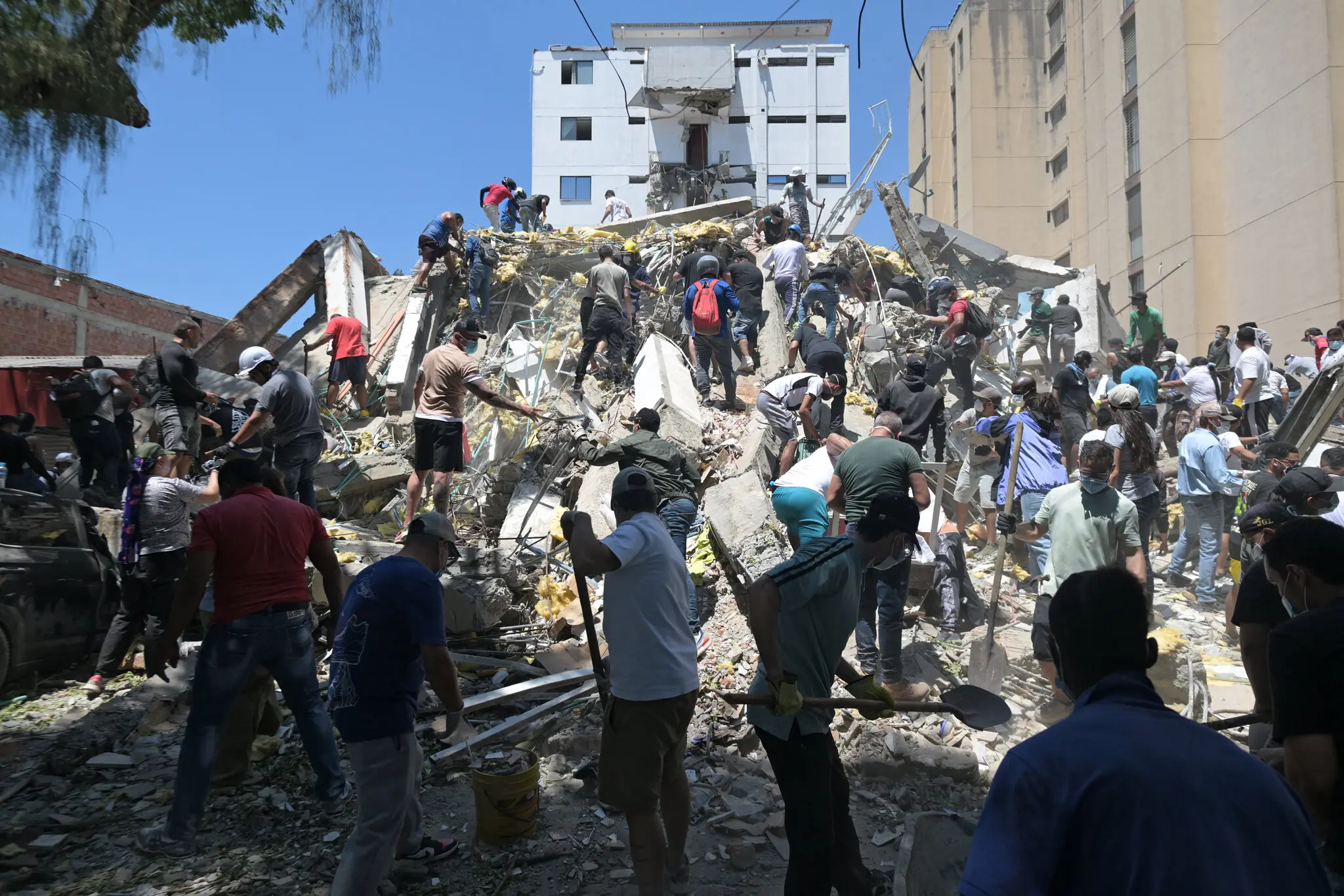
In the face of the recent earthquake’s magnitude in Colombia, President Abelardo de la Espriella is working to coordinate humanitarian aid and the reconstruction of affected areas, while the Venezuelan government offers assistance that is being questioned by its own population. | Photo: Joaquin Sarmiento/Agence France-Presse.
Guacamaya, August 11, 2026. This Monday, August 10, at 7:34 AM Colombian time, the country was shaken by the largest-magnitude earthquake recorded in its territory in the 21st century. The 7.4-magnitude earthquake, with its epicenter in San José del Palmar, Chocó, not only put the foundations of western Colombia to the test but also, for Venezuelans, inevitably evokes the pain following the seismic doublet of last June 24.
Although official figures in Colombia have been slow to consolidate, the most widely reported toll stands at 181 fatalities, compared to estimates from local and international media that put the death count at up to 250 as of the current date. At the same time, more than 2,500 injuries have been recorded, along with at least 195 missing persons, although citizen-led search networks already count around 4,000 reports of unlocated individuals.
The cities of Cali, Pereira, Manizales, and Quibdó concentrate the highest level of devastation, with reports of at least 165 collapsed buildings and severe damage to critical infrastructure. Faced with the magnitude of the catastrophe, President Abelardo de la Espriella declared a national disaster status and thus faces his first major test just days after assuming office.
Why is it not the same scenario as in Venezuela?
For those in Venezuela, this news arrives as an echo of the suffering caused by the earthquakes of last June 24. Although the events in both countries share a similar magnitude, the consequences, technical implications, and the capacity and immediate response measures mark a significant gap that must be addressed.
On the one hand, the Colombian earthquake consisted of the subduction (or diagonal-oblique movement) of the Nazca Plate beneath the South American Plate, an event felt across an area extending as far as Panama and Ecuador. In contrast, the Venezuelan disaster was a seismic “doublet” (two events of magnitudes 7.2 and 7.5, 39 seconds apart) caused by lateral displacement in the Caribbean Plate.
Furthermore, the earthquake in Colombia occurred at an intermediate depth of between 103 and 107 kilometers, according to data from the United States Geological Survey (USGS) and the Colombian Geological Survey (SGC). By contrast, the earthquakes in Venezuela were very shallow (20.3 km and 10 km), which explains why the tragedy has so far left a catastrophic death toll of more than 6,300.
However, soil vulnerability does present itself as a common aspect. Experts in Colombia point out that soil liquefaction due to ground moisture in Chocó and the Coffee Axis may have been decisive in building collapses. The phenomenon is explained similarly in Venezuela due to the sedimentary soils characteristic of the La Guaira coast.
Regarding response efforts, unlike Venezuela, Colombia has had a National Risk Management System since 2012 that coordinates territorial responses. Nevertheless, the current disaster on neighboring soil has reopened debate about the “historical debt” and the lack of State presence in marginalized regions such as Chocó—a criticism also voiced in Venezuela’s ground zero of the disaster.
Venezuelan aid and domestic criticism
Hours after the earthquake, the Venezuelan Executive, through Vice President Delcy Rodríguez and the Ministry of Foreign Affairs, formally offered to send a team of rescue workers and humanitarian aid. The official communiqué also emphasizes that this offer is made within the framework of “full respect for the sovereignty and self-determination” of Colombia.
However, this gesture of solidarity has sparked a wave of criticism on social media. Citizens in areas such as La Guaira denounce that grievances persist over the lack of attention and reconstruction following the June earthquake. Complaints highlight that the first official report on the event took six hours to arrive, without providing initial details on victims.
At the same time, the feasibility of meeting the government’s goal of delivering 4,000 housing units before year-end while offering external assistance is being questioned. Additionally, the political context between the new De la Espriella administration and figures from Colombia’s previous government adds a layer of diplomatic complexity to the acceptance of this aid.
Venezuelan reality is in fact manifested through another peculiar situation. The Mexican group Topos USAR BREC, which has been helping the country for over 40 days, is now seeking to move to Colombia. They are requesting pickup trucks and gasoline to cross the border by land, since air restrictions prevent the transport of fuel for their tools.
De la Espriella’s great political and administrative challenge
The tragedy has not escaped political polarization. De la Espriella’s government denounced an alleged campaign from “sectors of the outgoing administration” to discredit his management before international organizations. Even so, the fact that the Colombian government had to request international aid from the UN is seen by opposition sectors as an admission of overwhelmed capacity.
Another of the harshest criticisms of De la Espriella’s management is what some analysts and citizens consider a prioritization of public order over rescue logistics. While thousands of people remained trapped, the initial media and operational focus was on deploying 1,000 soldiers in Cali and imposing curfews in Pereira to prevent looting.
At the same time, the earthquake also exposes the historical “lack of State” in the Pacific region, where local leaders in Quibdó and Buenaventura denounce a slow institutional response. The collapse of the two main bridges in Buenaventura and the closure of six airports due to structural damage left entire communities cut off.
Furthermore, there is growing discontent over the slowness and discrepancies in official figures. While regional governorships reported death tolls exceeding 200, the National Government maintained considerably lower figures in its initial consolidated reports, generating a perception of disconnection between the capital and the regions.
Colombian crisis management faces the challenge of demonstrating that its strength is not merely rhetorical or military, but operational. Initial reconstruction estimates amount to 20 billion Colombian pesos (US$6.3 billion), equivalent to 1% of GDP—a figure that pressures the 2027 national budget amid government adjustments.
In Venezuela, meanwhile, the effects are observed with a mixture of brotherhood and bitterness, while it is remembered—or made evident—that the earth does not distinguish borders, but that the strength of institutions is the only thing that marks the difference between a natural threat and a humanitarian catastrophe.