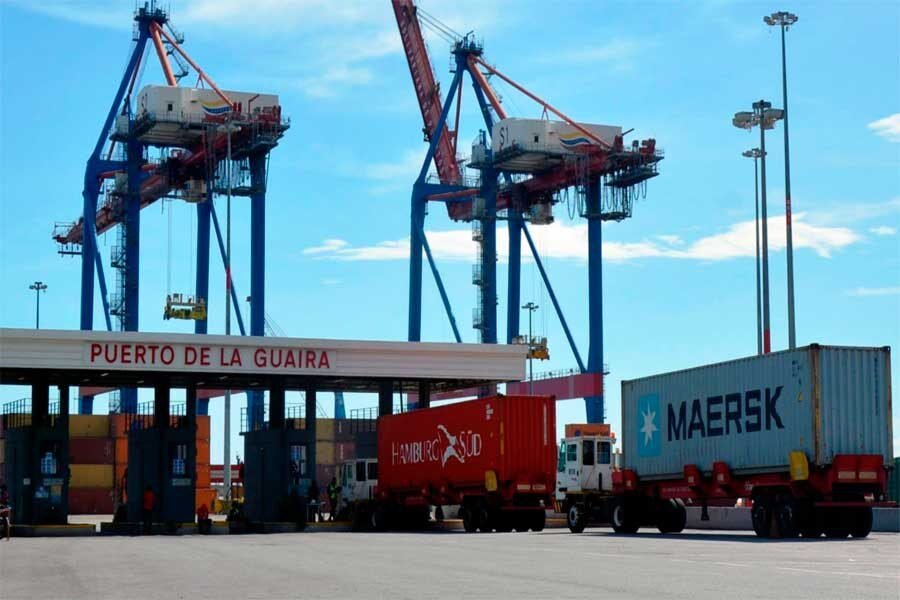
A decree to accelerate exports, a truce on commercial inspections before Christmas, and the ratification of an aeronautical treaty in Parliament were implemented within a 72-hour span to dynamize domestic and foreign trade. Photograph: Venezuelan Observatory Against the Blockade.
Guacamaya, November 5, 2026. During this week, tax management and logistical operations in Venezuela have registered a significant pace of change. What at first glance could be interpreted as a series of disconnected announcements actually responds to a coordinated state strategy of trade facilitation, replacement of inspections, and accelerated pursuit of non-oil foreign currency.
The replacement of cumbersome export permits with the exclusive requirements of the buyer country, announced by the Executive, coincided with the freezing of in-person inspections by the National Integrated Service of Customs and Tax Administration (Seniat). In turn, the National Assembly also sanctioned the Approving Law of the Montreal Convention for international air transport.
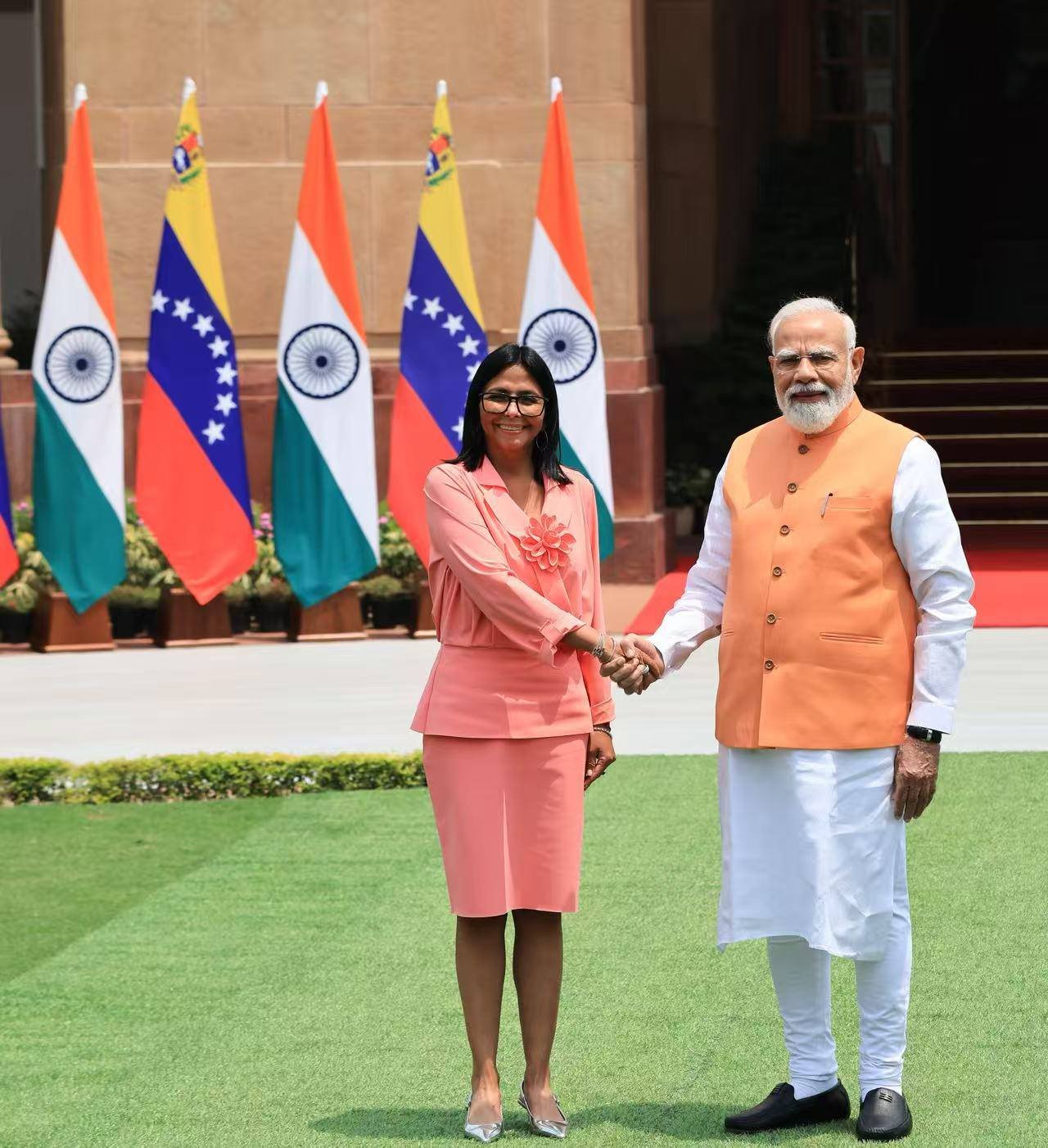
The cycle of announcements began on Tuesday, November 3, when acting President Delcy Rodríguez announced during the Conindustria 2026 Congress that the Executive was advancing in the massive elimination of procedures to dynamize exports. “We are ready with the procedures to simplify the entire export process so that, in that way, foreign currency can be generated for the country,” she stated.
The following day, the Sectoral Vice President of Administration and Digital Government and Minister of Economy and Finance, Anabel Pereira Fernández, accompanied by the Deputy Minister of International Trade, Saúl Ameliach, presented in detail the specifications of the new Decree on Simplification of Export Procedures. “Today we take a step so that our products reach further,” she said.
Then, on November 5, the Superintendent of the National Integrated Service of Customs and Tax Administration (Seniat), Román Maniglia, announced during the Annual Congress of Cavececo the suspension of in-person inspections until January 2027 within the framework of the transition toward the digital inspection system of Modernization, Digitalization and Automation (MODA).
But on that same November 5, the Plenary of the National Assembly unanimously sanctioned the Approving Law of the Convention for the Unification of Certain Rules for International Carriage by Air, also known as the Montreal Convention of 1999. The aim is now to reduce administrative burdens to provide greater support to foreign trade.
All these decisions are articulated on the legal basis established months earlier with the promulgation of the Organic Law for the Celerity and Optimization of Administrative Procedures, published in Extraordinary Official Gazette No. 7,018 on April 8, 2026. In this sense, an analytical breakdown of this gearwork of reforms and their impact on the country’s business fabric is presented.
The Export Decree: Suppression of Internal Permits and the Destination Country Rule
For decades, non-oil export activity in Venezuela has been conditioned by a dense network of bureaucratic requirements consisting of prior ministerial permits, mandatory sectoral registrations, special exporter codes, and sanitary certifications considered redundant that slowed shipments and reduced competitiveness at international ports.
The Decree on Simplification of Export Procedures, detailed by Minister Anabel Pereira Fernández and Deputy Minister Saúl Ameliach, radically transforms the doctrine of administrative control by establishing a clear rule: Venezuelan exporters must only comply with the formal requirements demanded by the destination country.
The decree introduces immediate modifications for the main exportable items. In fishing and aquaculture, the requirement of permits, registrations, and certificates is eliminated, as are restrictions on sales. In coffee and cocoa, export restrictions are repealed, including the “coffee exporter code.” And in industry and agri-food, the obligation before ministries is suppressed.
Regarding health and phytosanitary certifications, these will only be issued in cases where the buyer country explicitly requires them. Meanwhile, for the ground transport of goods to national ports, a single cargo movement document will suffice. Likewise, legalization procedures requested from abroad will have a maximum resolution period of 10 business days.
“With this simplification of procedures, shipping times decrease, thus fostering non-oil exports,” Pereira emphasized. Meanwhile, regarding guarantees for the domestic market, she stated that “the State will guarantee national supply and our producers will have simpler rules to position Venezuelan products in the world.”
These measures are announced in a macroeconomic environment in which the Executive seeks to strengthen non-oil foreign currency flows. In this sense, the Government reported that it maintains advanced negotiations with multilateral organizations to access a financing scheme of 17 billion dollars over the next five years, destined for productive projects of the public and private sector.
According to data disclosed by President Delcy Rodríguez, Venezuela closed October 2026 with a monthly inflation of 6.2% — the lowest figure recorded in the last two years — accumulated consumption growth of 23%, a 38.8% reduction in imports of processed foods through national substitution, and a 31% increase in imports of industrial raw materials.
The Seniat Truce and the Structural Migration Toward the MODA System
Alongside customs flexibilization, the fiscal front adjusted its control mechanisms. During the V Annual Congress of the Venezuelan Chamber of Shopping Centers and Affiliates (Cavececo), Seniat Superintendent Román Maniglia announced the suspension of in-person inspections and audits of commercial establishments during the last quarter of the year.
The head of the collecting entity explained that the decision, which will even extend until January 2027, seeks to serve as a relief stimulus for the Christmas season, although it demands in exchange accounting transparency and “clear books” to consolidate a new tax culture. “What we are doing is cross-referencing information. We are not pursuing anyone,” the official added.
This decision is thus framed within the restructuring of the collecting agency under the Modernization, Digitalization and Automation (MODA) system. Consequently, the freezing of the physical presence of tax inspectors does not represent a relaxation of the State’s control powers, but rather their replacement by algorithmic data analysis and real-time transactional cross-referencing.
The decision is part of a series of operational measures, among which stand out the elimination of the physical tax billboard, the indefinite validity of the RIF, the interconnection of data between Seniat and the Autonomous Service of Registries and Notaries (Saren), and the repeal of the mandatory use of fiscal machines, as well as the granting of 180 days of transition toward digital invoicing platforms.
Likewise, Superintendent Maniglia announced that the Executive will introduce in the coming weeks before the National Assembly a package of legal reforms that will encompass modifications to the Organic Tax Code, the Value Added Tax (VAT) Law, the Income Tax (ISLR) Law, and municipal tax harmonization norms.
The Montreal Convention: The Aeronautical Link of Logistical Facilitation
On November 5, the Plenary of the National Assembly unanimously sanctioned, in second discussion, the Approving Law of the Convention for the Unification of Certain Rules for International Carriage by Air, adopted in Montreal in 1999. The bill had been approved in first discussion on Tuesday, November 3.
Although the legislative instrument has an autonomous legal purpose centered on the regime of liabilities, compensation, and user protection in commercial aviation, it bears a direct complementary relationship, especially with the export decree.
By harmonizing the national air regime with global standards for cargo and merchandise traffic, the Montreal Convention provides legal predictability for the transport of perishable or high-value goods. While the Executive’s decree streamlines procedures at ports and land borders, the ratification of the Montreal rules shields the logistics chain in international skies.
The Legal Umbrella and Pending Demands
This entire architecture of simplification finds its normative support in the Organic Law for the Celerity and Optimization of Administrative Procedures, sanctioned by the National Assembly on March 26, 2026, and published in Extraordinary Official Gazette No. 7,018 on April 8, 2026.
This legal text of public order granted the Executive extraordinary powers to suspend, modify, or suppress procedures and obligated the Public Administration to adapt its procedures within a 180-day period that expired in early October.
However, business guilds insist that the true dynamization of the productive apparatus will require addressing pending debts such as the repeal of the Tax on Large Financial Transactions (IGTF), the reactivation of bank credit, cash flow relief with flexibilities in VAT and ISLR, in addition to effective municipal tax harmonization and guaranteed public services such as internet connectivity and electrical supply.