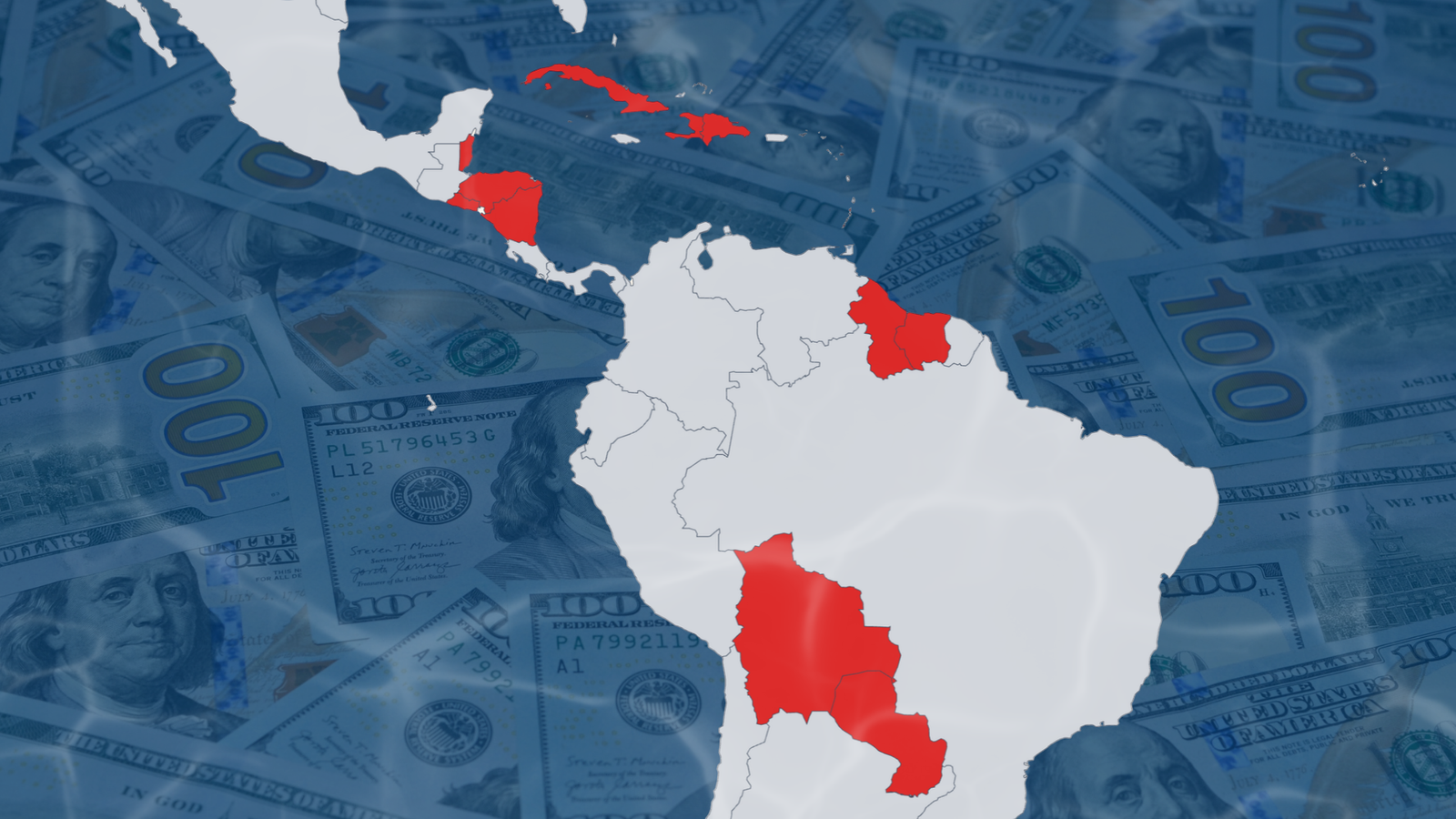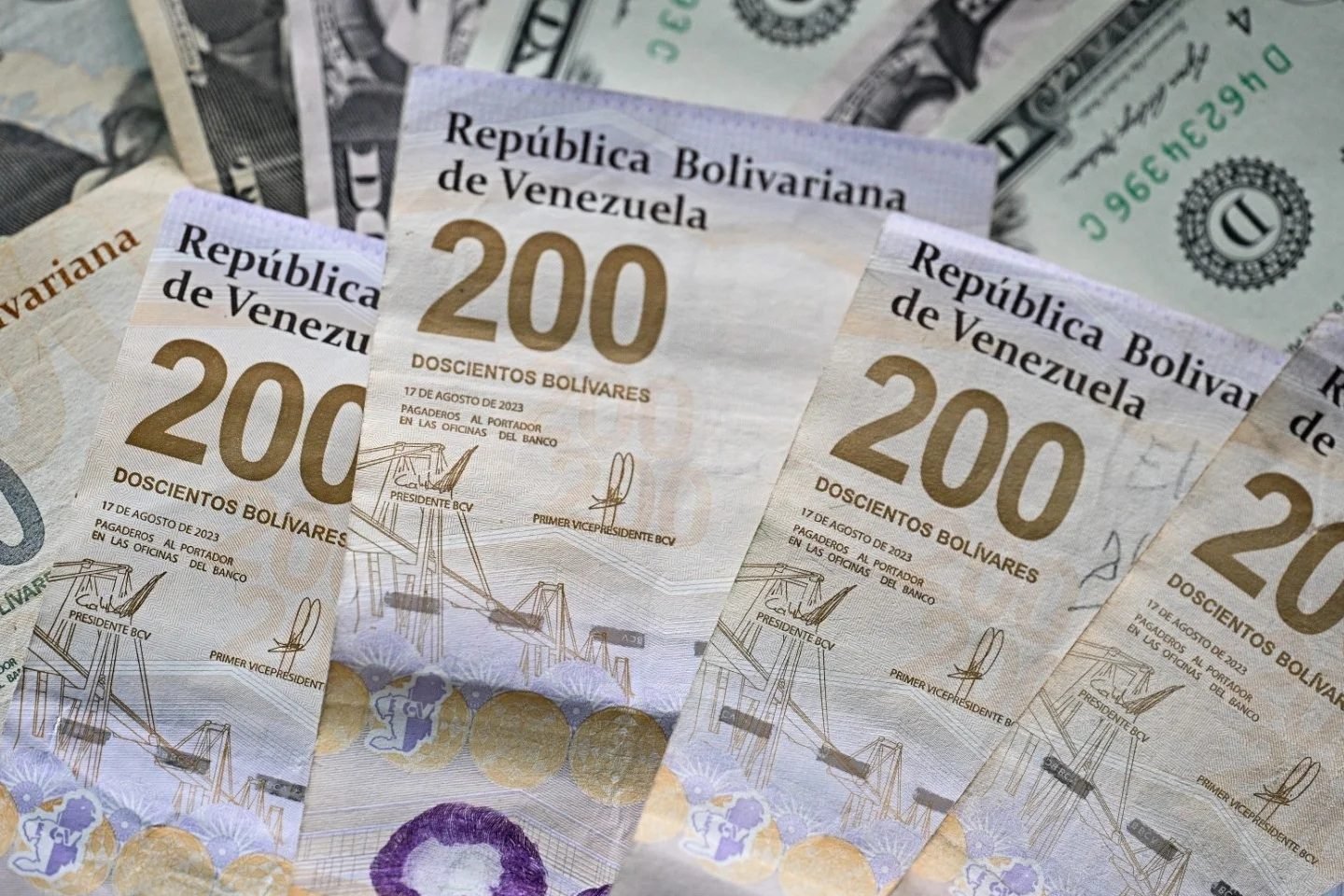
Given the constraints, financial products have reemerged alongside private microfinancing and social programs that address needs, entrepreneurship, and personal consumption. | Photo: Federico Parra/AFP via Getty Images.
Guacamaya, August 18, 2026. After years of near-total drought that reduced the financial system to its bare minimum, bank credit in Venezuela has begun to show signs of recovery in 2026. However, experts describe the pace as gradual and still insufficient, while ordinary citizens and the productive sector face a reality marked by tight limits, deep selectivity, and regulatory barriers.
As of July 2026, the loan portfolio reached USD 4,018.47 million, according to the firm Aristimuño Herrera & Asociados, representing a 59.38% increase in foreign currency compared to the same month the previous year. However, this growth occurs in an ecosystem where financing barely represents 3% of GDP, far below the regional average of 50% to 75%.
The Reserve Requirement as a Lock on Financing
To understand the slowness of this recovery, it is essential to analyze the behavior of the reserve requirement, which currently stands at 73%. This concept is defined as the portion of deposits that banks are required to keep immobilized at the Central Bank of Venezuela (BCV), with no possibility of lending them or using them again as a financial instrument.
In 2013, the reserve requirement was 17% to 22%, standard levels for the region. However, to curb hyperinflation and the rise of the dollar, authorities created the marginal reserve requirement in 2018, which reached 100% in 2019 and was applied exclusively to the increase in new deposits. Since 2022, both concepts have been unified into the fixed rate of 73%.
Although this is a relaxation compared to the 85% or 93% of previous years, the persistently high level of the reserve requirement is still considered by economists as a “drag” that prevents massive credit expansion. For Carlos Alberto Molina, professor at the IESA Finance Center, the current percentage also accelerates informal dollarization by destroying the usefulness of the bolivar as a savings instrument.
Despite this limitation, the financial system has managed to generate 57.8% of its total income from lending activity, which shows that intermediation, despite liquidity constraints, is once again the engine of the banking business. Both public and private entities are now offering financing products for the automotive sector, the productive sector, and personal consumption.
The Automotive Engine: Banesco, Bancaribe, and Provincial Lead the Offering
The vehicle sector has become one of the most dynamic in this reactivation phase, with plans seeking to attract both individuals and legal entities through loans indexed to the Credit Value Unit (UVC). This reference is adjusted daily according to the Investment Index (IDI), which depends on fluctuations in the official exchange rate.
- Banesco and its “CrediCarro”: This institution, which leads private banking in loans with a 17% market share, offers financing for the purchase of new vehicles. Its conditions include financing of up to 70% of the car’s value, with payment terms of up to 48 months and fixed monthly principal payments.
- Bancaribe and the “Auto Line”: The bank has activated a specific product for new vehicles (0 kilometers) that finances up to 50% of the sale price. The offering stands out for a 24-month term, a 16% interest rate, and a 0.50% flat commission on the financed amount.
- BBVA Provincial: It is currently the most versatile option as it includes used cars. It finances up to 90% for new vehicles and up to 50% for those with a maximum age of 7 years and a single transfer. Its terms also reach 48 months.
- Banco Nacional de Crédito (BNC): With its BNC Auto product, it allows the purchase of new or used vehicles with financing terms of up to 12 months.
In parallel, different dealerships, both for new and used cars, also offer independent financing alternatives for their clients.
Mortgage Credit and the Boost from the Double Earthquake
The reactivation of housing credit has been partial and is strongly driven by tragedy. After the double earthquake that shook the country on June 24, 2026, the Government launched the “Venezuela Renace” program. Through Banco del Tesoro, Banco de Venezuela, and the Banco Digital de los Trabajadores, subsidized mortgage loans are offered to replace housing in affected areas.
The plan’s conditions include:
- State subsidies: up to 80% for housing worth up to USD 70,000.
- Terms: up to 25 years with a 12-month grace period.
- Interest rate: 5% per year, indexed to the Credit Value Unit (UVC).
However, victims denounce an “overwhelming number of requirements,” including habitability certifications and proof of income that many pensioners or informal workers cannot meet. There is also fear that disbursement will be made in bolivars in a real estate market where transactions are almost exclusively in dollars.
Incentives for the Agro-Industrial Sector and Entrepreneurship
Public and private banking has also designed products for the independent productive sector and micro-entrepreneurs. At the same time, the Venezuelan countryside has found a solid alternative in the agricultural securities market.
Banco de Venezuela, with CrediEmprende, offers financing of up to 60 months for production and innovation projects. With CrediMujer and Microcrédito, it also provides financial options, with few requirements such as a professional title or an active account and terms of up to 12 months.
BBVA Provincial, for its part, offers microcredits and loans for entrepreneurs with installments adapted to the business’s cash flow and the possibility of early repayments without penalty. Meanwhile, Mercantil stands out with its offering of Credit Line, CrediMujer, Entrepreneur Credit, and Agricultural Credit.
The Bolsa de Productos e Insumos Agropecuarios de Venezuela (Bolpriaven) has granted more than 6 million dollars in the first five months of 2026, triple the amount in 2025, through agro-financial securities and factoring. This alternative has facilitated export operations for items such as coffee, cocoa, and shrimp.
Financing Alternatives for Companies
Although, according to economist Asdrubal Oliveros, in statements to Unión Radio, 90% of bank credit is concentrated in large and medium-sized companies, domestic banking is insufficient to cover their needs. In many of these cases, corporations turn to international banking, with external credits totaling between USD 2,000 and 2,500 million, similar to the Venezuelan volume.
Meanwhile, the firm Ágora Abogados explains that companies issue commercial paper or obligations with terms ranging from 15 days to 3 years, allowing them to raise funds without giving up equity control. At the start of 2026, the Certificates of Stock Market Financing (CFB) on the Caracas Stock Exchange moved 3,582 million bolivars, an astronomical jump compared to the 15 million at the start of 2025.
Expectations and Key Elements
The outlook for the end of 2026 is one of moderate optimism. Pedro Pacheco, president of the Venezuelan Banking Association, projects that the loan portfolio could grow between 40% and 45% by year-end. Despite the tragedy of last June 24, the year-on-year growth of 59.38% recorded through July already exceeds the sector’s aspiration.
According to Pacheco, “the variables are in place” for the projected growth to occur and for credit to begin to flow. However, the sustainability of this recovery will depend on achieving a relaxation of the reserve requirement, greater exchange rate stability, and a reduction in inflation that allows households to recover their payment capacity in the face of indexed loans.