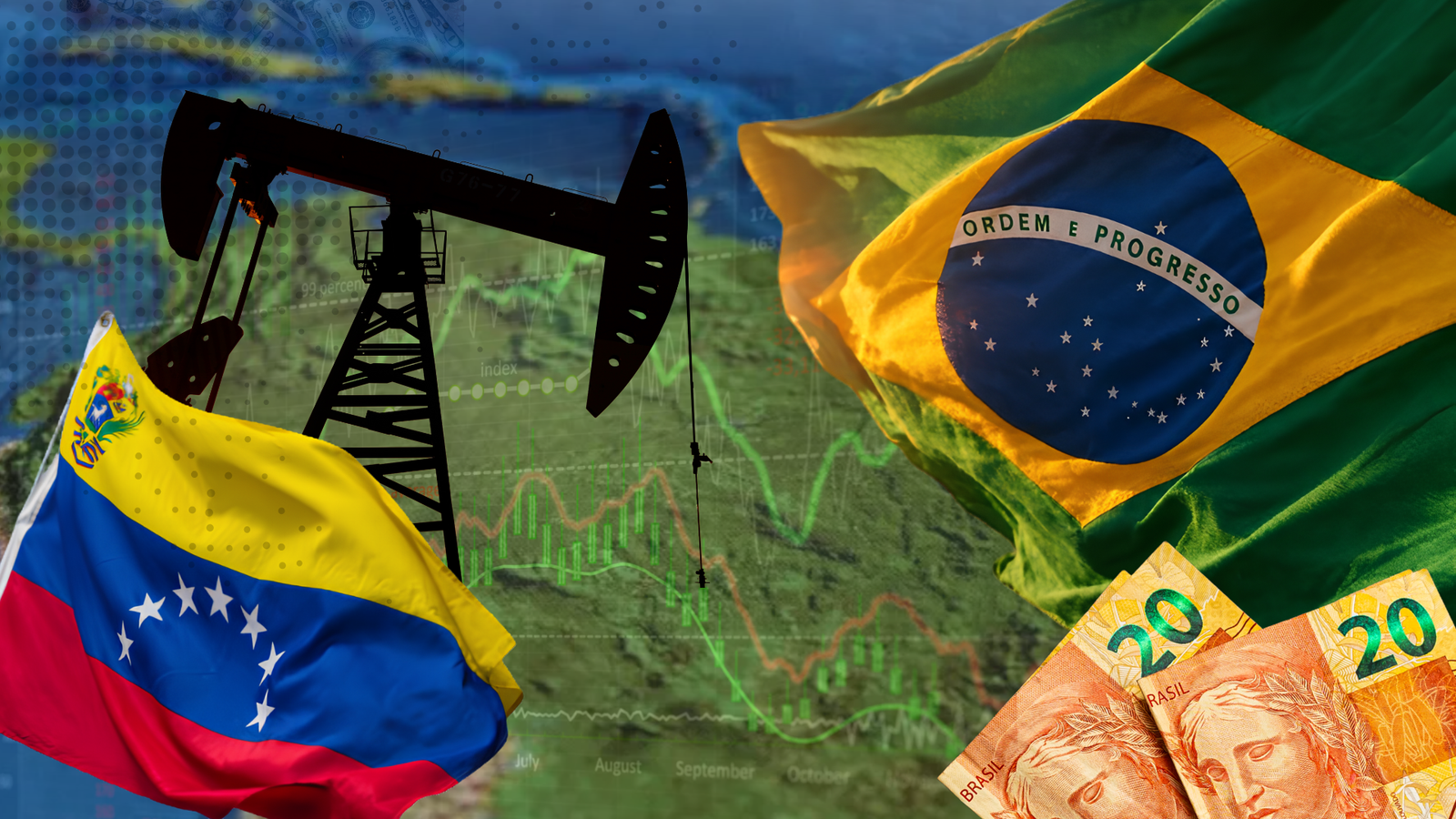
Venezuela could be the great growth opportunity for Brazilian capital in the coming decades. Image: Guacamaya.
Guacamaya, November 5, 2026. As the world rediscovers Venezuela’s energy reserves and the United States reclaims its historic weight in the oil sector, Brazilian pioneers in energy, agribusiness, finance, and technology are already taking positions in a sleeping giant where everything remains to be rebuilt and which is projected to see up to 30 years of sustained expansion.
There is an unwritten rule in the history of emerging markets: the greatest fortunes and most lasting corporate leaderships are not built when a market is expensive, mature, and saturated, but at the exact moment an economy with gigantic fundamentals begins its cycle of reconstruction. Today, that place on the Latin American map has a name, and it shares more than two thousand kilometers of border with Brazil: Venezuela.
On October 21, Jorge Botti, former president of Fedecámaras, Venezuela’s main business federation, put into numbers what many international analysts are beginning to model privately. After estimating that the Venezuelan economy will grow between 5% and 6% this year, Botti offered a long-term projection on Unión Radio: “It is very likely that we will return to double digits and that the next 25 or 30 years will be years of economic growth, and that is no small thing.” He then issued a warning to local business owners: a wave of foreign competition is coming, “with trained muscles, with economic and financial muscles.”
The question for Brazilian business is no longer whether Venezuela will recover, but what role Brazil will play in the largest economic expansion cycle in South America in the 21st century.
Beyond Shared History: Why 2026 Is Not 2008
For many Brazilian business owners, the name Venezuela evokes memories of the commercial boom of the Chávez era. Between 2008 and 2012, bilateral trade approached US$6 billion annually and Venezuela joined Mercosur. In those years, Brazil fed Venezuela and built a good part of its public works. However, that model had feet of clay: it depended on a single state buyer, artificial exchange controls, and government credit.
The opportunity opening up in 2026, following the thaw in sanctions and the economic opening, is radically different and much healthier. It is no longer about selling containers to the Venezuelan state; it is about investing from the private sector to the private sector, acquiring strategic assets at opportunity prices, rehabilitating existing infrastructure, and serving a population of nearly 30 million people who now demand goods, services, technology, and financing adapted to new realities.
The Role of the United States in Oil, and Where Brazil’s Real Opening Lies
To design a smart strategy in Venezuela, the Brazilian investor must read the current geopolitical board realistically. The United States has returned to a central role in Venezuela’s economic and energy architecture. On this very October 22, 2026, the U.S. Treasury Department lifted key investment restrictions on Venezuela, just days after oil investment projections of nearly US$76 billion over the next five years were announced at the 2026 Energy Conference, backed by 61 energy agreements and 17 agreements signed directly with the United States.
This has a direct implication for Brazil: breaking into the big leagues of Venezuela’s oil business will be extremely complex and highly competitive. As ConocoPhillips recently warned, the full recovery of the hydrocarbons industry will require at least a decade and tens of billions of dollars, a field where the large American majors arrive with historical, financial, political, and diplomatic advantages.
However, while there are specific oil niches where agile Brazilian companies are already making money, Brazil’s greatest opportunity lies precisely in the entire ecosystem that oil will drive but that American oil companies will not operate:
- The financial system, credit, and fintechs.
- Non-gold and industrial mining: Beyond gold, Venezuela holds in the Guiana Shield (bordering Brazil) colossal reserves of high-grade iron ore, bauxite, alumina, nickel, phosphates (key for fertilizers), silica, limestone, and minerals critical to the energy transition, all inputs that Brazilian industry and agriculture know well and demand at scale.
- Agribusiness, productive land, and livestock genetics.
- Commercial, industrial, and tourism real estate.
- Manufacturing, regional aviation, and engineering services.
While some investors continue to watch from the sidelines, the boldest Brazilian capital is already operating on the ground with tangible results.
Oil in high-profit niches and private equity
The Brazilian oil company Alvorada Heavy Industries, led by Paulo Buzanelli and financially backed by the asset manager Galápagos Capital, invested US$30 million to reactivate three abandoned oil blocks with 844 wells. It now extracts 4,000 barrels per day of light and medium crude (vital for diluting and transporting the heavy crude of the Orinoco Belt) and projects surpassing 20,000 barrels per day within two years.
The large conglomerates in energy and mining
In July 2026, brothers Joesley and Wesley Batista (J&F Group) formally entered the Venezuelan hydrocarbons sector through Fluxus Oil, Gas & Energy, acquiring a 49% private stake in the joint venture Petrolera Roraima in the Orinoco Belt. At the same time, they are evaluating acquisitions in the mining and energy sectors, recognizing the natural synergy between southern Venezuela and northern Brazil.
Industry, agriculture, and connectivity
The recent visit to Caracas by some thirty Brazilian heavyweights, from the meatpacking giant JBS and the agricultural company Sementes Aliança to the aircraft manufacturer Embraer, confirms that the appetite spans the entire value chain: from recovering cattle genetics and planting the Venezuelan plains to modernizing the aircraft fleet of a country that is reconnecting with the world.
The Institutional Arrival of Big Capital: Grupo LIDE and Orinoco Research
To these individual bets was added, this very week, a milestone of corporate coordination without precedent. Grupo LIDE (Group of Business Leaders), the most influential business organization in Brazil, founded by former São Paulo governor João Doria and globally chaired by João Doria Neto, announced its arrival in Venezuela in a strategic alliance with the consulting and market intelligence firm Orinoco Research.
The magnitude of this step is measured by the weight of its members: LIDE has a presence in more than 30 countries, brings together more than 2,000 companies and 4,000 business leaders, and its affiliated companies represent more than 52% of Brazil’s private-sector GDP. Following a first high-level meeting in São Paulo and ahead of its upcoming regional summit on November 13 in Paraguay, the alliance with Orinoco Research seeks precisely to build a direct technical and strategic bridge between Brazilian private capital and the real opportunities of the Venezuelan market.
A Sleeping Giant: In Venezuela Everything Remains to Be Done, but It Is Not Starting from Zero
A common mistake when analyzing Venezuela after an economic contraction of nearly 75% in the past decade is to compare it with nations that never managed to develop in the 20th century because they lacked energy resources. In Venezuela almost everything remains to be done, but the country is not starting from zero.
Unlike other emerging economies where jungle must be cleared to lay the first road (greenfield), Venezuela used part of its oil revenues for almost a century to build respectable physical and industrial infrastructure (brownfield): a network of highways connecting its main urban centers, Caribbean ports (Puerto Cabello, La Guaira, Guanta) just days by sea from the United States and Europe, an installed hydroelectric capacity of 10,000 megawatts at Guri, petrochemical and steel complexes, established industrial zones in Valencia, Maracay, Barquisimeto, Maracaibo, El Tigre, and Guayana, and an urbanized population with a tradition of modern consumption.
Venezuela is, in essence, a sleeping giant. It showed for decades what it can represent for the domestic and multinational private sector, and today, precisely because of the magnitude of the previous contraction, it offers a capacity for rebound and accelerated growth that no mature market in the region can match.
Is There Another Market Like It in Latin America?
If Venezuela’s potential is compared with other destinations where Brazilian capital has bet heavily, the asymmetry in Venezuela’s favor is evident:
| Comparable market | What Brazilian capital found there | Why Venezuela offers a superior opportunity today |
|---|---|---|
| Paraguay and its agro and maquiladora boom | Stable growth (4.5%–5.7% annually projected for 2026 by the World Bank), low tax burden, and fertile land. | Paraguay has only 6.8 million inhabitants, no coastline, and its assets already trade at mature prices. Venezuela has ~30 million inhabitants, direct access to the Caribbean and the Atlantic, and assets at a fraction of their historical value. |
| Guyana and double-digit growth | Explosive oil-driven growth (16.3% projected for 2026) fueled by offshore discoveries. | Guyana is a micro-economy of 800,000 inhabitants where everything must be built from scratch (greenfield). Venezuela holds 300 billion barrels in reserves, the world’s eighth-largest gas reserves, and brownfield infrastructure ready to be rehabilitated. |
| Peru and Colombia with their 2002–2013 opening cycles | Decades of sustained expansion after opening their mining, energy, and financial sectors. | Venezuela combines the energy and mineral potential of both, but starts from a base depressed by 75%, which multiplies the slope and duration of growth over the next 25 to 30 years. |
Real Estate and Productive Land: The Potential of South America’s Largest Asset Arbitrage
This “sleeping giant” condition is reflected with particular clarity in the real estate and farmland market, where Venezuela today presents the greatest undervaluation of real assets on the continent.
Farmland at one-tenth the price of Brazil and Paraguay
For the Brazilian agribusiness producer accustomed to the values of Mato Grosso (Sinop), Paraná, or the Cerrado, land prices in Venezuela are astonishing. While a developed agricultural hectare in Mato Grosso or in Paraguay’s soy-growing zones currently ranges between US$5,000 and US$13,700 per hectare, and land with capital expansion potential in the Cerrado runs from US$1,500 to US$3,000 per hectare, in Venezuela rustic and grazing lands trade between US$300 and US$600 per hectare, and first-quality productive farmland sits between US$400 and US$1,000 per hectare. We are talking about flat land in the Venezuelan plains (Portuguesa, Guárico, Barinas, Cojedes, and Monagas), with abundant groundwater and surface water, year-round tropical sunlight, and proximity to international ports, available at 10–15% of what an equivalent hectare costs in Brazil.
Urban and industrial real estate at an inflection point
A similar phenomenon is occurring in urban and industrial real estate. According to 2026 market reports based on indicators from the Venezuelan Real Estate Chamber, the price per square meter in the most exclusive corporate and residential zones of eastern Caracas (Chacao, Baruta, Las Mercedes) ranges between US$1,200 and US$2,500/m², less than half that of equivalent districts in São Paulo such as Itaim Bibi or Vila Olímpia (US$4,500–7,000/m²). Moreover, in the country’s manufacturing and agro-industrial heartland, such as Valencia (Carabobo) and Barquisimeto (Lara), prime properties located in areas with preferential access to services trade between US$800 and US$1,250/m², and there are industrial plants, logistics centers, and corporate buildings that can be acquired for a fraction, between 20% and 30%, of their construction cost. With the gradual return of private financing, this historic discount represents an unrepeatable window of capital appreciation.
Tax Reform and Fiscal Incentives
Beyond the undervaluation of assets, there is a transformation underway in the regulatory and tax environment. Brazilian business owners know better than anyone the weight of the so-called Custo Brasil: one of the most complex tax and bureaucratic burdens in the world.
Venezuela, aware that it needs to attract tens of billions of dollars in fresh capital, has begun to move toward offering competitive tax relief and incentives:
A new fiscal and labor architecture in 2026: After advancing the digitalization of SENIAT, in the course of this month (October 2026), trade associations such as Conindustria announced concrete progress with the Executive and Parliament toward approving labor reforms and new fiscal and parafiscal incentives before the end of 2026. The agenda includes extending the VAT filing period from 15 to 30 days to ease industrial cash flow, rationalizing municipal taxes, and creating a single-payment tax regime (monotributo) to facilitate the mass formalization of SMEs.
Special Economic Zones (SEZs): Through the Organic Law on Special Economic Zones enacted in 2022, Venezuela already provides for preferential tax regimes for projects in primary agribusiness for export, technology parks, financial services, logistics, aeronautics, energy, and tourism. These incentives include exemptions of up to 100% of income tax (ISLR) during the first years, exemptions from municipal taxes on economic activity, accelerated asset depreciation, and temporary duty-free admission for importing machinery, inputs, and raw materials intended for export.
The potential for comprehensive tax reform: As the oil recovery (projected at US$76 billion in investment) returns direct fiscal revenue to the State, Venezuela will have the fiscal room to consolidate a pro-investment tax reform with flat and competitive corporate rates, becoming an export platform to the Caribbean, North America, and northern Brazil itself.
An Ocean of Opportunity for Brazilian Fintechs: US$45 Million a Day in USDT
But perhaps another of the hidden gems for the Brazilian investor lies not only in the subsoil or in farmland, but in exporting São Paulo’s financial and technological experience to a market that already operates on digital rails at a surprising scale.
Over the past two decades, Brazil showed the world how to bring people into the banking system, extend credit, and build a thriving consumer middle class. Today, São Paulo is the undisputed technology capital of Latin America: the epicenter where Nubank, the Pix system, and global giants of the new digital economy such as ByBit coexist. From São Paulo, ByBit has integrated instant payment rails, award-winning crypto cards recognized by Mastercard, and multi-asset investment platforms.
Anyone who thinks that in Venezuela everything must start from scratch in the digital realm is unaware of what is happening today on the street and in businesses. According to figures presented in October 2026 at the StartUp Venezuela Summit and updated by economist Alejandro Grisanti (Ecoanalítica), between June 11 and October 20 of this year Binance’s P2P market in Venezuela traded an average of US$45.4 million per day in USDT, accumulating US$5.949 billion in just over four months. To put the figure in perspective: that digital flow equals 83% of all the dollars injected by the Central Bank of Venezuela (US$7.15 billion) through the financial system in the same period.
Even more telling is that, although the exchange-rate gap narrowed from 29.6% in June to 13.6% in October, the daily USDT volume held firm (between US$38.7 million and US$49 million per day). The reason? Individuals and small businesses, as well as the corporate sector, which already turns to OTC desks and on-chain operations to meet its demand for foreign currency, adopted stablecoins as their true operating system for hedging, savings, and working capital.
Venezuela thus lives an extraordinary paradox: it moves at an annualized pace that could exceed US$16.5 billion in a single P2P channel and shows delinquency rates below 2% on local financing platforms such as Cashea, yet its traditional banking system barely offers credit. In addition, the high fiscal opportunity cost of the current exchange scheme (which Ecoanalítica calculates as an implicit subsidy of US$1.2 billion since June) inevitably pushes toward the definitive elimination of exchange controls.
For fintechs, digital banks, crypto platforms, B2B liquidity desks, and credit originators (auto, mortgage, real estate, and agro-financial), Venezuela could be an ocean of opportunities with proven liquidity today. There is a middle class ready to be reborn that needs the support of the best.
Tearing Down Barriers and Taking the Lead
For decades, a silent barrier (language and the habit of looking toward other markets) meant that Brazilian and Venezuelan business people knew each other less than geography dictated. Today, in a global environment marked by the regionalization of supply chains (nearshoring) and the need for energy, mineral, and food security, that distance is a luxury neither country can afford.
Brazil has shown admirable internal resilience in overcoming its own economic cycles. It now faces the challenge of turning that resilience into constructive influence in its immediate surroundings. In Venezuela almost everything remains to be done, but on the foundations of a country rich in infrastructure, talent, and resources. No one in the south of the continent has the technical experience, financial muscle, and geographic proximity of Brazil to help rebuild it. For the Brazilian investor with a long-term vision, the time to cross the border is now.