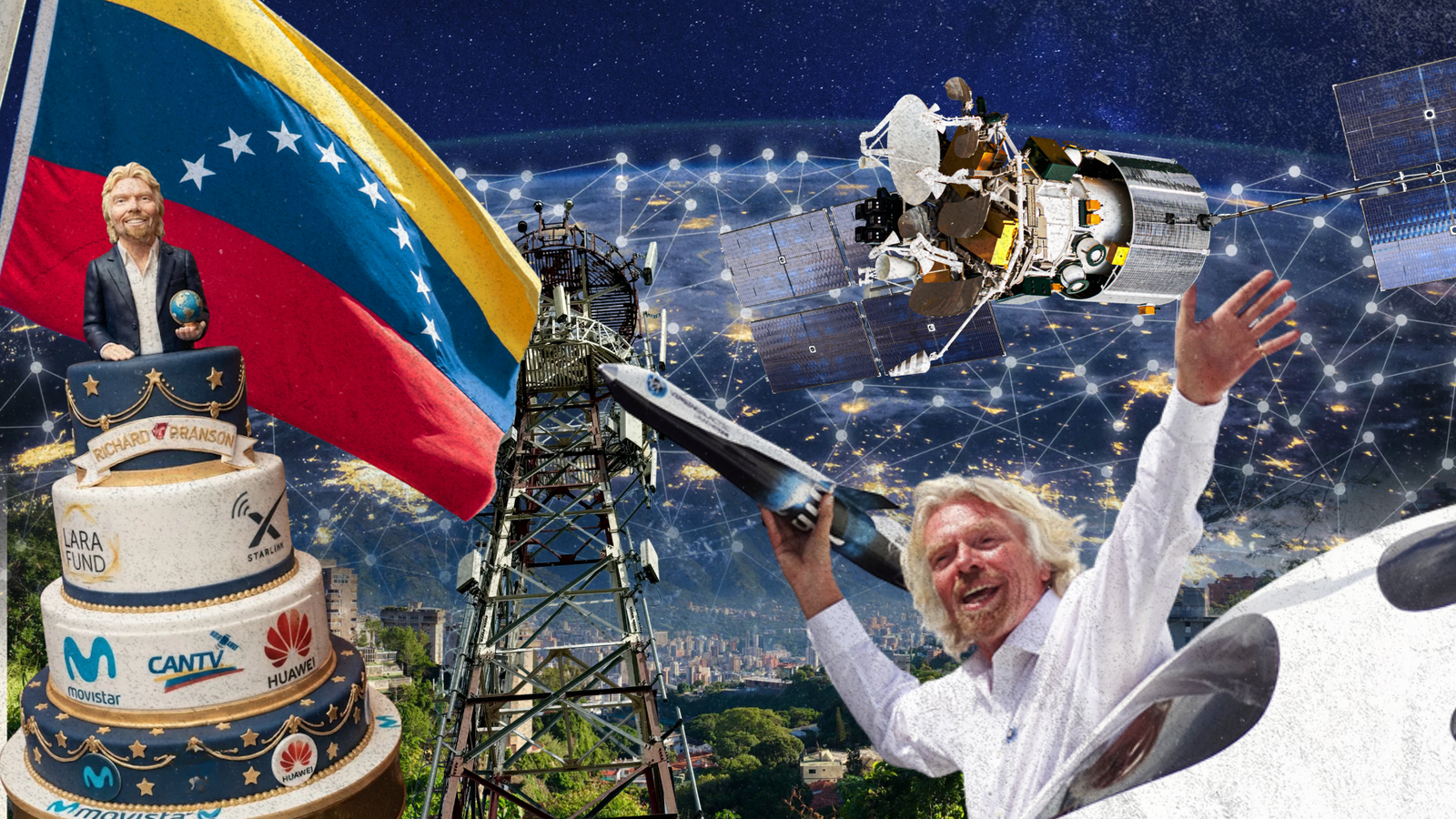
Telecommunications in the country are taking on a dynamic marked by the influence of the United States, but questions about the benefits for citizens or even the participation of national entrepreneurs remain open. Image: Guacamaya.
Guacamaya, November 10, 2026. Between the visit of Richard Branson, of the Virgin Group, to Venezuela, the interest on the part of Mauricio Claver-Carone in buying Movistar, the legal participation of Elon Musk in the country, through Starlink, and the implementation of new regulations by Conatel, telecommunications in the country are taking on a dynamic marked by the influence of the United States. However, questions about the benefits for citizens or even the participation of national entrepreneurs remain open.
Before January 3, 2026, telecommunications in the country were already under significant international influence, especially from China. For example, in the case of CANTV, close relations can be identified with companies such as China National Electronics Import & Export Corporation (CEIEC), Huawei and ZTE, especially during the management of Jacqueline Farías. In addition, one must not forget the denunciations by figures of Chavismo such as Rafael Ramírez, who in 2019 denounced that companies of Chinese origin would be operating in CANTV and Movilnet. However, given the lack of information and concrete evidence, these denunciations did not go beyond that.
Beyond those speculations, it is important to remember that, as of August 21, 2026, the United States Department of State granted a series of licenses that allow CANTV and Conatel to make purchases for the upgrading of infrastructure, software and licenses. But with an explicit restriction that prevents carrying out transactions with individuals or companies and institutions from countries such as China, Iran, Russia, North Korea and Cuba.
This move involving licenses was only the beginning of a larger structural and commercial process, which can be identified through certain movements in the market and in national legislation.
One can mention the case of Movistar (Telefónica), which, although since last year it had already expressed its intention to sell the Venezuelan subsidiary. According to the portal El Español, it now seems that a new momentum has been regained. Among the main groups that have recently shown interest are the business group Millicom, which manages the TIGO brand; as well as the company LARA Fund (Latin America Real Assets Opportunities). The latter is a private equity fund based in Miami, United States, focused on investments in Latin America and the Caribbean, whose main partner is Mauricio Claver-Carone, a man trusted by Donald Trump who served for a period as special envoy for Latin America and with clear influence on Venezuelan policy.
There are also other actors that have entered the telecommunications ecosystem in Venezuela. For example, in October 2026, Conatel authorized the operation of Elon Musk’s company, Starlink. In this case, it is also another businessman close to Donald Trump. Likewise, between October 21 and 23, Richard Branson, founder of Virgin Group, one of the largest telecommunications companies globally, will be at the sixth edition of the Startup Venezuela Summit (SVS).
On the other hand, Conatel has not only granted new permits, since, even before licenses issued by the Department of State for the end of June 2026, Conatel launched a public consultation regarding the draft Administrative Provision that establishes the Quality Parameters for Internet Services. Although it is a measure to improve service provision to users, it should also be interpreted as a signal transmitted by the regulatory body, focused on a possible larger modernization that would indeed imply a change in the Organic Law on Telecommunications (Lotel).
One must not forget that, in the Basic Legislative Plan 2026-2027 of the National Assembly, twenty-nine bills are contemplated, where certain proposed laws corresponding to the digital sphere are registered, such as the Cybersecurity Law; the Telecommunications Law; or the Digital Rights Law.
Under this scenario, it is likely that a new telecommunications law is close to being discussed, where the influence of the United States appears that it will be decisive. But there are open questions, for example: How is the participation of national companies and civil society guaranteed? Or will the distributions in the telecommunications market be transparent?
Undoubtedly, Venezuela needs investment in the sector. In the study “Venezuela in the global digital ecosystem: investment strategic opportunities” (2026), published by CAF-Banco de Desarrollo de América Latina y el Caribe, it is indicated that the country maintains a deficit in the “middle mile” and in international redundancy. This, in practice, means that the national backbone network is usually congested, obsolete or prone to outages due to electrical instability. Mobile networks continue to depend largely on 4G-LTE in urban areas, but are reduced to 3G or even 2G in rural areas. Likewise, it is noted that government digital systems are fragmented. In addition, a gap is noted at the executive level where high-level business leaders lack the strategic understanding of how to manage technologies such as artificial intelligence (AI) and digital transformation.
However, it is important to mention that a new telecommunications law should contemplate a restructuring of Conatel that allows for establishing real autonomy. Along those lines, the board of directors of this institution should be appointed for fixed periods that do not coincide with the electoral cycle of the national Government and with the participation of the National Assembly in the election of said board, on the basis of technical, not political, competencies. Likewise, it would be necessary to establish transparency rules to reduce and prevent political discretion in the granting of concessions.
Just like the oil sector, telecommunications are a space in dispute and intervention by new political actors on the ground; it is important not to lose sight of the new dynamics that may be configured in the coming months. The participation of Venezuelan society in this discussion must be a shared demand, since its exclusion can create new gaps for digital sovereignty and the country’s development possibilities.