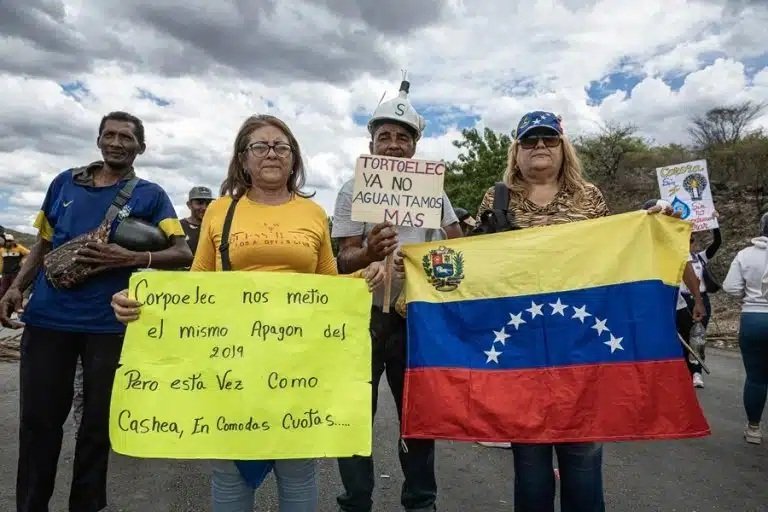
Using digital recruitment methodology, the report representatively evaluates public opinion in Venezuela on various topics of national relevance. Photograph: EFE.
Guacamaya, November 16, 2026. The most recent report corresponding to October 2026 from the Latam Pulse study, developed by AtlasIntel and Bloomberg, offers a broad snapshot of the critical moment Venezuela is going through. The research exposes the accelerated wear of government management, the weight of the collapse of public services, divided opinion on dollarization and distrust of the new oil pact.
The data collected between November 5 and 9 from a representative sample of 2,492 adults nationwide paint a country marked by severe pressure on Venezuela’s social, economic and political climate. Faced with the reality exposed, the study also outlines an electoral dynamic where the opposition consolidates clear leadership while non-traditional figures emerge.
Government Approval Falls and Rejection Deepens
President Delcy Rodríguez’s approval fell to 18.5% in October, after losing about one point compared to the 19.4% recorded in September. At the same time, inattention to social demands has driven disapproval of her management to 68.2%, registering a substantial increase compared to 64.8% the previous month.
When qualitatively evaluating the Government’s performance, an overwhelming 58.3% of respondents rate the management as “bad or very bad,” while 30.6% consider it “fair” and only 11.2% rate it as “excellent or good.”
The sectoral breakdown of public performance reveals that the electricity supply is consolidated as the dimension most punished by public opinion, with 74% of citizens rating it as “terrible” and 9% as “bad.” This crisis is followed by other critical areas such as the strengthening of democracy (66% terrible), the economy (55% terrible, 21% bad) and the fight against corruption (64% terrible).
The Return of MCM and the Bet on Lorenzo Mendoza
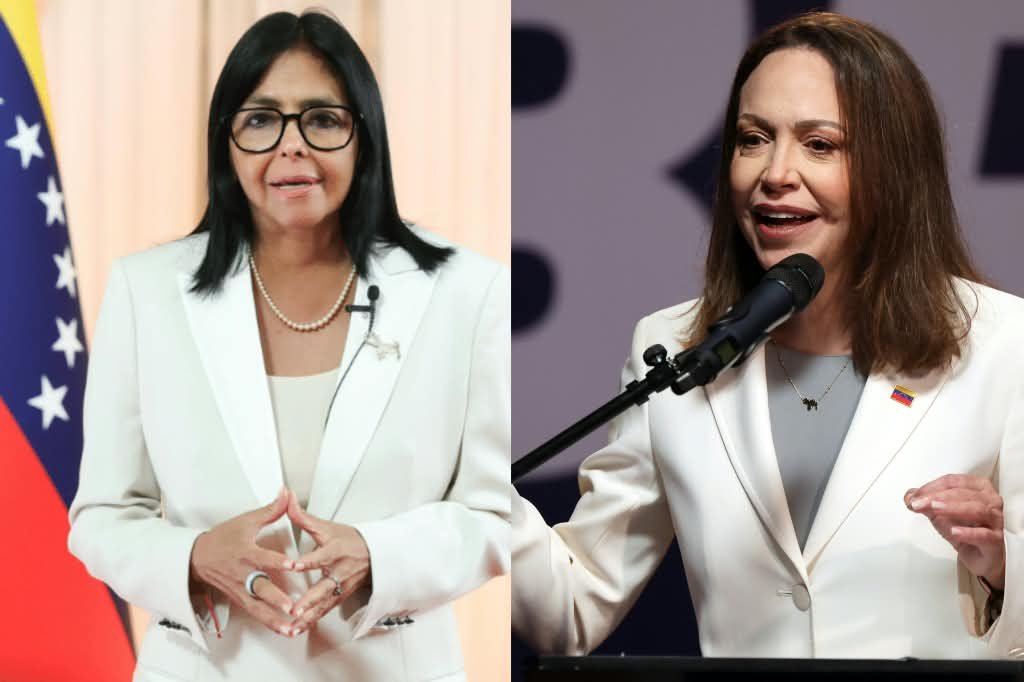
Facing a possible presidential election, the October survey confirms the hegemony of the majority opposition and records some variations compared to the September measurement. María Corina Machado consolidated her majority leadership by reaching 55.8% of voting intention in October, registering a recovery of 3.5 percentage points compared to the 52.3% obtained last month.
This rebound by María Corina Machado coincides with her public reappearance in the national territory and intensification of messages the previous month after periods of exile and clandestinity, a political factor that seemed to revitalize the adherence of opposition voters. Machado retains her widest advantage in higher education sectors (75.5%) and in regions of the west and east of the country.
The ruling party candidacy represented by Delcy Rodríguez fell to 17.2% in October, losing 2.0 points compared to the 19.2% reached in September. As previously anticipated, the Government’s candidacy suffers the direct impact of the collapse in the provision of basic services and the deterioration of purchasing power.
But the most interesting thing is that, since the September 2026 report, AtlasIntel decided to include businessman Lorenzo Mendoza, president of Empresas Polar, in its electoral simulations. This occurs despite the fact that Mendoza has not expressed any intention of participating in the political contest, although his figure does attract mainly disenchanted voters from independent sectors.
The Electricity Crisis and Its Link to Political Risk
The detailed analysis of electricity supply evidences a daily national emergency. 57.5% of the adult population reports suffering unscheduled interruptions of electric service in their home “every day or almost every day,” while 19.7% suffer them “several times a week.” Only 7.4% state they have not experienced outages in the last month.
Regarding the duration of the blackouts, among those who suffer failures, 38.4% indicate that the outages last “more than 6 hours” and 30.1% indicate that they last “between 3 and 6 hours.”
When inquiring about the structural causes of this collapse, citizens mostly reject the official narratives of sabotage. Public opinion attributes the electricity crisis mainly to the lack of investment and maintenance (66.4%), corruption (29.6%) and poor administration (27.8%), leaving the sabotage hypothesis relegated to only 5.8% and the impact of international sanctions to 5.9%.
The desperation generated by the lack of light has translated into street mobilization. 25.4% of respondents state they have participated during this year in protests motivated by electrical failures in their region. Additionally, pessimism about a solution is blunt, since 54.3% express little or no confidence that the electric service will improve significantly in the next two years.
This conflictivity is framed in a general picture where corruption stands as the main problem of the country for 57.1% of the population, followed by the weakening of democracy and lack of transparency (37.3%), unemployment (28.7%) and poverty and inequality (19.6%).
The Map of Economic Confidence
The analysis of the Consumer Confidence Index (Atlas-CCI) in the October report crudely exposes the gap between the harsh daily reality of Venezuelans and their projections for the future. The image of the present reflects a country severely hit in its economic, labor and family dynamics.
When evaluating the current economic situation of Venezuela, an overwhelming 77% of respondents rate it as “bad,” while only 12% consider it “good” and 10% say they do not know. This pessimism extends almost identically to the labor market, where 75% of citizens evaluate the employment outlook as “bad,” compared to only 14% who perceive it as “good.”
In the area of the family economic situation, although the impact slightly cushions the margin, more than half of the country (57%) states that the household economy is in a “bad” situation, compared to 30% who rate it as “good.” As a whole, the Current Situation Index (ISA) stood at -51.2 points.
However, when looking toward the next six months, the study records a notable contrast in economic expectations. Despite the recession of the present, 41% of Venezuelans foresee that the country’s general economy “will improve,” 35% believe it “will remain the same” and 24% anticipate that it “will worsen.”
Optimism is even more pronounced in the personal sphere: 47% trust that their family’s situation will improve in the next semester. Regarding the labor market, 41% project a positive evolution in six months. In this indicator, the Expectations Index (IE) stood at +16.6 points.
This duality between a recessive present and contained expectation directly affects consumption decisions for higher-value goods. Regarding the intention to purchase durable goods, 33.4% of respondents plan to make “fewer purchases” in the next six months, while 39.7% will maintain their consumption levels (“neither more, nor less”) and 26.9% plan to make “more purchases.”
A Divided Debate on Official Dollarization
When asked about dollarizing the economy, public opinion is divided, but leaning in favor: 43.2% agree (24.4% agree and 18.8% totally agree), while 18% declare themselves undetermined or indifferent. Despite plural support for the measure promoted by political leaders such as Antonio Ecarri (Lápiz), there is a resistance of 38.9% against, led by 28.4% totally in disagreement.
Faced with the hypothesis of an official dollarization, 43.5% of citizens identify as the main benefit the achievement of “greater economic stability,” seconded by 42.8% who point to “inflation control.”
However, the report also captures important reservations in the population regarding the risks of formalizing the use of the U.S. currency, such as 41.3% who fear greater “economic dependence on the United States” and 33.9% who regret the “loss of the national currency,” while 19.9% warn about less State control over monetary policy.
This finding becomes particularly relevant when contextualized with recent political debates, such as the proposal raised by Antonio Ecarri (LÁPIZ) in favor of formal dollarization and monetary stabilization measures. In demographic cross-tabs by prior political preference, voters aligned with Ecarri’s proposal highlight inflation control by 60.3% as the greatest advantage of the measure.
Distrust in the U.S.-Venezuela Oil Agreement
A key module incorporated in the October measurement addresses public perception of the recent oil agreement signed between the United States and Venezuela, which grants a leading role to the company linked to businessman Alejandro Betancourt in the exploitation of national crude fields.
The results reveal marked distrust and a significant degree of unfamiliarity. Regarding Alejandro Betancourt’s public image: 41.5% state they do not know him, 36.7% hold a negative image, 16.4% say they do not know and only 5.4% project a positive image.
When specifically asked how much confidence Betancourt inspires to handle this strategic oil production agreement, 38.5% respond “no confidence” and 19.2% “little confidence” (adding up to an overwhelming 57.7% of distrust). 34.7% preferred not to opine or did not know, while only 7.6% added evaluations of quite a lot or a lot of confidence.
These numbers reflect the skepticism of Venezuelan civil society toward energy pacts involving controversial business figures, relating these schemes to persistent fears of opacity and corruption in the hydrocarbon sector.