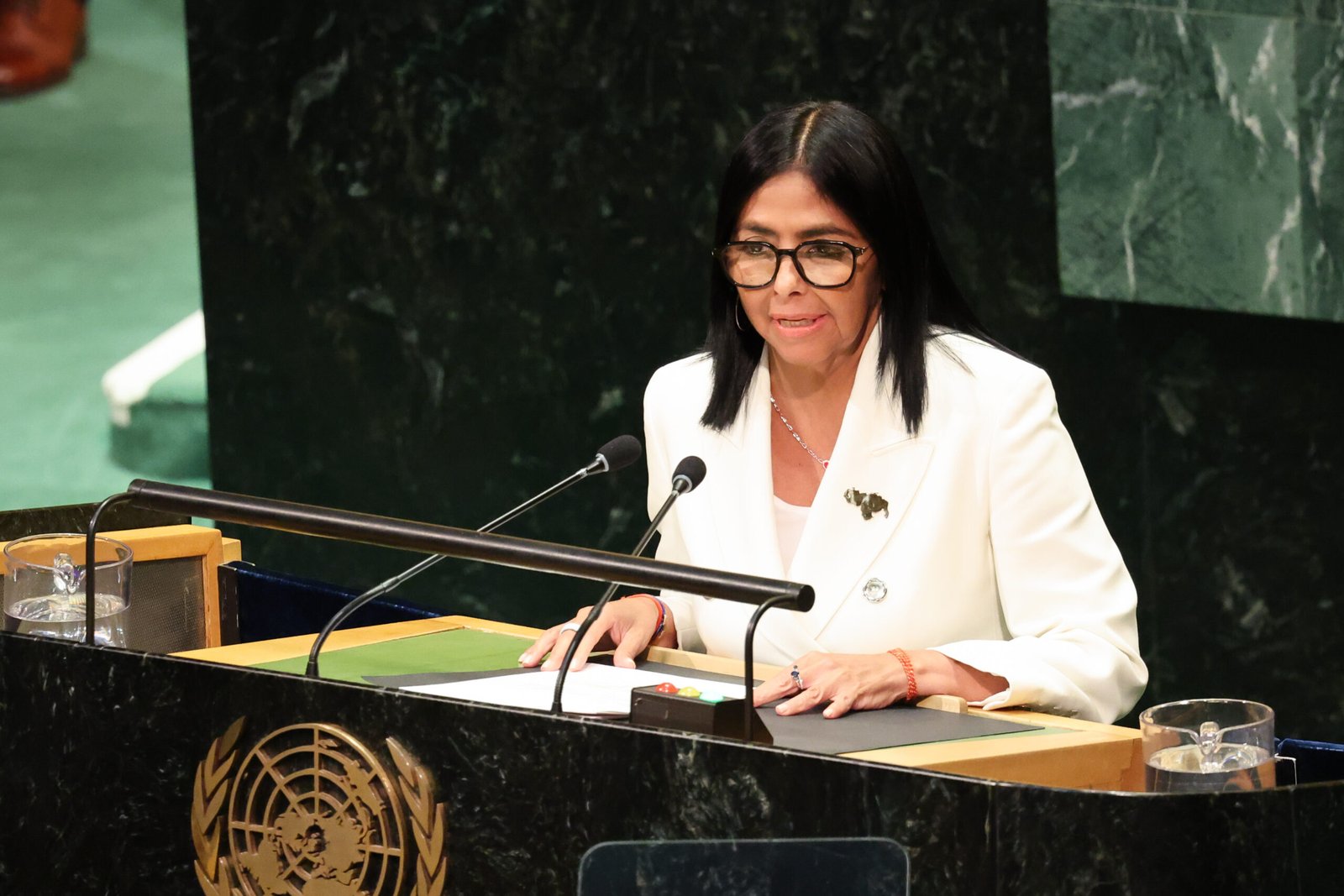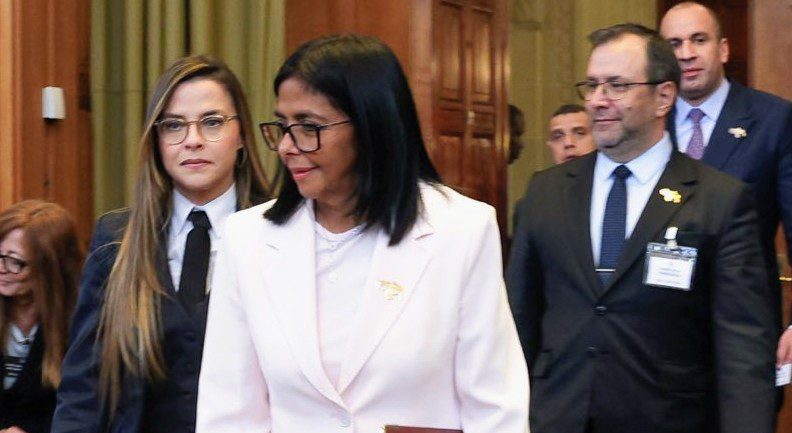
Delcy Rodríguez, acting President of Venezuela, leads the Venezuelan delegation during oral hearings at the International Court of Justice. Photograph: X account @MirafloresAlmomento.
Guacamaya, May 11, 2026. The acting president of Venezuela led in The Hague the technical and legal delegation that presented the country’s final arguments before the International Court of Justice (ICJ), reiterating that Caracas does not recognize the Court’s jurisdiction and defending the Geneva Agreement as the only valid mechanism to resolve the territorial dispute.
Venezuela’s position before the ICJ
Delcy Rodríguez appeared before the International Court of Justice in The Hague to defend the validity of the 1966 Geneva Agreement and reaffirm Venezuela’s historic position over the sovereignty of the Essequibo territory.
During her statement, she expressed being honored to represent “the voice of a people deeply committed to justice, peace, and international law,” while recalling the results of the consultative referendum held on December 3, 2023, regarding the disputed territory.
She emphasized that the process established “clear and decisive mandates,” including maintaining Venezuela’s historical position of not submitting existential matters related to territorial integrity to judicial mechanisms; reaffirming the Geneva Agreement of 1966; and defending Venezuela’s rights over the Essequibo through peaceful means in accordance with international law.
Rodríguez stressed that although Venezuela respects the ICJ as the principal judicial organ of the United Nations, its appearance does not imply recognition of the Court’s jurisdiction.
“Venezuela will not renounce its territory or its legitimate rights, expressly recognized and preserved in the Geneva Agreement,” she stated during the hearing, adding that the Essequibo “cannot be reduced to mere economic or commercial interests,” but forms part of the nation’s historical and moral identity.
She further reiterated that Venezuela has never consented to submit the territorial dispute to the Court’s jurisdiction, and that Article 4 of the Geneva Agreement cannot be interpreted as a jurisdictional clause granting competence to the ICJ.
Venezuelan delegation in The Hague
The Venezuelan delegation was composed of Foreign Minister Yván Gil; Attorney General Arianny Seijó; Venezuela’s Agent before the ICJ Samuel Moncada; as well as international legal experts Paolo Palchetti, Christian Tams, Jean-Marc Thouvenin, Andreas Zimmermann, and Makane Mbengue, who supported Venezuela’s legal defense before the Court.
The Attorney General’s intervention
Attorney General Arianny Seijó stated that the Venezuelan delegation presented an “irrefutable historical truth,” grounded in legal consistency and respect for international law.
She reiterated Venezuela’s position that the 1899 Paris Arbitral Award is null and void, arguing that evidence emerging during the decolonization process exposed irregularities that led Venezuela and the United Kingdom to set it aside through the signing of the Geneva Agreement in 1966.
Seijó stressed that the agreement is the only valid legal instrument governing the territorial dispute over the Essequibo, as it was specifically designed by the parties to reach a practical and mutually satisfactory solution.
The 1899 Arbitral Award: Venezuela’s historical view
From Venezuela’s perspective, the 1899 Paris Arbitral Award was the result of political influence and colonial pressure, particularly from the United Kingdom, which sought to expand its territory in South America.
Caracas argues that the territory west of the Essequibo River historically belonged to the former Captaincy General of Venezuela and should have been preserved under the principle of uti possidetis juris, used in Latin America to define post-independence borders.
Later revelations, including documents attributed to American lawyer Severo Mallet-Prevost, reinforced Venezuela’s claim that the award was politically influenced rather than a fully impartial legal decision.
The 1966 Geneva Agreement
Following Venezuela’s longstanding claim, Venezuela, the United Kingdom, and British Guiana signed the Geneva Agreement on February 17, 1966.
For Caracas, this treaty is the only valid legal framework for resolving the territorial dispute over the Essequibo.
The agreement formally acknowledged the existence of a territorial controversy and established the obligation of the parties to seek a practical, peaceful, and mutually satisfactory solution through negotiation mechanisms.
From Venezuela’s perspective, the Geneva Agreement effectively set aside the political validity of the 1899 award by recognizing the existence of an unresolved dispute.
Venezuela open to direct negotiations
In the final part of her statement, Rodríguez reaffirmed Venezuela’s willingness to engage in direct negotiations with Guyana, in line with the Geneva Agreement.
She stated that Caracas is “ready and prepared” to pursue practical and mutually acceptable solutions through bilateral dialogue.
Context of the visit
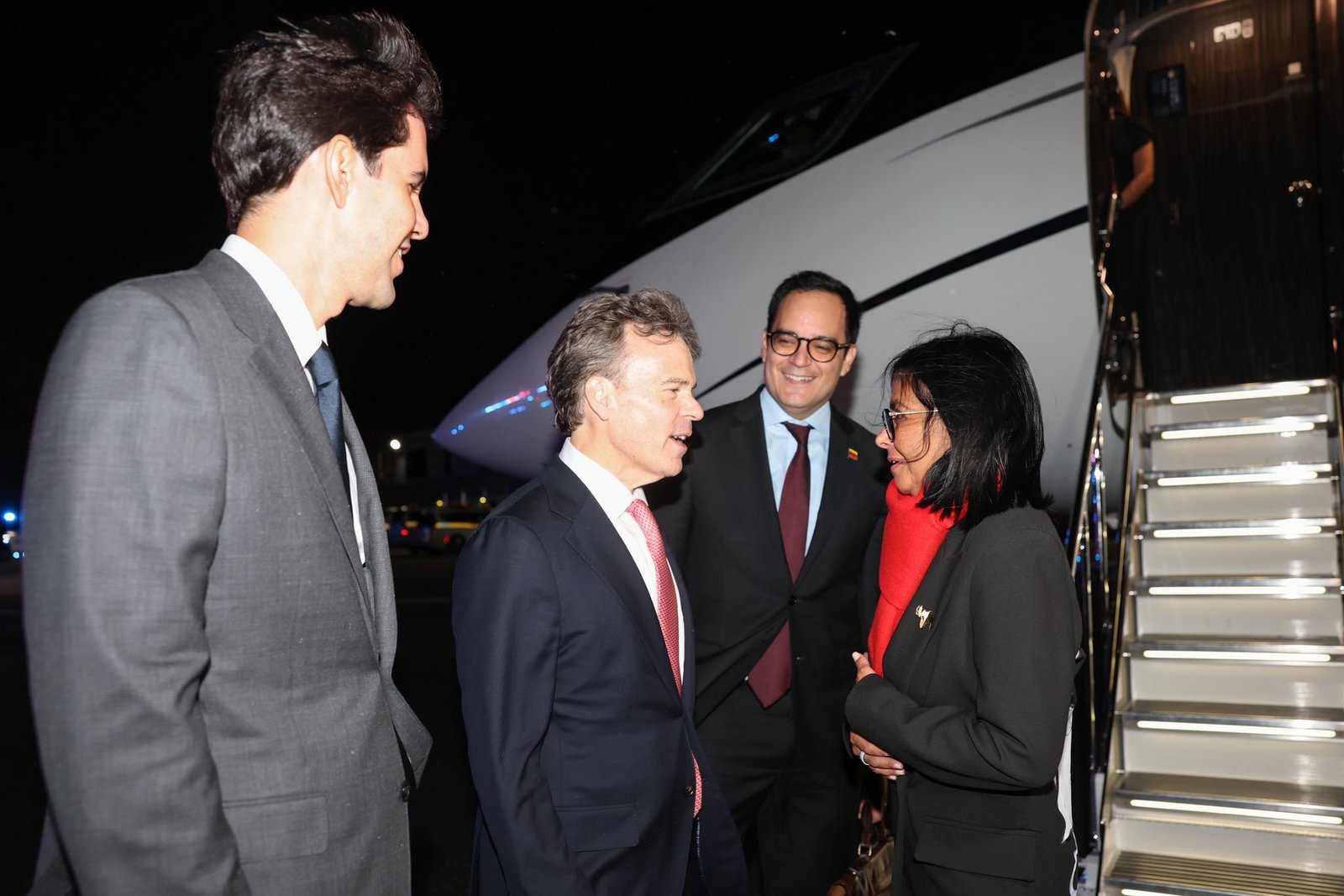
The acting president arrived in the Netherlands on May 10 to lead Venezuela’s legal and technical delegation during this decisive stage of oral hearings on the Essequibo dispute, a territory of approximately 160,000 square kilometers claimed by Caracas.
In public remarks upon arrival, Rodríguez asserted that the Venezuelan delegation had demonstrated “legal solidity” regarding Venezuela’s historical rights over the territory, stating: “There is no doubt: Venezuela is the sole rightful claimant of this territory.”
ICJ hearings timeline
The oral hearings before the International Court of Justice began on May 4 and are scheduled to conclude on May 11 with Venezuela’s final arguments.