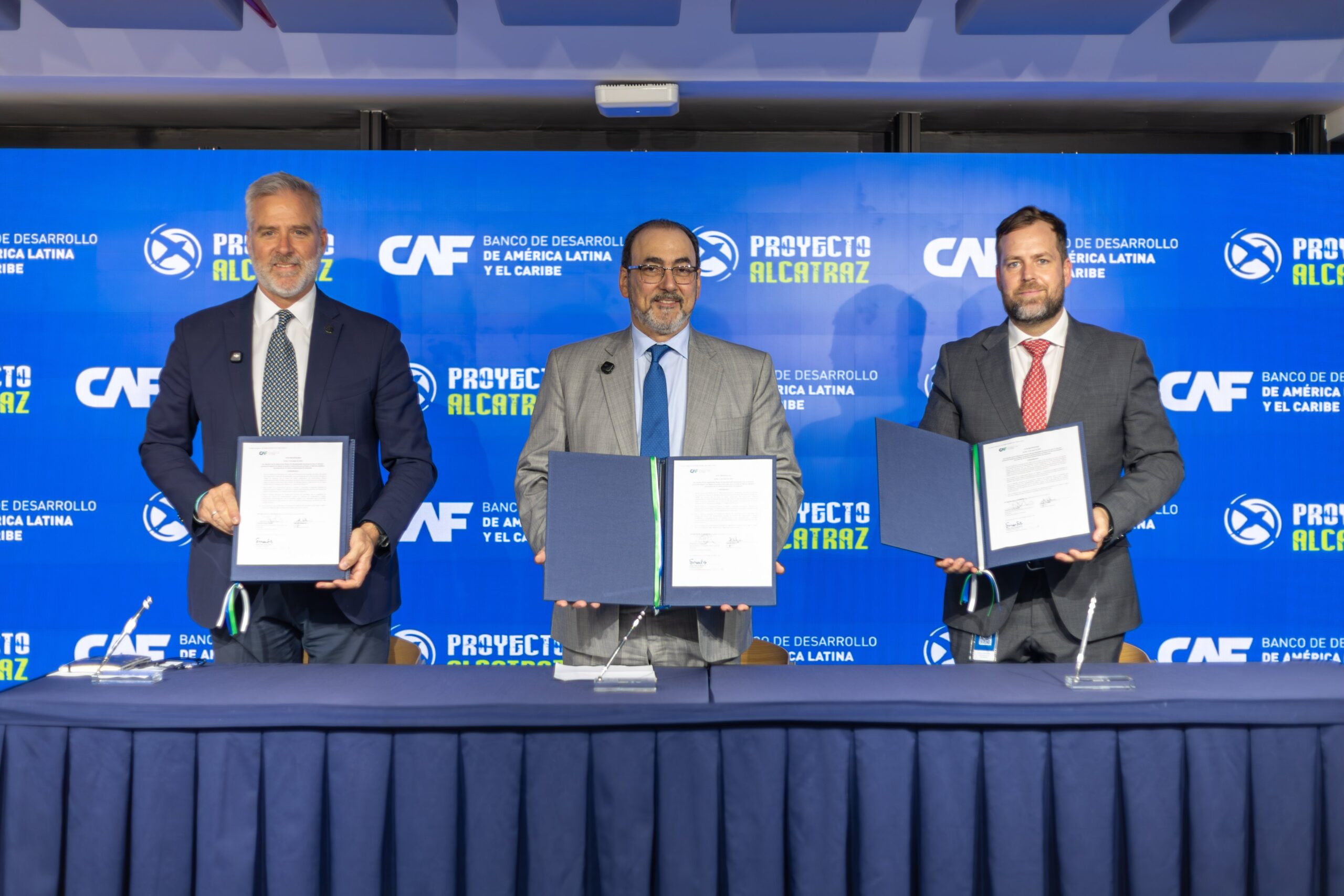
Sergio Díaz-Granados and Alberto Vollmer sign the cooperation agreement between CAF – Development Bank of Latin America and the Caribbean and Proyecto Alcatraz. Photograph: X social media/@AgendaCAF.
Guacamaya, May 21, 2026. The signing of the Phase II Protocol Act for the project “Comprehensive Psychosocial Care with an Emphasis on Restorative Justice for Persons Deprived of Liberty” between CAF – Development Bank of Latin America and the Caribbean and the NGO Proyecto Alcatraz represents far more than a technical cooperation agreement focused on Venezuela’s prison system. The agreement has become a concrete example of the potential collaboration between multilateral organizations and the private sector to promote social reintegration, violence prevention, and peacebuilding processes in Latin America.
The new phase of the initiative was led by Sergio Díaz-Granados and Alberto Vollmer and will expand the program’s reach to 16 Venezuelan penitentiary centers. The project will incorporate psychological and psychoeducational care, restorative justice training for families and prison officials, as well as support for former inmates during their reintegration processes.
Through this non-reimbursable technical cooperation, CAF reaffirms an increasingly relevant line of work for multilateral organizations based on supporting initiatives capable of generating social cohesion from within communities, especially in contexts marked by violence, exclusion, and institutional fragmentation.
A model born out of a local crisis
The history of Proyecto Alcatraz began in 2003 in El Consejo, Revenga municipality in the state of Aragua, an area that at the time had one of the highest homicide rates per capita in Venezuela. Poverty, unemployment, and the presence of criminal gangs coexisted around Hacienda Santa Teresa, the economic center of the region.
That year, after an armed attack against one of the company’s security guards, those responsible were captured. Instead of pursuing only a traditional criminal process, Alberto Vollmer made an unconventional decision: he offered them two options — go to prison or work for three months without pay as a form of restitution.
The young men accepted the second alternative. Days later, they asked to include other members of their gang and later members of rival groups. What began as an improvised experiment eventually became one of Latin America’s most recognized social reintegration initiatives.
The initiative evolved under the slogan “Zero Delinquency,” with a methodology based on community work, civic values training, vocational education, psychological support, and sports practice, particularly rugby.
Rugby, discipline, and social transformation
One of Proyecto Alcatraz’s most distinctive features has been the use of rugby as a tool for individual and community transformation.
The regular practice of the sport seeks to channel the aggression and energy of young people involved in violence into dynamics of discipline, teamwork, and belonging. Over time, rugby evolved from a complementary activity into one of the program’s central symbols.
Currently, more than 500 children and adolescents participate in training sessions organized by the Fundación Santa Teresa in youth and senior categories as a mechanism to prevent crime and drug consumption in Revenga municipality.
The experience also reached Venezuela’s prison system. The Prison Rugby program works weekly with more than 800 inmates held in prisons across the country, who receive technical and practical training from Proyecto Alcatraz coaches as well as psychoeducational support aimed at facilitating their reintegration.
The origin of this prison component emerged spontaneously. A former participant in the project, detained after leaving the program, requested a rugby ball to train inside prison with other inmates. Later, they asked for coaches from Fundación Santa Teresa, and in 2013 that prison team participated for the first time in the Rugby 7 Tournament organized by the foundation.
Restorative justice: from punishment to reconciliation
Another of Proyecto Alcatraz’s fundamental pillars has been the incorporation of restorative justice mechanisms, an approach that seeks to repair relationships damaged between victims and offenders through reconciliation processes, reparations, and community participation.
The methodology encourages those who committed crimes to recognize the harm caused and propose reparative mechanisms, while victims can actively participate in a process aimed at rebuilding trust and reducing cycles of violence.
Over time, this work evolved into a specialized diploma program in restorative justice aimed at community leaders and justice system operators, with the goal of developing human-centered and alternative strategies for peaceful conflict resolution.
The project also developed Diamante, a pilot plan for individual and group psychological support designed to strengthen the transformation process of incarcerated individuals and former participants.
The family and community dimension
Fundación Santa Teresa quickly understood that reintegration could not focus solely on the individual. In 2005, it created the Red de Madres (Mothers’ Network), a program aimed at wives, mothers, and relatives of participants.
Women receive human and vocational training, strengthening self-esteem, responsibility, and community commitment. According to testimonies collected by the project, many families describe the transformation of their sons or husbands as “coming back from darkness.”
Family inclusion has been considered one of the key factors behind the program’s success, especially in contexts where the absence of father figures repeatedly appears among young people involved in criminal dynamics.
Results and impact
The main indicator used by Proyecto Alcatraz has been the reduction in homicides in Revenga municipality. Since the program began, the rate reportedly decreased by approximately 65%.
Within seven years, five gangs were successfully reintegrated into society through employment and educational opportunities. Former gang members later became workers, entrepreneurs, and community leaders.
The project also managed to change social perceptions regarding former gang members. In communities previously dominated by fear, former offenders began to be recognized as neighbors, coworkers, and positive role models.
Economically, the methodology seeks to replace the “fast money” logic associated with crime with a culture of formal work, savings, and the construction of sustainable life projects. Many graduates eventually created businesses or purchased homes.
The initiative also incorporates cultural and environmental elements. Participants work on organic coffee harvests and learn traditional Venezuelan agricultural and construction techniques, strengthening ties to the territory and environmental stewardship.
International recognition and the role of Ron Santa Teresa
The international reach of Proyecto Alcatraz has been unusual for a community initiative born in Venezuela.
In 2004, it was selected by the World Bank as a replicable model in the fight against poverty and appeared on the front page of the The Wall Street Journal. It later became a case study at Harvard University and was featured by media outlets such as the Financial Times, The Washington Post, BBC, and ESPN.
In 2007, it received recognition from the World Economic Forum’s Young Global Leaders community, and in 2008 it was invited by the Organization of American States. In 2009, it received the Beyond Sport award after presenting at the University of San Diego.
Behind this experience is Ron Santa Teresa, Venezuela’s most emblematic rum producer and one of the best known in Latin America. Founded more than two centuries ago at Hacienda Santa Teresa, the company has combined the international positioning of its premium rums with a sustained strategy of social investment in Revenga municipality.
The brand has been widely recognized both for the quality of its products and for making corporate social responsibility a structural pillar of its identity. As part of Hacienda Santa Teresa’s 225th anniversary, it even launched a special edition designed by Proyecto Alcatraz ambassadors.
From the beginning, Alberto Vollmer promoted the idea of reinvesting part of the company’s profits into the social project. Over time, other national and international organizations joined the effort, including Inter-American Development Bank, the World Bank, Campari Group, General Motors, Venezuela Sin Límites, Swiss-Venezuelan Chamber of Commerce, and INCES.
Multilaterals and the private sector: an alliance with potential for Venezuela
The new alliance between CAF and Proyecto Alcatraz gains relevance in a regional context marked by rising urban violence, prison overcrowding, and the difficulties of social reintegration across Latin America.
For decades, much of the region’s security policy focused exclusively on punitive approaches. However, experiences such as Proyecto Alcatraz demonstrate that hybrid alternatives exist in which the private sector, communities, and multilateral organizations can collaborate to reduce violence and rebuild social fabric.
The Venezuelan case is especially significant because it combines corporate investment, psychosocial support, sports, vocational training, restorative justice, and international cooperation within the same ecosystem.
For multilateral organizations such as CAF, this type of initiative also opens new possibilities for action. Beyond financing infrastructure or traditional development programs, cooperation can be directed toward projects capable of generating social stability, reducing violence, and strengthening human capital from within communities.
The expansion of the program to 16 Venezuelan penitentiary centers could become a regional laboratory for alternative reintegration and restorative justice models, particularly in countries where prisons continue functioning as spaces that reproduce violence and exclusion.
In a continent where security is often approached through confrontation and punishment, Proyecto Alcatraz has spent more than two decades building a different narrative based on the possibility of transforming violent leadership into community leadership through sports, work, reconciliation, and real reintegration opportunities.
Beyond the statistics, international recognition, or institutional agreements, initiatives such as Proyecto Alcatraz carry a deeply human meaning for a country like Venezuela. In a society marked for years by economic crisis, violence, social fragmentation, and the loss of opportunities, investing in reintegration means investing in the belief that people can change and that communities can rebuild themselves.
Perhaps this is where the deepest significance of the alliance between CAF and Ron Santa Teresa lies: demonstrating that even in difficult contexts, it is still possible to create spaces for hope, reconciliation, and social mobility.
In Venezuela, where many young people have grown up amid exclusion, the absence of role models, and the normalization of violence, programs like this seek to recover something that is often lost first during times of crisis: the possibility of imagining a different future. It is not only about preventing someone from reoffending, but also about restoring a sense of belonging, dignity, and a real opportunity to reintegrate into society.
It is also significant that this model emerged from the private sector and later managed to articulate itself with multilateral organizations. This challenges the idea that peacebuilding depends exclusively on the State. Proyecto Alcatraz demonstrates that companies, communities, civil society organizations, and international actors can become allies in addressing structural problems that affect society as a whole.
At its core, the project raises a powerful question for Venezuela and Latin America: what happens when, instead of responding only with punishment and exclusion, mechanisms are created to transform violent leadership into community leadership?
After more than two decades, Proyecto Alcatraz’s message seems to be that peace is not built only through institutions or speeches, but also by offering second chances.