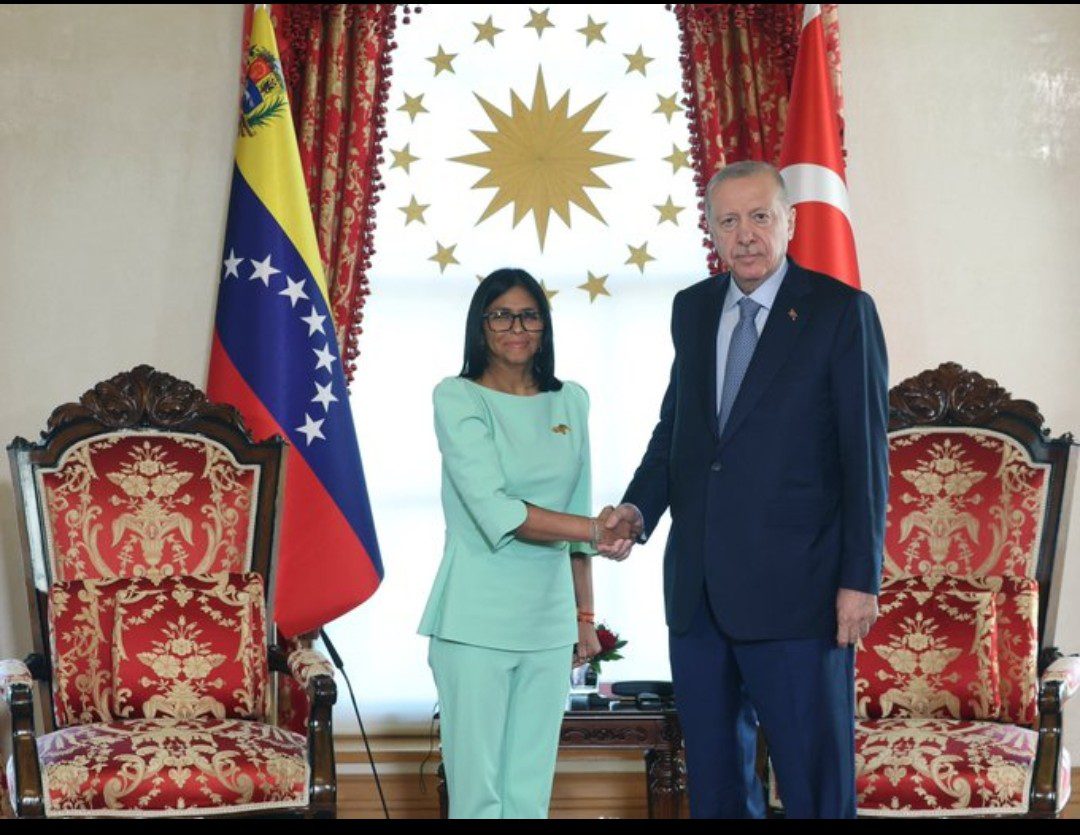
Delcy Rodríguez met with the President of Turkey, Recep Tayyip Erdoğan, to discuss bilateral cooperation between the two nations in the context of the changes that have taken place in Venezuela since January 3. Photograph: Presidential Press Office.
Guacamaya, June 8, 2026. Venezuela’s acting president, Delcy Rodríguez, concluded an international tour that included India and Turkey, where she held high-level meetings with President Recep Tayyip Erdoğan and Turkish officials to deepen bilateral cooperation in strategic areas such as energy, trade, mining, infrastructure, tourism, and air connectivity.
Acting President of the Bolivarian Republic of Venezuela Delcy Rodríguez arrived in Istanbul on Sunday from India to carry out a working agenda aimed at strengthening the strategic relationship between Caracas and Ankara, an alliance that has become one of the pillars of Venezuelan foreign policy in recent years.
Upon her arrival at Istanbul International Airport, Rodríguez was welcomed with official honors by a delegation led by Turkey’s Minister of Energy and Natural Resources, Alparslan Bayraktar; Istanbul Deputy Governor Mustafa Asım Alkan; and Istanbul Metropolitan Municipality Deputy Mayor Gökhan Gümüşdağ.
The Venezuelan leader was accompanied by a broad government delegation that included Foreign Minister Yván Gil; Sectoral Vice President for Science, Technology, Ecosocialism and Health Isabel Iturria; Sectoral Vice President for Communication and Culture Miguel Ángel Pérez Pirela; Minister of Science and Technology Gabriela Jiménez; Minister of Tourism Daniella Cabello; Minister of Transportation Jacqueline Faría; and Minister of the Office of the Presidency Juan Escalona.
The centerpiece of the visit was a high-level meeting between Rodríguez and Turkish President Recep Tayyip Erdoğan at the Dolmabahçe Presidential Office, where both delegations reviewed the current state of bilateral relations and explored new opportunities to expand strategic cooperation between the two countries.
During the meeting, the parties discussed priority areas including trade, investment, energy, housing, infrastructure, healthcare, transportation, and air connectivity, sectors that have gained increasing importance within the shared agenda of Caracas and Ankara.
Erdoğan also reaffirmed Turkey’s commitment to strengthening its strategic relationship with Venezuela, emphasizing that Ankara will continue supporting the South American nation and promoting new avenues of cooperation. The Turkish president noted that the energy, mining, and commercial sectors will remain priorities on the bilateral agenda and confirmed that both governments will take concrete steps toward achieving a bilateral trade target of $3 billion, a figure that would significantly expand current levels of economic exchange.
Relations between Venezuela and Turkey have strengthened considerably over the past decade thanks to the close political rapport developed between Erdoğan and Venezuelan President Nicolás Maduro. In January 2019, when several governments questioned Maduro’s legitimacy following the 2018 presidential election, Erdoğan publicly expressed his support and delivered a message that became emblematic of the relationship between the two governments: “Brother, stand firm. We are with you.”
For his part, Maduro was among the first international leaders to express support for Erdoğan following the attempted military coup in Turkey in July 2016, a development that helped deepen political trust between the two governments.
The death of Hugo Chávez in 2013 and the political transformations that Venezuela underwent in the years that followed prompted a diplomatic strategy aimed at diversifying international partnerships and expanding the country’s room for maneuver in an increasingly complex global environment. Within this process, Caracas’s support for the Turkish government following the failed coup attempt of July 2016 marked a turning point in bilateral relations. Venezuela’s defense of Turkey’s constitutional order was viewed in Ankara as a demonstration of political loyalty at a critical moment and became one of the foundations of the contemporary relationship between the two countries.
For Turkey, the failure of the 2016 coup attempt not only enabled President Recep Tayyip Erdoğan to consolidate his domestic position but also encouraged a reorientation of foreign policy toward the cultivation of new strategic partners beyond its traditional alliances. In this context, Venezuela emerged as one of the most significant partners in Turkey’s evolving international outlook.
Although diplomatic relations between Caracas and Ankara were formally established in 1950, during the military government that followed the overthrow of Venezuelan President Rómulo Gallegos, contacts between the two countries remained limited for decades due to geographical distance and the domestic priorities of both governments. The relationship began to gain momentum following Chávez’s death in March 2013, when then-Deputy Prime Minister Beşir Atalay attended his funeral and emphasized the regional impact of the Venezuelan leader’s passing. That visit helped lay the groundwork for a new phase in bilateral relations.
The most significant political breakthrough came in October 2017 with the official visit of Venezuelan President Nicolás Maduro to Turkey, the first by a Venezuelan head of state. From that point onward, cooperation expanded across multiple sectors, accompanied by Turkey’s broader interest in strengthening its economic ties with Latin America and the Caribbean.
Beyond the gold trade, economic relations between the two countries have deepened through direct investment in strategic sectors. In June 2024, the Venezuelan government announced agreements with Turkish companies to participate in mining projects within the Orinoco Mining Arc. Among the most prominent actors is Yildirim Group, an industrial conglomerate that has partnered with Minerven in gold extraction operations. The agreements also include investments aimed at rehabilitating infrastructure related to the iron and steel industries, as well as petrochemical projects, many of them structured through compensation mechanisms based on future production or mineral resources.
The history of Yildirim Group reflects the international expansion of Turkish industry. Founded in 1963 by Garip Yildirim as a small trading company in the city of Samsun, the group has grown into a global corporation operating in 57 countries and across nine economic sectors. Under the leadership of Ali Riza and Robert Yuksel Yildirim, the company employs more than 25,000 people and maintains assets in mining, ports, logistics, energy, and heavy industry. Its portfolio includes operations in Russia, Kazakhstan, Albania, Kosovo, and the United States, as well as a significant stake in the French shipping giant CMA CGM.
Yildirim’s presence in the United States is particularly noteworthy. In 2023, the company acquired the entirety of Elementis plc’s chromium business, including production facilities in Texas, North Carolina, Nebraska, and Wisconsin, in a transaction that required approval from U.S. regulatory authorities.
One of the company’s most ambitious projects in Venezuela is focused on the petrochemical sector. In 2024, Yildirim announced an investment of approximately $750 million to modernize Pequiven’s ammonia plant in Zulia State. The initiative aims to increase production capacity and strengthen exports of fertilizers and other strategic inputs for the agricultural sector.
The international experience and Western market exposure of Turkish companies provide a competitive advantage in today’s Venezuelan context. Firms with operations in the United States are generally subject to rigorous compliance standards, financial oversight, and regulatory requirements, reducing risks associated with sanctions regimes and facilitating access to international financing and investment mechanisms.
This factor has become even more relevant following the easing of certain U.S. sanctions in 2026. After the political developments of January 3 and the subsequent reconfiguration of relations between Washington and Caracas, the United States began expanding licenses that allow commercial activities and investment in sectors such as oil, natural gas, and fertilizers, creating new opportunities for international actors interested in the Venezuelan market.
In this new environment, companies capable of operating simultaneously in Venezuela and Western jurisdictions may play a critical role as vehicles for investment and technology transfer. For conglomerates such as Yildirim, this represents an opportunity to expand projects related to mining, petrochemicals, logistics, and infrastructure.
Economic cooperation has also expanded into manufacturing. In early 2025, it was announced that Turkish investors would assume management of fifteen plastic-processing plants located across eight Venezuelan states. The initiative, promoted by the Independent Industrialists’ and Businessmen’s Association of Turkey (MUSIAD Venezuela), seeks to reactivate facilities that had remained idle despite retaining operational equipment.
According to Turkish business representatives, these plants could rapidly resume production of medical supplies and industrial materials, contributing both to industrial recovery and job creation. Their reactivation could also generate positive spillover effects for logistics networks, service providers, and essential sectors such as healthcare.
On the political and diplomatic front, Turkey has sought to maintain an active role in Venezuelan affairs. As a founding member of the United Nations and an observer in several Latin American regional organizations, Ankara has participated in initiatives aimed at fostering political dialogue. Its presence at international meetings on Venezuela, including the summit convened by Colombian President Gustavo Petro, reflects this interest in playing a constructive role in mediation efforts.
This approach was also evident during the 2020 visit to Caracas by then-Foreign Minister Mevlüt Çavuşoğlu, who met not only with government officials but also with opposition leaders, including Henrique Capriles and Stalin González. This willingness to engage with different political actors has helped position Turkey as a country capable of maintaining communication channels with all sides of Venezuela’s political spectrum.
Energy remains another central pillar of the bilateral relationship. In recent years, Turkish Petroleum, through its international subsidiaries, has explored opportunities for cooperation with Venezuela in oil and gas exploration and production, particularly within the Orinoco Oil Belt. These initiatives form part of a broader strategy aimed at diversifying Venezuela’s international partnerships in the hydrocarbons sector.
Acting President and Minister of Petroleum Delcy Rodríguez has held several meetings with representatives of Türkiye Petrolleri Anonim Ortaklığı (TPAO) and other Turkish energy entities to evaluate opportunities for cooperation. In February 2025, Rodríguez and Turkish Energy Minister Alparslan Bayraktar reviewed existing agreements in oil, natural gas, and mining during a meeting in Istanbul and expressed their intention to move toward concrete projects. Nevertheless, many of these initiatives remain in the planning stage and have yet to translate into large-scale operational ventures.
That political alignment later translated into growing economic ties. By 2023, bilateral trade had reached nearly $1 billion, driven primarily by the mining, gold, and commercial sectors.
Energy currently occupies a central place in the bilateral agenda. In February 2024, the energy ministers of both countries signed memoranda of understanding covering oil, natural gas, and mining cooperation. Later that year, the Venezuelan government announced agreements designed to facilitate Turkish participation in gold extraction projects in southern Venezuela.
International sanctions imposed for years on Venezuela’s energy and mining sectors limited the implementation of several of these initiatives. However, the easing of some restrictions in recent months has generated expectations of increased Turkish investment, both public and private, in strategic sectors of the Venezuelan economy.
In this context, Rodríguez also held a working meeting with Turkey’s Minister of Energy and Natural Resources, Alparslan Bayraktar, to review ongoing energy cooperation initiatives and explore mechanisms for advancing new joint projects.
According to both parties, the visit reaffirmed their commitment to strengthening channels of political dialogue and economic cooperation, consolidating a strategic partnership that has become one of Venezuela’s most dynamic relationships with a major Eurasian regional power.