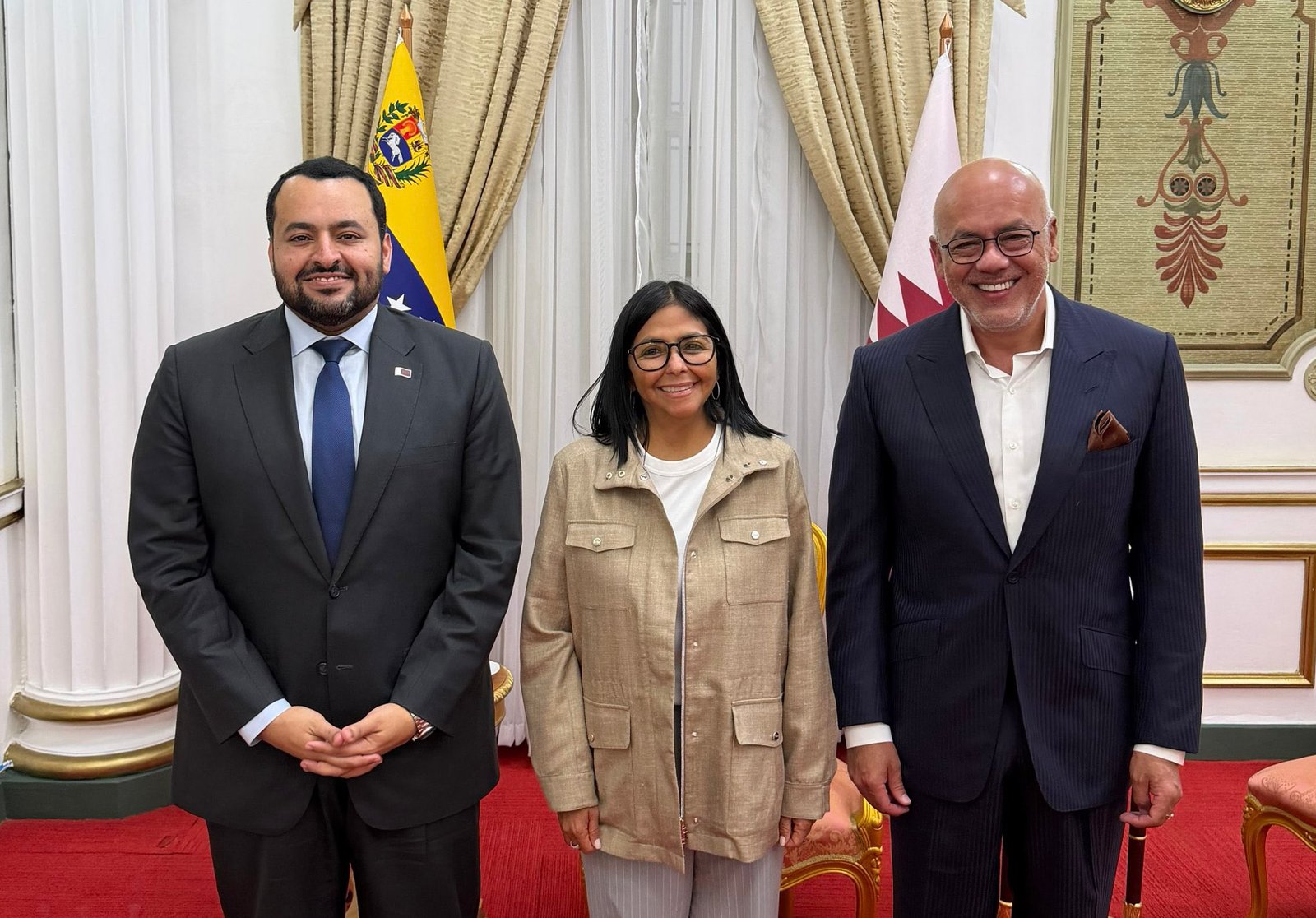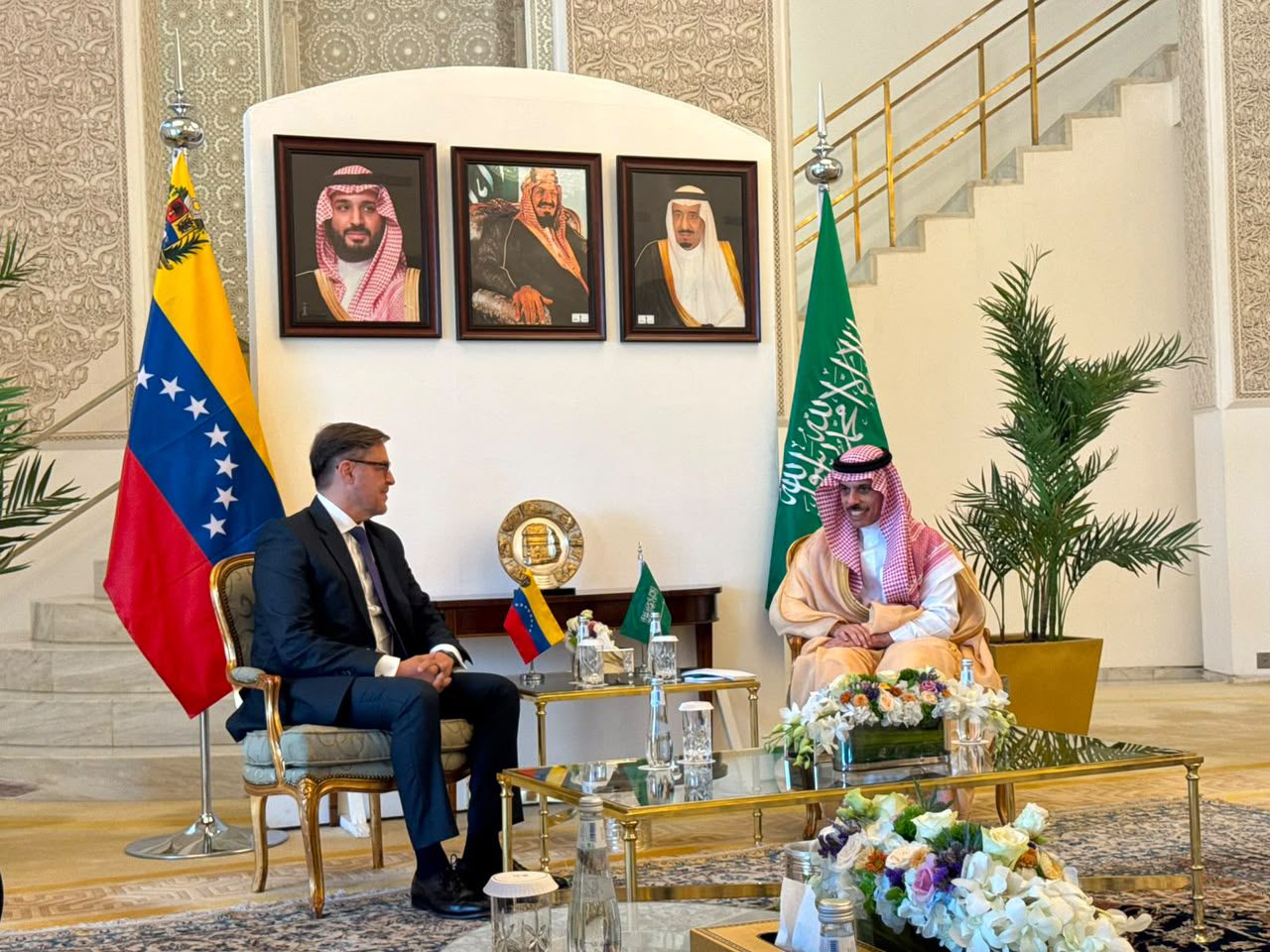
In the image, Venezuela’s Minister of Foreign Relations and Foreign Trade, Félix Plasencia, with the Chancellor of Saudi Arabia, Prince Faisal bin Farhan Al Saud. Photograph: Ministry of Foreign Relations and Foreign Trade.
Guacamaya, July 20, 2026. Chancellor Félix Plasencia’s first international tour confirmed a trend that has been consolidating since January 3: the foreign policy of the administration led by Delcy Rodríguez is concentrating a large part of its efforts on the Middle East, particularly on the monarchies of the Arabian Peninsula.
Beyond strengthening bilateral relations, Caracas is seeking to attract investments for the country’s reconstruction, open new markets, consolidate energy alliances, and establish channels of communication with Washington through some of the region’s most influential actors.
Plasencia’s tour, now Minister of Foreign Relations and Foreign Trade, began in Qatar, where he attended the funeral of the former Emir, Hamad bin Khalifa Al Thani. During the visit, he held at least two meetings with the current Emir, Tamim bin Hamad Al Thani, a diplomatic gesture that is unusual and of high political significance.
Qatar: A Key Bridge to Washington
The relationship between Doha and Caracas has strengthened in recent years, particularly around the figure of Delcy Rodríguez. Even when she served as Executive Vice President, Emir Tamim bin Hamad held direct meetings with her, breaking with traditional protocols reserved for heads of state. This closeness has turned Qatar into one of Venezuela’s main international interlocutors.
Doha’s role in Venezuela has not been small: for years, it has played a discreet role as a facilitator of dialogue between Venezuela and the United States, leveraging its unique position as a strategic ally of Washington and, at the same time, a reliable interlocutor for actors in conflict with each other. Its mediation capacity has been demonstrated in conflicts such as Afghanistan, Gaza, and Iran, making it one of the most diplomatically influential countries in the Middle East.
That role takes on even greater relevance under the Trump administration. The growing coordination between Washington and Doha on regional security, energy, and conflict negotiation has strengthened Qatari influence within U.S. foreign policy. For Caracas, maintaining a privileged relationship with Qatar also means keeping an indirect communication channel open with Washington.
In the economic sphere, the main company currently representing the interests of the Qatari royal family in Venezuela is UCC Holding. It is studying investments in Block 4 of the Orinoco Mining Arc, in the Los Pijiguaos bauxite mine, and in projects in Carbozulia, although the agreements remain in a preliminary and non-binding phase.
Despite being a private company, UCC Holding has served as the executing arm of the Emir’s foreign initiatives, playing a relevant role in the reconstruction of Syria after the war, in which it has committed 7 billion dollars.
Saudi Arabia: Energy and Access to Washington
Plasencia’s second stop was Saudi Arabia, where he was received by the Minister of Foreign Affairs, Prince Faisal bin Farhan Al Saud, in addition to holding a videoconference with the Minister of Commerce, Majid Alkassabi.
According to official information, both parties discussed investment opportunities in agriculture, tourism, infrastructure, and oil. However, the scope of the relationship is much broader.
Saudi Arabia continues to be one of the United States’ main partners in the Middle East and maintains significant influence within the Trump administration. Its leadership in international energy markets and its central role within OPEC make it an essential actor for any Venezuelan strategy of economic reinsertion.
For Caracas, strengthening ties with Riyadh not only opens up investment opportunities but also allows for closer relations with one of the governments with the greatest capacity to influence Washington.
It is worth mentioning that Saudi Arabia has hosted high-level talks between the United States and Russia to explore a negotiated exit to the war in Ukraine. Additionally, it is relevant to note that Russia is one of Venezuela’s main bilateral creditors and its presence in the country has been the subject of debate between Washington and the interim administration in Caracas.
United Arab Emirates: Investments, Security, and Reconstruction
An important actor to mention is the United Arab Emirates. Although the nation was not part of Plasencia’s tour, it is key to understanding the context of Caracas’s rapprochements with the Gulf monarchies.
Venezuela’s strategy toward the Gulf is not limited to Qatar. During February, Delcy Rodríguez received Ali Mohammed Hammad Al Shamsi, special envoy of the President of the United Arab Emirates and Secretary General of the Supreme Council for National Security, at Miraflores Palace.
The visit had special significance because Al Shamsi is not a conventional diplomat. He is one of the main officials responsible for the Emirati state security apparatus, with experience as ambassador to Jordan, Pakistan, and Afghanistan and responsibilities in ports, borders, identity, and national security. His presence in Caracas evidenced that bilateral cooperation transcends the economic sphere and extends toward strategic areas.
A few weeks after January 3, the Venezuelan government’s main economic advisor, Calixto Ortega, participated in the World Government Summit held in Dubai. From there, he presented the new Venezuelan political scenario and explained, in an interview with Tucker Carlson, the economic vision of Delcy Rodríguez’s administration, sending a message of openness to international investors and Gulf governments.
On the energy front, ADNOC (Abu Dhabi National Oil Company), the Abu Dhabi state oil giant, has evaluated opportunities to participate in projects related to natural gas production and commercialization in Venezuela. These conversations are part of Caracas’s effort to attract companies with financial and technological capacity to develop its energy sector.
Following the June earthquakes, the United Arab Emirates also provided financial support for the country’s reconstruction, complementing the humanitarian assistance deployed by other Gulf partners. Their participation reinforces the perception of Abu Dhabi as one of Venezuela’s main potential allies for economic recovery.
Pakistan: A New Diplomatic Actor
Another country beginning to acquire importance within Venezuela’s strategy is Pakistan.
Venezuelan Chancellor Félix Plasencia, after his tour in the Middle East, held a conversation with his Pakistani counterpart, Mohammad Ishaq Dar, with the aim of deepening bilateral cooperation in sectors such as trade, investment, and technology transfer. During the meeting, Caracas highlighted Pakistan’s potential as a strategic market, given its population of nearly 300 million inhabitants, while Plasencia thanked Islamabad for the support and solidarity expressed following the recent earthquakes that affected Venezuela.
For decades, Islamabad concentrated its foreign policy on South Asia and protecting its border interests. However, in recent years it has begun to position itself as an increasingly relevant mediator between the United States and some of its main adversaries.
Its experience facilitating negotiations with the Taliban, its growing participation in initiatives related to the Middle East, and its inclusion in new diplomatic mechanisms promoted by the Trump administration reflect a growing recognition of its strategic value.
At the same time, Washington considers Pakistan a fundamental partner for maintaining influence over Afghanistan and exerting pressure on the Taliban, especially in a context marked by renewed strategic interest in the Bagram air base. This evolution has strengthened the political weight of General Asim Munir, Chief of Army Staff and the country’s main figure of power.
In this context, the rapprochement between Caracas and Islamabad takes on a broader dimension. For Venezuela, strengthening ties with Pakistan means getting closer to an actor whose capacity for dialogue with Washington and the Gulf monarchies continues to grow. Its position as a bridge between different regional powers makes it a diplomatic partner with a strategic value superior to what it traditionally had for Latin America.
A Priority in Venezuelan Foreign Policy under Delcy Rodríguez
The priority given to the Gulf was also reflected during the new government’s first months. Between January and February, Caracas received high-level delegations from Qatar, the United Arab Emirates, and Jordan, while Delcy Rodríguez intensified her contacts with the region’s main leaders.
After the June earthquakes, that relationship began to translate into concrete results. Qatari brigades participated in humanitarian assistance efforts, and the United Arab Emirates contributed financing for reconstruction, reinforcing both countries’ presence in Venezuela.
The evolution of Venezuela’s stance regarding the recent escalation between Iran and Israel also offers clues about this shift in priorities. Unlike previous crises, Caracas adopted a more moderate tone and condemned the Iranian response, a position interpreted as a message directed at the Gulf monarchies, with which it seeks to deepen its political and economic cooperation.
Equally significant was the decision that Delcy Rodríguez’s first international communication after the crisis was not with Tehran, but with Qatar. The gesture represented a statement of priorities and confirmed the central role that Doha occupies within the new Venezuelan diplomatic architecture.
Taken together, these moves show that Venezuela’s foreign policy is entering a new stage. Without completely abandoning its traditional alliances, Caracas appears to be betting on a more pragmatic strategy, aimed at strengthening relations with Gulf countries, attracting investments for reconstruction, expanding its channels of communication with the United States, and positioning itself alongside some of the actors with the greatest capacity for influence in contemporary geopolitics.