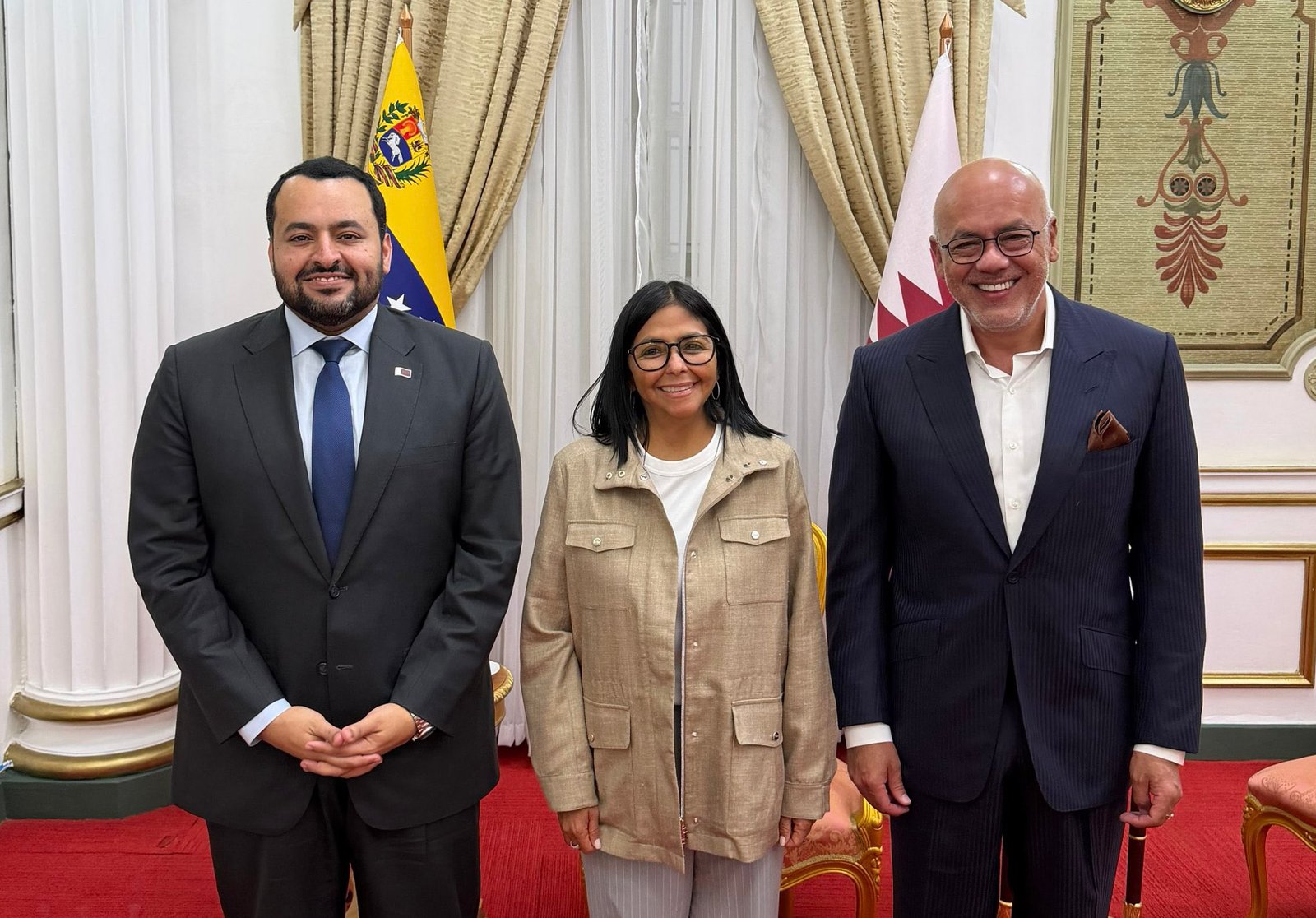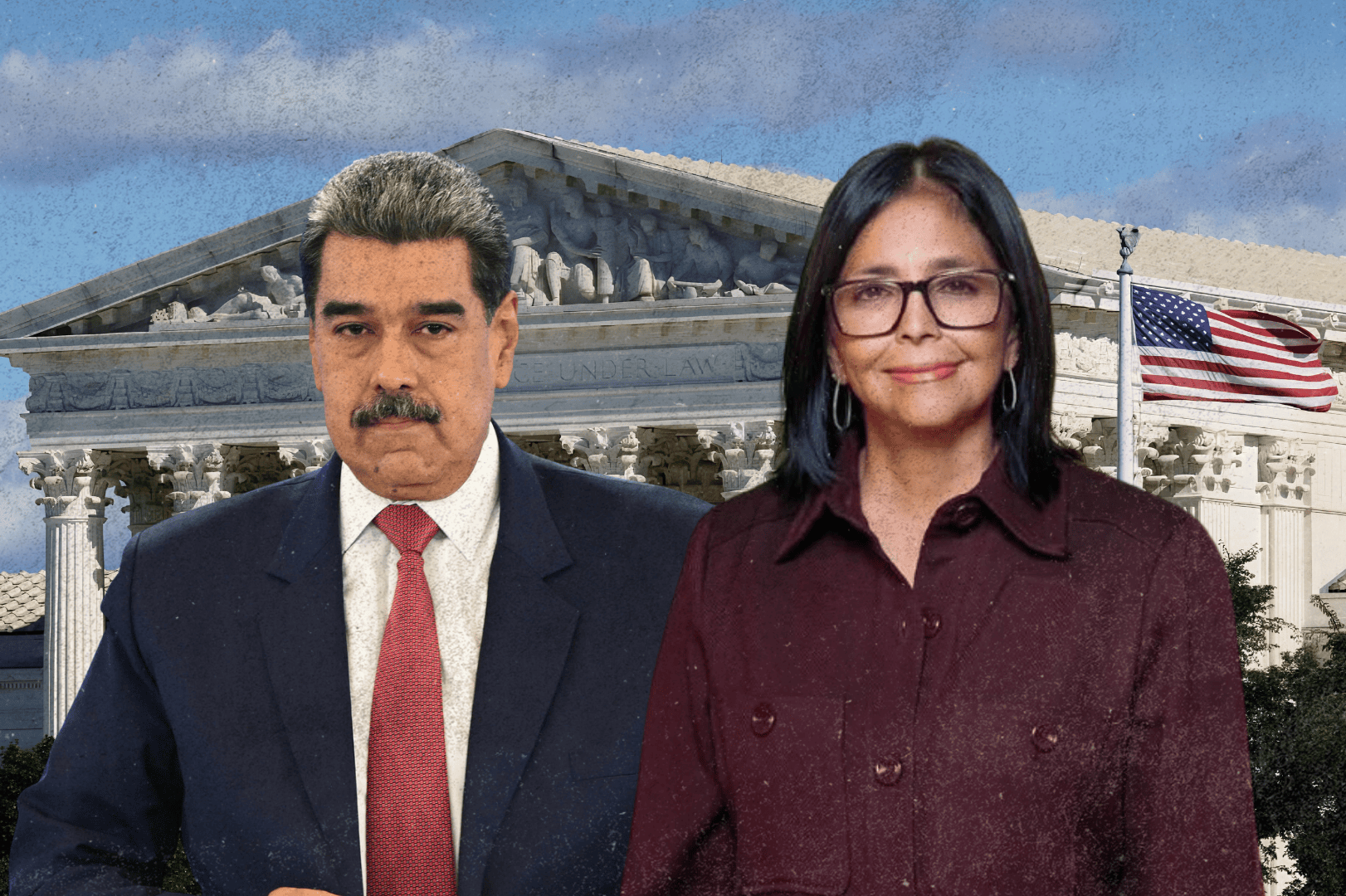
In Venezuela, interim command has been assumed by Delcy Rodríguez, amid a scenario of great uncertainty regarding the future recognition of national leadership. | Image: Guacamaya.
Guacamaya, July 22, 2026. The judicial proceedings against Nicolás Maduro and his wife, Cilia Flores, have reached a critical point following the third hearing held in Manhattan, New York. Although the court has set June 1, 2027, as the date for the start of the trial, the defense is preparing a legal offensive that challenges the jurisdiction of U.S. courts to try the former Venezuelan president.
In parallel, the government of Donald Trump has formally requested a U.S. court to guarantee “diplomatic immunity” for Venezuela’s current leader, Delcy Rodríguez, in order to have the charges against her dismissed in a civil lawsuit filed in Florida. The request is based on the formal recognition of Rodríguez, since March 5, as the acting head of state.
The possible turn in the case: Jurisdiction and immunity
The trial of Maduro could take a significant turn because U.S. courts may decide that they lack legal authority to proceed with the case. This argument, supported by legal experts such as Michael Rips, is based on an extradition treaty from 1922 between the United States and Venezuela, which stipulates that any disagreement over its execution must be decided by international arbitration.
Defense attorneys, led by Barry Pollack, seek dismissal of the charges by arguing precisely that Maduro enjoys diplomatic immunity as a sovereign head of state. The prosecution, for its part, maintains that since 2019 Washington does not recognize Maduro as president, and therefore he would lack such status.
Timeline of the presidential couple’s hearings
In context, the judicial proceedings against Nicolás Maduro in New York have been marked by significant milestones.
At the first hearing on January 5, the former president pleaded “not guilty” to charges of narcoterrorism and conspiracy, also defining himself as a “prisoner of war.”
Likewise, during the second appearance on March 26, Judge Alvin Hellerstein rejected the defense’s request to dismiss the case, which argued that the freeze on Venezuelan funds due to U.S. sanctions prevented affording adequate legal defense.
Finally, at the third session on July 22, the schedule setting the trial start for June 1, 2027, was confirmed, in a brief session where Maduro’s physical appearance drew attention, as he appeared noticeably thinner.
The next hearing is set for November 17, when the judge is expected to evaluate the defense’s motion to dismiss the case by invoking presidential immunity.
Trends in the prediction market: Polymarket
Public sentiment and betting on platforms such as Polymarket reflect the high uncertainty of the case. Despite his detention, as of the date of this publication, regarding official recognition, the market assigns an 81% probability that Nicolás Maduro will still be recognized as Venezuela’s leader by the end of 2026, compared to 12% for Delcy Rodríguez.
Regarding his detention, bets are low for release this year, at 8% for Maduro and 31% for Cilia Flores. On sentencing, 36% bet on an outcome of “no prison time,” while 29% foresee a sentence of more than 60 years, and the rest anticipate intermediate sentences. In addition, only 24% of traders believe Maduro will be found guilty on all charges.
These trends suggest that, although the judicial path is mapped out until 2027, the complex legal defenses based on international treaties keep open the possibility that the case may be dismissed before going to trial.
The contrast in treatment of Maduro and Delcy
There is a marked difference between the legal treatment received by Delcy Rodríguez and that of the former presidential couple. While a “hard-line” policy is applied against Maduro and Cilia Flores, Rodríguez is treated with “kid gloves,” maintaining fluid communication with senior officials such as Secretary of State Marco Rubio.
This cooperation has included coordination on economic policies and legal reforms, even though Rodríguez has publicly criticized the military operation that led to Maduro’s capture. According to prediction markets, there is an estimated 91% probability that Rodríguez will remain the de facto leader of the country by the end of 2026.
For his part, the 1922 extradition treaty emerges as the most disruptive piece of Maduro’s defense. If the court is forced to refer the case to independent arbitration to assess whether the capture in Caracas was illegal, the federal judicial process could come to a complete halt, forcing the United States to release its captive.
In conclusion, the future of the Venezuelan presidential couple depends on whether the court prioritizes national jurisdiction based on the security of its citizens or strict compliance with century-old international treaties that could invalidate the entire capture operation.