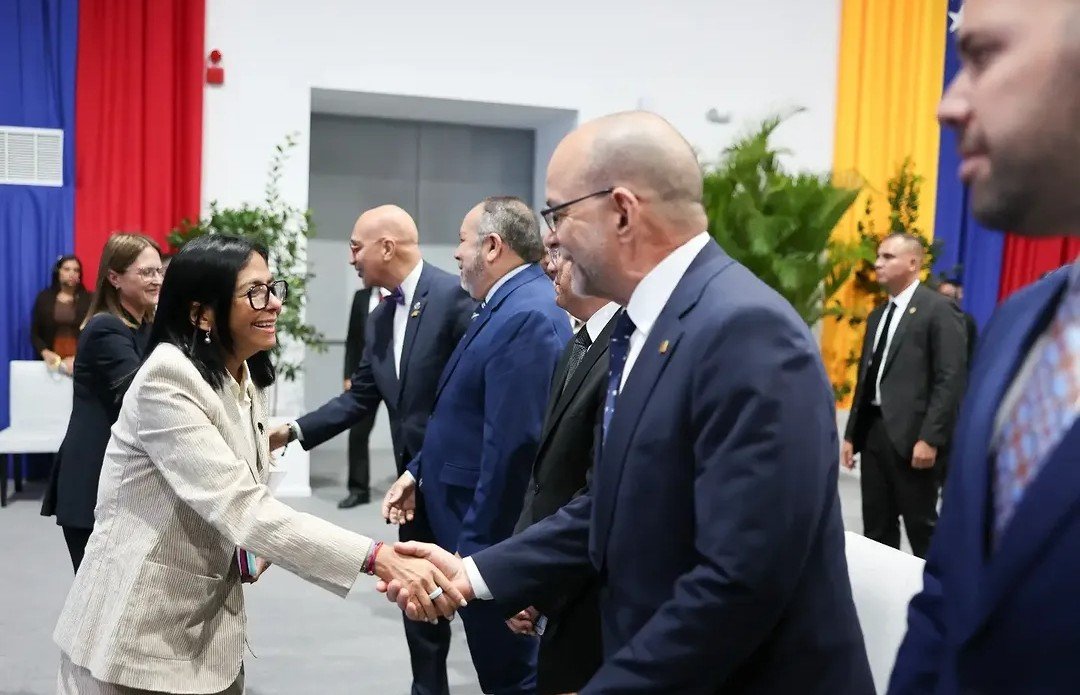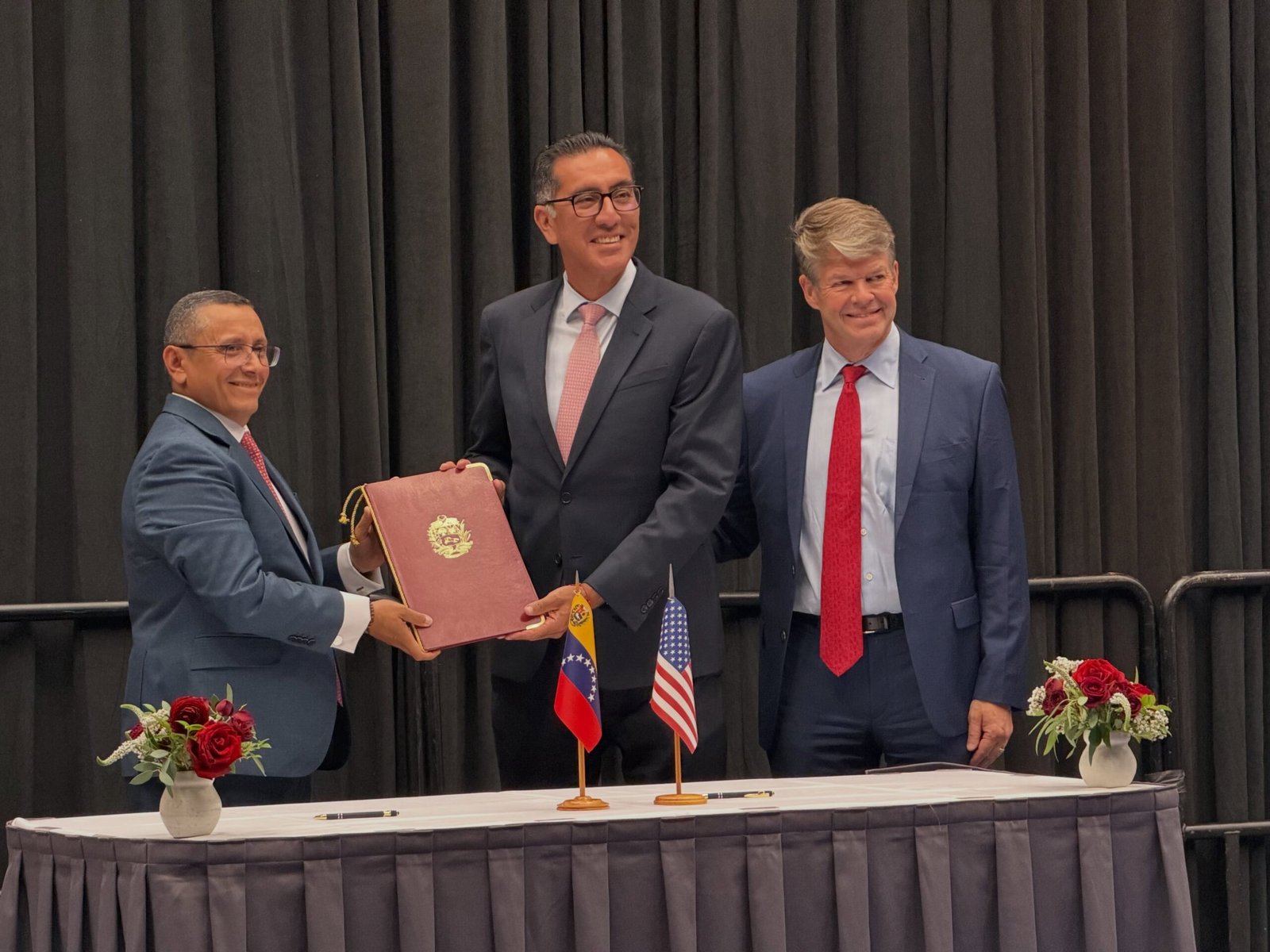
Jovanny Martínez, executive vice president of PDVSA, and Hunter L. Hunt, president of Hunt Oil, signed an oil production contract during the IMAGE 2026 conference in Houston, Texas. Photo: Instagram / @usembassyve.
Guacamaya, August 20, 2026. Within the framework of the IMAGE 2026 conference, Hydrocarbons Minister Paula Henao formalized a productive participation contract with Hunt Oil alongside Crossover Energy Holding, and a framework alliance with SLB for integrated reservoir studies throughout the national territory.
The signatories have very different track records in the country: two have just arrived after January 3; the other never fully left.
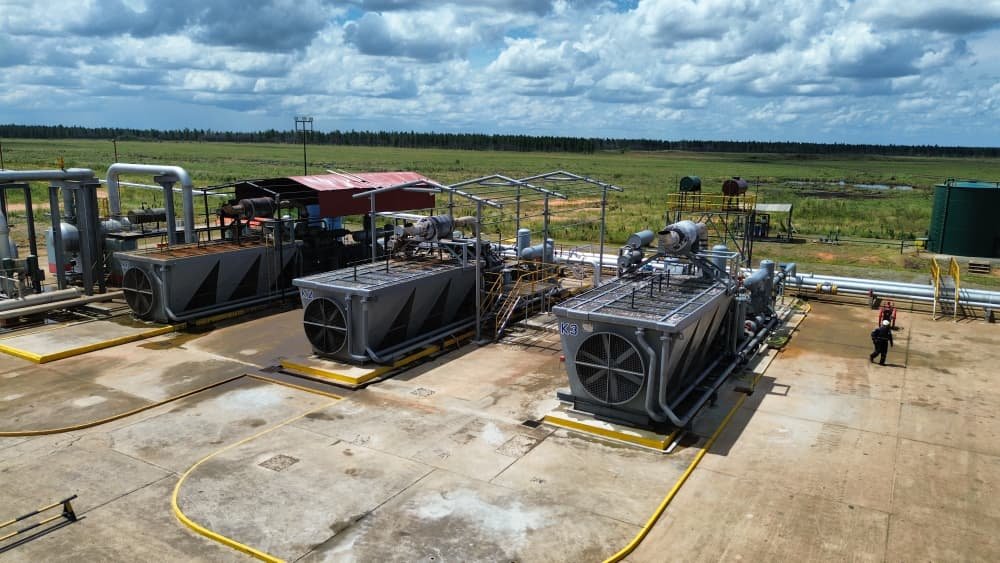
The Venezuelan delegation, headed by Henao and accompanied by Vice Minister of Geopolitics Eduardo Ramírez; PDVSA Executive Vice President Jovanny Martínez; and Venezuela’s Chargé d’Affaires in the U.S., Johann Álvarez, signed a hydrocarbon productive participation contract with Hunt Oil on Tuesday, August 18, aimed at developing and leveraging production from the Caro and Carisito fields.
Henao described the company as “a firm with a recognized track record” that will aim to recover production from those areas.
In parallel, a framework alliance was signed with SLB — formerly Schlumberger — for services related to integrated reservoir studies throughout the country, though the minister did not specify investment amounts or expected additional production volumes. According to Reuters, both companies had already signed preliminary agreements with Venezuela earlier this year, and the exact scope of the new pacts was not immediately clear.
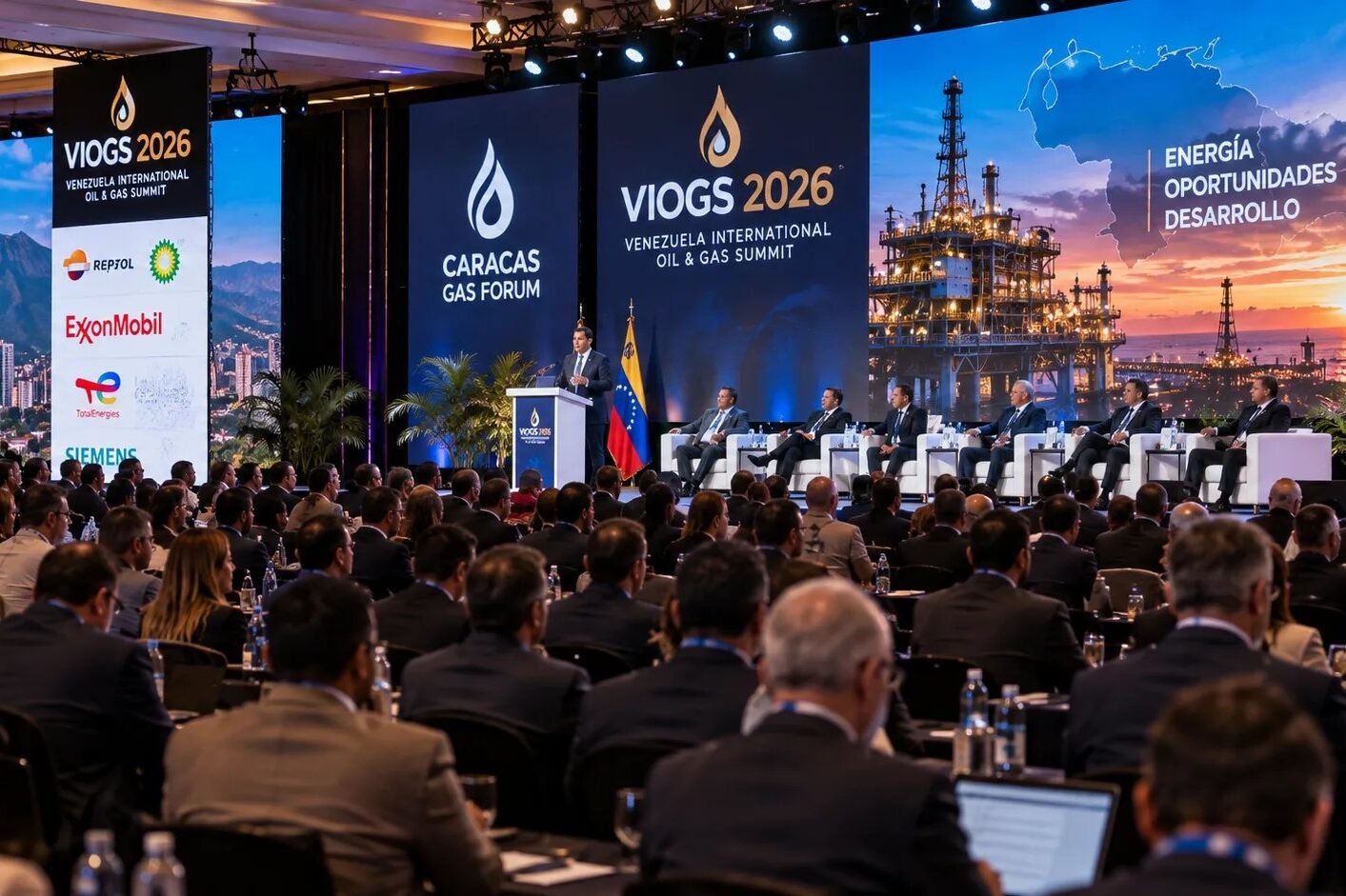
The agreements were framed within the forum “Empowering Venezuela: Energy, Investment & Opportunity,” where the delegation shared a panel with U.S. Deputy Secretary of Energy Kyle Haustveit, as part of the IMAGE 2026 agenda.
Hunt Oil: from “Dallas” to Kurdistan, and now the Orinoco Belt
Hunt Oil Company is a private oil company founded in 1934 by H.L. Hunt in Dallas, Texas — the same patriarch who, according to some press accounts, inspired the archetype of the oil magnate in the television series “Dallas.” It is now led by Ray Lee Hunt, the founder’s son, whose net worth is around $9.16 billion according to Bloomberg and who joined the board of the Federal Reserve Bank of Dallas in 2026.
The company has a recognizable pattern of entering high-political-risk scenarios. Its track record includes an early incursion described as “bold” into the Camisea field in Peru, as well as operations in North Africa.
The most high-profile point in its history was an exploration contract signed in 2007 with the Kurdish Regional Government of Iraq to operate in fields considered strategic by Washington amid postwar political instability. Hunt Oil broke the consensus of major multinationals by signing a production-sharing contract in Iraq’s autonomous Kurdistan region. The agreement was deemed illegal by Baghdad’s central government, which maintained that only the national ministry had the exclusive right to grant oil licenses.
The firm’s CEO, Ray L. Hunt, was a prominent Republican fundraiser and a member of the President’s Foreign Intelligence Advisory Board, according to The New York Times.
Ray Hunt also sat on Halliburton’s board at the appointment of then-Vice President Dick Cheney, a central figure in the invasion of Iraq and the overthrow of Saddam Hussein, and contributed $35 million to George W. Bush’s presidential library.
War critics, such as U.S. Congressman Dennis Kucinich, denounced that the agreement proved the 2003 military invasion was not about weapons of mass destruction, but rather to facilitate private access to and control of Iraqi crude reserves.
At this point, it is key to recall that the U.S. State Department publicly discouraged regional pacts to avoid fragmenting Iraq. However, congressional investigations revealed emails proving that U.S. officials secretly endorsed and permitted Hunt Oil’s efforts.
In July 2025, the Ain Sifni field operated by Hunt Oil in Dohuk province suffered multiple attacks by explosive-laden drones.
Security investigations point to the Islamic Resistance in Iraq, a bloc composed of Shiite militias financially backed by Iran under the name of the Popular Mobilization Forces. These groups attack U.S. economic and military interests in retaliation for the American presence in the region, the context of the war in the Middle East, and Washington’s support for Israel.
Following the 2025 attacks, Hunt Oil and other foreign companies were forced to temporarily shut down their plants, cutting regional production by more than 140,000 barrels per day. Although operations resumed weeks later after demanding greater air defense systems from Iraq, instability has continued throughout 2026 amid the escalation of the naval conflict in the Persian Gulf and the Strait of Hormuz — something that has possibly influenced the need to look at operations in Venezuela.
In Venezuela, Hunt Oil confirmed its interest in July 2026 following a memorandum of understanding with the administration of Delcy Rodríguez. According to the firm’s senior vice president for Latin America, María Julia Aybar, the bet was decided as “risky and aggressive” but with high production potential. As early as April, a first energy agreement between Hunt and Rodríguez’s government was signed to operate in the Orinoco Belt. With this week’s signing, Venezuela becomes the second country in the region with Hunt Oil operations after Peru, initially coordinated from its Peruvian service platform, Hunt Services.
SLB: the one that never fully cut ties
SLB, rebranded from its former name Schlumberger, is the world’s largest oil services company and was already operating in Venezuela before this announcement. Unlike other international firms, SLB remained active under Chevron’s license — the only U.S. oil company with its own production in the country, approximately 240,000 barrels per day in joint ventures with PDVSA — and was, according to statements by its own CEO, Olivier Le Peuch, the only international service company with active operations in Venezuela following the exit of other sector players.
In January 2026, following the capture of Nicolás Maduro, Le Peuch stated on an investor call that SLB could rapidly increase its activity in the country, subject to the existence of appropriate licenses, payment conditions, and safety parameters. The company — headquartered in Houston — was already receiving numerous inquiries from clients interested in the Venezuelan market. In June, SLB and the Venezuelan government signed a preliminary memorandum of understanding in Caracas to explore cooperation in oil and gas services with cutting-edge technology; the framework alliance signed this week in Houston formalizes and expands that understanding to reservoir studies throughout the national territory.
Additionally, according to information gathered by Reuters, oil services provider SLB, private equity firm Formentera Partners, and another financial sector company are evaluating alternatives to reactivate currently idle drilling rigs in Venezuela, as well as to move new equipment into the country over the coming months.
Blake London, managing partner of Formentera Partners, explained during the Houston conference that the firm, which specializes in energy investments, is in talks with international oil service companies to facilitate the arrival of drilling rigs to Venezuela.
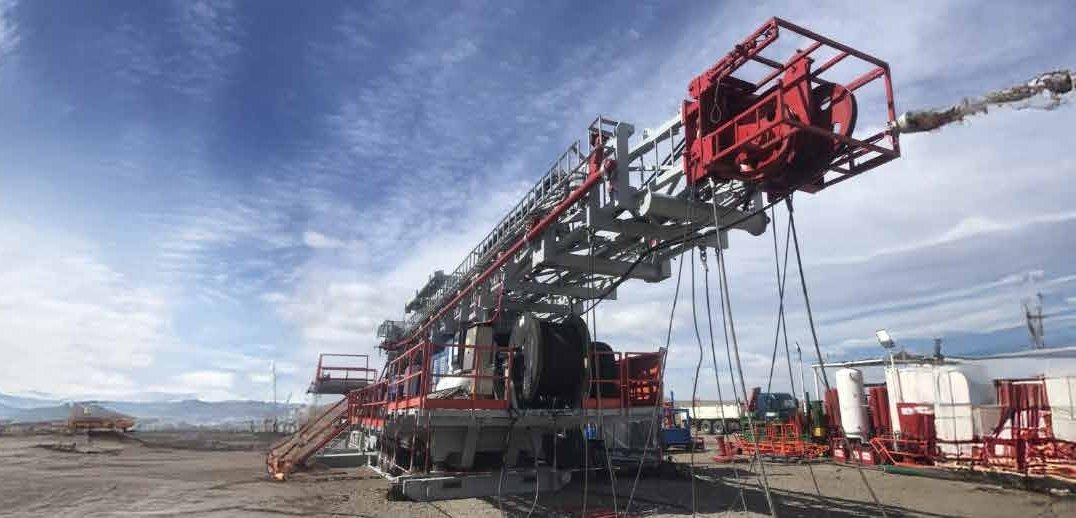
The limited availability of this equipment remains one of the main obstacles to raising production. At the end of July, only two onshore rigs remained operational in the country, according to Baker Hughes. This constraint comes as Venezuelan production hovers around 1.25 million barrels per day, according to official figures.
International suppliers also face difficulties in bringing in machinery and specialized equipment due to permit requirements, overland transport, and other logistical restrictions. Nevertheless, industry representatives indicated they are seeking to move equipment from other markets and, in parallel, negotiating with Venezuelan authorities to expedite its entry.
During the conference, Oil Minister Paula Henao called on international companies to increase their investments in Venezuela and contribute to strengthening the national supply chain, with the aim of ensuring that production growth can be sustained and remain economically viable in the long term.
However, major oil companies’ interest in returning to the country remains limited. Companies such as ExxonMobil and ConocoPhillips have indicated that outstanding issues remain regarding the protection of their contracts and investments before considering a significant return to Venezuela.
SLB, for its part, is considering putting up to 15 rigs already within Venezuelan territory back into operation. William Antonio, president of the company’s operations in Mexico, Central America, and Venezuela, explained that the process would begin with smaller equipment intended for workover jobs.
The executive told Reuters he expects these rigs could be fully operational in less than a year. Specifically, SLB estimates that up to four rigs could be back at work this year, though that will depend on the formalization of contracts with oil companies.
Antonio also anticipated that Venezuelan production could experience a significant increase over the next two years. However, he warned that the main challenge will be determining to what extent that growth can be sustained over time, especially due to the need for diluents and the persistent limitations in the country’s oil infrastructure.
The case of Crossover Energy Holding
Crossover Energy’s CEO, Eric McCrady, stated at a conference in Houston that negotiations for oil agreements with PDVSA and Venezuela’s Hydrocarbons Ministry are nearing completion. The information comes from Reuters. Unlike Hunt Oil, which arrives in Venezuela with nearly a century of history, Crossover is a firm with no verifiable commercial registration, no corporate website, and no prior operating track record before this agreement.
According to Reuters, McCrady declared on August 19 at a conference in Houston that his company’s oil agreement negotiations with Venezuela had advanced and were about to be finalized. The agency specified that Crossover acquired control of an operating company in eastern Venezuela to establish itself in the OPEC member country, and that earlier this year it signed a memorandum of understanding with the government that paved the way for negotiations on business opportunities.
Crossover Energy Holding formally entered the Venezuelan radar on April 30, 2026, when its president and CEO, Eric Paul McCrady, signed a memorandum of understanding with Delcy Rodríguez’s government at Miraflores Palace, in the same event where Hunt Overseas Oil Company — represented by its president, Igor Salazar — signed its own preliminary agreement. According to local coverage, the memoranda contemplated the development of fields in the Orinoco Belt, areas of northern Monagas, and associated gas projects in Anaco and Barinas.
The signing took place with direct backing from Washington through Jarrod Agen, executive director of the U.S. National Council for Energy Dominance and deputy assistant to President Trump, who led the business delegation that arrived in Caracas on the first direct Miami-Caracas flight in nearly a decade. Agen’s presence was decisive in getting Hunt and Crossover to commit investments. Alongside Hunt and Crossover, that post-reform round of agreements included Chevron, Eni, Repsol, BP, and Shell — companies with prior history in Venezuela; Hunt and Crossover were noted as the only two firms arriving in the country for the first time.
McCrady’s track record includes leading Sundance Energy Inc., a company that filed for Chapter 11 bankruptcy in 2021 with over $250 million in debt, before being sold and liquidated in 2022. One hypothesis is that Crossover may operate as a special-purpose vehicle constituted specifically for the Venezuelan agreement, with no prior assets or operational history of its own.
In his own communications, McCrady has described the agreement with PDVSA as an alliance to “bring technical capital to the world’s largest energy reserves,” framing it within Venezuela’s economic normalization and the Trump administration’s energy agenda.
The backdrop
The agreements come amid a rapidly reconfiguring Venezuelan energy sector following Maduro’s capture on January 3, 2026, and Delcy Rodríguez’s assumption as interim president, who appointed Henao — until then vice minister — to head the oil portfolio in March. The partial reform of the Organic Hydrocarbons Law, approved that same month by the National Assembly, expanded the ministry’s powers, reduced tax burdens, and enabled asset transfers and outsourcing, as part of a reconstruction plan driven by Washington.
Crude production reached 1.2 million barrels per day in July, a 29.8% increase from January’s 924,000 bpd, according to official figures not yet independently verified.
Venezuela’s agenda in Houston also includes promoting the Energy Week, scheduled in Caracas alongside the African Energy Chamber, as a showcase of the country’s oil, gas, and petrochemical potential to global investors.