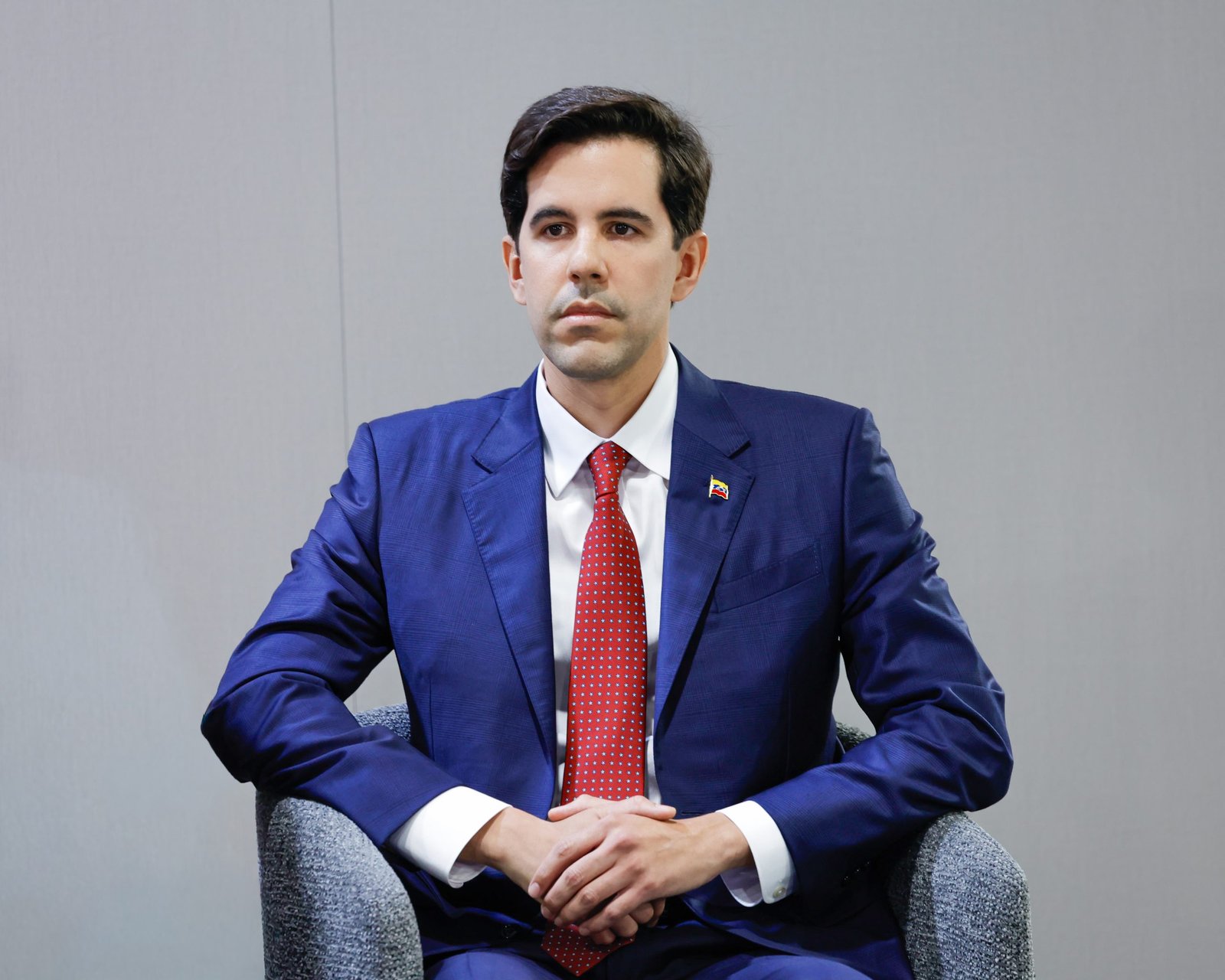
Oliver Blanco is the youngest Foreign Minister in Venezuela’s recent history, and stands out for his background outside the ruling party. Photo: Presidential Press.
Guacamaya, October 30, 2026. Acting President Delcy Rodríguez appointed Oliver Blanco, a UCV internationalist and former youth cadre of Acción Democrática, as Venezuela’s foreign minister this October 29. Blanco, who was the communications voice of the National Assembly under Henry Ramos Allup and had held the Deputy Ministry for Europe and North America since February, replaces Félix Plasencia, whom President Delcy Rodríguez is sending to London with the mission of recovering the gold reserves held at the Bank of England, while other changes are made at the Foreign Ministry.
The head of state announced the appointment during a VTV broadcast. “I have decided to appoint Oliver Blanco as foreign minister of the Bolivarian Republic of Venezuela. I hope that this strengthened team continues to advance in the changes and in Venezuela’s geopolitical recovery in areas of cooperation and friendship with all countries,” she said.
The appointment comes with a broader reshuffle in the foreign policy team. Félix Plasencia, appointed foreign minister in July, moves on to head International Affairs at the Presidency with a specific task. “I told him that his first task was to install himself in the United Kingdom until we recover the gold that belongs to Venezuelans,” explained Rodríguez, who added that Plasencia will represent the Presidency in the “essential, strategic” tasks the country requires.
Blanco thus becomes one of the youngest foreign ministers in Venezuela’s contemporary history and the youngest in the 21st century, also standing out for his past militancy outside the PSUV, the government party.
An internationalist with a past in the opposition
Blanco holds a degree in International Studies from the Central University of Venezuela and a master’s in Political and Government Studies from the Metropolitan University. His career combines politics and communication, and is historically linked to the opposition and, in particular, to Acción Democrática. Within the party he was a youth leader, participated in mobilizations and public pronouncements on the country’s crisis, and on several occasions defended negotiation as a path to a political solution.
He became known after the 2015 parliamentary elections, when the opposition won control of the National Assembly. During Henry Ramos Allup’s presidency in 2016 he held relevant positions in the Parliament’s communications apparatus. He was director of Strategic Communications and Institutional Relations and one of the institution’s visible voices during a period of high confrontation. He was an assistant to Ramos Allup, to whom he was considered close. He is also linked to Diego Arria, the Venezuelan diplomat who came to preside over the UN Security Council and who participated in peace missions in Bosnia and Herzegovina.
Those years exposed him to political tension, specifically in 2016 when he denounced having been assaulted by pro-government supporters near the legislative headquarters. In 2017, during the protests, he spoke before the Mexican Senate to denounce the Venezuelan situation and seek external support. Those actions consolidated him as an international spokesman for the opposition in certain circles, though far from the spotlight of other leaderships. He belongs to a generation formed among social networks, activism and strategic communication, with a discourse aimed at international audiences and the diaspora.
Throughout his career he has held meetings with heavyweight leaders, among them former Brazilian president Fernando Henrique Cardoso. Cardoso is a key figure in Brazil’s democratic consolidation after the dictatorship (1964-1985); as senator, foreign minister and later president, he promoted the Real Plan and reforms of governance, transparency and civil rights.
From deputy minister to foreign minister
In February 2026, Rodríguez appointed him deputy minister for Europe and North America within a restructuring of four deputy ministries. The official announcement presented him as a young internationalist with an opposition past and declared commitment to the country. After the appointment, Blanco issued a statement in which he affirmed maintaining independence from the governing party. He presented his appointment as a sign of openness to “diverse perspectives in the service of the country” and said he seeks to promote national unity, because “generating trust is fundamental to defining our future.”
From that position he led official visits to Switzerland, the European Union and several countries of the bloc. He was also present at the meeting between Rodríguez and Donald Trump on the margins of the UN General Assembly.
Blanco has been a fundamental figure in the reconstruction of Venezuela’s international relations with the political West, especially with the European Union, Switzerland and the United States, in this new stage the country is experiencing after January 3.
He also played a key role in coordinating humanitarian aid and international assistance to Venezuela after the June earthquakes, and has become a key operator of Delcy Rodríguez’s reformist foreign policy.
The other pieces of the reshuffle
The most important is undoubtedly Félix Plasencia, who leaves the Foreign Ministry but does not leave the president’s circle. A career diplomat, he entered the foreign service in 1991 through public competition, under the government of Carlos Andrés Pérez. He met Delcy Rodríguez in 1994 at the Venezuelan embassy in London, and that relationship became a bond of political trust. He studied International Relations at the UCV, European Studies at the Catholic University of Leuven and Diplomatic Studies at Oxford. He was deputy minister, minister of Tourism and Foreign Trade, ambassador to China (2019-2021), foreign minister (2021-2022), ambassador to Colombia and representative to the International Maritime Organization in London. In February he was already serving as representative of the interim authorities before the United States. His new mission rests on that experience, and on his link with London.
For her part, Marynna Saatdjian will be deputy minister for Europe and North America, the office Blanco held. Until now she was deputy minister of International Trade. In her duties she has met with the ambassador of Brazil, the EU charge d’affaires and the commercial attachés of the U.S. Embassy, in addition to coordinating export diversification workshops with UNCTAD and CAF.
Another appointment was that of Saúl Ameliach, until now deputy minister of Economy and Finance, who will take over the Deputy Ministry of International Trade, which Saatdjian leaves.
Blanco’s appointment is not merely administrative. His opposition past and his communication profile may prove less ideologized for European governments and for Washington, and would serve as an interlocutor on delicate matters such as sanctions, economic cooperation and multilateral agreements. In addition, it would reinforce a narrative of inclusion, “reencounter” and generational renewal.
The gesture fits with the reconciliation phase of the three-phase plan attributed to Marco Rubio and backed by Trump. Rubio has argued that normalization must include diverse political actors and build trust between government and opposition. The gesture could also send the opposition the message that there are channels of participation within the State.
The appointment indicates that the government seeks to approach international actors with a more inclusive and professionalized discourse without compromising the Executive’s central political line. It remains to be seen whether it can consolidate this in concrete deeds and how the international community will assess it.
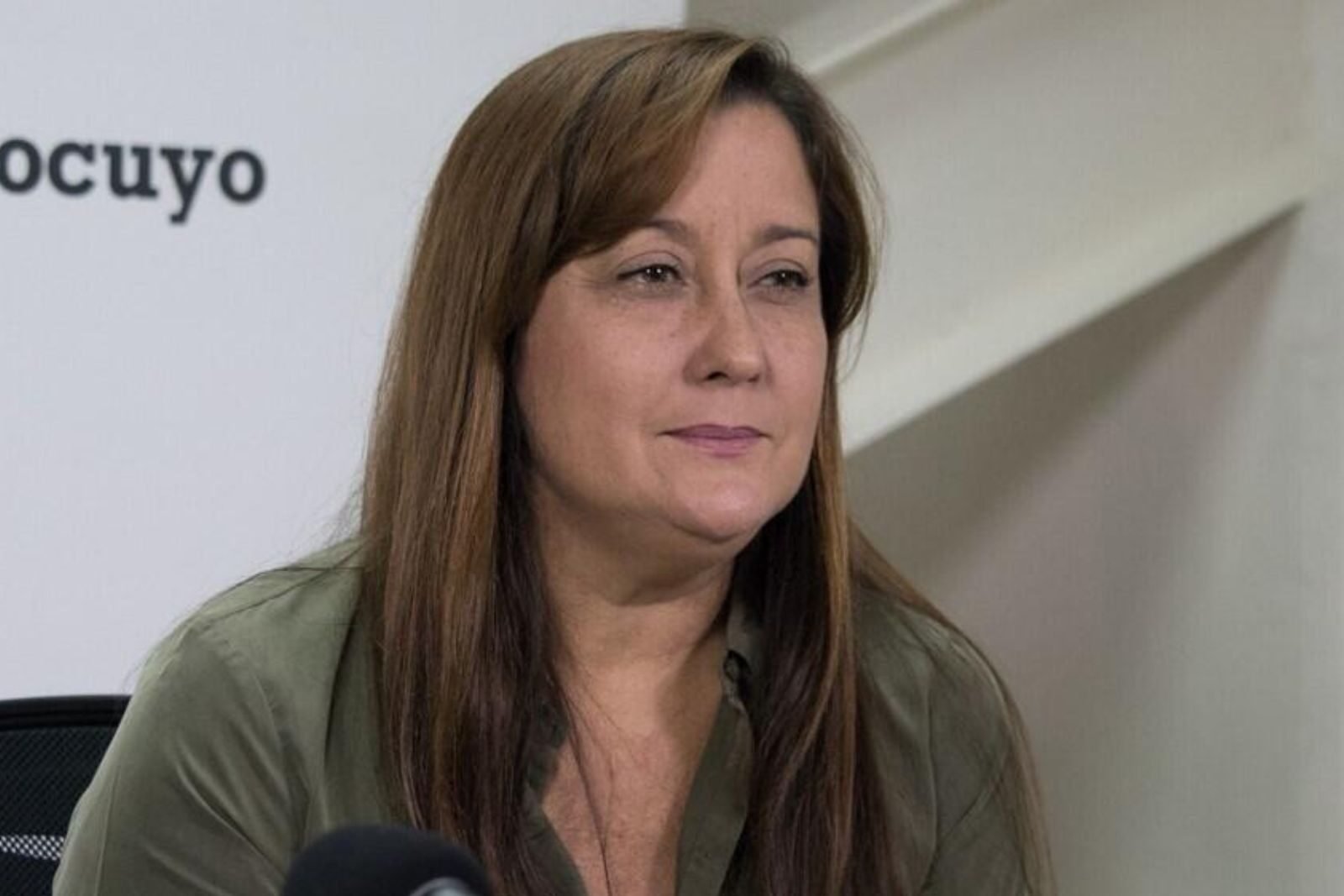
The designation of Oliver Blanco as Venezuela’s foreign minister has generated a signal of particular relevance for the country’s new political scenario. Especially after the public endorsement of Rocío San Miguel, a lawyer and human rights defender who was a political prisoner during Nicolás Maduro’s government. Her message, beyond constituting a personal congratulation, raises important elements for understanding the challenges of national reconciliation and the reconstruction of democratic coexistence.
“Dear @OliverBlanco, I congratulate you on your appointment as foreign minister of Venezuela. I wish you wisdom and temperance in a responsibility that demands representing all Venezuelans, without distinction, and contributing from foreign policy to security, human rights and democratic dialogue. A hug, friend,” San Miguel expressed in her message addressed to the new head of Venezuelan diplomacy.
San Miguel’s words acquire relevance because of her trajectory and the political context in which this exchange takes place. Her reference to the need to represent all Venezuelans, without distinction, introduces one of the fundamental principles for any reconciliation process and is the recognition that the State must act in the name of society as a whole, regardless of political, ideological or any other differences.
The gesture is also significant because of Blanco’s trajectory, linked in the past to sectors of the opposition and his incorporation to the head of Venezuelan foreign policy. In a country marked by years of confrontation, distrust and political exclusion, recognition between figures with different experiences can contribute to creating conditions for broader dialogue, although by itself it does not guarantee structural changes.
Another central element of the message is the association it establishes between foreign policy, security, human rights and democratic dialogue. The reference points to a conception of diplomacy that transcends the formal representation of the State and places the protection of people, stability and the search for understandings between political actors among its priorities. For Venezuela, this poses an especially relevant challenge: that of recovering international trust while advancing in the construction of guarantees within the country.
The Venezuelan experience shows that overcoming polarization requires more than individual gestures, for it demands institutions capable of guaranteeing rights, effective spaces for political participation and conditions that allow differences to be processed without persecution or exclusion. Democratic dialogue can only be consolidated when it is accompanied by verifiable guarantees and a real commitment to the rule of law.
In this context, San Miguel’s message can be interpreted as a favorable signal for the possibility of building bridges in a deeply divided society. Her congratulation to Blanco does not necessarily imply general support for the Government or for all its decisions, but it does highlight the importance of distinguishing between political differences and the need to find points of agreement around shared objectives.
The new Venezuelan stage will be marked, to a large extent, by the capacity to convert these signals into concrete deeds. The representation of all citizens, the defense of human rights and the opening of channels of dialogue will be some of the criteria by which the willingness to advance toward democratic coexistence can be evaluated. In that sense, the exchange between San Miguel and Blanco offers an opportunity to reflect on a fundamental question: reconciliation does not require that Venezuelans think alike, but that they can recognize each other as part of the same society and count on guarantees to coexist in their differences.