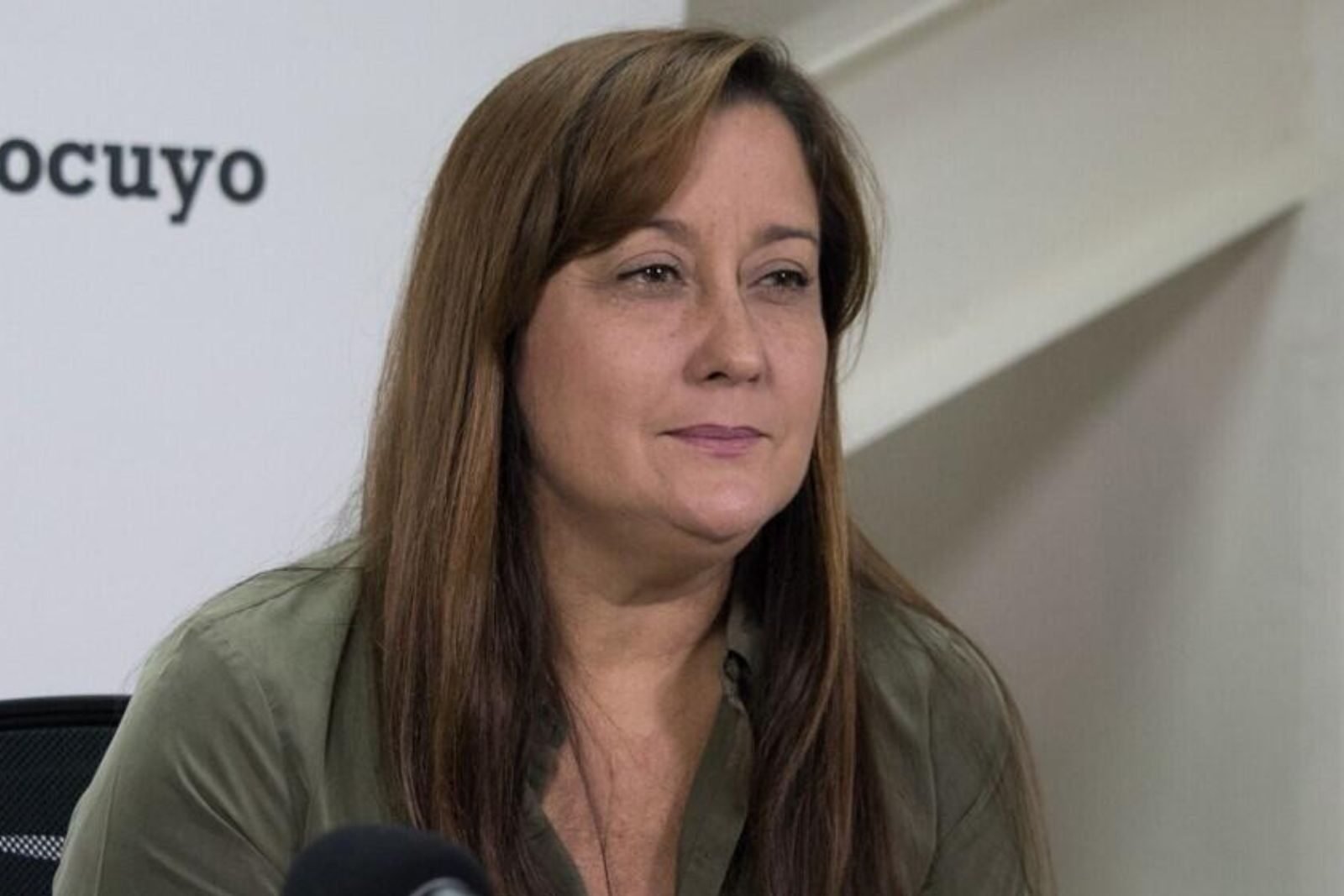
The director of the NGO Control Ciudadano was arrested in February 2024 at Maiquetía airport under accusations linked to the case known as “White Bracelet.” | Photograph: Social Media.
Guacamaya, October 2, 2026. The 3rd Trial Court of First Instance with competence in Terrorism issued an acquittal in favor of lawyer and activist Rocío San Miguel, declaring her free of all criminal responsibility in relation to the “White Bracelet” case. However, the same court issued convictions against ten defendants after finding their participation in the events proven.
San Miguel’s acquittal constitutes a judicial and institutional milestone that closes one of the many denounced episodes of criminalization against human rights defenders in Venezuela. The measure, agreed on the night of October 1 following a formal request from the Public Ministry itself, puts an end to more than two years of questioned judicial action and restriction of freedoms.
Regarding the ten individuals who were convicted, details revealed by the Public Ministry and by non-governmental organizations defending human rights established sentences ranging from 3 to 18 years in prison. According to Attorney General Larry Devoe, the responsibility of these ten citizens was formally proven during the oral and public trial debate.
An Activist Two Decades Under the Watchful Eye of Power
At 60 years of age, a lawyer by profession and a specialist in security, national defense, and military affairs, Rocío del Carmen San Miguel Sosa consolidated herself over two decades as one of the country’s independent voices with the greatest technical authority. Her career, marked by analytical rigor and institutional vocation, made her a recurring target of state harassment.
In 2004, San Miguel was dismissed from the government’s National Borders Council after signing the petition for the recall referendum against then-President Hugo Chávez, which led her to be included in the so-called “Tascón List.” In early 2005, she founded the NGO Control Ciudadano, from which she exercised systematic social oversight over the Bolivarian National Armed Forces (FANB).
Due to the prolonged harassment and threats she suffered for her advocacy work, the Inter-American Commission on Human Rights (IACHR) granted her precautionary protection measures in January 2012.
Detention in Maiquetía and the White Bracelet Case
The persecution escalated dramatically on February 9, 2024, when security agents apprehended her at Maiquetía International Airport while she was preparing to board a flight with her daughter. During the following 48 hours, they concealed her whereabouts, a pattern of temporary enforced disappearance denounced by more than 600 civil organizations and international human rights bodies.
The crackdown included the detention of her immediate family circle: her daughter Miranda, her brothers Miguel Ángel and Alberto, her father Víctor Díaz Paruta, and her ex-husband, retired Colonel Alejandro José González Canales. Although her relatives received substitute precautionary measures with a prohibition on declaring to the press and periodic court appearances, San Miguel and González Canales remained deprived of liberty.
Then-Attorney General Tarek William Saab publicly linked the activist to the so-called “White Bracelet” Operation—an alleged conspiracy network against Nicolás Maduro and military authorities in Táchira. In televised appearances, the Prosecutor’s Office formally accused her of the crimes of treason, conspiracy, terrorism, and criminal association, baselessly labeling her a “spy.”
As supposed “forensic evidence,” intelligence agents seized from her residence iPads and 18 old cartographic maps of Venezuelan security zones, maps that San Miguel legitimately used to teach at higher military studies institutes.
Defenselessness, Imprisonment in El Helicoide, and the International Reaction
Rocío San Miguel was held at the headquarters of the Bolivarian National Intelligence Service (SEBIN) in El Helicoide, described by the UN Fact-Finding Mission as a systematic torture center. Alejandro González, for his part, was transferred to the headquarters of the General Directorate of Military Counterintelligence in Boleíta.
For months, the violation of her right to due process and legitimate technical defense was continuously denounced. The 2nd Control Court in Terrorism imposed public defenders on her and systematically blocked transfers to courts to swear in her private attorneys of trust, Joel García and Juan González Taguaruco.
Internationally, the Office of the United Nations High Commissioner for Human Rights (OHCHR), the Fact-Finding Mission, the European Union, the European Parliament, and the OAS demanded her immediate release. The firmness of the OHCHR’s denunciations even led the Venezuelan government to expel its officials from the country in February 2024.
Release, Exile in Spain, and the Return to Venezuela
The political scenario took a decisive turn after the capture of Nicolás Maduro in a U.S. military operation and the subsequent start of a release process led by acting President Delcy Rodríguez. On January 8, 2026, after 700 days of imprisonment, Rocío San Miguel was released under substitute precautionary measures and transferred directly on a flight to Spain.
On the flight were other European citizens, in a process facilitated by diplomatic efforts of former Spanish President José Luis Rodríguez Zapatero. Despite being safe in Madrid, San Miguel made the determination not to remain in exile. Protected by the guarantees of the Amnesty Law, she voluntarily returned to Venezuela on May 27, 2026.
Her objective was categorical: to reunite with her family, rebuild her case file, and push the oral trial forward until achieving the definitive closure of the process and her total acquittal in the courts.
The Court’s Ruling: Withdrawal of Charges and Full Acquittal
The definitive outcome materialized this Thursday, October 1, 2026. During the debate phase of the oral and public trial, the Public Ministry—now under Attorney General Larry Devoe—formally requested the acquittal after concluding, following an objective analysis of the evidence, that there was no element whatsoever incriminating the activist.
At 11:26 p.m. on Thursday, October 1, Rocío San Miguel took a public position through her account on the social network X, confirming the definitive closure of her judicial persecution: “This decision ratifies what I maintained from the first day of my detention, on February 9, 2024: I am innocent. During this time, my capacity for resistance and the true weight of my principles were put to the test.”
In her message, the president of Control Ciudadano expressed her deep gratitude to her legal team, to human rights NGOs (such as Amnesty International, Front Line Defenders, and Human Rights Foundation), to diplomatic missions, and to former President Rodríguez Zapatero for the support provided.
She also declined to consider the cause for human rights in Venezuela concluded while arbitrariness persists against other citizens. “My solidarity is with all citizens, activists, and political prisoners who continue facing criminal proceedings (…). As for the convictions issued in this case against other defendants, I hope they will be annulled for being profoundly unjust,” she said.
The 10 Convicted and the Sentences Imposed
While Rocío San Miguel, Alejandro González Canales, Luis Camacaro, and Guillermo López received full acquittal, the court issued convictions against ten defendants. According to records gathered by organizations such as Foro Penal, the sentences are distributed as follows:
For the crime of conspiracy:
- Ángelo Julio Heredia González: Former military officer/former captain whose initial detention in 2023 was used by the Prosecutor’s Office as the origin of the case’s accusations. He was sentenced to 18 years in prison. He remains held at El Rodeo I prison center.
- Guillermo Enrique César Siero: Military officer, originally indicated in the prosecutorial file for allegedly possessing the operation order of the plot. He was sentenced to 12 years in prison.
- Ronald Ferrer: Sentenced to 12 years in prison.
For the crime of concealment (3-year prison sentence):
- Karen Gomez (First Lieutenant)
- Carlos Sánchez (Army Colonel, released last June 9)
- Guillermo Henry César (Sergeant Major, released last June 9)
- Diana Suárez
- Jesús Suárez (who received a substitute precautionary measure of liberty)
- Diana Victoria Justo (Army Major)
- Tomás Martínez Chico Macías (Army Captain)
Shadows in Justice and the Political Context
The ruling decreeing the full acquittal of Rocío San Miguel, her ex-husband Alejandro González Canales, and political leaders Luis Camacaro and Guillermo López represents an undeniable milestone on the path toward institutional reparation, but it simultaneously opens complex questions about the real scope of judicial reforms in the country.
This duality within the same case file highlights a pattern of differentiated justice, where the exoneration of figures with high international visibility coexists with the ratification of drastic convictions for other defendants in the same network.
The decision is framed within a dynamic of political change, characterized by the application of the Amnesty Law, the push for mass releases, and a formal restructuring of the Public Ministry under the leadership of Larry Devoe. Although authorities claim to have granted measures to more than a thousand people within the framework of the dialogue and flexibilization process, organizations such as Foro Penal warn that at least 328 political prisoners remain behind bars.