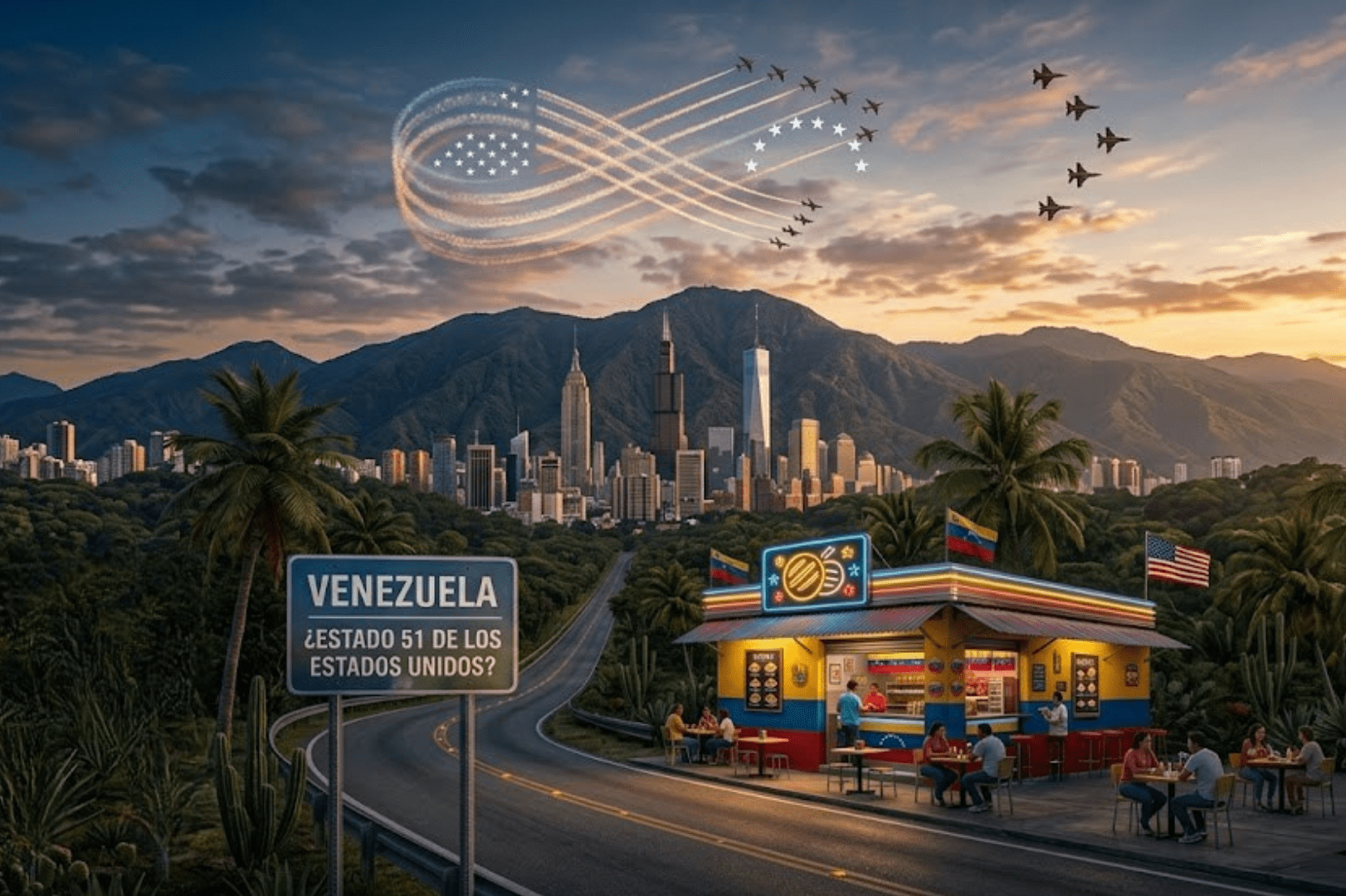
A joint post by Donald Trump and the White House elevated the comment from a rhetorical strategy to an act of official communication, redefining the debate. Image: Guacamaya.
Guacamaya, May 13, 2026. The idea that Venezuela could become the 51st state of the United States has, until now, seemed like a provocation or part of Donald Trump’s characteristic rhetorical strategy. However, the discussion about Venezuela’s future political status has gained relevance following new statements by the president and the most recent coordinated social media post between him and the White House.
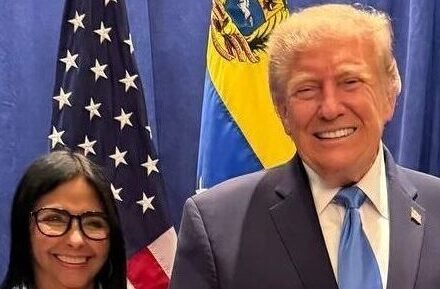
In a joint message on X, an image of Venezuelan territory was presented under the flag of the United States with the label “51st State.” Prior to this, Trump had told a Fox News journalist that he was “seriously considering” the idea, basing it on the fact that “there are 40 billion dollars in oil there” and that “Venezuela loves Trump,” in the president’s own words.
This has reignited the debate about the South American country’s stability being tied to a possible integration into the American Union. However, although the proposal has generated significant media coverage, it would face significant constitutional and diplomatic challenges. The question then is whether this is a real possibility or another discursive maneuver designed to project dominance.
The discussion now mixes energy, sovereignty, constitutional law, markets, and hemispheric geopolitics. Furthermore, Venezuela enters this debate amid a prolonged political crisis, a power reconfiguration following the capture of Nicolás Maduro in January 2026, and an interim administration led by Delcy Rodríguez that tries to project stability while resisting external pressure.
Meanwhile, the South American country remains a key piece on the global energy board, especially given a context of tensions in the Middle East and volatility in hydrocarbon markets. At this intersection of strategic necessity and institutional void, the idea of “statehood” finds discursive fuel, but also a legal and political wall that cannot be easily ignored.
Oil as a Magnet
President Donald Trump has based the possibility of integration on the strategic value of Venezuela’s natural resources. His interest focuses on hydrocarbon reserves, which he himself estimates at 40 billion dollars. Following the events of January 3, he declared that U.S. oil companies plan to invest 100 billion dollars to “rebuild” oil and gas infrastructure.
More recently, the Office of Foreign Assets Control (OFAC) authorized companies such as Chevron, Eni, Repsol, BP, and Shell to resume operations in Venezuela under “very strict regulatory supervision.” At the same time, it has been reported that ExxonMobil and ConocoPhillips have held confidential conversations to return to the Venezuelan market with “legal protections for their capital.”
This resource base should make the South American country a privileged player in the global market; but under conditions of institutional collapse, it becomes a space of dispute between power projects. Given the instability in the Strait of Hormuz and tensions with Iran, Venezuela’s proximity offers Washington a geographically strategic and secure energy source.
Thus, the international energy dispute has returned strategic value to the Western Hemisphere. In this context, Venezuela appears not only as a potential supplier but as a geopolitical asset close to the U.S. coast, something of interest to any administration in Washington. Oil, therefore, not only drives the economy but also organizes narratives of sovereignty.
The Barriers to Statehood
At the constitutional level, statehood is neither a shortcut nor a unilateral decision. The United States cannot turn a foreign country into a state by mere presidential will. Article IV, Section 3 of the U.S. Constitution prohibits creating new states from the territory of an existing state without the consent of that state’s legislature and Congress.
If applied to Venezuela, it would require, at a minimum, local legislation and, in practice, a much broader political and legal agreement. Specifically, Venezuela would not only have to consent to any status change, but the U.S. political system would also have to assume the internal costs of incorporating a new territory, with the electoral, cultural, and fiscal implications that entails.
As temporal precedents, one can consider the most recent annexations. Alaska, the 49th state, was admitted in 1959, 92 years after its purchase from Russia in 1867. Hawaii, the 50th state, added as a territory in 1898, was admitted as a state in 1959, 61 years later. Thus, waiting for such a “solution” would mean sacrificing the country to more years of institutional uncertainty.
In this sense, a good part of public opinion has insisted that Trump’s comment functions more as a political thermometer or media spectacle than as an executable program. Statehood, in this case, functions almost as an excessive metaphor, revealing more a way of saying that Washington wants, or in some way exercises, more control, more access, and more influence over Venezuela.
The Position from Venezuela
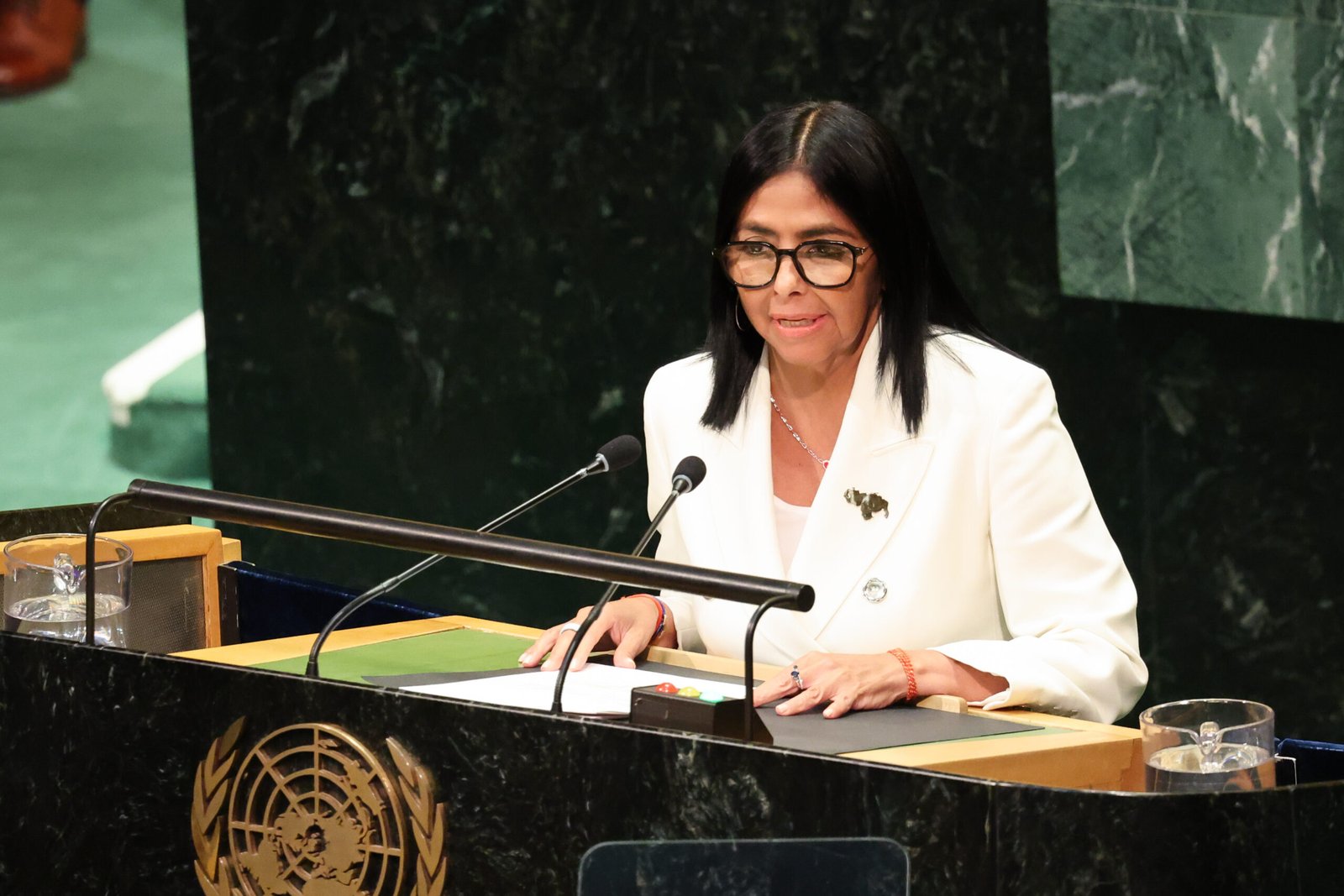
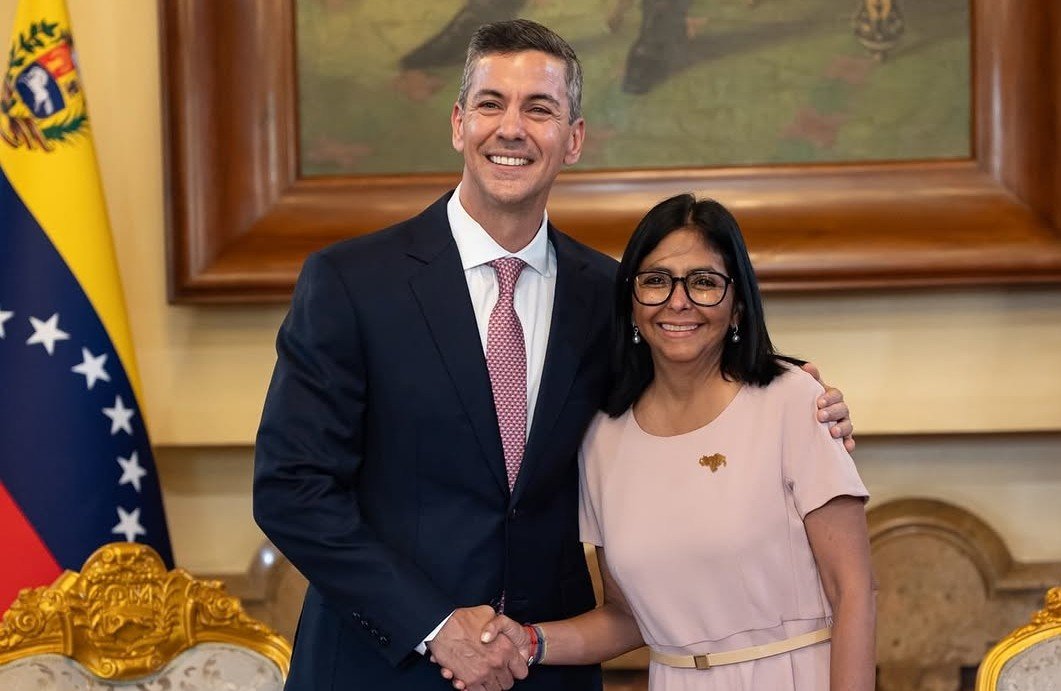
“That is not planned, it would never be planned, because if there is one thing we Venezuelans have, it is that we love our independence process,” declared the acting president of Venezuela, Delcy Rodríguez. The statement was made in The Hague, precisely within the framework of oral hearings at the International Court of Justice over the sovereignty dispute concerning the Esequibo territory.
The reaction, although direct, has been restrained. That tone contrasts with the usual style of the hardest-line Chavismo, which has historically responded to U.S. pressure with combative rhetoric, accusations of aggression, diplomatic communiqués, and symbolic mobilization. It seems they chose not to unnecessarily escalate a declaration that, for now, has no immediate legal viability.
Likewise, Delcy Rodríguez did not raise her tone because she is currently prioritizing a stage of cooperation, negotiation, and de-escalation with Washington. In fact, during her intervention, she highlighted the role of diplomatic cooperation as the main path for bilateral understanding. “We have been working on a diplomatic cooperation agenda. That is the course and that is the path,” she stated.
In that framework, a harsh response to Trump’s phrase would have been inconsistent with the line she herself has been building following the new political moment. Thus, the moderate tone reads as a calculation. If the interim government is trying to maintain channels with Washington, any verbal escalation could complicate the energy and diplomatic negotiation terrain.
The Venezuelan opposition, for its part, has not issued a clear or unified reaction. Its individual leaders have not echoed the matter either. That silence does not necessarily mean indifference; it may reflect the same political calculation, or prudence, or fear of being caught between the officialist narrative and an idea that, while seductive to some, is alarming to others.
In fact, María Corina Machado was consulted in an interview with El País, specifically about Trump’s idea of annexation, and yet she avoided speaking directly on the issue. Instead, she preferred to emphasize the need for international support to ensure an electoral transition. That nuance reinforces the desire to maintain channels with Washington, without validating extreme proposals.
Specifically, the authorities in Venezuela no longer respond with automatic stridency, while the opposition has not wanted to enter a field where any phrase would be used against them. In this way, they seem to have internalized that feeding that narrative and debate too much could grant it a political dimension it does not yet have.
What Do People in Both Countries Think?
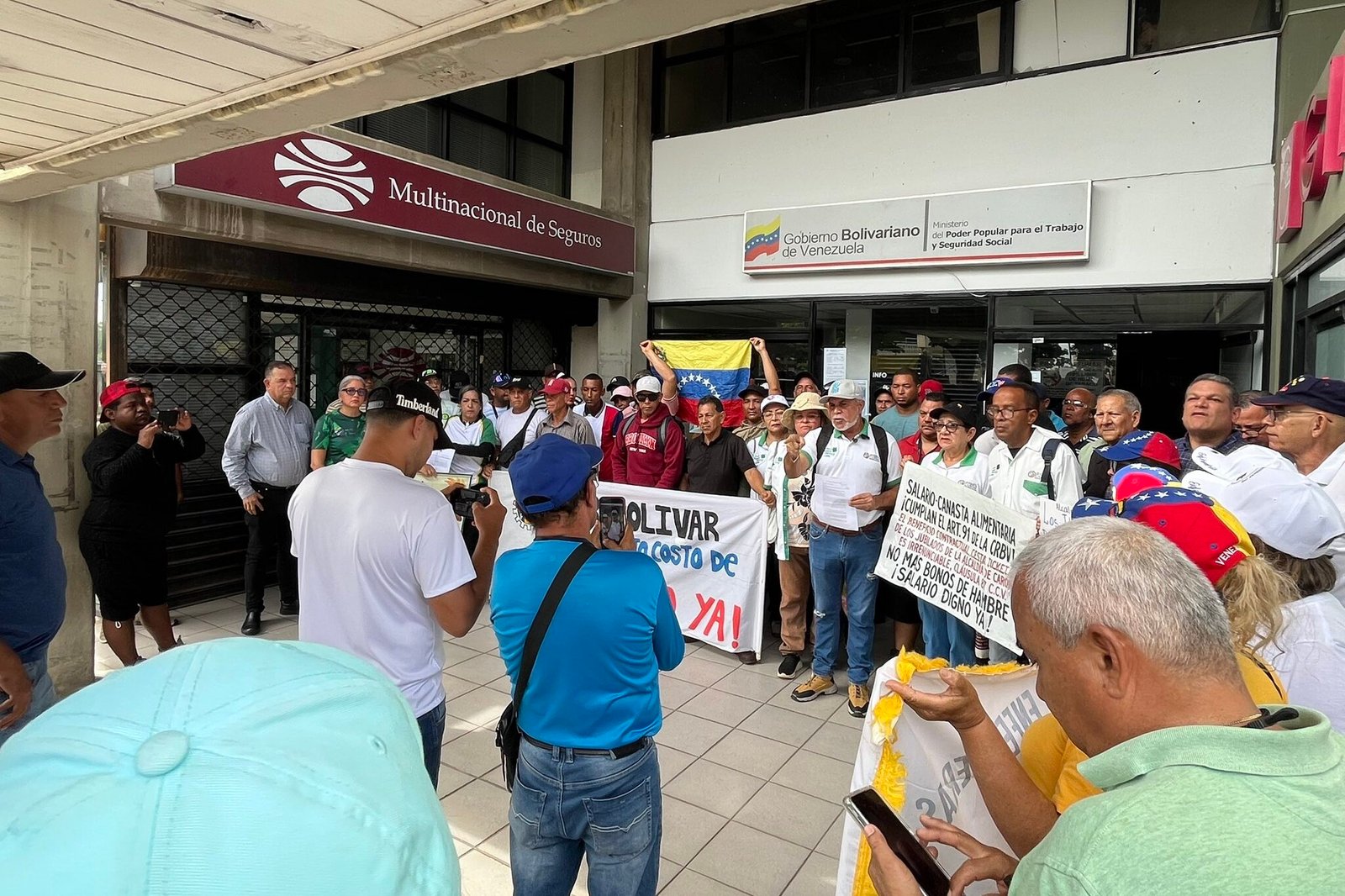
In Venezuela, although there have been no recent polls on the matter, public opinion on social media has been especially intense as it mixes irony, calculation, and propaganda. Some voices argue that annexation, besides violating sovereignty, is impossible without an extensive legal and judicial sequence; while other voices present it as a “realistic” way out of “institutional collapse.”
The mere discussion reflects something deeper: the Venezuelan crisis has generated a social disposition to imagine solutions outside the usual repertoire. When a part of the country no longer believes in competitive elections, reliable institutions, or effective pacts, any extreme option begins to circulate as a conversational possibility, because the local horizon is perceived as blocked.
There are even citizen platforms like 51state.online that propose statehood as “a democratic exit based on historical precedents.” This position is also nourished by a certain recognition of Donald Trump’s figure among Venezuelans, who, according to polls by AtlasIntel and Bloomberg, maintain, although with slight declines, a positive image of around 50%.
However, this approach has a basic problem: it confuses political desire with constitutional architecture. It also omits that statehood is not a magic solution to Venezuela’s crisis, but a radical transformation of sovereignty, citizenship, and the system of representation. Hence, many voices see these initiatives as insufficient to address the current political reality.
Meanwhile, in the United States, although there are also no polls available on the specific issue, there have been previous signs of disapproval of an intervention or occupation. Following the events of January 3, an ABC7 report summarizes that nearly half of Americans oppose the U.S. taking control of Venezuela, and 90% believe that Venezuelans themselves should decide the country’s future.
Similarly, a Reuters/Ipsos study indicates that 72% fear a long conflict with Venezuela, and The Washington Post reports that 63% question the legality of actions without Congressional approval. Although public opinion may be divided according to partisan affiliation, the support of certain sectors for pressure against Venezuela does not necessarily translate into support for a formal annexation.
However, prediction markets reacted to Trump’s rhetoric. On Polymarket, the probability of Venezuelan annexation has recently risen from 4% to 6%. Meanwhile, the Kalshi platform places Venezuela at the top of the candidates with 6.5%, surpassing Puerto Rico (5.7%) and Canada (2.7%). Despite the speculation, 93-94% of bets are leaning towards “No,” reflecting skepticism given the complex constitutional, legal, and political requirements.
Functional Integration Rather Than Annexation
Given the development discussed, the most reasonable scenario, beyond a formal annexation, is that of deeper functional integration. This situation would imply greater energy, financial, technological, and logistical interdependence between the two countries, with a progressive erosion of economic borders, though not of legal borders.
Certainly, the dependency relationship would be highly asymmetric, but it would not alter the constitutional map, nor would it generate major internal political and legal costs for either party. The true dispute, beyond the territorial scope, is over who decides the destination of revenue, infrastructure, and market access regarding strategic sectors.
Specifically, the “51st state” proposal faces the resistance of the interim administration, as well as the constitutional barrier that grants exclusive power to the U.S. Congress and all the political, fiscal, and cultural implications that entails. Nevertheless, the discussion highlights two key contexts: the institutional erosion after years of crisis in Venezuela and the reconfiguration of energy power in the hemisphere.