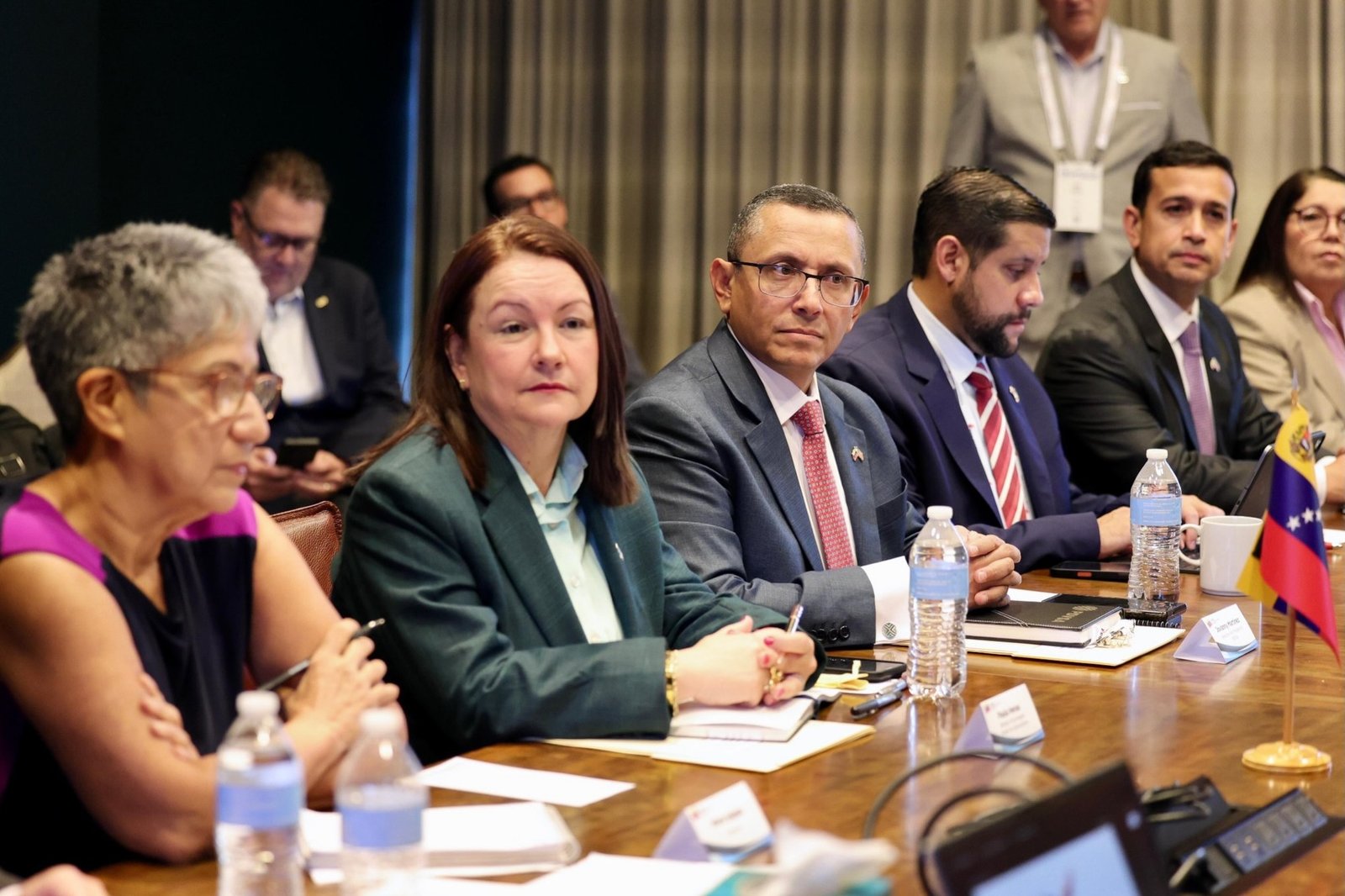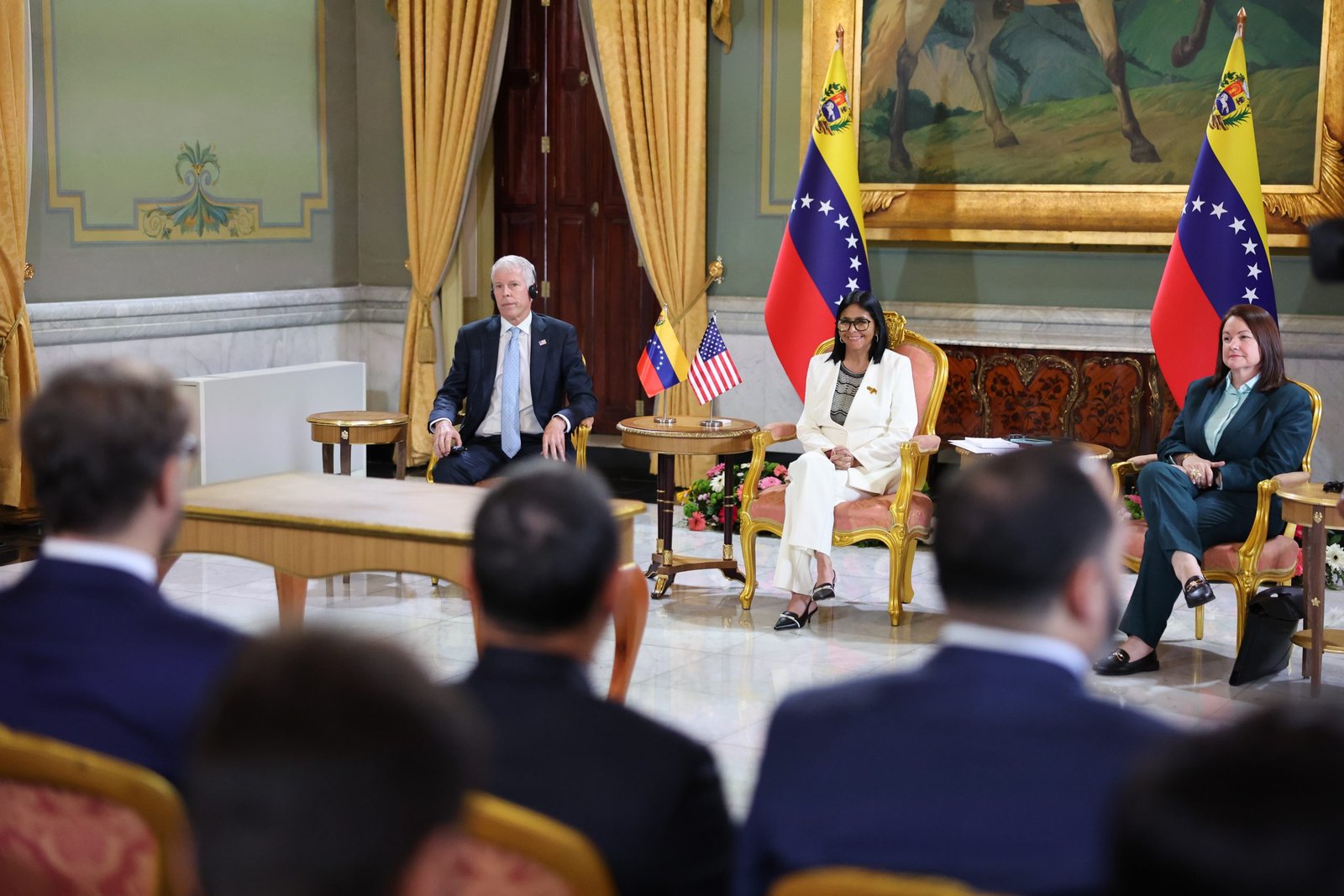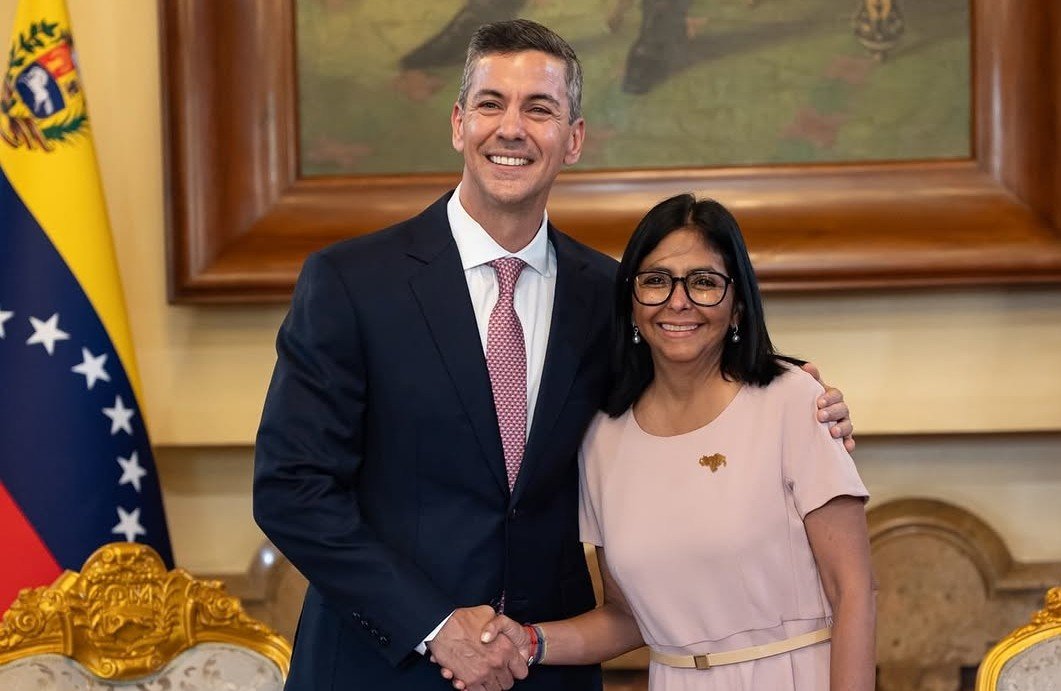
Santiago Peña, President of Paraguay, meets with Delcy Rodríguez, Acting President of Venezuela, at the Miraflores Palace, marking the restoration of relations between the two countries. Photo: @santipenapy on Instagram.
Guacamaya, September 20, 2026. Santiago Peña traveled to Venezuela ahead of the United Nations General Assembly, marking Paraguay’s first formal engagement with the Miraflores Palace since Delcy Rodríguez took power following the capture of Nicolás Maduro. The trip closes — at least for now — a twenty-month cycle of diplomatic rupture and reopens a bilateral file that combines political recognition, an oil debt dispute being litigated in Paris, and nearly a decade of swings depending on who is in power in each capital.
Relations between Paraguay and Venezuela have for more than a decade functioned as an almost exact barometer of Paraguay’s domestic politics. Every change of government in Asunción — and every election, whether contested or otherwise, in Caracas — has produced a marked shift between recognition, rupture, reconciliation, and rupture once again.
The precedent most frequently cited by Chavismo dates back to January 2019, when then-Paraguayan President Mario Abdo Benítez severed diplomatic relations with Venezuela following Maduro’s second inauguration, which Asunción described as “illegitimate.” Paraguay then became one of the Lima Group countries to recognize Juan Guaidó as interim president; weeks later, Abdo Benítez received him in Asunción. The rupture remained in place throughout Abdo Benítez’s presidency (2018–2023).
With Santiago Peña’s arrival in office, Paraguay restored relations with Caracas in November 2023. The reconciliation lasted little more than a year. On January 5, 2025, following a video call between Peña, Edmundo González Urrutia, and María Corina Machado, during which the Paraguayan president recognized González as the “winner of the Venezuelan presidential elections” held in July 2024, Maduro’s government severed relations “in the full exercise of its sovereignty” and expelled Venezuelan Ambassador Ricardo Capella, giving him 48 hours to leave the country. Caracas accused Peña of repeating “a failed practice reminiscent of the fantasies of the defunct Lima Group.” Paraguay, for its part, reaffirmed its recognition of González Urrutia as president-elect.
The oil debt
The origin of the liability dates back to a supply agreement signed in 2009, during the presidency of Fernando Lugo, and ratified by the congresses of both countries. Since then, the amount claimed has varied. In 2012, the figure stood at around $250 million; in 2016, under President Horacio Cartes, PDVSA claimed between $273 million and $287 million and threatened legal action if Petropar failed to pay by June 10 of that year. In 2019, at the time diplomatic relations were severed, Paraguay acknowledged a debt of $280 million. In 2023, under Abdo Benítez, PDVSA cited a figure exceeding $300 million. And in January 2025, Paraguayan Attorney General Marco Aurelio González publicly acknowledged that the debt “exists,” placing it at least at $300 million, compared with the more than $400 million claimed by Venezuelan minister Diosdado Cabello.
The discrepancy between the figures is not a reporting error. It reflects a genuine dispute over the applicable interest rate and the point at which default interest begins to accrue — a dispute that, when proceedings are not suspended because of the diplomatic rupture, is being handled by an arbitration tribunal based in Paris.
Paraguay has never denied the debt itself. Even in the 2019 statement announcing the diplomatic rupture, the Paraguayan government clarified that it “does not deny the debt incurred with PDVSA” and that it would be “honored by the Paraguayan State in due form and at the appropriate time” once the dispute was resolved. What has been contested at different points is whether Venezuela can apply a default interest rate higher than the one originally agreed upon, and whether a second agreement — which Petropar maintains is not binding on it — changes those terms.
On Thursday of this week, Paraguay’s foreign minister acknowledged the existence of the debt shortly before Santiago Peña’s trip to Caracas.
Over the past decade, Paraguay has been one of the Latin American governments most consistent in applying diplomatic pressure against Chavismo, although with differences depending on the political orientation of the government in office. Abdo Benítez publicly condemned the political disqualification of María Corina Machado in 2023, describing it as a violation that “clearly and scandalously clashes with the clear language of human rights.” Peña, in 2025, invoked the Barbados Agreement — the pact between the opposition and Chavismo intended to guarantee free elections — to justify his support for González Urrutia, arguing that the regime had never complied with its terms and that Paraguay had denounced the banning of opposition candidates since January 2024.
It is also worth recalling that Paraguayan President Santiago Peña traveled to Oslo in December 2025 to attend the ceremony for the 2025 Nobel Peace Prize awarded to Venezuelan opposition leader María Corina Machado.
The january 3 turning point
That cycle of diplomatic pressure, however, was overshadowed by an event that no Latin American foreign ministry had anticipated in those terms. In the early hours of Saturday, January 3, 2026, U.S. military forces carried out Operation Absolute Resolve, an attack that, according to Washington, neutralized Venezuela’s air defenses and culminated in the capture of Nicolás Maduro and his wife, Cilia Flores, at their residence in Caracas. Both were transferred to the USS Iwo Jima, with a stop at the Guantánamo naval base, before being handed over to U.S. federal authorities in New York, where Maduro faces charges.
Delcy Rodríguez, then vice president, assumed power on January 3 and formally took office as acting president on January 5, 2026.
The first Latin American head of state to travel to Caracas following the change in power was then-Colombian President Gustavo Petro, in April 2026. Santiago Peña’s visit, authorized by the Paraguayan Senate on Wednesday, September 16, would be the second such visit and the first by a government that, until just eight months ago, had maintained diplomatic relations with Caracas severed because of its refusal to recognize Chavismo as a legitimate interlocutor.
What is now on the table
The Paraguayan Presidency announced Saturday afternoon, Venezuela time, that Peña had arrived and had been received by Venezuelan Foreign Minister Félix Plasencia. He subsequently met with acting President Delcy Rodríguez at the Miraflores Palace. All of this took place ahead of his participation in the general debate of the United Nations General Assembly, scheduled for September 19–29.
According to EFE and Paraguayan and Venezuelan media outlets that reproduced its report, the meeting addressed “pending bilateral issues,” including Petropar’s debt to PDVSA, which once again stands at close to $300 million according to the latest figure cited by the Paraguayan press.
Another element connects this rapprochement to the region’s migration crisis. On January 9, 2026, Paraguay’s Foreign Ministry announced that all Venezuelan nationals seeking to enter its territory would be subject to “prior verification” of their documents and criminal records, tightening a regime that had allowed visa-free entry since 1996 for stays of up to 60 days. The measure, adopted just days after Maduro’s fall, suggests that Asunción anticipated — or fears — a new wave of Venezuelan migration stemming from the political uncertainty that followed January 3.
It remains to be seen whether Peña’s trip will lead to the formal restoration of full diplomatic relations, including the reopening of embassies, or whether it will remain, for now, an exploratory meeting with Delcy Rodríguez, whose own status as “acting” or “de facto” head of state still lacks a clear constitutional definition nearly nine months after Maduro’s departure.
Santiago Peña’s visit could mark a turning point in Venezuela’s reintegration into the region and in the restoration of relations that had been frozen in recent years, particularly following the rise of right-wing governments. With the backing of the United States, a path may now be opening toward the reconstruction of Caracas’s regional ties, which had become more difficult to restore than its relations with European countries, for example.