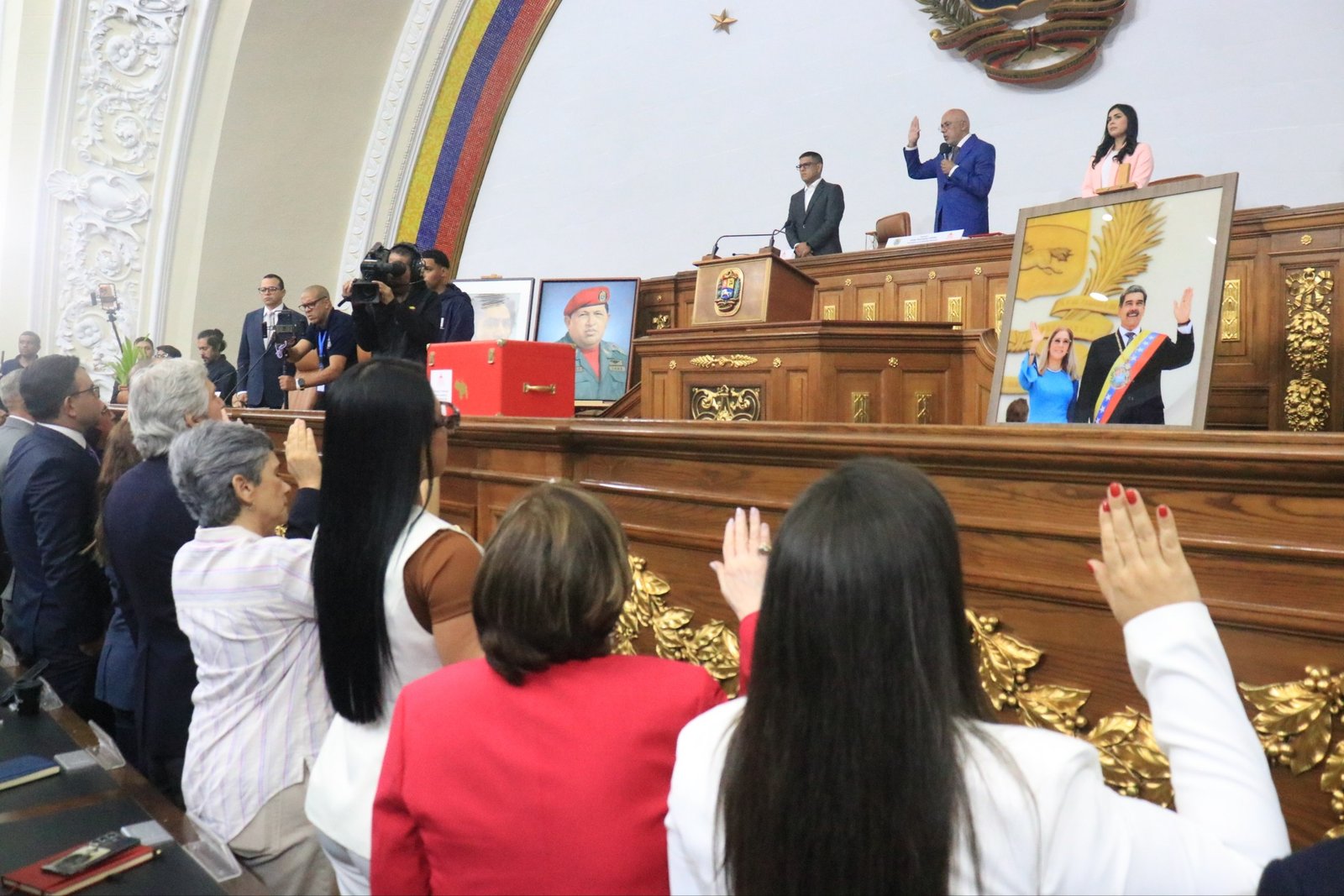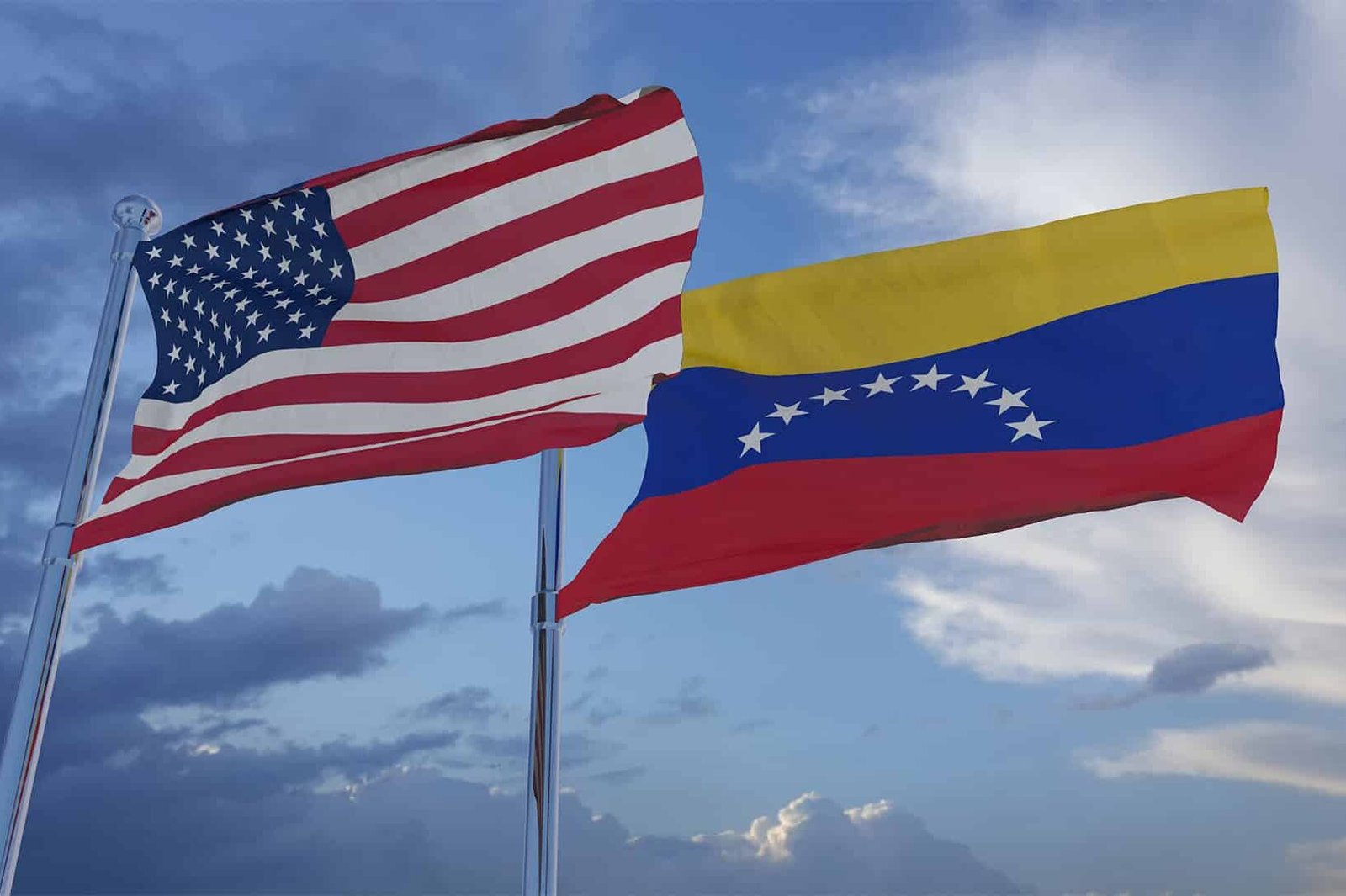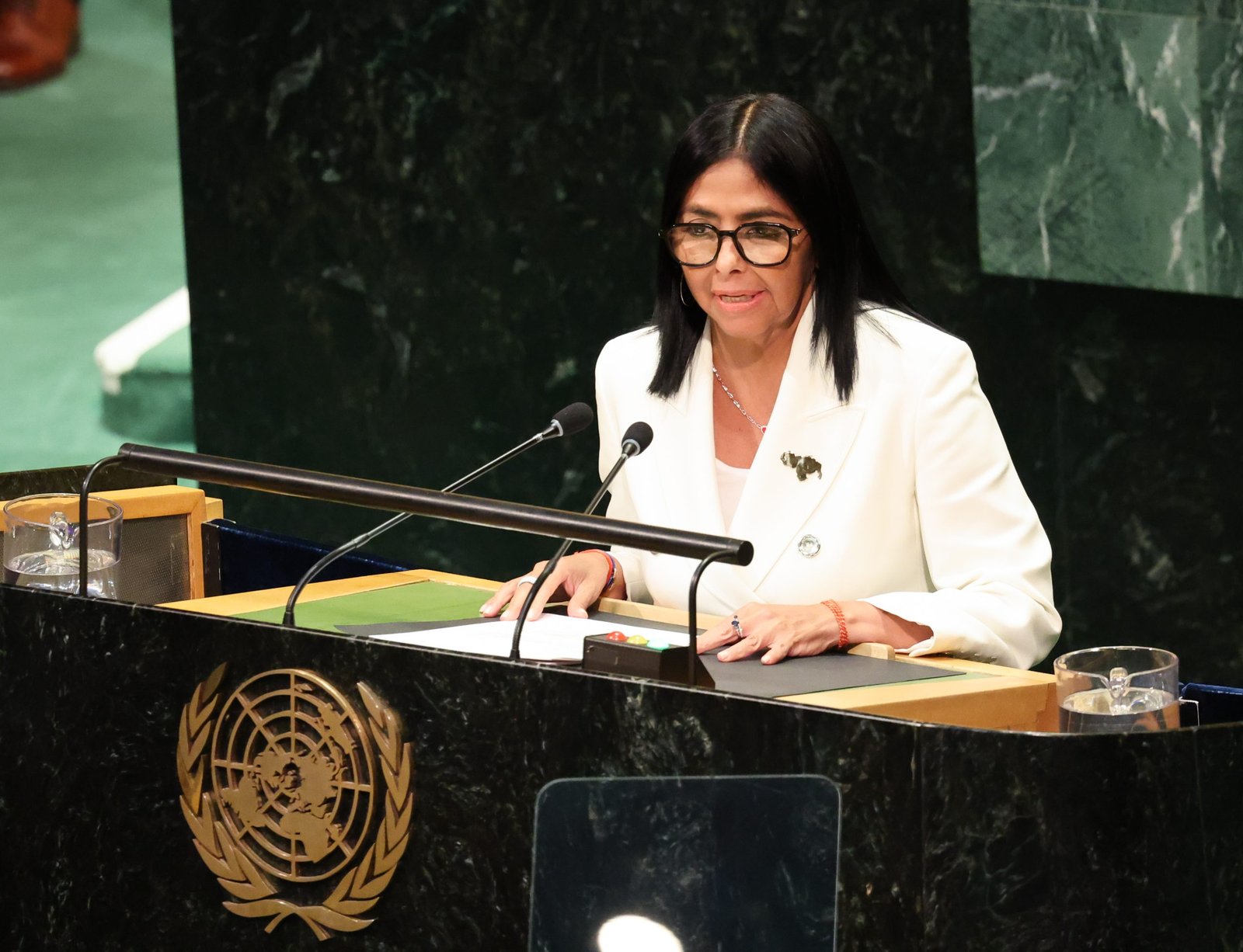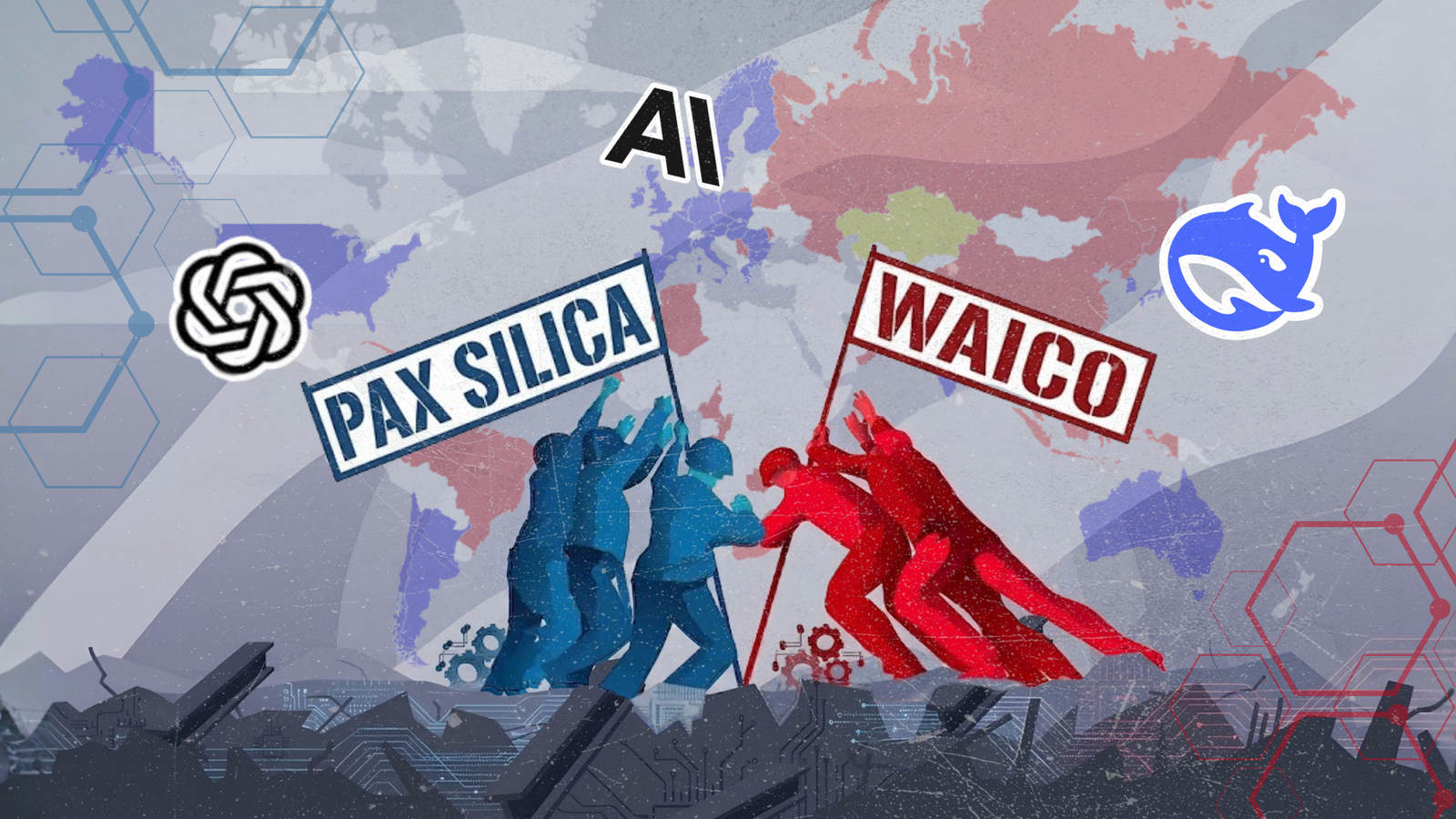
Venezuela signed on as a founding member of WAICO, the artificial intelligence alliance spearheaded by China. Image: Guacamaya.
Guacamaya, September 8, 2026. Venezuela signed on as a founding member of the AI organization spearheaded by Xi Jinping, right as Washington begins demanding exclusive loyalty from its tech partners. The decision, made in the midst of the post-January 3rd political reconfiguration, opens a fracture that no official statement has wanted to name.
On July 16, in Shanghai, 29 countries signed the founding charter of the World AI Cooperation Organization (WAICO), the intergovernmental body China had been incubating since Premier Li Qiang proposed it in July 2025 and which Xi Jinping reiterated months later at the APEC forum. Venezuela was among the founding signatories, represented by the Sectoral Vice President of Science, Technology, Ecosocialism, and Health, Isabel Iturria, within the framework of the eighth edition of the World Artificial Intelligence Conference (WAIC).
Joining Caracas as signatories were Russia, Belarus, Serbia, Cuba, Brazil, Kazakhstan, Pakistan, Indonesia, Laos, and about twenty other African and Asian nations; Iran would join two weeks later. UN Secretary-General António Guterres witnessed the ceremony, and Foreign Minister Wang Yi signed on behalf of Beijing.
Official Venezuelan coverage of the event—issued by the Ministry of Science and Technology and state media—framed participation almost exclusively around the use of AI for seismic risk management, in reference to the dual earthquake on June 24, and around the rhetoric of “equitable access” and “inclusion of the Global South” that China has deliberately cultivated to position WAICO as an alternative to Western tech governance.
What did not appear with the same prominence in that coverage was the hard-to-dispute fact that the signing places Venezuela inside an AI governance block explicitly constructed by Beijing as a counterweight to Washington—at a moment when Venezuela’s own political reconfiguration is taking place under active U.S. diplomatic influence and accompaniment.
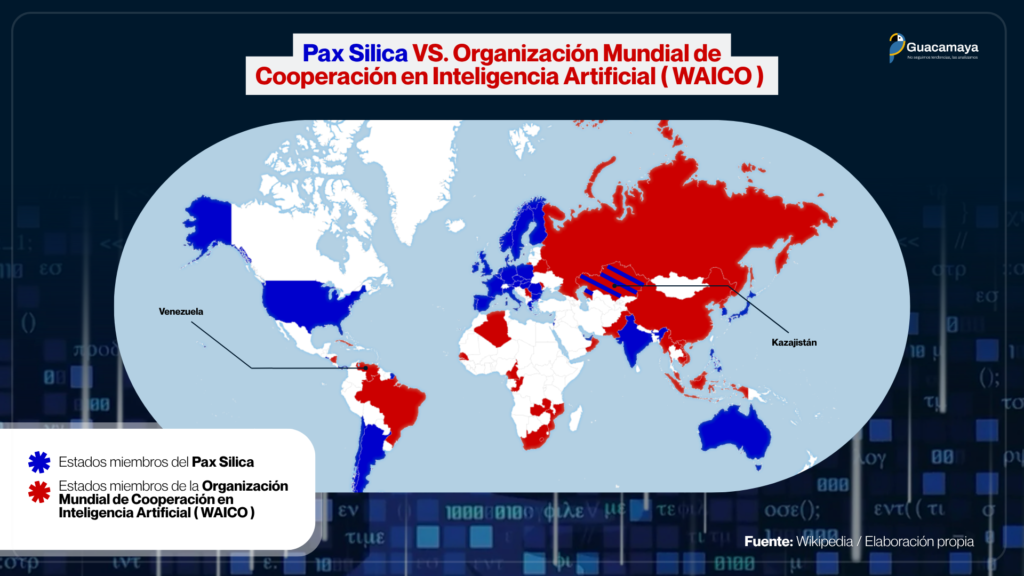
Two Architectures, One Single Dispute
To understand the weight of that signature, it must be placed within a broader institutional competition that has crystallized over the last eight months.
On one hand, we have WAICO, which presents itself as an independent international organization outside the United Nations system—though rhetorically aligned with its Charter—oriented toward the Global South and with permanent headquarters in Shanghai. China has built its appeal on three pillars: the promotion of open-source AI models—whose use among companies has jumped from less than 10% of processed tokens in mid-2025 to nearly 40% a year later—financing, and technical training. Xi Jinping promised five thousand training opportunities for developing nations in a speech denouncing the concentration of computing power in a handful of American companies.
On the other hand, we have the Pax Silica initiative on the U.S. side. This non-binding framework was launched in December 2025 and is coordinated by Under Secretary of State Jacob Helberg. It already brings together roughly twenty-four countries—including Japan, Australia, South Korea, Israel, Singapore, and, most recently, Kazakhstan—around the coordination of “trusted” supply chains for semiconductors, AI models, critical minerals, advanced manufacturing, and associated energy and data infrastructure. Unlike WAICO, Pax Silica does not aspire to be a universal governance forum; it is, in essence, a club for strategic alignment with Washington, DC.
Tension between the two projects escalated on August 14, when Reuters disclosed a State Department draft memo aimed at the thirty-five countries that signed the U.S. “Declaration of AI Opportunities” in June. The document warns that membership in Pax Silica “is not merely an adhesion, but a commitment” that cannot coexist with participation in “duplicate initiatives whose expectations conflict” with those of Washington, DC—a veiled reference to WAICO. The case raising alarms in the U.S. is Kazakhstan—the only nation, so far, with a foot in both blocks—whose status as a strategic reserve of lithium, cobalt, and rare earths makes it the ultimate test of whether the United States can truly enforce a binary choice. The State Department declined to comment on what it called “allegedly leaked internal documents,” and the dispatch date of the letter remains undetermined.
The Venezuelan Problem: An Unambiguous Signature
Unlike Kazakhstan, Venezuela is not listed—so far as can be verified—among the signatories of Washington, DC’s AI Opportunities Declaration or among the members of Pax Silica. Strictly speaking, there is no double membership to force a resolution on. Yet that fact does not clear up the ambiguity; it merely shifts it. Venezuela signed WAICO without making any parallel gesture toward the U.S. framework, at a time when its relationship with Washington, DC—following the end of the Maduro government on January 3 and the onset of a reconfiguration process under the presidency of Delcy Rodríguez—critically depends on building trust with the United States regarding security, energy, and financial normalization.
The logic Washington, DC applies to its thirty-five signatories—”to be part of everything is to be part of nothing”—is not formally directed at Caracas, but the underlying principle translates effortlessly. Any government aspiring to the lifting of sanctions, U.S. investment in its energy sector, or cooperation on hemispheric security can hardly maintain an active role as a founding member of Beijing’s flagship tech governance platform, complete with its headquarters location. The fact that the signing occurred with virtually no critical coverage in Venezuelan public debate does not alter how it is read in Washington, DC—especially on a chessboard where Kazakhstan makes headlines for maintaining ambiguity, while Venezuela did not even need ambiguity to sign up on the opposite side of the line the United States is drawing.
The Asset Venezuela Does Possess: Critical Minerals
Where Venezuela’s position gains real weight—beyond the diplomatic symbolism of a signature in Shanghai—is in its endowment of subsoil resources that both powers need to sustain the physical infrastructure of AI. Venezuela holds the world’s largest proven oil reserves, alongside deposits of coltan, gold, bauxite, iron, and, on a smaller documented scale, lithium in the Orinoco Mining Arc.
None of these resources currently enter the “trusted” supply chains Pax Silica seeks to build. The very architecture of sanctions and export controls that has governed the bilateral relationship for over a decade has kept the country outside the critical mining investment circuits that Washington, DC has cultivated with Kazakhstan, the Democratic Republic of the Congo, or Australia. The question left open by the post-January 3 period is whether Venezuela can become a node in Western supply chains for critical minerals—and under what conditions of governance, transparency, and environmental oversight Washington, DC would demand—or whether, by institutional default, those resources will continue drifting toward Chinese and Russian circuits that already hold a established presence in the Venezuelan extractive sector.
Gloria Xiong, Assistant Professor of Political Science at Colby College, and Jessica Chen Weiss, Professor of Chinese Studies at the Johns Hopkins School of Advanced International Studies (and former senior advisor on the State Department’s Policy Planning Staff from August 2021 to July 2022), recently published an article in Foreign Affairs titled “How China Found Its Most Powerful Weapon: The Real Story of Beijing’s Rare Earth Dominance.” They establish that Beijing did not identify rare earths as a geoeconomic lever until 2010, and learned to use them precisely by observing the sanctions and export controls applied by Washington, DC.
The foundational episode was almost accidental: in 2010, after a Chinese fishing trawler collided with a Japanese Coast Guard patrol near the Diaoyu/Senkaku Islands, Japan detained the captain. China responded—according to research by geographer Julie Klinger cited in the article—not through a central directive, but because customs and port officials in a city north of Nanjing decided on their own to hold shipments, outraged by what they perceived as Japanese aggression. Beijing denied the events while they were happening; only after an investigation by Japanese customs authorities did the central government learn what was occurring in its own ports.
A RAND report cited by Chen Weiss and Xiong places China’s real objective over the subsequent decade not in weaponization, but in resilience: the fear—likely exaggerated, but real within the decision-making apparatus—that China would waste its advantage if it did not act cautiously. Academic Yang Danhui, of the Chinese Academy of Social Sciences, warned in 2015 that at the 2008 extraction rate, the Bayan Obo deposit in Baotou would be exhausted in 25 years, forcing China to import rare earths at elevated prices. That defensive—not offensive—logic explains subsequent moves illustrated in the “dual circulation” strategy of May 2020 to reduce external tech dependence, the Export Control Law of late 2020, and the creation in December 2021 of the China Rare Earth Group under direct supervision of the State Council.
What the article by Chen Weiss and Xiong describes as a conceptual framework—an action-reaction spiral with no single architect—is verified point by point in the sequence of events from 2023 to 2026, which shows how every U.S. tech containment move almost systematically preceded a Chinese response using critical minerals.
The first turn occurred fifteen years after the 2010 incident, when Washington, DC ceased being a bystander in the dispute between Beijing and Tokyo and became a direct target. It was not until the United States announced extraterritorial export controls aimed at denying China access to advanced chips and chipmaking equipment that Beijing chose, for the first time, to retaliate with critical minerals. In July 2023, following the Biden administration’s floated possibility of expanding controls to Nvidia’s A800 chips, China announced that exporters of gallium and germanium would require licenses and must declare the end use of those minerals. The U.S. Geological Survey (USGS) estimated at the time that a total ban on both minerals could reduce U.S. GDP by $3.4 billion.
Six months later, barely a week after the House Select Committee on China proposed tax incentives to rebuild domestic rare earth magnet manufacturing, Beijing responded on December 21, 2023, by banning the export of rare earth processing technology—the precise link where it concentrates the 85% global dominance documented by Chen Weiss and Xiong. A year later, China issued its first regulation explicitly targeting the United States, under which exporters had to assume that licenses for American end-users would be denied.
According to the authors, the escalation surged under the second Trump administration. Following the “Liberation Day” tariffs of April 2, 2025, Beijing responded two days later by adding seven rare earths and their permanent magnets to its dual-use control list. The Chinese export control office, staffed by barely 30 employees, received tens of thousands of license applications; rare earth magnet exports fell 74% in May compared to the previous year. Washington, DC responded by restricting jet engines and semiconductor design software, until both sides agreed to step back in June.
The peak of the spiral arrived on September 29, 2025, when the Trump administration expanded the so-called “affiliates rule”—banning any entity with 50% or more ownership by an already-sanctioned Chinese firm. Ten days later, China responded by claiming, for the first time, its own extraterritorial jurisdiction over the right to license any foreign product containing even a minimal fraction of controlled Chinese rare earths, or manufactured using Chinese processing technology. The International Energy Agency calculated that full implementation of that measure would cost non-Chinese industries $6.5 trillion. Confronted by the sheer edge of the precipice, both sides favored mutual de-escalation at the APEC Summit in Busan that same month; Beijing agreed to a one-year suspension of its most recent controls.
Taking all this tense and unstable context into account, Venezuela could prove significant in supplying the subsoil resources both powers need to sustain the physical infrastructure of AI, given that semiconductors, data centers, power grids, and chips themselves do not exist without a mineral chain that begins with mining. The Orinoco Mining Arc—112,000 km², roughly 12% of the national territory, declared a strategic development zone in 2016—concentrates most of that endowment. However, it should be noted with the same caution expressed by technical bodies themselves: a major portion of these reserves is geologically identified but neither certified nor quantified under rigorous international standards, and it coexists with irregular exploitation, illegal mining, and a lack of formal traceability.
- Coltan (columbite-tantalite): This is probably the Venezuelan mineral with the most direct link to the AI industry. Tantalum and niobium are extracted from it, serving as essential components of the electrolytic capacitors that stabilize power supply in motherboards, servers, and graphics processing units (GPUs). There is no GPU, network switch, or data center server that does without tantalum in its circuitry. The U.S. Geological Survey (USGS) classifies both tantalum and niobium among critical minerals, and Venezuelan deposits—located mainly in Bolívar state and northern Amazonas—have been cited as strategic reserves for nearly two decades without a formal certification of their volume.
- Bauxite: The raw material for aluminum, which in the AI industry is used in server rack frames, chip packaging, and thermal dissipation components. The 2018 Venezuelan mining catalog estimated 99.4 million tons of bauxite, and the ore can also contain gallium, another element the USGS includes on its critical list due to its use in high-frequency semiconductors.
- Copper: With identified deposits in Guayana, it is the least glamorous yet most indispensable metal in the entire chain. Wiring, transformers, transmission lines, and the internal power grid of any data center depend on copper in volumes that the global transition to large-scale AI has driven skyward.
- Nickel: A key input for lithium-ion battery cathodes—the technology sustaining uninterruptible power supply (UPS) systems in data centers—as well as the stainless steel used in cooling infrastructure.
- Tungsten (wolfram): Less frequently cited in Venezuelan public debate but increasingly relevant. The Guiana Shield has documented potential for wolframite, and 2026 has been a year of particular tension in this market—the concentrate price doubled between January and March due to deficits in Chinese supply—precisely because tungsten is a critical input in semiconductor manufacturing processes and precision tooling for the chip industry.
- Gold, Diamonds, and Rare Earths: Gold has niche applications in high-conductivity contacts for precision electronics; diamonds—beyond jewelry—are used in cutting and polishing tools for semiconductor fabrication. As for rare earths proper (the seventeen elements used in permanent magnets for electric motors and cooling systems), maximum caution is warranted: the USGS does not include Venezuela among countries with confirmed rare earth reserves, unlike China, the United States, Brazil, or Greenland. What exists are preliminary geological indications—lanthanides and thorium associated with the Orinoco’s “black sands”—lacking certified quantification.
Water: The Other Resource Deciding Where AI Is Trained
There is a third axis, less discussed in Venezuelan public discourse, that connects directly to AI geopolitics: water. Training and operating large-scale models depend on data centers that consume massive volumes of water for cooling—a factor that has already sparked social friction in hubs like Arizona, Chile, or Ireland, where local communities have questioned allocating scarce water resources to the tech sector. Venezuela, possessing high-volume river systems—led by the Orinoco—and a hydroelectric infrastructure historically underutilized relative to its installed capacity, theoretically holds the physical conditions to host water- and energy-intensive computing infrastructure at a relatively lower environmental cost than arid regions.
Converting that potential into real investment, however, would require three conditions that are currently unmet: regulatory and legal stability to reassure data center operators, a reliable power grid after years of underinvestment and recurring blackouts, and above all, a clear geopolitical alignment dictating who builds that infrastructure. A data center is not neutral; therefore, the nationality of its operators, the origin of its chips, and the jurisdiction under which it operates determine whether those Venezuelan water and energy resources ultimately serve the computing architecture of Pax Silica or that of WAICO. The signing on July 16 is, in that sense, a signal—still reversible, but real—about which technology block would have priority access if Venezuela decided to monetize its water potential for data centers.
Flared Gas: The Wasted Fuse the AI Industry Already Knows How to Monetize
Venezuela burns, vents, or loses to the atmosphere a volume of gas equivalent to the production of a medium-sized LNG export plant. Elsewhere in the world, that exact type of gas—the kind without a market or infrastructure to reach one—is already becoming the preferred energy source to power artificial intelligence computing centers. Venezuela, for now, is merely burning it.
Venezuela is one of the top gas-flaring countries on the planet, both in absolute terms and relative to its production. The World Bank’s Global Gas Flaring Tracker 2026 report places the country among the nine largest gas-flaring emitters globally—alongside Russia, Iran, Iraq, Mexico, Libya, Algeria, Nigeria, and the United States—a group that in 2025 accounted for 83% of all global flaring despite producing less than half the world’s oil. Global flaring reached 167 billion cubic meters that year, a waste valued by the World Bank at $54 billion.
On a national scale, Venezuelan figures are striking even within that select group. An analysis by the specialized firm Gas Energy Latin America placed Venezuelan flaring on the order of 2.2 billion cubic feet per day (Bcf/d)—a volume exceeding the production of the Freeport LNG export facility in Houston, which has a capacity of 15 million tons per year. A January 2026 Bloomberg report, citing British firm Capterio, calculated that Venezuela flares, vents, or leaks around 13 billion cubic meters of natural gas annually. This represents roughly a quarter of the country’s total gas production—the highest loss rate in the world, nearly ten times the global average—and an estimated $1.4 billion a year in lost potential revenue. Other official estimates put unused gas at roughly 2 billion cubic feet per day, concentrated mostly in the so-called mechurrios (flare stacks) of northern Monagas state, which the World Bank ranks as one of the largest single sources of natural gas flaring on Earth.
The decline is neither recent nor accidental. Between 2012 and 2022, Venezuela’s flaring intensity—cubic meters flared per barrel of crude produced—quadrupled, the largest increase among all countries studied by the World Bank, reaching the highest rate in the world by 2022.
The technical explanation is well-known: without investment to reinject gas into fields or infrastructure to process and transport it, PDVSA has systematically chosen to burn it off or let it escape. A January 2026 Bloomberg report added another layer to the problem, showing satellite imagery of methane plumes rising from abandoned platforms, rusted pipelines, and deteriorating infrastructure. This pattern of leaks—beyond intentional flaring—has begun scaring off major American oil companies from investing in the country, leaving the field to smaller, less experienced firms.
In other regions with the same problem—remote fields, stranded gas, nonexistent transport infrastructure—the artificial intelligence industry has already found an answer. The American firm Crusoe Energy, founded in 2018, built its entire business model on that premise: instead of flaring associated gas that emerges from an oil well with no commercial outlet, a mobile generator is installed directly on-site, converting that gas into electricity that feeds containers filled with GPUs for high-performance computing. The technology is called Digital Flare Mitigation (DFM) and currently reports a combustion efficiency near 99.9%—far superior to an open flare stack—achieving methane reductions of around 98% compared to conventional flaring.
Crusoe began by mining bitcoin—the perfect use case for intermittent power, because a rig can be powered up or down alongside the flow of gas—and today operates as one of the AI industry’s so-called “neoclouds.” It sold its mining business to NYDIG in 2025 to focus entirely on computing infrastructure for model training and inference, boasting over 425 modular data centers deployed across seven U.S. states and Argentina, as well as contracts tying it to OpenAI and Oracle’s Stargate project in Abilene, Texas—a 1.2-gigawatt facility. There is an almost literary coincidence in all this: the company took its name from Robinson Crusoe, the Daniel Defoe character shipwrecked on an island off the coast of Venezuela. The company that turned wasted gas into the raw fuel of the AI revolution bears, perhaps unknowingly, the name of a castaway stranded opposite the shores of the nation currently maintaining one of the highest gas-flaring profiles on the planet.
The model has already crossed borders. Reports indicate that Argentina—with its own remote deposits and stranded gas, particularly in Vaca Muerta—is already applying similar schemes to monetize flared gas through modular computing, and the industry expects other countries with similar profiles (isolated gas fields, weak power grids) to follow suit. The underlying logic, which industry observers have begun calling the “energy-first” or “bring your own power” approach, flips the traditional method of building digital infrastructure: instead of bringing computing to the existing power grid, computing is brought to the energy source, no matter how remote or disconnected that energy is from any formal grid.
Translating that model to Venezuela requires all the caution the situation warrants, but the exercise in plausibility is eye-opening. Reinaldo Quintero, president of the Association of Small and Medium Petroleum Companies (Petropymi), offered a figure in April 2026 that illustrates the scale of the waste: if the gas currently flared in northern Monagas—around 1.92 billion cubic feet per day, by his estimate—were captured and directed to combined-cycle power generation, it could generate up to 7 gigawatts. That volume is enough to meet demand for the entire north-central region of the country and eliminate the strain that causes current blackouts. That calculation is intended for the national grid, not AI computing, but the order of magnitude—gigawatts, not megawatts—is precisely the scale on which the world’s most ambitious AI campuses, such as the Stargate project in Texas, are being designed today.
The gap between that theoretical figure and a real-world application involves hurdles that have surfaced elsewhere in this coverage and are heightened here. Crusoe’s model works because the United States combines an abundance of associated gas with legal certainty, capital markets willing to finance mobile generators, and a demand for computing willing to pay for “behind-the-meter” power. Venezuela possesses the first ingredient—excess associated gas, literally burning away—but lacks the other two, such as investment in basic capture infrastructure and gas compression.
Compounding this is the fact that, under current circumstances, recovered gas has a designated priority destination already announced by the government: domestic thermoelectric generation, not exporting computing power. PDVSA projected in August 2026 that it would raise methane gas supply to the domestic market to 2 billion cubic feet per day by December, with the explicit goal of bolstering the country’s power generation fleet before considering any other use.
Despite its geological potential, Venezuela is unlikely to play a significant role in critical minerals for at least the next decade, owing to a combination of deficient geological data, a low-skilled workforce, organized crime, lack of investment, and political volatility.
Venezuela could re-enter global supply chains faster by rehabilitating existing mining assets and formalizing already operational districts—iron, bauxite, gold—if governance, infrastructure, and market access are restored.
Washington, DC’s Security Criteria
The lens through which the State Department and the Pentagon are likely to view the Venezuelan case is not limited to commercial competition over minerals or infrastructure. More decisively, it encompasses the dual-use nature of AI in national security—covering surveillance, border control, signals intelligence, and ultimately, the possibility of Chinese-origin technology or governance becoming intertwined with the institutional reconstruction of a country where Washington, DC has invested significant political capital following January 3. This includes supporting reforms led by Delcy Rodríguez and normalizing hemispheric security channels, early signs of which include visits by U.S. congressional delegations to Caracas and the initiative known as the Shield of the Americas.
Under that logic, Venezuela’s membership in WAICO would not be read in Washington, DC as a simple gesture of scientific cooperation on seismic risk management—the framing privileged by official Venezuelan communications—but as a signal of institutional alignment competing, symbolically and potentially practically, with the relationship of trust the United States seeks to build. The warning the State Department is preparing for its thirty-five formal signatories does not currently include Venezuela, but its underlying principle—that technological neutrality is not an option in this phase of competition between Washington, DC and Beijing—is precisely the dilemma Caracas would have to resolve if it hopes its potential in critical minerals, energy, and water infrastructure will translate into Western investment.
Without as many spotlights on it, Venezuela finds itself caught in one of the most consequential geopolitical disputes of recent times—one that will define the future of generations to come and lay the groundwork for the new international order.