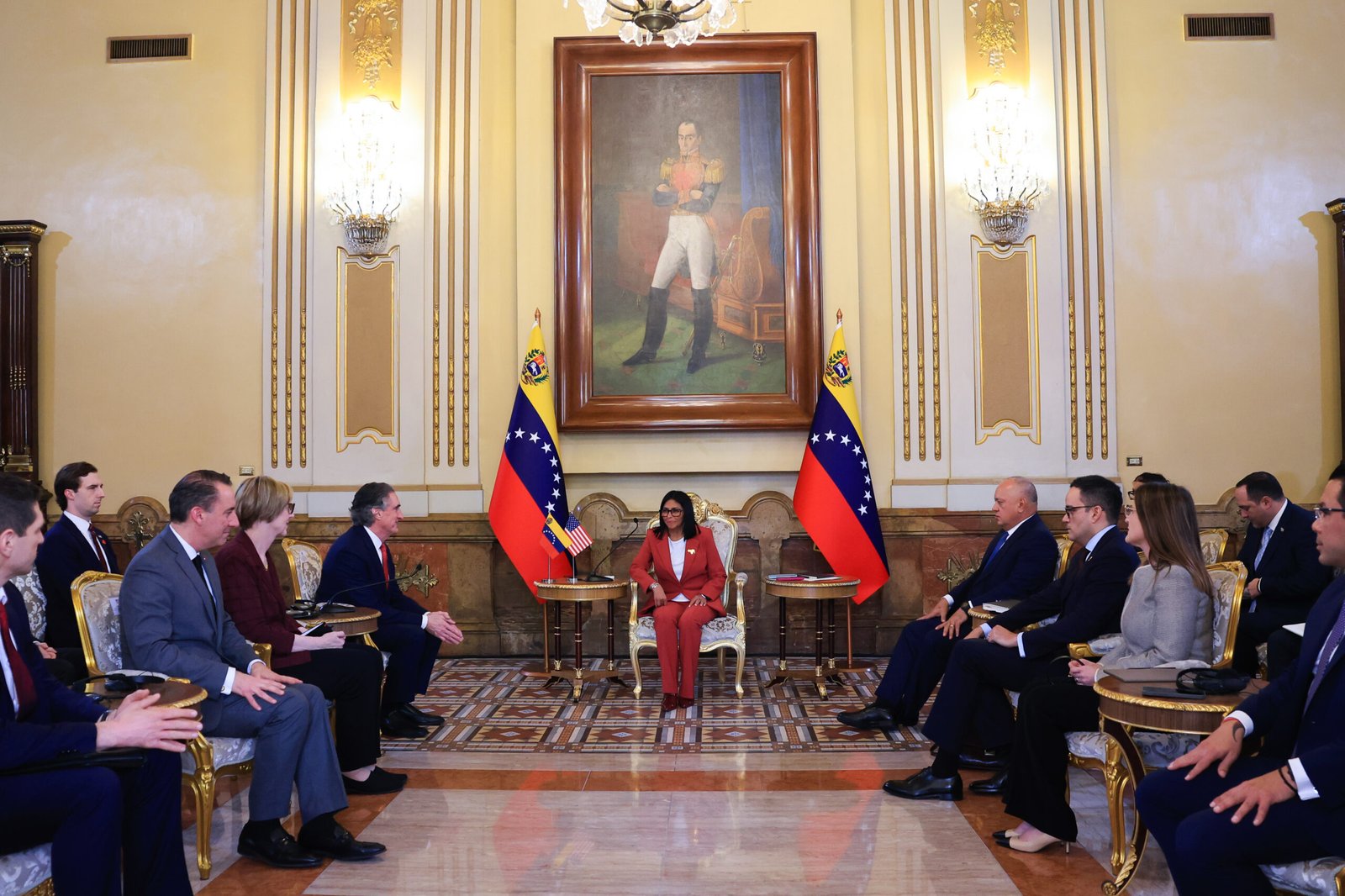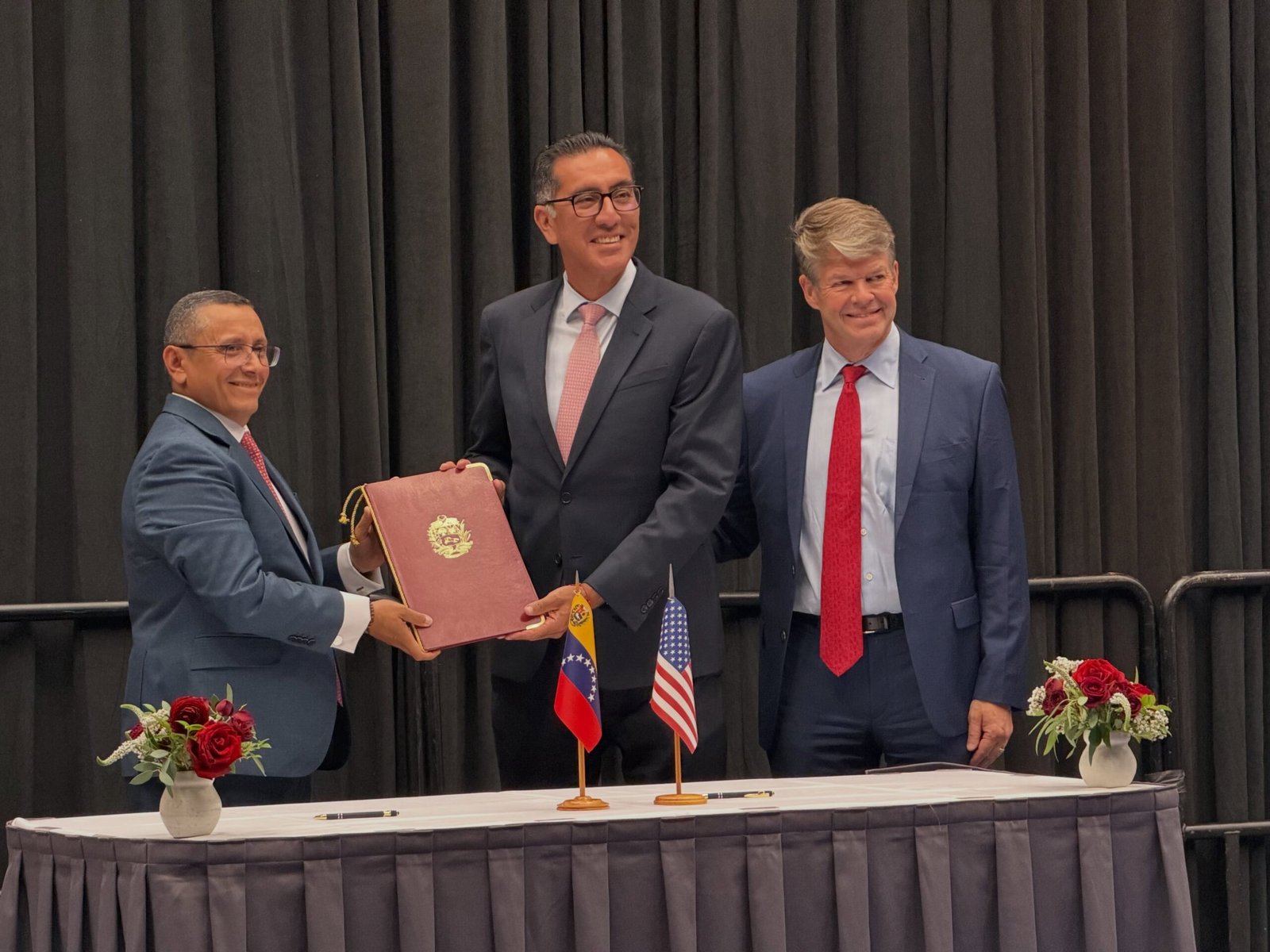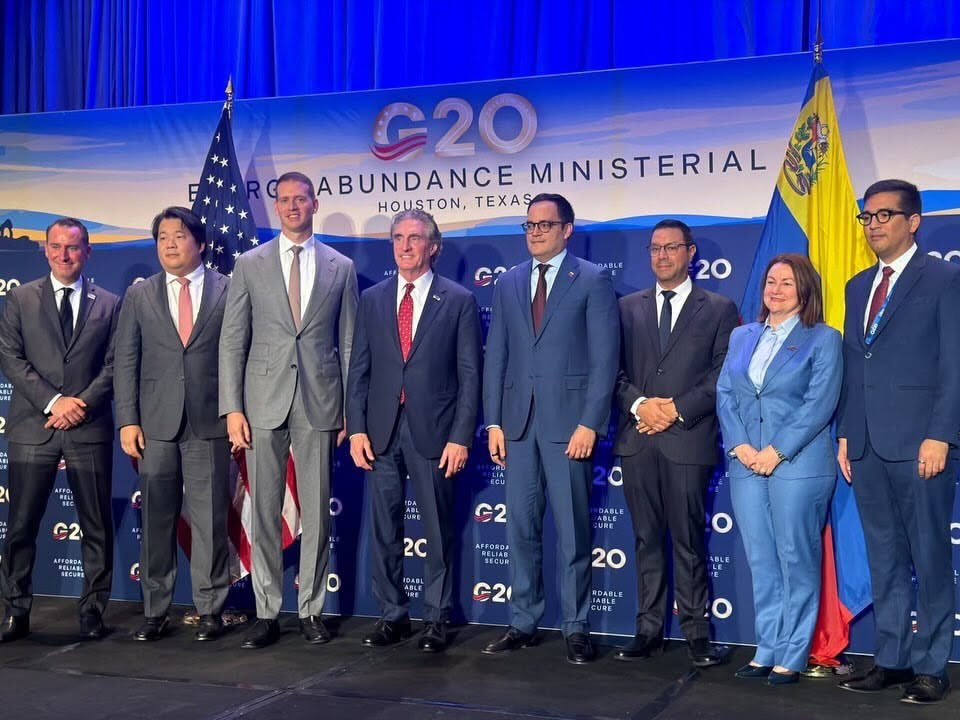
At the G20 summit in Houston, Venezuela did not participate as a member of the club but did hold several bilateral meetings and signed oil and mining agreements with Continental Resources and Heeney Capital. Photo: Instagram / @minmineria_ve.
Guacamaya, September 17, 2026. This week, Venezuela achieved a historic participation in the G20 energy ministers’ summit in Houston, Texas, at the invitation of President Donald Trump’s White House.
Although the Venezuelan delegation did not take part in the official closed-door meetings, it did take the opportunity to sign important agreements — on the one hand with oil magnate Harold Hamm, and on the other with two partners for gold and aluminum: Heeney Capital and Mercuria Energy Group.
Among the Venezuelan senior officials in Houston were the Sectoral Vice President for the Economy, Calixto Ortega, the Minister of Hydrocarbons, Paula Henao, and the Minister of Mining, Héctor Silva.
Simultaneously, press reports indicated that ExxonMobil executives traveled to Caracas on Tuesday to accelerate their return to the South American country’s oil fields.
These talks and agreements come shortly after the signing of a major deal between the United States, Venezuela, and Alejandro Betancourt’s company, North American Blue Energy Partners; followed by a series of new contracts with companies such as Chevron, Eni, GeoPark, and Primavera.
Harold Hamm: The Shale Magnate
Within the framework of the G20, Hamm’s company, Continental Resources, signed a memorandum of understanding with PDVSA for the exploration of the Ayacucho 2 block, in the Orinoco Oil Belt.
The area covers more than 500 km² and holds reserves of 30 billion barrels, according to the company. Its CEO, Doug Lawler, stated that oil production could begin in 18 months.
Continental Resources is one of the largest privately held oil companies not listed on the stock exchange—unlike Chevron or ExxonMobil. Along with others, it drove the “shale revolution,” introducing fracking in the oil basins of states such as North Dakota and Oklahoma.
Hamm is also a prominent Republican donor and supported Trump in his three presidential candidacies. For his part, the president has continued to promote the slogan “Drill, baby, drill!” in favor of fracking.
Heeney Capital and Mercuria After Venezuela’s Commodities
The New York investment fund of Sean Pi and Henry Heeney signed an agreement for the operation and export of minerals from the Chocó gold mine, in the Callao Municipality, in Bolívar.
The agreement also involves Mercuria Energy Group, a commodities trading company headquartered in Switzerland. Heeney Capital estimates it could invest 1 billion dollars over the 30 years of the concession.
In May, the two firms announced an agreement with the Venezuelan government to export raw materials, primarily gold. Initially, sources close to the matter linked the agreement to plans for debt restructuring, which would involve swaps for state assets. However, this process is currently paused, with no further official statements since June.
This same week, Heeney and Mercuria also secured an agreement to export 15,000 tons of aluminum, originating from the state-owned Venalum, to the United States.
The aluminum shipment is valued at close to 50 million dollars. Although it is insignificant in total U.S. demand, it represents a milestone as the first shipment of its kind and could help reactivate the basic industries.
Venezuela’s two state-owned aluminum companies, Venalum and Alcasa, have an installed capacity to produce 700,000 tons per day, but they barely operate at 10%. This is essentially the situation in which most of the metal processing plants of the Venezuelan Corporation of Guayana find themselves, which also includes Bauxilum, Briquetera del Caroní, Ferrominera, and Sidor, among others.
ExxonMobil’s Long Road Back
After the G20, there has also been talk of ExxonMobil’s return to Venezuela, a topic that has resurfaced on several occasions this year, with various ups and downs. Its CEO, Darren Woods, said in mid-January that various conditions made the country “uninvestable.”
According to press reports, executives of the energy giant traveled to Caracas on Tuesday to accelerate their return to the country. The corporation has already gone through two nationalizations of its assets in Venezuela: first in 1976 under then-President Carlos Andrés Pérez, and later in 2007 under President Hugo Chávez.
In this case, the energy giant could be seeking to recover its former assets in Petromonagas—formerly known as Cerro Negro—and Petrovictoria, currently operated between PDVSA and a Russian state company, Petromost, which replaced Rosneft following U.S. sanctions.
ExxonMobil has also shown interest in other fields that would also be in the Carabobo block, the area at the eastern end of the Orinoco Oil Belt.
Why Did Trump Invite Venezuela to the G20?
These agreements have significance in Washington’s foreign policy. Given the conflicts in the Middle East and Ukraine, the Trump administration wants to present Venezuela as a reliable source of raw materials—particularly oil, but not exclusively.
The Russian invasion of 2022 generated an initial shock in commodity markets, particularly energy, which has not been fully resolved. And later, the various conflicts in the Middle East, which have escalated into an open war between the United States and Israel against Iran, have completely dismantled maritime trade in the Persian Gulf and the Red Sea.
Metals and other mining resources are also important. For example, among the leading aluminum producers are China, Russia, and the monarchies of the Arabian Peninsula: the United Arab Emirates, Bahrain, Saudi Arabia, Qatar, and Oman, in that order. The former are rivals of the United States, while the latter are cutting their production as a result of the war with Iran.
Meanwhile, Venezuela continues to undertake a transition in its economic development model, in which foreign private companies are given an increasingly prominent role through concessions where the latter obtain greater margins and operational control.
However, large corporations are still reluctant to invest in a country with high political risk. It is, therefore, the hour of the “wildcatters” and other independent entrepreneurs, often taking advantage of political connections in Washington and Caracas.