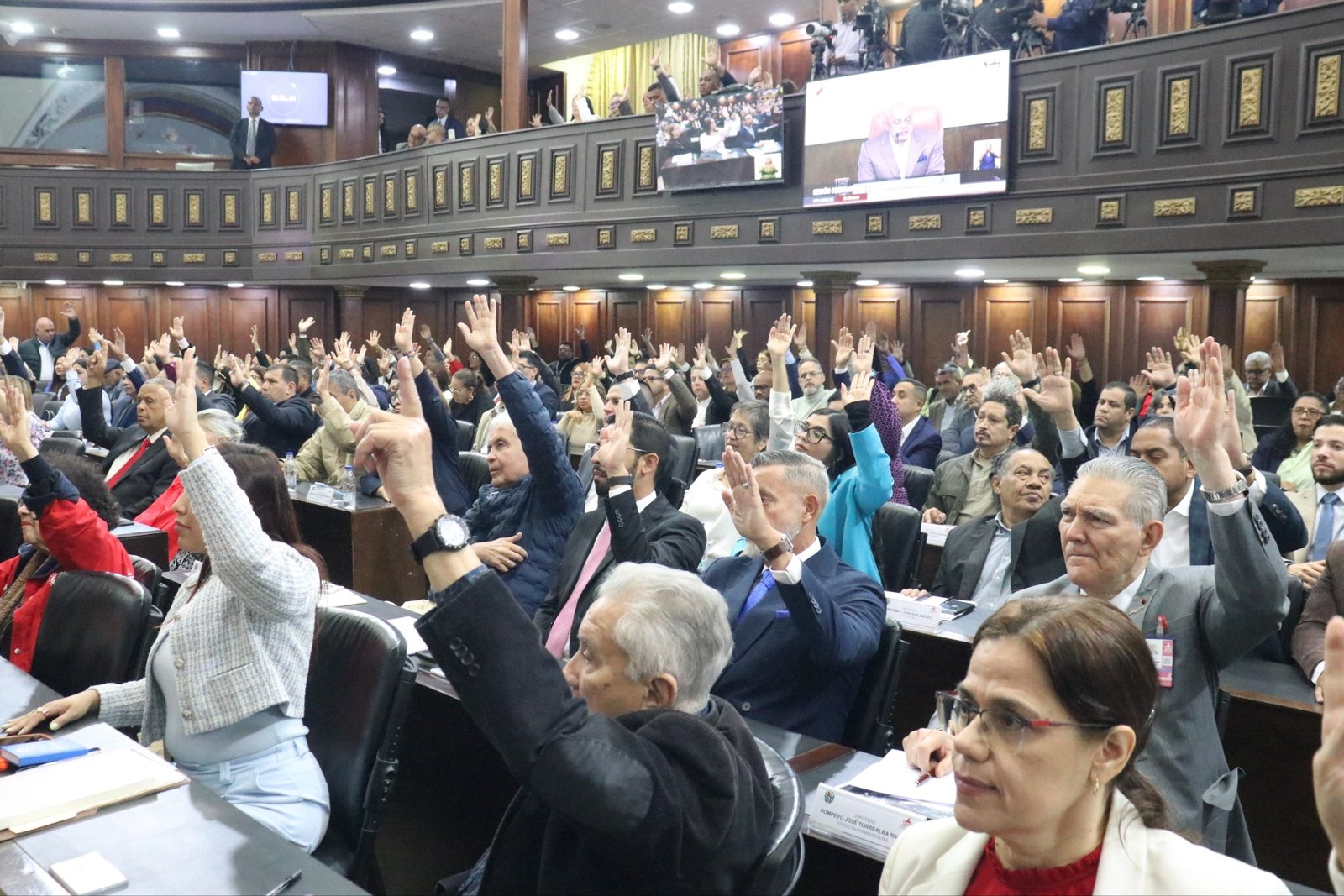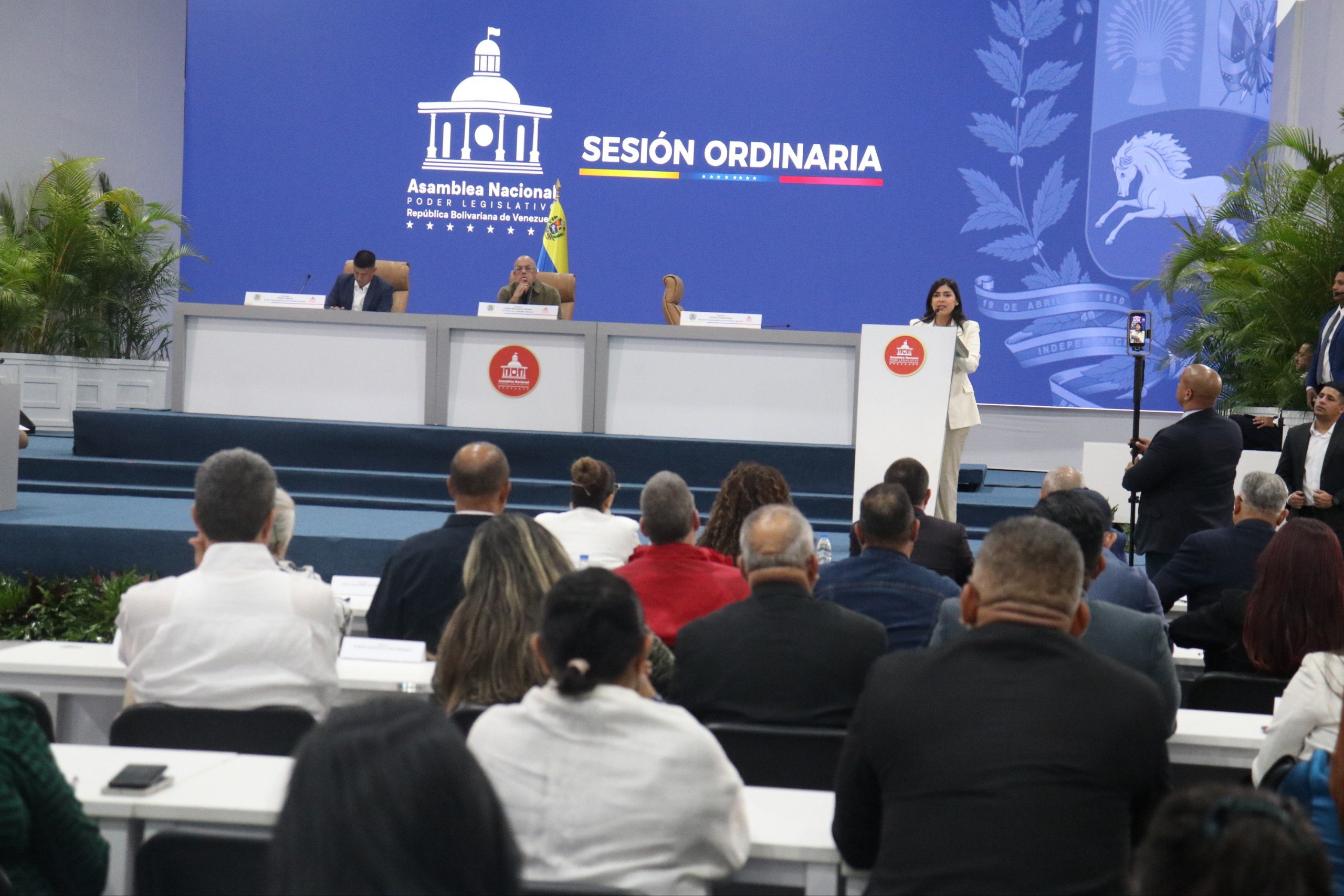
The National Assembly signed a solidarity agreement with the victims of the double earthquake, demanding the immediate cessation of sanctions and coercive measures. Image: National Assembly
Guacamaya, July 14, 2026. In an unprecedented scenario marked by the impact of the double earthquake on June 24, parliamentary activity in Venezuela resumed this Tuesday under exceptional conditions. Due to structural damage to the dome and other areas of the Federal Legislative Palace, the National Assembly (AN) was forced to hold session in a provisional plenary hall at the La Carlota Convention Center.
Prior to the start of the session, one of the most significant announcements was the confirmation of a joint working roadmap between the National Assembly elected for 2026 and former members of the 2015 National Assembly, to begin on August 1. The agreement was ratified through parallel communiqués that aim for “stability, democracy, and national recovery.”
A key precedent for this rapprochement was the return to the country of Dinorah Figuera on June 18, after eight years in exile. Figuera, who presides over the Delegated Commission of the 2015 AN, arrived in Caracas under an operation coordinated with the U.S. Department of State. Her return marked a break with María Corina Machado and the Unitary Platform, who reportedly were not notified of her agenda.
U.S. recognition of this process was immediate and coordinated. Secretary of State Marco Rubio used his personal X account to repost the communiqué from the “2015 AN.” This momentum was complemented by statements from Deputy Assistant Secretary for the Western Hemisphere Michael Kozak, who validated the joint effort, stating that Washington seeks a “middle ground” regarding the electoral timeline.
According to Figuera in an interview, the working group will be composed equally of 20 representatives, 10 from Chavismo (2026 AN) and 10 from the opposition (Delegated Commission of the 2015 AN). Among the most urgent issues are strengthening the electoral system, reconfiguring the CNE, electoral laws, and the release of approximately 400 political prisoners.
New Legislation on Leasing and Construction
The central focus of the session was the legal response to the housing crisis. On the one hand, the reform of the Law against Real Estate Fraud was given the green light. On this point, Deputy Rigel Sergent (PSUV/Dtto. Capital) stated that the goal is to “revitalize the real estate market” by facilitating access to private bank financing through the relaxation of penalty and economic clauses.
Sergent defended the Great Venezuela Housing Mission, asserting that its structures remained standing thanks to earthquake-resistant standards. Meanwhile, Deputy José Gregorio Correa (AD/Nacional) supported the initiative and requested that a Special Commission specifically address people under rental arrangements affected by the earthquake.
Likewise, Parliament unanimously approved, in its first discussion, the Draft Law on the Special Regime for Leasing Properties for Housing Purposes. Deputy Pedro Infante (PSUV/Miranda), in charge of presenting the proposal, explained that the instrument, consisting of 4 chapters and 27 articles, seeks a “sound legal balance.”
According to Infante, also First Vice President of the National Assembly, the regulation will allow the use of security deposits or insurance policies of up to three months, with the obligation to return them within 15 days after the contract ends. “The aim is to protect citizens by creating a formal market attractive to investment,” the parliamentarian emphasized.
New Legislation on Leasing and Construction
The session was charged with emotion after the confirmation of the death of Deputy Jessica Carolina De León (PSUV/Guayana Esequiba) and her daughter during the catastrophe in La Guaira. Jorge Rodríguez also highlighted the commitment of Deputy María Gabriela Vega, from La Guaira, who, despite losing her own home, immediately joined community relief efforts.
In the political debate, the demand for an end to sanctions was unanimous. The AN’s Second Vice President, Grecia Colmenares, presented a solidarity agreement, stating that “we have felt fear with every aftershock, and collective pain.” In a similar vein, Jehyson Guzmán (PSUV/Nacional) emphasized that “the best way to help us is not to get in the way” and that lifting the blockade is vital for the “Venezuela Reborn Plan.”
From the opposition, Deputy Tomás Guanipa (UNT/Nacional) urged redirecting the legislative agenda toward the reconstruction of La Guaira, demanding that funds be managed with “transparency and real oversight.” Likewise, Deputy Yusmaro Jiménez (VVC/Cojedes) praised the solidarity of the people of La Guaira, though he denounced attempts to block roads during the emergency.