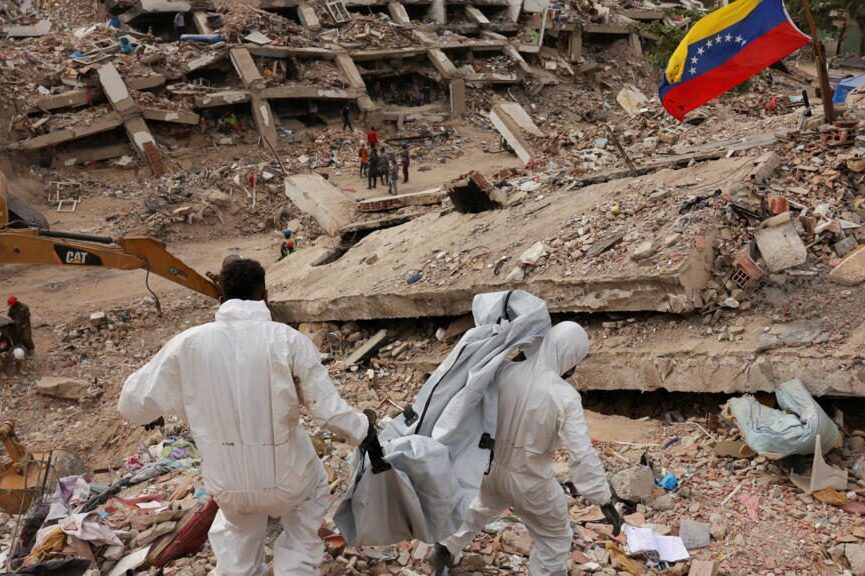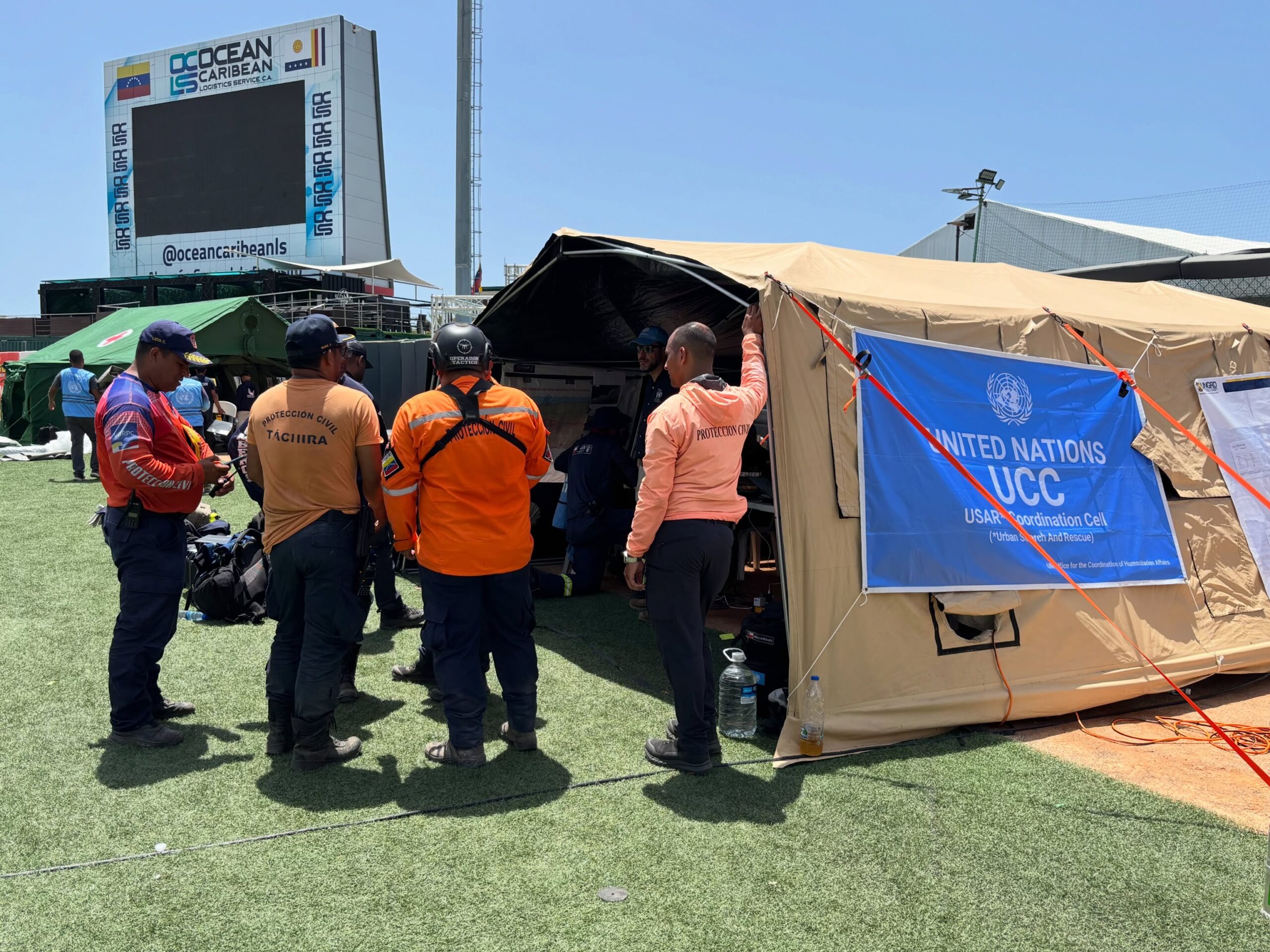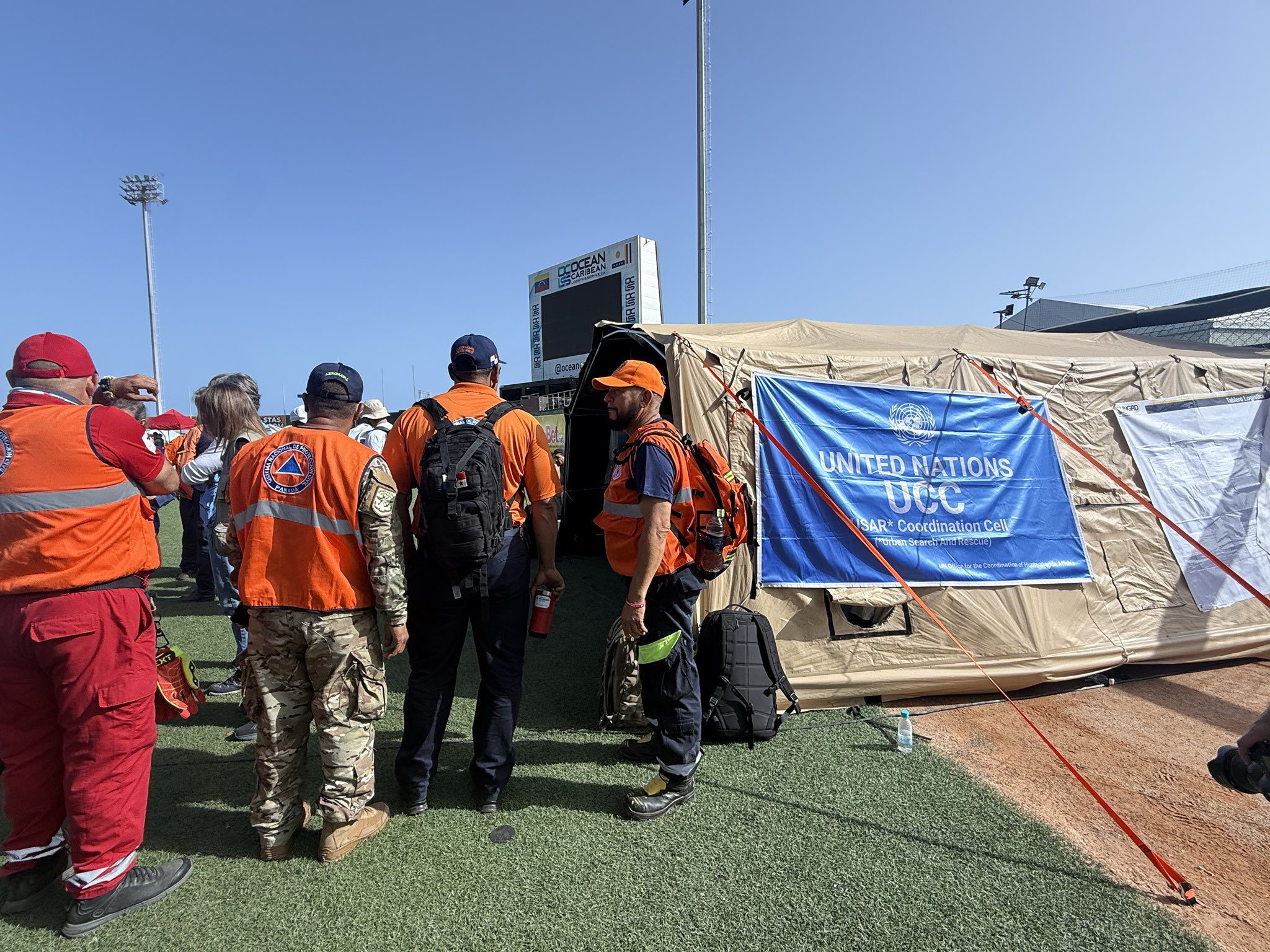
A United Nations camp was set up at the “José Luis García Carneiro” baseball stadium in La Guaira, the area hardest hit by the earthquake in Venezuela. Photo: X / @UNOCHA.
Guacamaya, June 29, 2026. The international response to the June 24 earthquakes in Venezuela has produced one of the largest humanitarian deployments recorded in the country’s recent history. Dozens of governments sent search and rescue teams, field hospitals, medical personnel, humanitarian aid, and financial resources, while multilateral organizations, foundations, and private companies announced funds to support the emergency and future reconstruction efforts.
The tragedy caused by the earthquakes that struck Venezuela on June 24 triggered a broad international mobilization of humanitarian aid. So far, at least 27 countries have sent or announced the deployment of search and rescue teams, medical personnel, field hospitals, specialized machinery, logistical assistance, and financial resources to support emergency operations.
According to the United Nations, a total of 30 international Urban Search and Rescue (USAR) teams have been mobilized to Venezuela, 17 of which are operating under the coordination of the United Nations Office for the Coordination of Humanitarian Affairs (OCHA).
Acting President Delcy Rodríguez reported that governments from around the world have offered support, expressly mentioning the United States, the Dominican Republic, El Salvador, Mexico, and Qatar for sending rescue teams, as well as China, Brazil, and several Caribbean nations for their humanitarian aid contributions. She also highlighted the backing of Ecuador and Panama.
On the diplomatic front, numerous governments expressed solidarity with Venezuela, including Russia, Cuba, Uruguay, Costa Rica, Saudi Arabia, the United Arab Emirates — which donated $10 million — Kuwait, Romania, Portugal — which sent a rescue team — Angola, Libya, and Uganda, though in several cases the announcements were limited to political and diplomatic support without, so far, including the deployment of resources on the ground.
The Main Rescue and Humanitarian Contingents Arriving in Venezuela
The United States announced the deployment of a Disaster Assistance Response Team (DART), specialized personnel, and financial aid estimated at $200 million, partially earmarked for United Nations agencies and humanitarian organizations working on the ground.
El Salvador deployed 188 rescue workers — from a contingent initially announced at up to 300 — along with approximately 150 tons of machinery and supplies for rescue operations.
Switzerland sent 80 specialists and 18 tons of equipment, while Brazil dispatched 36 firefighters with the capacity to set up a field hospital.
Spain mobilized 59 members of its Military Emergency Unit (UME), accompanied by eight dogs specialized in searching for survivors beneath collapsed structures.
Mexico confirmed the dispatch of technical personnel and equipment specialized in rescue and medical assistance. In addition to government contributions, volunteer “topos” — experts in rescuing victims from the rubble of destroyed buildings — have also arrived from Mexico.
From Latin America, Colombia, Chile, the Dominican Republic, and Ecuador also incorporated search and rescue contingents into the international operation.
Germany, Italy, and the Netherlands announced additional resources and specialized equipment to bolster the international response.
Turkey organized one of the most comprehensive operations. Two A-400M military aircraft transported a team of 38 specialists from the Disaster and Emergency Management Authority (AFAD), five medical professionals from the National Medical Rescue Unit (UMKE), two representatives from the Turkish Red Crescent, two search dogs, and three specialized vehicles. A second aircraft carried an additional contingent of 22 members from the Turkish Ministry of Defense’s Humanitarian Aid Brigade.
India launched what it called “Operation Friendship,” deploying a field hospital, medical officers specialized in health crisis management, and a military and institutional delegation to assist those affected.
Among the most symbolic moments of the international response was the dispatch of a search and rescue mission by Syria — considered the first international humanitarian operation ever conducted by that country. Qatar also sent specialized teams.
Financial Assistance and the Unlocking of Funds
On the financial front, the Venezuelan government announced the creation of an initial $200 million fund for reconstruction and another for direct victim assistance. This would not constitute a donation, however, but rather access to IMF Special Drawing Rights (SDRs) that have been frozen since the pandemic.
The Andean Development Corporation (CAF) announced the creation of a Venezuela Recovery and Reconstruction Fund, open to contributions from governments, international organizations, companies, foundations, and private individuals. The development bank will make an initial contribution of $1 million to activate the mechanism and pledged to manage the resources without charging commissions, through accountability mechanisms, to finance projects prioritized by Venezuelan authorities. The CAF estimates the fund could manage up to $200 million.
In addition to its rescue teams, the United States is making more than $300 million in assistance available, according to the latest State Department statement. This would include $100 million in “bilateral financing” and another $100 million in “support through the UNOCHA common fund.” Partners receiving these donations include Samaritan’s Purse, Catholic Relief Services, UNICEF, IOM, WFP, International Medical Corps, Project HOPE, and the Red Cross.
Government financial donations also include €2 million from the Netherlands for an international rescue team, $10 million from the United Arab Emirates, and €100,000 from the Vatican. The European Union also announced a common fund of $5.6 million for emergency aid.
China announced a new humanitarian aid package worth $14.7 million to support Venezuela following the earthquakes, which have left more than 1,450 dead and tens of thousands missing, according to United Nations figures. Foreign Ministry spokesperson Guo Jiakun stated that the assistance will include emergency supplies to bolster rescue and reconstruction efforts, to be delivered “as soon as possible.” Beijing will also make satellite imagery of the affected areas available to facilitate search and rescue operations, and stated it is prepared to expand its support as the situation on the ground evolves. President Xi Jinping also conveyed a message of condolence to Venezuela’s interim president on Friday, expressing the solidarity of the Chinese government and people with the victims of the disaster.
Among Washington’s actions, also notable is General License 60, which authorizes transactions related to humanitarian aid following the earthquakes through October 23 of this year. This measure reflects the ongoing impact that sanctions continue to have on Venezuela’s economy and its ability to even receive assistance in the wake of a natural disaster.
International NGOs and Private Companies Add Their Contributions
Various international organizations have also launched support campaigns. Groups such as the Red Cross and Cáritas have positioned themselves among the primary recipients and distributors of humanitarian aid in Venezuela, responding from the very first moments thanks to their international networks.
Corus International activated its partner network to distribute assistance to affected communities, while the platform GoFundMe set up a verified donation center to fund the recovery and reconstruction of devastated areas. World Central Kitchen is organizing the immediate delivery of $1 million in emergency aid.
The private sector also announced significant contributions. Chevron committed $1 million to fund temporary shelter, food, drinking water, and emergency medical care through humanitarian organizations present in the country.
Mining company Gold Reserve announced a further $1 million donation, to be coordinated with the U.S. Embassy and Venezuelan authorities to support assistance and recovery efforts in the hardest-hit communities.
The Venezuelan-American Chamber of Commerce (VACC) joined forces with Médicos Unidos, Dividendo Voluntario para la Comunidad, Cáritas, and Fe y Alegría to channel donations from the United States.