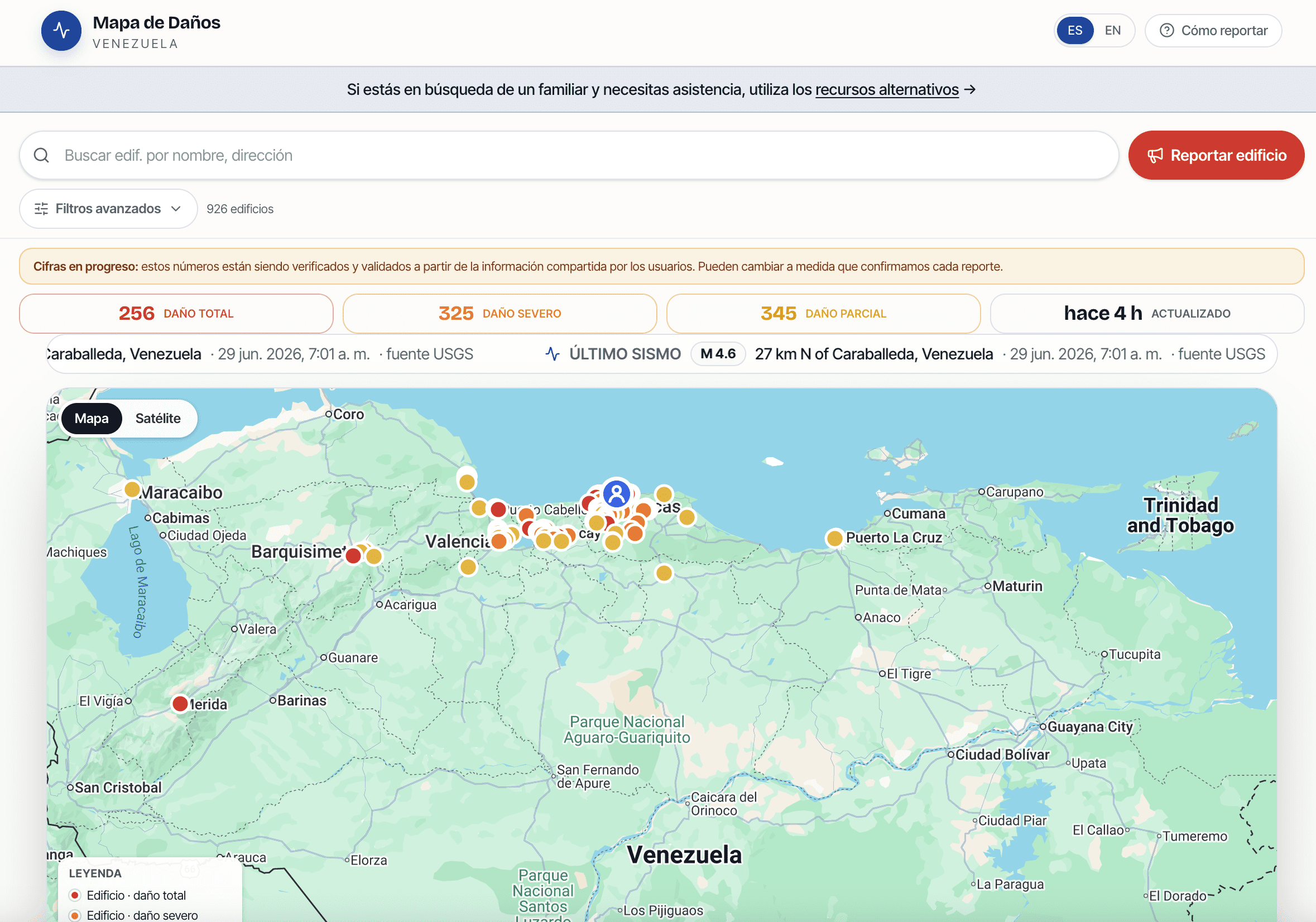
In the image, a screenshot of the website Mapa de Daños Venezuela, an initiative to record in real time the damage to buildings throughout Venezuela.
Guacamaya, June 29, 2026. After June 24, Venezuela not only faces a devastating double earthquake, but also a scarcity of institutional information along with widespread distrust among the population toward its government.
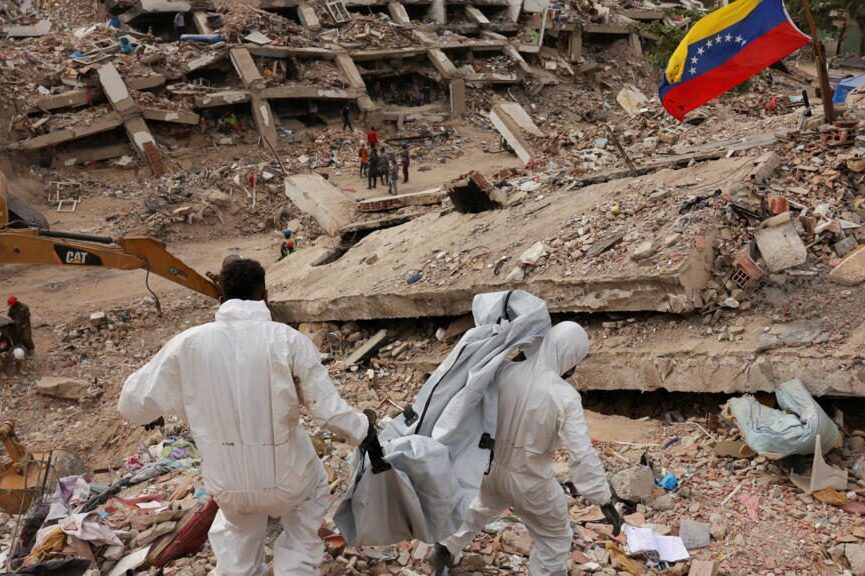
The magnitude 7.2 and 7.4 earthquakes, with epicenters in Yaracuy, caused one of the biggest natural disasters in the country’s recent history. Faced with a lack of information, however, the population has responded by creating new platforms to centralize data, while social media has filled up with offers and calls for help.
So far, the Venezuelan government, for example, has not published a list or even a figure for missing persons, while it continues to have difficulties centralizing and organizing search efforts and humanitarian assistance.
In this context, social media has become the main space for disseminating information about the earthquake response, with accounts outside public institutions and traditional media taking center stage.
Citizen platforms emerge to centralize data
Several web developers have created platforms to register and locate missing persons, in the absence of a government registry. Among them we can find Desaparecidos Terremoto Venezuela, Ubicados Venezuela, Venezuela te Busca, and Venezos.com.
On “Desaparecidos Terremoto Venezuela,” the one with the most records, 80,000 reports have been made, of which 59,894 unique individuals have been identified. Of these, 44,706 remain missing, while 15,188 have already been located.
From there, platforms have also emerged to facilitate the location of people already found, such as Localizados VE. Both were created by “cyberactivist” Giuseppe Gangi, the same person behind macedoniadelnorte.com, the website that centralized records from the 2024 presidential elections.
The delivery and mobility app Yummy has also created sos.yummyrides.com to cross-check and analyze reports of people across multiple platforms. Its founder, Vicente Zavarce, has also launched other initiatives: one collects donations, and 12 companies match them with an additional 25%, including Yummy itself, El Dorado, Slash, and Kavak. He has also offered free transportation for volunteers to collection centers and for patients to hospitals and clinics.
Another platform, Mapa de Daños Venezuela, shows a live map with the status of buildings damaged or collapsed by the earthquakes, relying entirely on citizen-supplied information, which is then verified.
This platform also includes links to other websites about searching for missing persons, engineering volunteering, and finding shelters.
Following the earthquake, Venezuelans have responded with an avalanche of donations of essential goods, from water and food to medicines, work gloves, and diapers. Collection centers appeared everywhere, not only in Caracas and surrounding areas, but throughout the country. Also abroad, especially in cities with a large Venezuelan diaspora presence.
However, without centralized information, it is difficult to know where the need exists. This is how platforms like centrosayudavenezuela.org and ayudaparavenezuela.com were born.
The power of social media
Beyond new websites, the use of conventional social media to transmit this same information has proliferated: Instagram stories and notes, forwarded WhatsApp messages, Facebook or TikTok posts.
This should come as no surprise: 89% of Venezuelans get their news through social media, according to the 2025 National Survey on Cultural Consumption by the Andrés Bello Catholic University.
Feeds in Venezuela have filled up with people offering mattresses and tents, asking for medicines for nearby hospitals, and calling for volunteers. Even some volunteers use them as a transparency mechanism with their donors, posting photos of receipts and bags full of supplies.
From the very first moment, digital media outlets, Venezuelan and foreign influencers, corporate accounts, and others have lent their platforms to inform amid the confusion and information vacuum. Furthermore, they have been able to act much faster than traditional media.
This has demonstrated the broadcasting power that certain actors on social media can have, in this case to have a positive impact: saving lives in a race against time.
The on-camera actions of certain influencers have also drawn criticism, with accusations that they are engaging in “disaster tourism” or trying to take center stage above humanitarian efforts.
Perhaps the most controversial case was that of Gianpiero Fusco, self-styled as “el Tigre.” Beyond trying to seek the spotlight with videos featuring rage-bait or incendiary speeches, he appeared walking barefoot through rubble in La Guaira, possibly hindering rescue efforts and setting a bad example regarding safety measures for rescuers.
They have also highlighted the risks of decentralized information. In some cases, they have helped spread falsehoods with real and harmful impact, such as the misleading alert about a possible tsunami on June 25. It was also rumored on social media that a Spanish rescue team, the UCSAR, had been barred from entering Venezuela, but they themselves denied it.