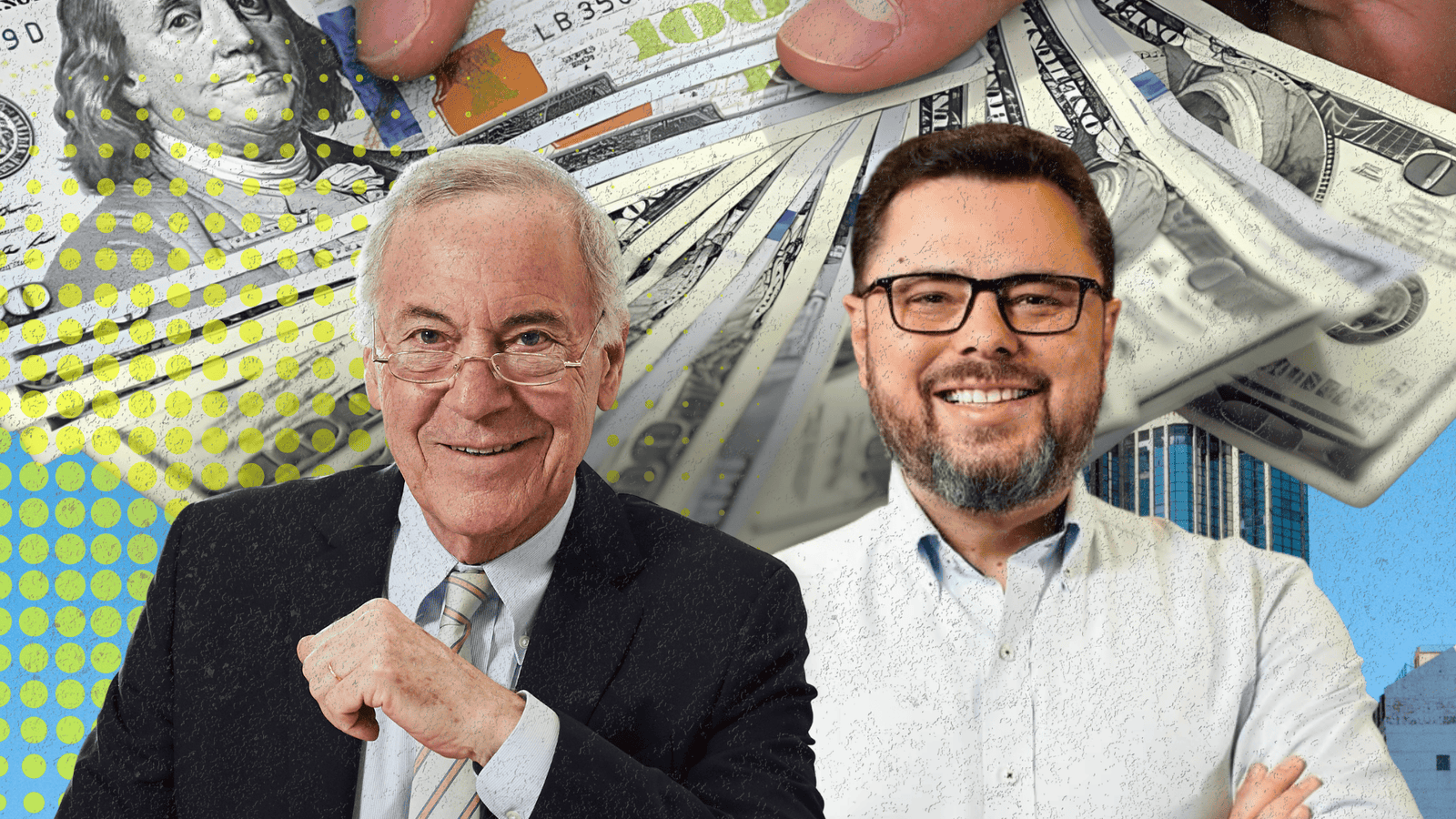
Fortune magazine reported that American economist Steve Hanke and Venezuelan deputy Antonio Ecarri are working on a plan to formally dollarize Venezuela. Image: Guacamaya.
Guacamaya, August 20, 2026. American economist Steve Hanke, internationally known as the “Money Doctor” for his involvement in monetary reforms to halt hyperinflationary processes, is working alongside deputy and former presidential candidate Antonio Ecarri on a proposal to formally dollarize the Venezuelan economy, according to Fortune.
Hanke has drafted a bill that proposes replacing the bolívar with the U.S. dollar and shutting down the Central Bank of Venezuela (BCV). The economist is working closely with Ecarri on the development of this initiative, aimed at advancing toward a formal dollarization of Venezuela’s economy.
Hanke’s central argument is that Venezuela first needs to recover monetary stability in order to rebuild its economy. According to his estimates cited by the magazine, Venezuelan inflation stands at nearly 400% annually. Dollarization would eliminate the possibility of financing public spending through new bolívar issuance and would reduce authorities’ discretion over monetary policy.
Hanke further contends that a stable price environment could facilitate the return of credit, mortgages, and private investment—currently limited by monetary uncertainty. He also believes the measure could boost investment in sectors such as oil and electricity and help accelerate a potential restructuring of Venezuela’s debt.
Hanke’s International Experience
The proposal for Venezuela draws on Hanke’s long international track record advising governments and designing monetary reforms.
In Montenegro, he participated in the process that led the country in 1999 to abandon the Yugoslav dinar—which had been hit by severe inflation—and adopt the German mark. Subsequently, Montenegro replaced the mark with the euro, which it continues to use as its currency.
In Ecuador, Hanke advised the finance minister during the dollarization process in 2000, when the country abandoned the sucre and officially adopted the U.S. dollar. Fortune notes that Ecuador has maintained comparatively low inflation rates over the past two decades, although dollarization has also sparked debates about the loss of capacity to devalue the currency against regional competitors.
In Zimbabwe, Hanke served in 2009 as an informal advisor to Prime Minister Morgan Tsvangirai amid one of the most severe episodes of hyperinflation recorded in contemporary history. As the local currency collapsed, the population began massively using foreign currencies, and the government eventually formalized a dollarized system. According to Hanke, inflation “practically disappeared” as long as that scheme was maintained.
The economist also designed or advised on currency board systems—mechanisms by which a local currency maintains a fixed exchange rate against a strong currency and its issuance is backed by reserves—in Estonia, Lithuania, Bulgaria, and Bosnia.
His Second Attempt in Venezuela
This is not the first time Hanke has tried to promote monetary reform in Venezuela. Between 1995 and 1996, during the second government of Rafael Caldera, he served as an economic advisor and designed a currency board proposal to stabilize the bolívar. The project did not obtain the necessary support in Congress at the time.
Three decades later, he considers the scenario to be different. The dollar already occupies a fundamental space in Venezuela’s everyday economy, and a significant portion of transactions, prices, and savings are denominated in the U.S. currency.
Hanke defines this process as “spontaneous dollarization.” In addition to the use of U.S. banknotes, dollar-pegged stablecoins—particularly USDT or Tether—have gained a significant presence in payments and remittances. For the economist, this demonstrates that citizens themselves have already begun choosing the currency they prefer to use.
The proposal that Hanke is working on alongside Antonio Ecarri now seeks to bring that economic reality from the market into the law. The goal is to convert a dollarization that emerged informally in response to the loss of confidence in the bolívar into an institutional monetary regime, with price stability as the starting point for recovering credit, attracting investment, and rebuilding Venezuela’s economy.