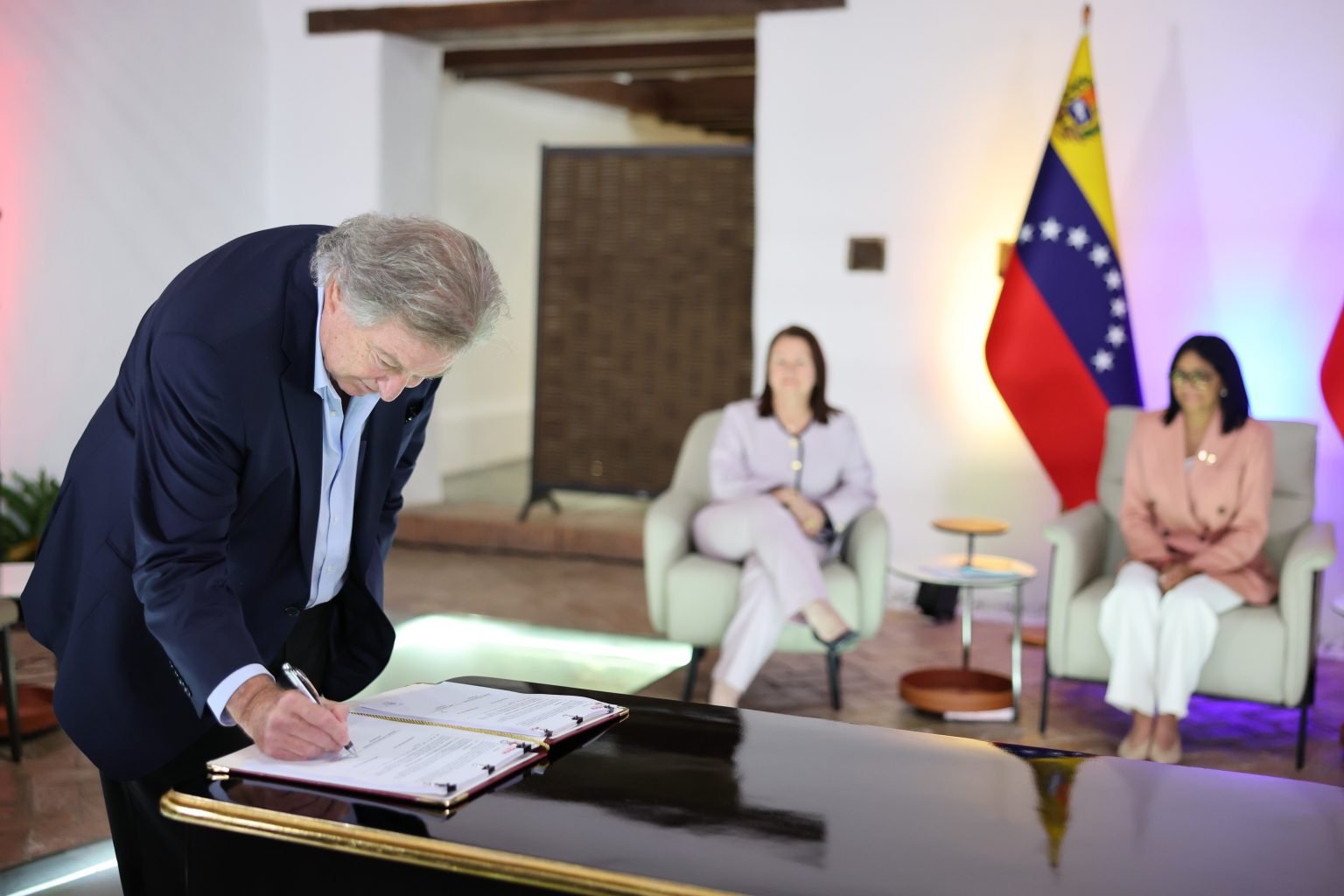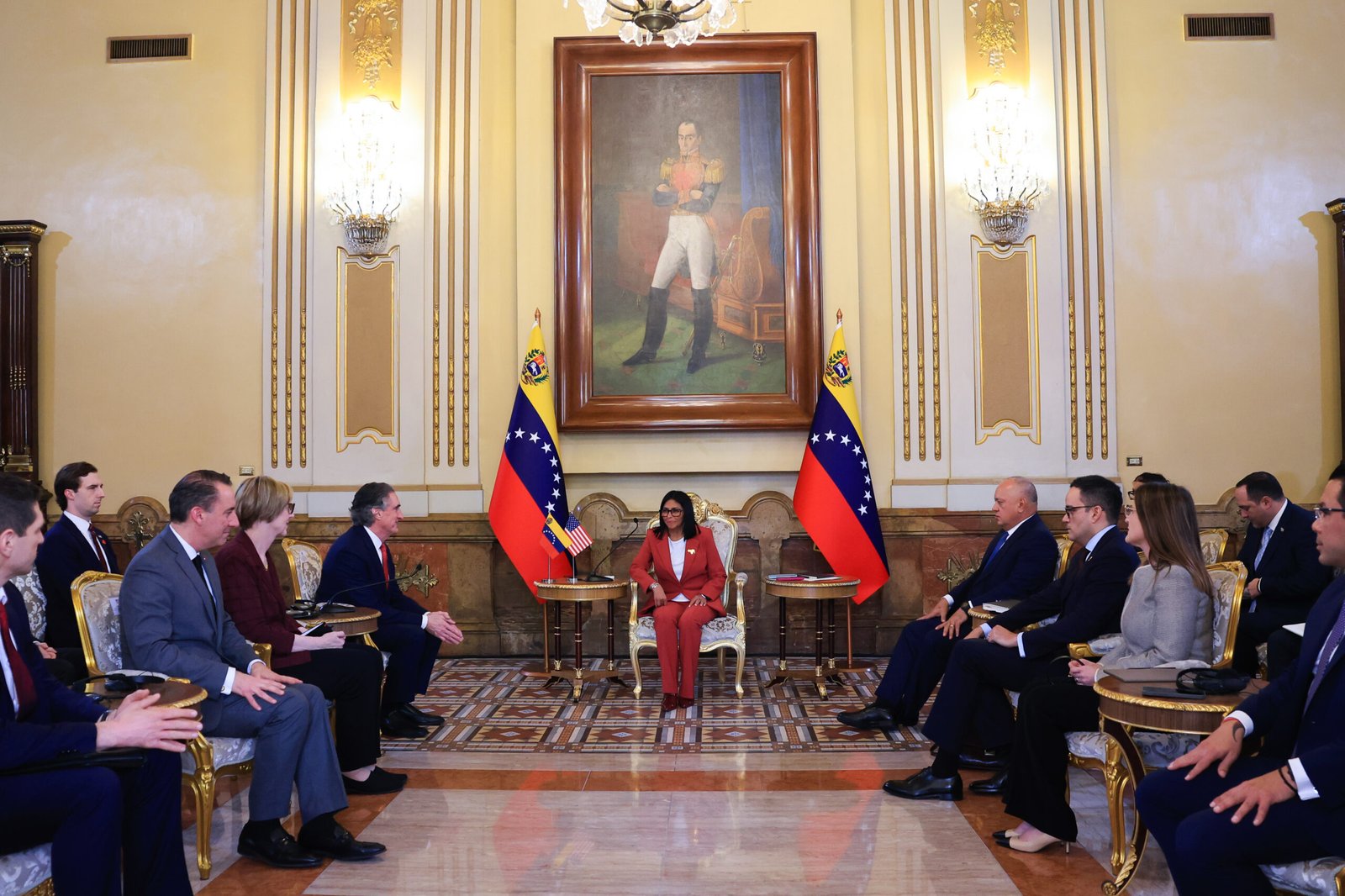
U.S. Secretary of the Interior Doug Burgum has authority over natural resources and mining and is a member of Trump’s Energy Dominance Council. He visited Caracas in March 2026. Photo: Presna Presidencial.
Guacamaya, September 8, 2026. The U.S. Department of the Treasury recently expanded its general licenses to include coal within the mining exception regime to sanctions on Venezuela, while several foreign companies are beginning to show interest in the country’s deposits.
Although oil plays a leading role in relations between the United States and Venezuela, mining also ranks among Washington’s priorities. This fact has been confirmed by the visit of Secretary of the Interior Doug Burgum in March, and by dozens of American mining industry executives throughout this year.
On the other hand, UCC Holding, a Qatari firm, is emerging as one of the pioneering investors in the new bet on Venezuelan gold and infrastructure. In this case, it reaffirms Caracas’s key relationship with Doha, which, in turn, serves as a discreet—though increasingly visible—hinge in the relationship with President Donald Trump’s White House.
The Treasury Department’s Office of Foreign Assets Control (OFAC) issued an update on Wednesday, September 2, to three general licenses—51D, 54C, and 55A—which for the first time incorporates coal, previously outside the scope of these authorizations. The latest versions replace licenses 51C, 54B, and 55, approved only at the end of August, and directly name Carbones del Zulia S.A. (Carbozulia) alongside the already-known CVG Compañía General de Minería de Venezuela (Minerven) as the state enterprises with which U.S. entities may now operate.
License 51D authorizes ordinary and incidental transactions for the export, re-export, purchase, sale, transport, and storage of Venezuelan-origin coal and minerals, provided the U.S. entities involved were registered before January 29, 2025. License 54C enables the supply of goods, services, technology, and maintenance for exploration and processing operations, with an obligation to report every 90 days to the Departments of State and the Interior. And License 55A permits negotiating and signing memoranda of understanding and letters of intent for future investments, although any effective execution remains conditioned on an additional specific license.
All three licenses maintain the same red lines that already governed the rest of the mining sector: any contractual disputes must be resolved in U.S., U.K., French, or Singaporean courts; participation by individuals, companies, or governments from Russia, Iran, North Korea, Cuba, and China is prohibited; and payments in cryptocurrencies—including the Petro—as well as debt swaps or in-kind payments, are forbidden.
Why Does Washington Care About Coal?
The expansion to coal may seem minor compared to the symbolic weight of gold or oil, but it responds to a specific industrial logic. Despite decades of energy transition, coal remains the basic input for two value chains that the United States cannot replace at the same speed with which it reduces its electricity consumption—namely, thermoelectric generation in much of the developing world and, above all, the steel industry. Metallurgical coke—the variety of coal of interest here, which Venezuela produces in Zulia through Carbozulia—is a nearly irreplaceable component in blast furnaces that produce primary steel; there is no equally efficient industrial-scale substitute for reducing iron ore.
This dependency takes on added geopolitical weight in times of tariff-driven reindustrialization and competition with China over critical mineral and metal supply chains.
Securing sources of coke and related minerals outside China’s orbit—and, by extension, preventing Russia, Iran, or Cuba from capturing those same Venezuelan deposits, hence the explicit veto in the licenses—aligns with the stated objective of the Trump administration to diversify access to strategic inputs in the hemisphere. The very text of the licenses, by nominally banning those four countries, reveals that the opening is not merely commercial but also an instrument of containment, especially of Chinese presence.
Qatar, the Hinge That Arrived Before the Oil Companies
It is important to read these announcements in conjunction with the recently published Foreign Policy report by Sam Skove on UCC Holding’s job offer to lead a “Gold Division” in Caracas, because the coincidence is not an isolated piece of data in this scenario; it is the corporate confirmation of a political link that was forged before January 3. According to an investigation by The Guardian published in January, Delcy Rodríguez and her brother Jorge—then Vice President and President of the National Assembly, respectively—had offered cooperation to both U.S. and Qatari officials since the fall of 2025, a relationship that even dates back to the Doha Agreements during the Biden administration. Qatar, the investigation notes, acted as a discreet intermediary in contacts between Caracas and Washington, leveraging Rodríguez’s ties with Doha’s ruling elite.
That hinge function continued after Maduro’s capture. Rodríguez, now as interim president, has described January 3 as a “turning point” that led Chavismo to resume the diplomatic path with the United States—a strategy that, in her own words in June, she considers “has been the right path.” In that realignment, Qatar has not played a secondary role; the firm UCC—controlled by Syrian brothers Moutaz and Ramez Al-Khayyat—already had a presence in Venezuelan energy through a joint stake with BP in the Loran gas field, and is now extending its footprint into gold.
It is no coincidence that the Al-Khayyat brothers combine interests in Venezuela with real estate investments in Albania alongside Jared Kushner and Ivanka Trump, nor that they lobbied—successfully, after the repeal of the Caesar Act in December—for the lifting of sanctions on Syria. UCC’s profile illustrates a pattern in which Qatari capital moves in parallel with White House diplomacy, entering markets where other Western investors are still calculating the risk.
This connection deserves attention because Kushner is not just any American businessman. He is Donald Trump’s son-in-law and was one of the main White House advisors during Trump’s first term.
The Al-Khayyat brothers belong to a Qatari business elite that has grown closely linked to the country’s economic development process. UCC secured numerous contracts for Qatar’s strategic projects and participated in infrastructure related to the 2022 World Cup. The company itself highlights that it has worked as a contractor for large-scale projects and government entities.
There is also an interesting relationship with Qatar’s institutional ecosystem. In 2020, UCC was a lead sponsor of a conference on public-private partnerships organized by the Qatari Chamber, and the businessman was publicly recognized by Sheikh Thani bin Ali Al Thani, a member of the ruling family.
The Al-Khayyat brothers attended Donald Trump’s second inauguration in January 2025.
UCC has been entering countries undergoing reconstruction or economic opening processes.
In Syria, for example, UCC led a consortium that in 2025 announced an energy project worth approximately $7 billion, aimed at building gas-fired power plants and a solar facility.
In 2026, it also partnered with a company that has a very significant presence in Venezuela—Chevron—and the Syrian state company to explore offshore hydrocarbons.
Additionally, UCC is related to Power International Holding, which also controls or participates in companies in sectors as diverse as agriculture, food, real estate, entertainment, healthcare, construction, and energy.
UCC’s move is part of a broader trend in Venezuelan foreign policy under Rodríguez: the search for partners in the Gulf states as a way to diversify financing and investment without relying exclusively on Washington, Beijing, or Moscow—both of which have increasingly narrow room for maneuver due to the very conditions imposed by OFAC. The agreement between BP, the Emirati XRG, and UCC itself for the development of the Loran field—the first investment by a Gulf monarchy in Venezuelan energy—had already marked that shift months earlier. The arrival now of Qatari capital in gold and airport infrastructure suggests that Doha is not seeking a single asset, but rather a diversified position within Venezuela’s reconstruction economy.
For Caracas, this orientation toward the Gulf serves a dual function: it offers a source of capital with less political baggage than the U.S. variety—and therefore more malleable in Chavismo’s internal narrative—while at the same time reinforcing before Washington the image of an interim government capable of attracting international investment linked to Trump’s circle under the very rules that OFAC has been gradually relaxing. If licenses 51D, 54C, and 55A open a legal door, it is Qatar that, so far, has shown itself most willing to walk through it.
Future Prospects
Venezuela has significant gold potential. An analysis by the Center for Strategic and International Studies (CSIS) estimates that the country holds some 2,343 metric tons of gold, an amount that would place it among the world’s leading countries in terms of identified resources.
Despite this wealth, the participation of international companies in Venezuelan gold mining remains limited. One exception is Canadian firm Gold Reserve, which previously operated a project in the country before its assets were confiscated in 2009 and which has now announced its intention to resume mining activities. Added to this is Trafigura, a Swiss multinational commodity trading firm, which has expressed its willingness to work alongside Minerven, the state enterprise in charge of gold production.
The scant interest shown by other foreign companies reflects the difficulties Venezuela still faces in turning its mining potential into a fully developed industry.
CSIS itself identifies several obstacles that must be overcome before Venezuela can attract larger-scale investment, such as infrastructure and access difficulties, legal uncertainty, and security problems. The country’s geological potential has also not translated into proportional production. Of the 24 gold mines analyzed, 19 remain currently inactive.
Added to these limitations is the high degree of state control over mining activity. The Venezuelan government moved toward nationalizing the sector in 2011, considerably reducing space for private and foreign participation. At the same time, gold activity in various parts of the country is traversed by informal and illegal economies. According to CSIS, criminal groups and actors linked to the state apparatus itself exercise control over a significant portion of these operations, making security and territorial control another major challenge for any company intending to invest in the sector.