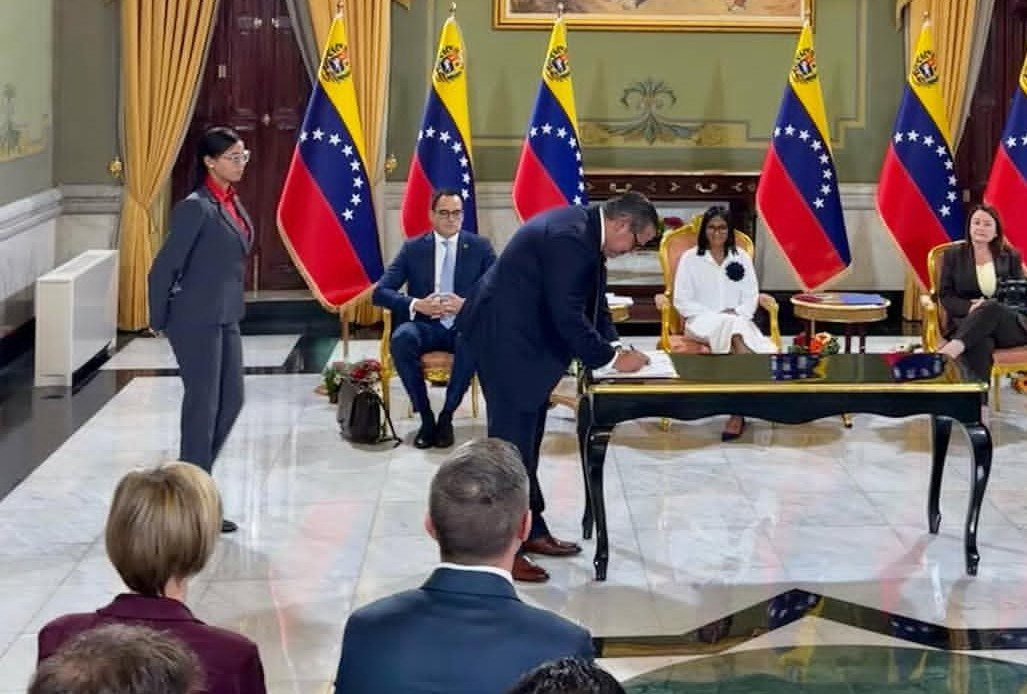
Javier La Rosa, Chevron’s representative, signs the agreement with the Venezuelan government at Miraflores Palace in the presence of acting president Delcy Rodríguez and U.S. officials. Photo: Instagram / @usembassyve.
Guacamaya, April 14, 2026. Energy giants Chevron and Shell are strategically positioning themselves to maximize opportunities in Venezuela following a largely unprecedented asset swap involving government participation.
The result is that Chevron will strengthen its role in extra-heavy crude production, primarily in the Orinoco Oil Belt, while Shell consolidates its position in natural gas development.
The core structure of the deal is an asset exchange in which Chevron expands its footprint in the Orinoco Oil Belt while relinquishing its stake in the offshore Loran gas field to Shell. The British multinational is assembling gas assets between eastern Venezuela and Trinidad and Tobago, with the potential to turn the region into a major natural gas export hub.
This agreement unfolds within a context of global geopolitical crisis—particularly tensions surrounding the Strait of Hormuz—while Venezuela’s economic opening has renewed interest from international energy capital. Combined, these factors place the South American nation back on the map as an emerging, though still marginal, player in a global oil market under strain and trading above $100 per barrel.
The agreements were signed at Miraflores Palace in Caracas, in the presence of U.S. Deputy Secretary of Energy Kyle Haustveit, who is currently visiting the country, alongside Venezuela’s acting president, Delcy Rodríguez.
Chevron expands its footprint in the Orinoco Oil Belt
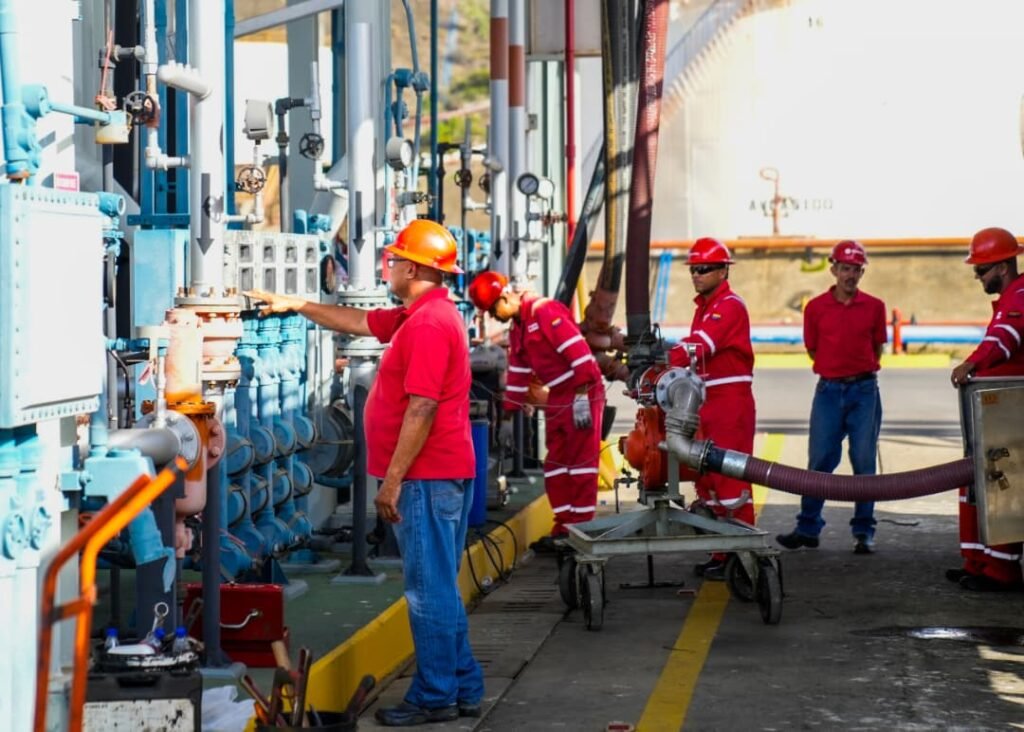
This move is significant. Chevron will incorporate the Ayacucho 8 block into its flagship joint venture, Petropiar, and will also increase its stake in Petroindependencia—from 35.8% to 49%, the legal maximum.
Petropiar produces over 100,000 barrels per day, while Petroindependencia produces around 40,000 barrels per day. At the same time, Chevron is divesting its stake in Petroindependiente in western Venezuela, where production remains below 2,000 barrels per day.
In short, Chevron is doubling down on its strengths—large-scale heavy and extra-heavy crude assets—while exiting smaller, less strategic operations and an undeveloped (greenfield) gas project.
Shell and the construction of an energy hub between eastern Venezuela and Trinidad and Tobago
For Shell, gaining control of the Loran field opens the door to leading gas development in the eastern Caribbean. It is important to understand the nature of this asset: the Loran field is part of the Loran–Manatee transboundary system, a single natural gas reservoir shared between Venezuela and Trinidad and Tobago but divided by maritime boundaries.
In practice, it is one geological resource under two jurisdictions: Loran in Venezuelan waters and Manatee in Trinidadian waters.
Chevron was not the “owner” of the gas but rather an operational partner on the Venezuelan side, a role it assumed during Venezuela’s offshore gas development push in the 2000s. In 2010, both countries agreed to unitize the field, treating it as a single development. However, technical delays, investment constraints, and later sanctions halted progress. By 2019, the project was de-unitized.
Now, under the new agreement, Chevron exits its operational role in Loran, which is transferred to Shell. This does not mean Chevron leaves the Trinidadian side, but rather that it ceases operating the Venezuelan portion of a still geologically unified system.
Beyond the asset swap, Shell is pursuing a broader strategy: transforming the maritime space between eastern Venezuela and Trinidad into an integrated gas production and export corridor for global LNG markets.
A key component is the offshore Hibiscus (Trinidad)–Dragon (Venezuela) system. Additionally, Shell is expanding gas transport infrastructure, including a pipeline capable of handling up to 1 billion cubic feet per day, up from the initially planned 700 million.
Carito and Pirital: Shell’s onshore strategy in eastern Venezuela
Shell is also exploring onshore integration, particularly in the Carito and Pirital fields in northern Monagas, which contain associated gas with commercial potential.
Due to their proximity to the coast and Trinidad, these fields could be connected via pipelines to offshore infrastructure.
The ultimate goal is clear: establish a direct chain from Venezuelan gas fields to Trinidad’s processing and liquefaction facilities, where gas can be converted into LNG and exported globally.
If successful, this would position the Venezuela–Trinidad axis as one of the most important energy hubs in the Western Hemisphere.
Venezuelan gas: a wasted resource amid urgent economic needs
Venezuela holds 221 trillion cubic feet of gas reserves—78% of Latin America and the Caribbean’s total—making it the seventh largest globally.
Yet the country produces around 4 Bcf/d and consumes only 1.7 Bcf/d, leaving a significant surplus unprocessed.
Globally, gas demand is expected to grow by 32% by 2050, and by 83% in Latin America between 2023 and 2035.
The issue lies in inefficiency. PDVSA’s Eastern Division—home to key facilities such as the José Complex and major refineries—is also the country’s main environmental liability due to widespread gas flaring.
In 2023, Venezuela flared approximately 9.763 billion cubic meters of gas, or 32.9% of its production, ranking among the top global emitters.
This represents both environmental damage and economic loss. Crucially, even a fraction of this wasted gas could meet domestic demand in Colombia and Trinidad and Tobago, highlighting a missed geopolitical opportunity.
From flaring to regional integration
Shell’s strategy directly addresses this inefficiency: capturing flared gas and integrating it into a regional pipeline network linked to Trinidad.
Rather than building entirely new infrastructure, the model reorganizes existing flows, leveraging Trinidad’s LNG capacity.
This could transform Venezuela from a system characterized by waste and fragmentation into a key regional energy supplier.
A new energy cycle for Venezuela?
The agreements with Chevron and Shell signal more than isolated investments—they suggest the beginning of a new energy cycle.
The combination of Orinoco heavy crude and offshore gas could reposition Venezuela as a relevant supplier, particularly regionally.
However, challenges remain: regulatory uncertainty, infrastructure deficits, operational risks, and geopolitical dependence.
More importantly, gas changes the nature of energy relations. Unlike oil, which operates in flexible global markets, gas—especially via pipelines—creates long-term structural interdependence.
Venezuela could thus shift from being marginal in “soft” oil connectivity to central in “hard” gas connectivity, building durable energy ties with Trinidad and beyond.
Venezuela is re-entering the global energy radar at a time of profound uncertainty. Its recovery is underway, but still overshadowed by larger crises—and embedded in an increasingly strategic competition between the United States and China.