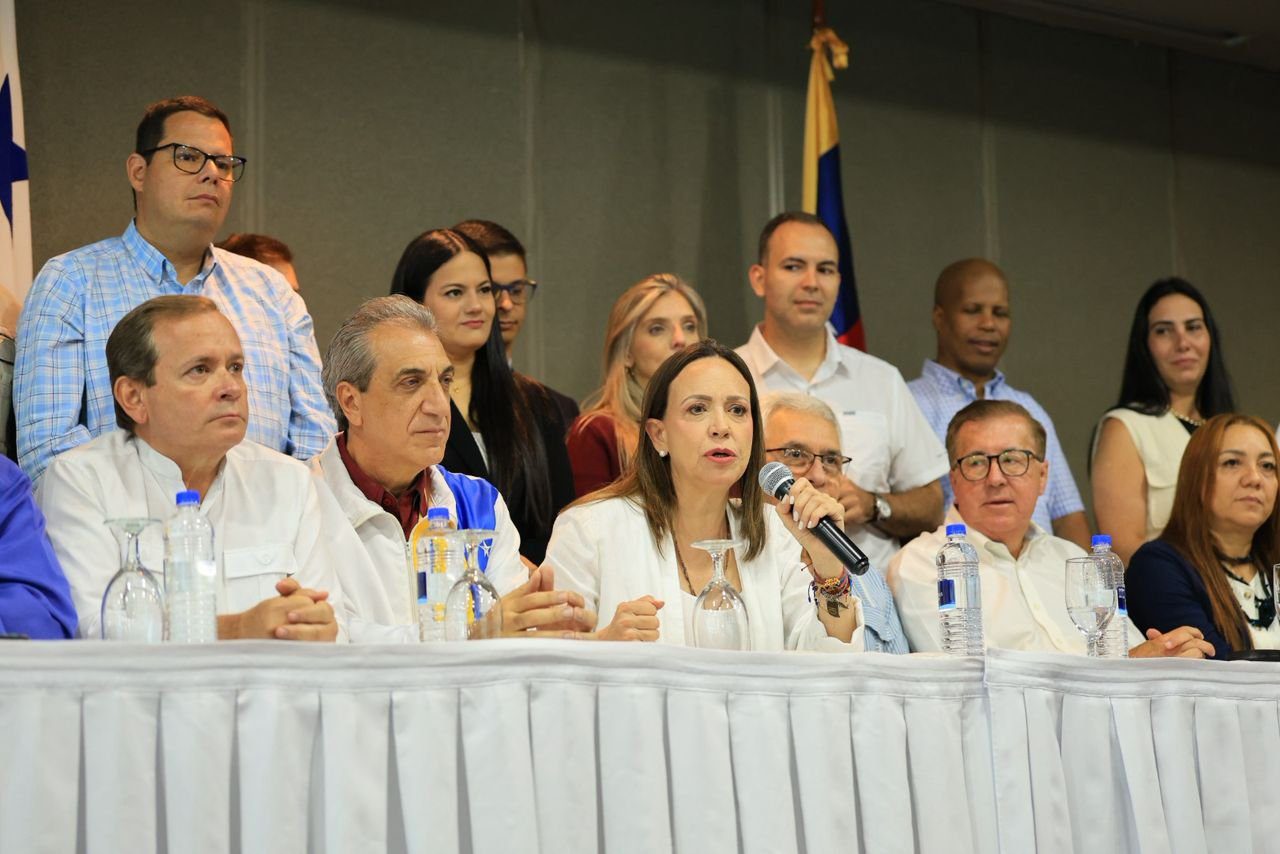
The articulation of a political, mobilization, and institutional agenda attempted to define a clear path toward achieving an electoral schedule. / Photo: Vente Venezuela.
Guacamaya, May 26, 2026. Between May 22 and 25, Panama City hosted political leader María Corina Machado in what constituted a multi-purpose visit aimed at a political transition in Venezuela. The focus was on a meeting held Friday with leaders from various opposition sectors, in order to define a common strategy for the new political landscape.
Following the capture of Nicolás Maduro in January of this year and the establishment of an interim administration under Delcy Rodríguez’s mandate, the foreign meeting represented the first in-person gathering of the full Unitary Platform in over two years. However, there were various reservations and reactions regarding the participating figures and the lack of concrete achievements.
A meeting protected under the three-phase plan
The debate revolved around the three-phase plan outlined by Secretary of State Marco Rubio: stabilization, recovery, and transition. The gathered opposition factions sought to articulate mechanisms for the United States to accelerate “Phase 2” and, fundamentally, to push for “Phase 3,” which involves holding presidential elections.
Machado was emphatic on this point: “To favor, accompany, and facilitate this plan, it is necessary for this process to culminate in a presidential election.” Thus, the central motivation of the meeting was the redefinition of a common strategy in the face of a scenario of U.S. oversight or protection over the Venezuelan transition.
The dynamic between unity and pragmatism
The meeting took place at the Megapolis Hotel and brought together around thirty leaders, including seven former political prisoners. The delegation included figures who traveled from Venezuela, such as Delsa Solórzano (Citizen Encounter), Juan Pablo Guanipa (First Justice), and Biagio Pilieri (Convergence), as well as exiled leaders like Leopoldo López (Popular Will) and Antonio Ledezma (Brave People’s Alliance).
The arrangement in the press room was designed to project an image of breadth and order. After an internal draw, Machado, who occupied the center, was flanked on her right by leaders from Democratic Action and on her left by center-left sectors and figures from dissident Chavismo, such as Rodrigo Cabezas (former Finance Minister) and Atenea Jiménez (Alliance for Sovereignty and Democracy).
The inclusion of former pro-government officials, as well as representatives of the old opposition guard, was promoted as an effort to broaden the coalition’s base. This seems to respond to recommendations made by Rubio in January. “The only way to have a free and prosperous Venezuela is for all sectors of society to have a say in politics,” he noted.
Nevertheless, internal tensions in public opinion and questions from María Corina Machado’s own traditional followers were not long in coming, after she gave space to alternative figures. Furthermore, the meeting also allowed them to move beyond the debate over recognizing the 2024 presidential results to focus on demanding new elections.
This perspective was also endorsed by Edmundo González Urrutia, to whom most of the opposition attributes victory in that election. The former unitary candidate, despite recent health problems, participated virtually from Madrid and blessed the meeting, also calling the path toward new elections a “point of no return.”
Reactions, achievements, and reservations
Other internal reactions were marked by efforts to dispel doubts about a possible “distribution of quotas.” Antonio Ledezma was emphatic: “This is not an agreement to distribute power quotas.” In turn, Leopoldo López confirmed cohesion around the candidacy of the Vente Venezuela leader: “We are aligning a common route, which is to have an election with María Corina as a candidate.”
Collectively, the attendees ratified the need for a guaranteed presidential electoral process, including a new CNE (National Electoral Council) and an update of the electoral registry for Venezuelans abroad. The debate was over timing: While Machado’s team estimates a period of 7 months as viable, other sectors see a longer horizon, towards 2027 or even 2028, an option that Washington is pushing.
In parallel, there were reservations among other opposition sectors. The president of A New Era, Manuel Rosales, did not respond when asked about the meeting during a press conference, although he reaffirmed his organization’s commitment “to unity” and “the electoral path.” His party, excluded from the Unitary Platform in 2025, along with Union and Change, makes up the “Libertad” faction, the main opposition force in the National Assembly, a coalition that also did not echo the meeting.
An agenda that integrated mobilization and institutional meetings
After the conclave, Machado led a symbolic rally on Saturday on Cuba Avenue, which gathered Venezuelan migrants, although it did not have the massive attendance she has had in other countries. During the event, the leader reaffirmed her promise to return to the homeland “very soon,” despite having postponed the date on several occasions in her various appearances.
“This is a pact with the people, not just with parties,” she asserted at the public event, after being questioned on social media about the controversial meeting, the invited political figures, and the absence of a concrete agreement. Subsequently, and not far from controversy, she held a meeting on Sunday with the Israeli ambassador to the Central American country, Mattanya Cohen.
The trip, however, culminated in a high-level diplomatic agenda on Monday, May 25. Machado was received at the Palacio de las Garzas by President José Raúl Mulino and Foreign Minister Javier Martínez-Acha. She also received the Keys to Panama City from Mayor Mayer Mizrachi, a gesture symbolizing regional support for her cause.
Perspectives and challenges for the opposition
Going forward, the opposition is expected to intensify national and international pressure to force a concrete electoral schedule. The challenge will be to keep actors with such disparate backgrounds together—from the traditional opposition to dissident Chavismo—while facing the survival strategy of the interim government, which seeks to buy time under the protection of the United States.
Machado, despite garnering support from many sectors, failed to communicate concrete results from the meeting. The uncertainty about the possibility and proximity of her return also brings to the debate the viability of the different electoral options and the mechanisms for achieving presidential elections.