Carlos Delgado Flores is a journalist, a professor at UCAB, and a researcher in knowledge society and digital culture.
Guacamaya, July 24, 2026. Among the responses that self-organized citizens have given to the emergency caused by the two earthquakes on June 24 in Venezuela, one of the most impressive has been the co-creation, in less than 72 hours, of nearly 130 digital applications for reporting information. Many of these have been cataloged by Acceso Libre, an organization dedicated to protecting online freedom of expression, digital privacy, and free access to information for all Venezuelans, according to its own definition.
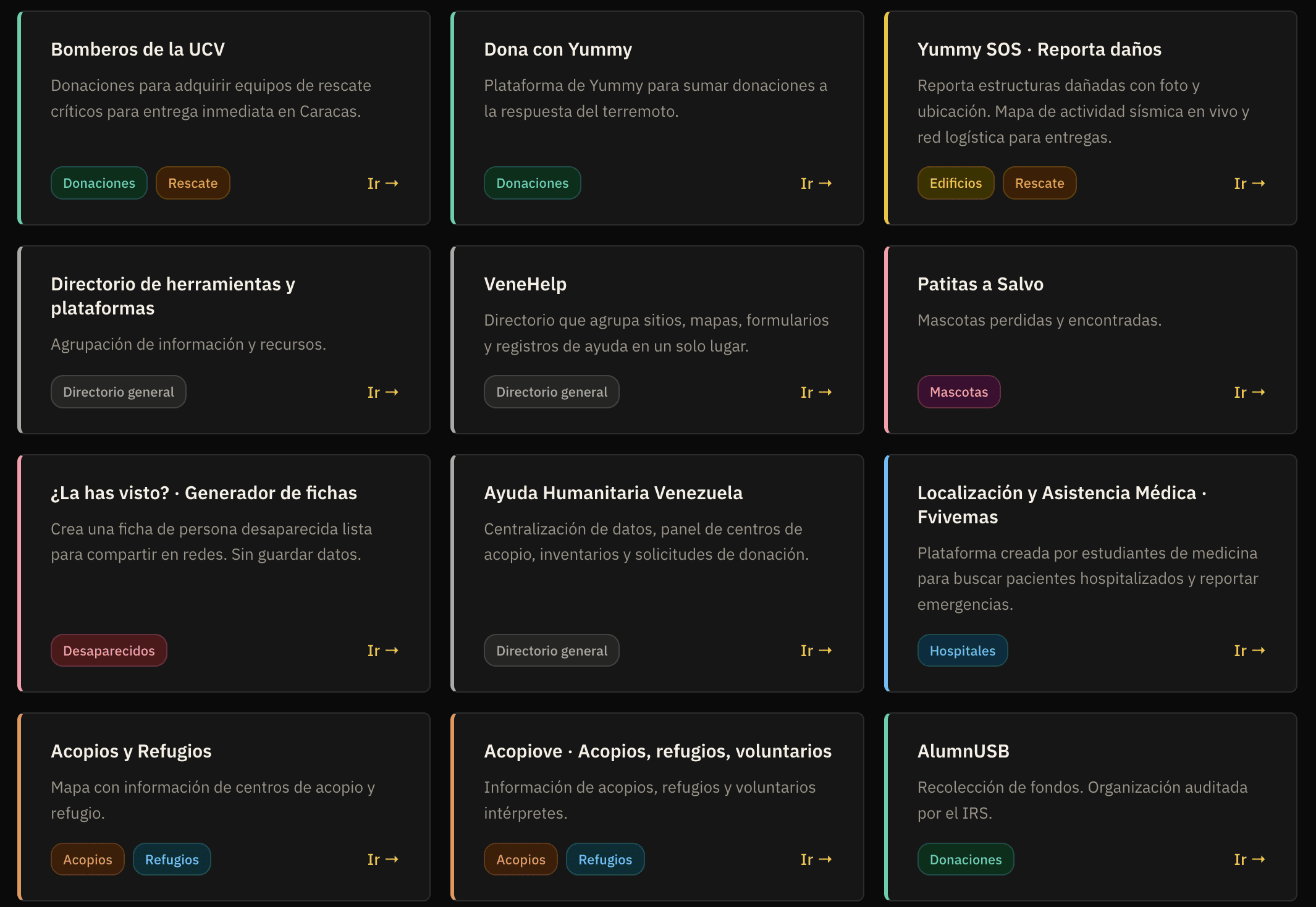
The applications—127 so far—were developed mostly by volunteers and are grouped into the following categories: Collection Centers, Missing Persons, General Directory, Donations, Maps, Pets, Doctors, Children, Rescue, Shelters, and Mental Health. Likewise, their records are up to date as of the date of this publication.
Marianne Díaz, director of Acceso Libre, is a writer, lawyer, and digital human rights activist. Her explanation of the initiative is eloquent, centering on the very contingency: “Originally, a message appeared from someone looking for their mother among those missing in the tragedy; that search led to a map and then to six more layers emerging, with data contributed by people, in an exercise of human crowdsourcing to classify, generate categories, and establish reliability criteria, later enhanced with data scraping powered by Artificial Intelligence” (Claude, to be precise, which does not operate in the country by decision of Anthropic itself).
Díaz continues the account: “I put out a call for volunteers and 500 showed up, and when we saw there was too much information to verify and that it couldn’t be unified into a single application, we thought of a solution that would add value, and that was when we set up the directory.”
A review of the directory provides access to collaborative maps for reporting the injured, missing persons, donations, shelters, resource availability, or pet accommodations, among other categories. Some are developed on Google Maps, others on Kobo©, others on Arcgis©, no-code, in freemium versions of paid applications; not all will be available for long.
These applications speak to three things: people’s willingness to organize for management, to operate as a swarm, and not to wait for the State or institutionalized leadership to collaborate. “There is a network, a structure that is not, from the outset, praiseworthy, in which civil society substitutes for the State,” Díaz notes, adding: “This is beautiful.” But is this an exercise in democratization of civil society through social learning? We must keep watching.
Catastrophes—it is a fact—accelerate social learning and allow for the emergence of new leadership, first focused on the contingency, later won over to political agency.
An important exercise to undertake at this hour is to identify active collaborators in communities and their capacity to articulate networks strategically. Marianne Díaz identifies three stages of communication after the earthquakes: 1) “I help because I need to help”; 2) “I identify actions that truly help”; and 3) “I orient myself toward the other, highlighting identity.”
“In the process with the volunteers, I have had to distinguish moments of guidance from moments when we do what they say. The true leader renounces ego,” she acknowledges, while emphasizing that culturally we can indeed cultivate a different kind of leadership, because “we are a deeply good country, with all the trash-talking included; a country that goes beyond anti-values, that articulates itself as a bridge: we are friends, we are going to help each other, we build familiarity, and from this, the social fabric is formed.” Her words resonate with the theme of the convivial Venezuelan.
After this emergency, Marianne Díaz will return to the tasks of her online course Rebuilding the Republic, dedicated to the topic of generating consensus in democracy, for which people remained on a waiting list. And she will do so with her hair on end.