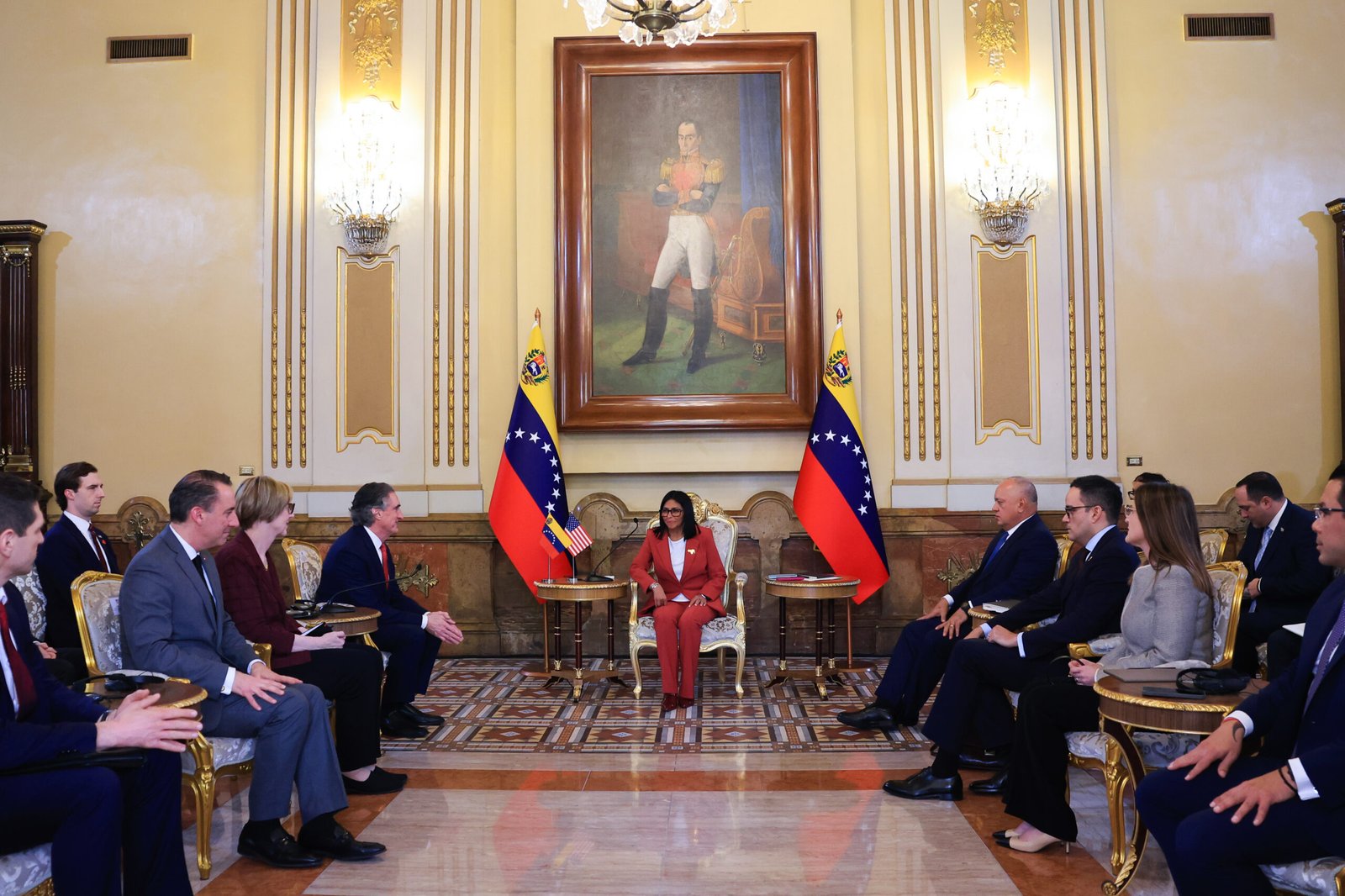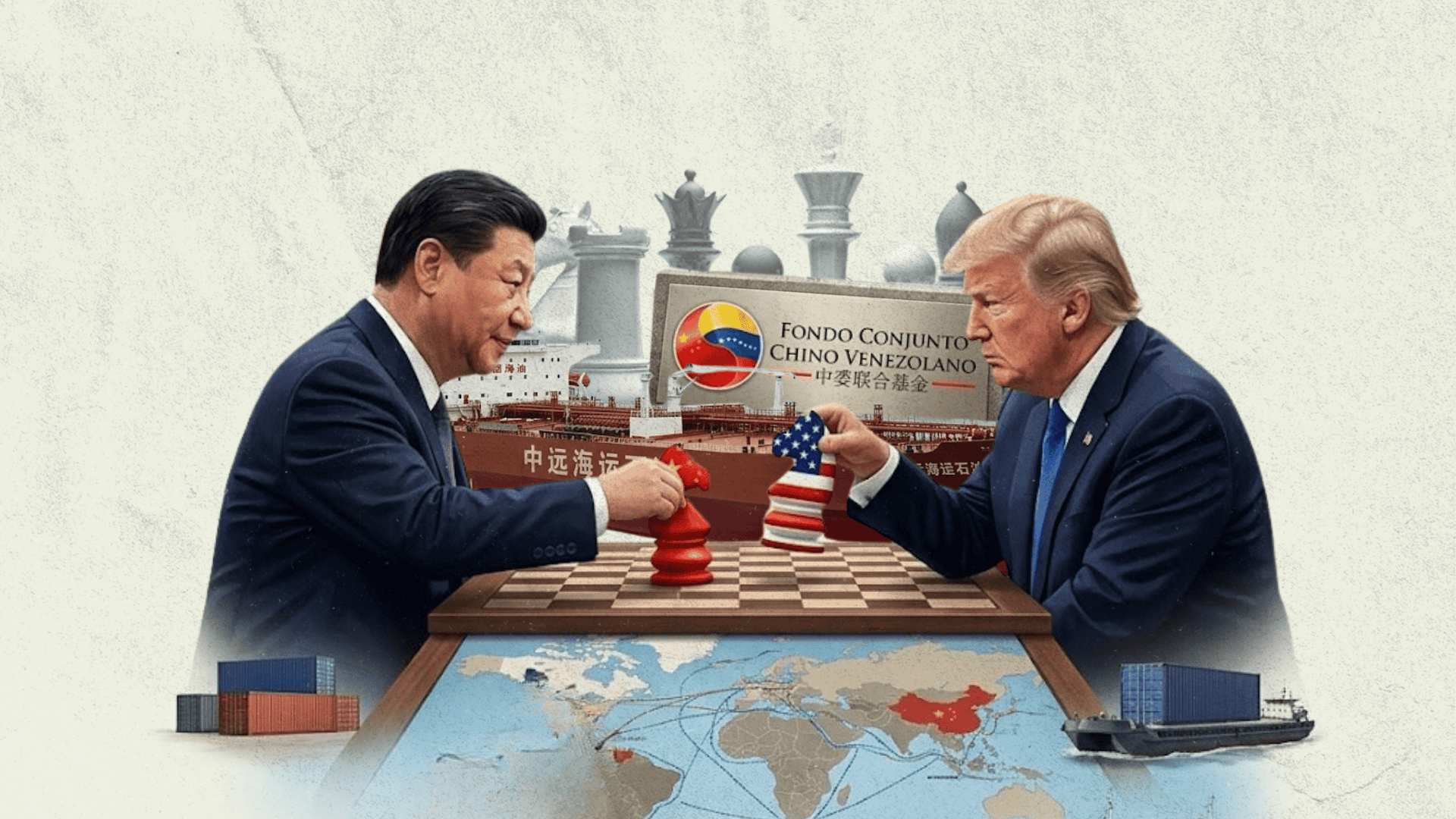
Although Chinese state entities represent only a relatively small portion of Venezuela’s sovereign debt, they have a crude oil-backed collection scheme and could invoke veto power. Image: Guacamaya.
Guacamaya, August 4, 2026. The Venezuelan government’s decision to initiate a comprehensive restructuring of its external public debt and that of PDVSA transcends the strictly financial realm. The announcement, made on May 13, coincided with President Donald Trump’s visit to China, amid growing tensions between Washington and Beijing over trade, energy, and economic security. This overlap in timing is no coincidence, as it places the Venezuelan process within a much broader dispute over control of energy flows and global financing sources.
U.S. officials have begun framing policy toward Venezuela as another piece in the competition with China for access to energy resources. This reading suggests that the future of Venezuelan debt—and its oil sector—will be increasingly conditioned by the rivalry between the world’s two major powers.
China: A Creditor with Veto Power
China holds a relatively modest portion of Venezuela’s external debt. According to various estimates, it stands between $10 billion and $12 billion, compared to a total of approximately $170 billion—an extreme calculation puts it as high as $240 billion—if we include bonds, arbitration awards, unpaid invoices, and other types of debt.
Much of that exposure, however, is secured by oil shipments, giving Beijing a collection channel directly connected to the country’s main export asset. Under this type of repayment, the full nominal value is considered, without the haircut that would be common in a restructuring. This structure allows it to delay or complicate a comprehensive debt renegotiation, especially if it prefers to continue collecting in crude rather than accept a writedown.
This poses a fundamental problem for any negotiation under the IMF umbrella: the principle of “comparable treatment,” which seeks to prevent some creditors from retaining privileged collection mechanisms while the rest absorb losses.
Rachel Lyngaas, a senior researcher at the RAND Corporation and former chief sanctions economist at the U.S. Department of the Treasury, describes the Venezuelan process as nascent: “While the May 13 announcement of a comprehensive restructuring was an important step and we have already observed the mobilization of a creditors’ committee, in practice the process has not advanced much beyond that.”
Lyngaas warns, in comments to Guacamaya, about the secrecy of the process: “The fact that these conversations are taking place outside the formal IMF channels and under almost total secrecy implies a critical lack of transparency. As of today, there are no concrete elements to specify what China’s final approach will be or how it is internally managing this negotiation.”
Faced with this void, the researcher proposes looking at recent precedents: “Lacking detailed public information, we must look back at restructuring precedents in countries like Zambia or Sri Lanka. In those cases, it became clear that China does not approach these processes exclusively from a financial perspective; it always processes them through a deeply geopolitical lens.”
Precedents Are Important: Lessons from Zambia, Sri Lanka, and Ghana for Venezuela
China went, in two decades, from being a marginal player in sovereign financing to becoming the main bilateral creditor of the developing world, especially through infrastructure, energy, and commodities. Unlike traditional creditors of the Paris Club—the United States, France, Japan—Beijing operates with a more fragmented architecture: state banks, development funds, and frequently opaque contracts, many backed by natural resources or future revenue.
This institutional difference has generated growing frictions in sovereign restructuring processes, because China does not automatically accept the parameters promoted by the IMF and the Paris Club.
Zambia is the most emblematic case. The country defaulted in November 2020 with China as its largest bilateral creditor. The IMF conditioned its bailout on official creditors offering “financing assurances”—credible commitments to an orderly restructuring—but negotiations extended over two years due to disagreements over the “debt perimeter,” meaning which loans should be included and which China considered commercial rather than official debt.
This African country offers the most representative example of the difficulties that can arise when China is the main bilateral creditor. After defaulting in 2020, the country had to wait more than two years to obtain a comprehensive restructuring agreement due to disagreements between China, the Paris Club, and other creditors over which loans should be included and how to distribute losses.
The delay postponed the full disbursement of the IMF program, limited access to new financing, and prolonged uncertainty for investment and economic recovery. Only after China agreed to coordinate negotiations under the G20 Common Framework and an understanding was reached on the treatment of official debt, was it possible to advance with the restructuring and gradually stabilize the country’s financial outlook.
Sri Lanka, after the economic collapse of 2022, experienced a similar problem. China was reluctant to accept explicit writedowns and preferred maturity extensions, which delayed for months the unblocking of the IMF program.
In Sri Lanka, the main obstacle to activating the IMF program after the 2022 default was obtaining guarantees from bilateral creditors, especially China, which held about 52% of the country’s bilateral debt. While the Paris Club and other creditors accepted moving toward a restructuring with a reduction in the present value of the debt, China avoided backing explicit writedowns and primarily proposed extending maturities and refinancing due dates.
This divergence delayed the IMF financing agreement for several months, prolonging the foreign exchange shortage, import restrictions, and economic recession. Only when China issued financing assurances considered sufficient by the Fund, in March 2023, was the $2.9 billion assistance program approved, allowing macroeconomic stabilization and negotiations with creditors to begin.
Ghana defaulted in December 2022 amid record inflation of 54.1%, and availed itself of the G20 Common Framework to restructure its debt. China, its largest bilateral creditor with $1.7 billion (about 80% of debt outside the Paris Club), co-chaired the official creditor committee alongside France and, after providing financing assurances to the IMF in December 2023, signed the agreement in May 2024 to restructure $5.4 billion of bilateral debt.
That pact activated the principle of comparable treatment, forcing private bondholders to match China’s favorable terms, which led Ghana to close in April 2024 a 37% haircut on $13 billion in bonds.
The pattern has a concrete economic cost: the longer a country remains trapped in unresolved negotiations, the deeper the contraction, the greater the capital flight, and the slower the investment recovery. For the Trump administration, which needs to present Venezuelan stabilization as a success of its hemispheric security doctrine, this risk of stagnation is a direct threat to its political narrative.
Although Venezuela’s debt to China is smaller in relative terms, its oil and collateralized component gives Beijing pressure tools much greater than the size of its claim suggests. It is not far-fetched to think that China will repeat, with nuances, the script of Zambia or Sri Lanka—not openly blocking an agreement, but delaying or conditioning it enough to affect the viability of an IMF-backed program.
A Decisive Actor, Even Without Being the Largest Creditor
What distinguishes China is not the size of its debt, but its collection mechanism, through oil cargoes. This weight is also explained by the context of sanctions on PDVSA; Venezuela lost traditional buyers and became increasingly dependent on China, which became the main buyer, although the absolute volume of cargoes fell.
Added to this is the persistence of mixed companies such as Sinovensa and Petromonagas—linked to China and Russia—which, according to economist Tamara Herrera, in her chapter of the book On Sanctions in Venezuela, have maintained their contribution almost constant, around 20% of national production. Beijing thus consolidated itself as a buyer of last resort and a creditor with direct influence over the country’s oil revenues. We are no longer only talking about an energy investment, but a mechanism of financial and geopolitical pressure.
“This financial design gives China a disproportionate influence over Venezuela’s real payment capacity, which in a conventional restructuring would force the IMF to secure Beijing’s participation in order to advance,” says Lyngaas. “However, the Venezuelan case is atypical: today, the Fund is out of the picture and the process rests, to a large extent, on the management of Centerview Partners.”
For the researcher, this model of “out-of-program restructuring” is a double-edged sword: “While the evident advantage is speed, my great concern lies in transparency. A restructuring requires, by definition, a debt sustainability assessment that is common and accepted by all parties; historically, it is the IMF that guarantees that technical credibility. I am very skeptical that a private advisor can produce an analysis of that caliber that is binding or credible for such a heterogeneous group of creditors.”
There is, however, a paradoxical way out. As Lyngaas puts it: “By operating outside the IMF framework—and therefore, not being strictly subject to the principle of comparable treatment—the process could allow the rest of the creditors to move forward without China. In that scenario, if Beijing decides to stay out, it would simply be left out of the payment scheme. Paradoxically, this would nullify its blocking capacity and its procedural delay tactics.”
Washington’s Bet: Diversify Buyers
In an article published in January 2026 in The Sanctions Age titled “How to Ensure China Doesn’t Spoil Venezuela’s Debt Restructuring,” Lyngaas argues that “the United States should reduce the weight of Chinese influence over Venezuela’s recovery by decreasing Caracas’s dependence on the Chinese market as the almost exclusive destination for its oil exports.”
In her view, the main risk to U.S. interests lies in Beijing consolidating itself as the “residual buyer” of Venezuelan crude during a possible political and economic transition, which would allow it to preserve preferential payment mechanisms linked to oil debt. To avoid this, she proposes fostering an early diversification of Venezuelan oil buyers and designing a transparent restructuring scheme that limits parallel agreements or opaque repayment mechanisms, as well as offering creditors long-term financial instruments tied to a possible recovery in oil production, so that China can accept writedowns without needing to maintain privileged access to export flows.
When assessing the current landscape, Lyngaas notes: “I think it is evident that, both by paving the way toward recognition of Venezuelan authority under Delcy Rodríguez, and by facilitating a re-engagement between the Venezuelan government and the international community, a new space for interaction has opened up. We have observed how institutions like the International Monetary Fund and, in my view, also the World Bank, have adopted a similar line of approach.
In parallel, the U.S. administration has granted licenses to oil companies to resume operations in the country, which makes it clear that there is a strategic intention to increase the participation of U.S. actors in the Venezuelan oil sector.”
The logic is simple: the less diversified the Venezuelan oil market, the greater China’s capacity to use its dual status as creditor and buyer as a pressure tool against the IMF and other creditors. A greater market opening, on the other hand, reduces the room for opaque bilateral agreements.
The Pieces on the Board: Western Companies, the Indian Market, and “Donroe” Diplomacy
This thesis is reflected in recent moves in the Venezuelan energy sector: on the one hand, the entry of large Western multinationals such as BP, Shell, TotalEnergies, ExxonMobil, and ConocoPhillips is being encouraged, along with the expansion of Repsol and Eni; on the other hand, Washington is also supporting the entry of exclusively U.S. “wildcatters” such as HKN, Hunt Oil, Crossover Oil, Aspect Holdings, and Continental Resources.
The line connects the licenses granted to Chevron under Biden with Trump’s current approach: reopening the market to the United States, Europe, and India reduces dependence on China and its capacity to influence a possible IMF-backed restructuring. The more buyers Venezuelan crude has, the less pressure power a single creditor—in this case, China—can exert.
In the book On Sanctions in Venezuela, economists Asdrúbal Oliveros and Jesús Palacios argue that the sanctions, far from weakening China and Russia, strengthened irregular marketing schemes and consolidated opaque circuits for placing Venezuelan crude, without reducing international oil prices. The current easing of sanctions and the return of Western companies are, according to that same logic, reversing the incentives that for years favored that concentration in alternative intermediaries.
A concrete example of this strategy is the agreement reached between the United States and India in 2026 to facilitate Indian refiners’ access to Venezuelan crude under U.S. licenses, in a context of pressure on New Delhi to reduce its purchases of Russian oil. For India, the agreement means supply diversification; for Washington, it reduces India’s dependence on Russia and expands the buyer base for Venezuelan crude.
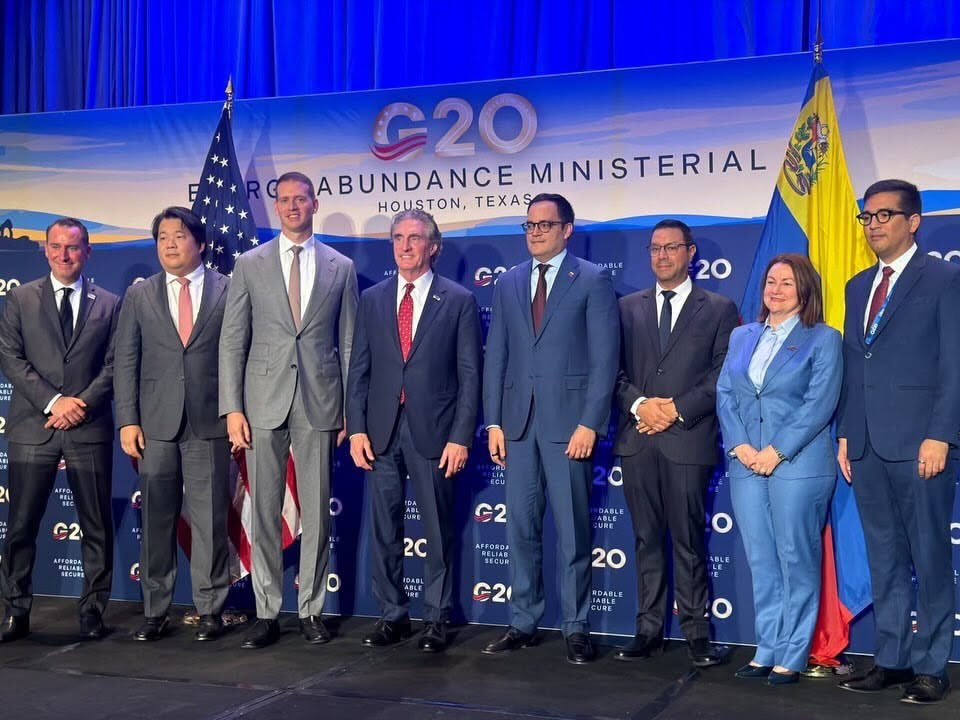
The statements of Secretary of the Interior Doug Burgum about preventing China from acquiring Venezuelan and Iranian oil at low cost summarize this logic: Venezuelan crude ceases to be just an export product and becomes a strategic asset within the competition between Washington and Beijing.
Within that same architecture fits the designation of John Barrett as the U.S. representative in Caracas. His previous experience in Panama, where he helped limit Chinese influence over the Canal and its logistics infrastructure, positions him as a diplomat specialized in great-power competition. His arrival can be read as the “operational management” phase of the strategy based on ensuring that Venezuela’s energy opening results in a fragmented network of buyers led by the United States, rather than greater dependence on China.
Transparency: The Missing Piece
Added to this diplomatic and commercial architecture is the announcement by Treasury Secretary Scott Bessent about external auditors to oversee oil flows, part of the “controlled opening” that Washington is building in the energy sector. The new supervision framework—external audits, license control, and flow monitoring—seeks to reduce the margin for hidden payments and generate the institutional confidence necessary to stabilize the restructuring, especially in view of a possible IMF program.
However, U.S. legislative reports indicate that the lack of a defined agreement on auditing, together with the complexity of financial circuits—custody accounts, OFAC licenses, intermediation structures—limits the real effectiveness of these controls. A recent New York Times article points in the same direction: despite promises of greater transparency from Caracas and Washington, opacity persists, from the structuring of contracts to the final circulation of revenues. The fact that a good part of Venezuelan bonds are governed by New York law, nevertheless, reinforces Washington’s capacity to influence the country’s financial ecosystem.
For Lyngaas, an independent monitoring mechanism is preferable to the alternative: “From Venezuela’s perspective, implementing an independent monitoring mechanism is, in the long term, much more preferable than being subject to the management of a single actor in control of its revenues. It is not only a convenience for the government; it is a step that also benefits the creditors who aspire to be repaid, the international community, and fundamentally, any actor that values a minimum of transparency.”
But she warns that the effectiveness of any program depends on avoiding parallel payments and off-balance-sheet repayment structures, especially vis-à-vis creditors with privileged access to export flows, such as China. Oil, she notes, operates simultaneously as a commercial asset, a sanctions instrument, and a tool of great-power competition, which structurally limits even the most sophisticated control mechanisms.
The Knot of “Comparable Treatment”
Another recurrent point of friction is the principle of comparable treatment, under which China often demands guarantees that private creditors—bondholders, traders—absorb losses equivalent to those requested from Beijing.
Lyngaas describes it as follows: “The principle of comparable treatment is, indeed, one of the most recurrent breaking points in sovereign debt negotiations; it is a systemic concern of the international community, not a phenomenon exclusive to Venezuela. The great lingering question is how to ensure that equity when some creditors have instruments linked to commodities or specific guarantees that place them in a privileged position.”
According to the researcher, the reluctance of other financial actors is fully justified: “It is understandable that creditors attempting to participate in the restructuring are cautious. If there is no clarity on the value and priority of those collateralized assets, it is very difficult for them to accept moving forward under current conditions.”
Lyngaas concludes on this point with a reflection on the limits of current expertise: “Honestly, there are no easy solutions to this Gordian knot. Beyond enhancing transparency and the acceleration mechanisms we have discussed, we are facing a challenge of high-complexity financial engineering.
There are academics and researchers delving into this issue currently, and I believe the definitive answer on how to harmonize these opposing interests is still in the process of being built.”
Other Actors Also Play a Role: The Case of Congo
“We must not fall into the error of pointing solely at China as the obstructive actor par excellence; private creditors can be equally or more decisive, as we already saw in the case of the Republic of Congo,” Lyngaas clarifies.
In that case, private creditors were the biggest obstacle in the restructuring of Congolese debt. Traders Glencore and Trafigura, which had financed the country with loans secured by future crude cargoes worth about $1.7 billion combined, resisted accepting writedowns for years, even suspending oil deliveries as a form of pressure in 2020. While China closed its own restructuring in 2019, Trafigura only finalized its agreement in March 2021 and Glencore took even longer, delaying for more than two years the full disbursement of the rescue program that the IMF had approved for the country.
On the lessons of this case for Venezuela, Lyngaas warns: “Nevertheless, if I had to offer advice to Venezuelan authorities, I would say that this approach of operating outside the IMF can be a double-edged sword: while it facilitates speed and allows building consensus among the majority of creditors—reducing the blocking capacity of individual actors—the real challenge is credibility.”
For the academic, the greatest risk of this strategy lies in the information vacuum: “Venezuela’s ability to present statistics that are accepted as truthful by the international community and the private sector is the real obstacle. This is extremely difficult to achieve without the technical seal of the International Monetary Fund.”
A Middle Path
Lyngaas proposes an intermediate path for Caracas: “I consider it vital that IMF staff have a presence on the ground, advancing the updating of statistics and the eventual publication of an Article IV report, something that has not happened in two decades. Even if the government decides not to hand over to the Fund the keys to the creditors’ committee, getting the organization to issue a Debt Sustainability Assessment (DSA) would provide the necessary legitimacy to set the process definitively in motion.”
On China specifically, she does not anticipate frontal resistance: “At the end of the day, we are talking about a relatively modest figure for China, estimated between $10 billion and $12 billion in outstanding claims. I do not imagine this is a scenario where Beijing decides to resist a writedown frontally, especially if the rest of the creditors are accepting similar conditions under a framework of equity.”
But she shifts the discussion to a deeper hemispheric plane: “It is difficult to project exactly what China’s future trajectory in Latin America will be. However, it is evident that the much more assertive posture that the U.S. government is adopting in hemispheric affairs is changing the rules of the game. We are facing a phase of strategic reconsideration.”
And she closes by observing a change of tone in Asian power circles: “In fact, I have already identified in Chinese academic literature an incipient discussion about the need to adopt a much more cautious approach in their financial and diplomatic deployment in the region.”
On the oil guarantees that underpin much of China’s debt, Lyngaas is blunt: “Guarantees backed by oil cargoes are inherently risky in any debt agreement. Volatility in commodity prices is a very difficult factor to predict. Although the current environment of high prices may seem promising for cash flows, prices can fall drastically overnight. I do not consider these mechanisms to be, ultimately, in the best interest of the debtor country; they must be approached with extreme caution.”
One Interdependent System
The restructuring of Venezuela’s debt cannot be read as an exclusively financial process. It is an intersection of economics, energy, and geopolitical competition, where the centrality of oil as a payment asset, the fragmentation of creditors, and the presence of collateralized mechanisms have turned the country’s macroeconomic sustainability into a function of both the IMF’s technical coordination and the power balances between major powers. China does not act only as a bilateral creditor; it is a structural actor with capacity to influence the timing, conditions, and architecture of the final agreement.
The growing diversification of buyers, the return of Western energy companies, and the use of Venezuelan oil as an adjustment instrument within U.S. energy policy add an additional layer of complexity. Debt, oil, and sanctions today operate as parts of the same interdependent system, where each financial decision has direct implications for the distribution of global influence.
The outcome of the Venezuelan restructuring will ultimately depend not only on the country’s technical capacity to close an agreement, but on how the competition between the models of international insertion that today dispute the control—direct or indirect—of its main energy flows is resolved. It is a discussion that transcends Venezuela’s numbers and finances, with implications for the country’s sovereignty and its future.