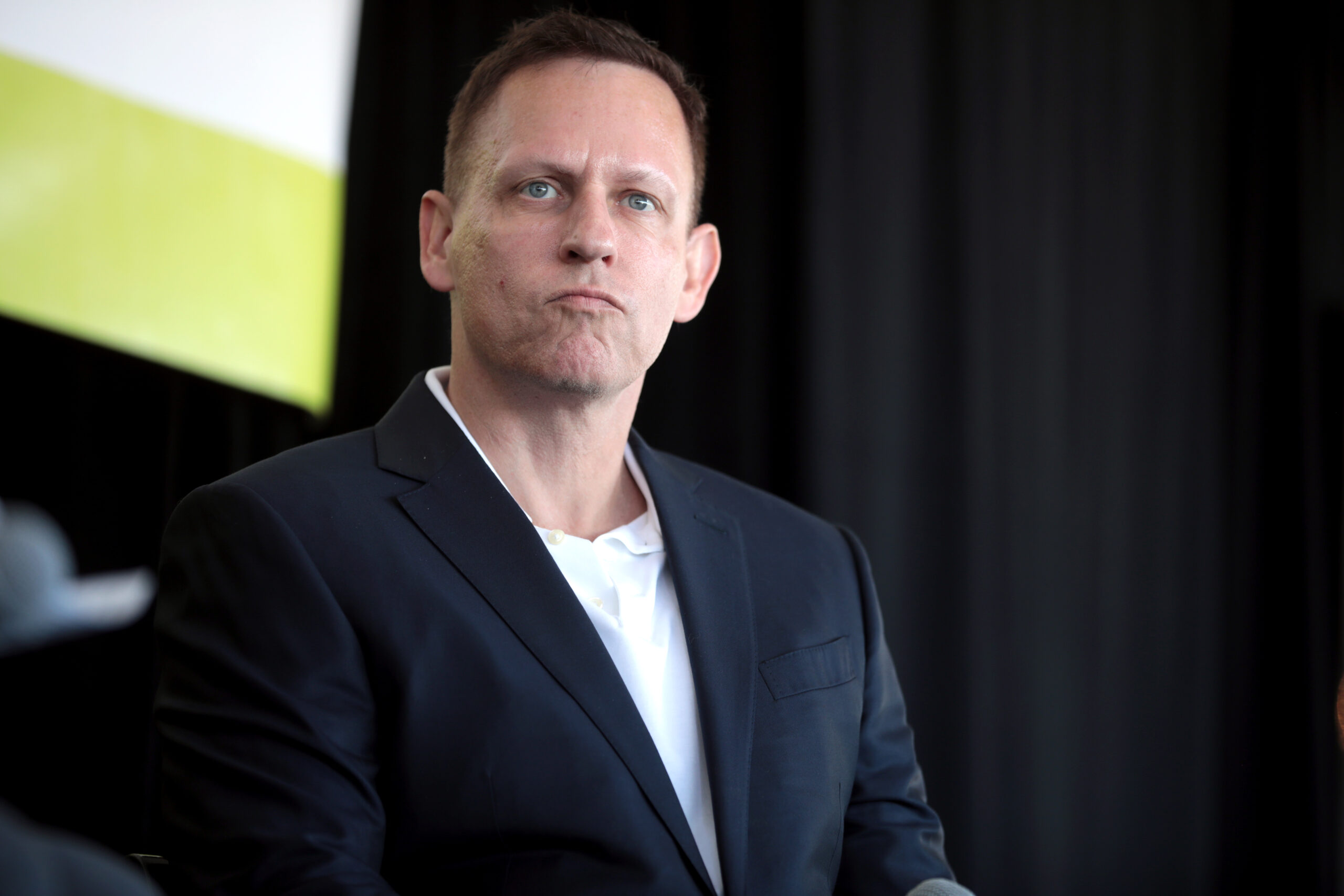
Peter Thiel, founder of companies such as Palantir, PayPal, and Founders Fund, is a German-American venture capitalist with growing influence in U.S. politics as well as in other countries. Photo: Gage Skidmore.
Guacamaya, August 6, 2026. Peter Thiel, venture capitalist and now also one of the leaders of the new techno-right in the United States, has his sights set on Venezuela. His investments, which combine the pursuit of profitability with his ideological vision of the world, have already begun to appear in the South American country.
The new Venezuela after January 3 holds a completely different meaning for the United States. This is no ordinary foreign policy operation, as several illustrative cases show. In recent months, there have been visits from multiple high-ranking U.S. government officials, including Secretaries Chris Wright and Doug Burgum; a thaw in relations with Israel has occurred; and one of the most influential lobbying firms under the current Trump administration is establishing itself in Caracas.
In this context, although they have not made major announcements, U.S. technology and arms industries are also eyeing Venezuela. Not attracted by a local market, but by strategic resource reserves, now largely controlled by Washington’s directives.
Thiel’s trajectory largely explains his path to becoming the business and ideological leader he is today. He was born in Frankfurt am Main; at one year old, his family emigrated to the United States and then to South Africa and Namibia, where his father worked in mining during apartheid. The man who now looks toward Venezuelan coltan and rare earths was shaped as a child in the world of Southern African mines.
After Stanford, he co-founded PayPal and became known as one of the members of the so-called “PayPal Mafia,” alongside Elon Musk, David Sacks, Max Levchin, and Reid Hoffman, among others. Through Founders Fund, created in 2005, he was an early investor in companies like SpaceX, Facebook, Stripe, Spotify, Polymarket, and Palantir Technologies, where he is listed as a founder.
His investment career is combined with the use of theses from certain philosophers to promote his vision. We find Carl Schmitt, a jurist committed to Nazism itself, and Leo Strauss, the Jewish philosopher who fled Germany but retained his distrust of mass democracy. Both maintained that all real politics rests on the ability to decide who the enemy is and when the norm must be suspended. From Schmitt, he took the idea of the sovereign who decides the exception; from Strauss, the conviction that certain truths can only be communicated in an esoteric register, reserved for those who govern.
Thiel has cited, via Schmitt, the key to his thinking: Ausnahmezustand, which in German means “the state of exception.” The sovereign is not the one who governs in normality but the one who decides when to suspend it. Thiel turned that idea into the core of his business philosophy based on the founder-monarch who stands outside the rules of the market, the “Straussian moment”—he titled one of his most cited essays that way—in which the West must accept esoteric truths reserved for those prepared to govern. Every decision of his, whether business, financial, or banking, is the repeated exercise of that same faculty.
Behind Political Power: The United States, Honduras, and Argentina
In 2022, Thiel allocated $35 million to Republican candidates, including JD Vance, now Vice President. In other years, he has also made contributions to Republicans, though smaller, including $1.5 million for Trump’s first presidential campaign.
The donations he has made through the Thiel Foundation reflect some of his priorities: he supports artificial intelligence projects, life extension, and seasteading—maritime territories beyond the reach of governments. He has also pushed these ideas outside U.S. territory. In Honduras and Argentina, where he perceives more malleable governments, we see him promoting regulations and territories with less state control.
Since 2017, he has backed Próspera, a charter city on the island of Roatán in Honduras. Operating as a “Zone for Employment and Economic Development” (ZEDE), it is a territory under a fiscal, legal, and regulatory framework different from the rest of the country. The governing council has five elected members and four appointed by Honduras Próspera Inc., financed by venture capitalists. Government decisions require a two-thirds majority, so the latter have veto power.
The now former president of Honduras, Xiomara Castro (2022-2026), tried to repeal the ZEDE law and end the charter city. This led to litigation at ICSID, where Próspera is claiming $10.7 billion—a quarter of Honduras’s GDP. Its founder, Erick Brimen, paid “hundreds of thousands of dollars” in lobbying in Washington, trying to secure sanctions and the cessation of U.S. assistance if Castro did not cease her offensive against Próspera. The ZEDEs remain operational today.
In Javier Milei’s Argentina, we see a broader approach. Thiel settled in Buenos Aires this year and traveled several times to Patagonia, where—according to corroborating reports from various media—his fund Founders Fund would be exploring the construction of a network of data centers leveraging the natural gas surplus from Vaca Muerta, through Crusoe Energy Systems, and the region’s watercourses for cooling.
The offer to Milei, as described by the Argentine press, combines three elements: legislation without restrictions for the development of artificial intelligence, unlimited openness to foreign capital purchasing land, and an explicit state commitment not to regulate. Palantir also has contracts to manage Argentine state data. It is, in essence, the same logic as Próspera transplanted to the scale of an entire region of a sovereign country, with Palantir positioned to operate as the infrastructure managing the Argentine state’s own data in exchange for that access.
The two cases of Honduras and Argentina, although distinct, are part of the same strategy: negotiating exceptional regimes beyond the reach of ordinary regulations. For Venezuela, the pattern suggests that entry will not be through an open ZEDE but, as in Argentina, through privileged access negotiated with the government—banking first, then mining, energy, and data—with the risk of arbitration if a future government were to try to reverse the conditions.
Erebor Bank: The Foot in the Door in Venezuela
The entry into Venezuela is not through Palantir or a mining or energy company, but by occupying a key position in finance. We are talking about Erebor Bank, founded only in 2025 by Palmer Luckey, with support from Thiel’s Founders Fund. The entity has already appeared in Venezuelan news, but showing only the tip of the iceberg. There is talk of intentions to reach correspondent agreements when they are already operating.
Erebor Bank’s strategic role is due to the oil sales scheme controlled by Washington, where foreign currency is deposited in U.S. Treasury Department accounts. According to sources with direct knowledge of the information, Erebor is responsible for transferring them to the Central Bank of Venezuela and other state entities. The “neo-bank” operates, in practice, without real competition and backed by the Trump administration.
Among the next steps in Venezuela, we can foresee an interest in its natural resources, reflecting both reports from close sources and his ideological and business vision. To understand this, it is important to understand his philosophy and that of Palantir, Thiel’s flagship company, positioned at the intersection of data analysis, mass surveillance, and the defense industry.
Palantir: A Data Company and a Manifesto of Twenty-Two Theses
Palantir was formally founded in 2003 by Peter Thiel, Alex Karp—of whom we also speak—Joe Lonsdale, Stephen Cohen, and Nathan Gettings. The first external investments were notably from In-Q-Tel, a CIA investment vehicle, and Founders Fund.
Today, Palantir has billions of dollars in contracts with the U.S. federal government, including the Pentagon, ICE, and the IRS, as well as with other state entities in other countries, from British public health to the Spanish Ministry of Defense. The U.S. armed forces remain the largest client, with a single contract with the Army reaching $10 billion.
In April 2026, Palantir published on X a summary of the book The Technological Republic by its co-founder Alex Karp, turned into a manifesto of twenty-two theses. These were designed to circulate as slogans but, read together, reveal a program for complete state reform disguised in republican vocabulary. Karp speaks on an exoteric level—moral debt, national service, defense of democracy—while reserving an implicit level for his real determination focused on replacing state bureaucracy with private infrastructure.
According to Thiel, the hard power of this century will be built on software; Palantir’s platforms do not administer data, they offer themselves as a weapons system, and decisions that once belonged to public deliberation are transferred to engineering. Any objection is presented as weakness against China. Other theses advance a cultural program—critique of introspection, indulgence toward business leaders, defense of cultural superiority, rejection of pluralism—the same normalization of aggression that Karp mapped in his thesis, now applied to the hierarchization between cultures.
Alexander Karp: The Philosopher of the Cone of Light
If Thiel provides the philosophy of the exception, Karp provides the language that makes it acceptable. His doctoral thesis revolves around Selbsterhaltung, “self-preservation”: the mechanism by which a subject reorganizes his desires and fears around pure survival.
Trained at Haverford, he arrived in Frankfurt in the 1990s without speaking German. His thesis, supervised by Karola Brede and written in German by his own choice, studied aggression not as pathology but as a social integrator, taking as a case study Martin Walser’s 1998 speech, when he denounced the “moral cudgel” (Moralkeule) of the permanent remembrance of Nazism. Karp read the elite’s ovation as proof that certain forms of aggression are not perceived as transgression but are claimed by the social body that receives them. The key, taken from Adorno, was the concept of jargon, which refers to a language legible only to the circle that shares it, saying one thing while conveying, in the subtext, the opposite.
That framework reappears in The Technological Republic, where he takes up Walser’s discourse—now without the theoretical apparatus—to argue that Germans never rebuilt a national identity after 1945. His own thesis director, Karola Brede, considers that reading simplified, but revealing in that military and surveillance force is not an anomaly to be repressed but a legitimate element of cohesion, if the social body accepts it as normal.
Palantir does not just sell software; it sells the promise that surveillance power can be exercised without being perceived as transgression, wrapped in the language of security and the defense of the West. That framework—aggression as integrator, jargon as a vehicle for a double message, culture and drive as forces in permanent tension within what Habermas called the Lebenswelt (“immediate world” in Spanish)—was not archived in a library. It reappears, transfigured, in the business project that Karp built after leaving Germany and crossing the Atlantic to San Francisco, where he met Thiel.
That conviction translates into the mechanism the company calls “land and expand”: you enter an institution with a limited contract, and with the engineers comes an ontology—the set of categories with which the system organizes institutional reality; technical dependence becomes conceptual and then political. The British National Health Service and the Israeli Ministry of Defense illustrate that track record; in the U.S. Army, tech executives—one from Palantir among them—were incorporated as reserve officers without leaving their corporate positions. At the top, the founders interpret the threat; in the middle, the engineers translate it into code; below, citizens provide the data that the system converts into files or targets.
Venezuela as Bestand: The Permanent and Available Reserve
Among the German readings that marked Karp in Frankfurt—according to Karola Brede’s own account—is Heidegger, from whom he borrowed, via Habermas, the problem of untranslatable concepts.
But there is another Heideggerian term, unrelated to Karp’s thesis but pertinent to this section, that illuminates better than any isolated data point the place Venezuela occupies today in the eyes of Washington and Silicon Valley: that of Bestand. In German, it designates “available existence or permanent reserve.” With that word, Heidegger described the way modern technology ceases to see nature as something with its own meaning and begins to look at it solely as a resource awaiting mobilization, storage, and production. Under that premise, a river is no longer a river but a potential power plant; a forest is no longer a forest but a timber reserve.
Read in that key, what follows is not just an inventory of minerals and megawatts, but the description of an entire country converted, in the outsider’s gaze, into Bestand, that is, a territory available rather than a nation with its own history.
Here it is worth introducing the term “techno-feudalism,” increasingly used to describe a new stage of capitalism in which the central dispute is no longer over control of industries and territories, but over ownership of computing infrastructure, data, and the platforms that mediate access to both. Whoever controls the cloud and the models that run on it extracts a rent—not ordinary commercial profit—from those who depend on that infrastructure to operate.
A country with an energy surplus, cheap labor, and low environmental regulation, as Venezuela could potentially become, would not participate in this scheme as a value producer, but as a host territory; it would be the physical place where others’ servers are erected, while intellectual property, data, and rent remain in the hands of the companies—often the same ones already building military surveillance infrastructure—that finance and operate those centers.
If the Palantir manifesto describes a philosophy, Venezuela’s mineral map describes its condition of possibility. The software-based hard power that Karp and Thiel speak of does not float in the air; it needs chips, sensors, batteries, heat- and fatigue-resistant alloys, and an entire mineral supply chain that is currently dominated, in its refining phase, overwhelmingly by China.
Venezuela concentrates several of these inputs, including hydrocarbons, mineral resources, and large rivers. The Orinoco Mining Arc harbors gold, iron, bauxite, coltan, rare earths, nickel, copper, and increasingly mentioned, tungsten, whose price doubled between January and March 2026 amid supply shortages from China.
Among the energy reserves, in this case it is not oil that stands out, but gas. One image summarizes better than any figure the problem and opportunity that Venezuela represents for the next generation of computing infrastructure: that of the flares in the eastern part of the country, burning day and night over the oil fields of Monagas, burning gas that no one captures or sells.
According to PDVSA figures, Venezuela burns approximately 26.75 million standard cubic meters of natural gas daily, representing estimated losses of $4.12 million per day—around $1.5 billion per year—in energy that simply dissipates into the atmosphere.
The most recent World Bank report, the Global Gas Flaring Tracker 2026, confirms the magnitude of the problem: Venezuela ranks among the nine nations—alongside Russia, Iran, Iraq, Mexico, Libya, Algeria, Nigeria, and the United States—that concentrate more than eighty percent of global flaring, and occupies fourth place in the global ranking for 2025, a year in which planetary gas burning reached 167 billion cubic meters, its highest level since 2019. The International Energy Agency has been even more specific, stating that the venting and flaring intensity of Venezuelan oil facilities is twelve times higher than the global average, and the country concentrates nearly half of all methane emissions in South America.
That wasted gas—a surplus from oil extraction, with no infrastructure to capture, process, or transport it—is exactly the type of resource that has begun to interest the artificial intelligence industry elsewhere on the continent. The most eloquent case for understanding why is Argentina’s own Patagonia, where Peter Thiel has been building, with concrete money and technology for over a year, the model he might be considering for Venezuela.
To that gas surplus is added a second resource that Venezuela possesses on a scale few countries in the region can match: fresh water. Cooling is, along with energy, the second major bottleneck for any high-density data center. Venezuela’s great rivers, notably the Orinoco, the third largest in the world by volume, come into play here. These water reserves also offer great hydroelectric potential: the Simón Bolívar plant at Guri has an installed capacity of 10,235 megawatts, generating more than 60% of the electricity the country consumes.
The combination of both resources, abundant gas and water, reproduces the equation that attracted Thiel to Patagonia, while institutional weakness and the need for foreign capital reduce the host state’s capacity to demand stricter conditions.
The Mining Arc, the hydrocarbon basins, and rivers like the Orinoco and Caroní; read in this key, cease to be geographical features of Venezuela and become Bestand on a national scale, representing for Palantir an entire country available as a reserve of raw materials and computing power for the technological republic that Thiel and Karp dream of.
The Past to Be Overcome
There is a German word that Karp’s own doctoral thesis forces us to bring into this final section: Vergangenheitsbewältigung, the “overcoming” or “reckoning” with the past that Germany named from the 1960s onward. This is also the underlying problem of Karp’s thesis, especially in his case study, Walser’s 1998 speech; it is the moment when a part of the German elite tried to declare that process closed.
Almost thirty years later, thesis fifteen of the Palantir manifesto takes up that impulse, displaced from the symbolic to the military realm: “the neutralization of Germany and Japan after the war must be reversed.” The weight of the past—guilt, constitutional pacifism, limits on military spending—is, for Karp, an obstacle to be removed rather than a lesson to be preserved.
That impulse has a concrete supply chain in the case of the two countries mentioned in the company’s manifesto. We are talking about German and Japanese rearmament, which depends on inputs abundant in Venezuela’s subsoil, necessary to produce quantities that Berlin and Tokyo have not manufactured since 1945.
Each Venezuelan mineral serves, in that sense, a specific function within the chain that sustains both German and Japanese rearmament and Palantir’s business:
- Coltan (columbite-tantalite): Tantalum is used for high-density capacitors in military and guidance electronics; niobium for super-resistant alloys in turbine engines and aerospace components.
- Rare earths: They function as precision magnets for guided missiles, drones, radars, and military-use electric motors; a segment in which China concentrates more than ninety percent of global refining capacity.
- Tungsten: Essential for armor, penetrators, and high-density munitions; its global scarcity has already doubled its price in the first quarter of 2026.
- Nickel: Used for special steels and superalloys for naval hulls, armor, and components subjected to high temperatures, such as jet engines.
- Copper: Used for wiring, onboard electronics, and military communication systems, with Venezuela among the countries concentrating a significant portion of world reserves.
- Bauxite and iron: Used for aluminum and structural steel for light armor, fuselages, and shipbuilding.
Securing access to this mineral rear guard not only diversifies Washington’s supply chain vis-à-vis China; it directly strengthens Palantir’s position as a provider of the software layer that organizes and prioritizes the use of that hardware, from mineral extraction to the final weapons system. The more Germany and Japan depend on minerals extracted, processed, and classified within a logistical infrastructure in which Palantir already has a foot in the door, the more the circle closes between the manifesto calling for the rearmament of the two powers defeated in World War II and the company that benefits from providing the artificial intelligence that this rearmament needs to function.
In Japan, the shift is no longer hypothetical, since from February 2026 Prime Minister Sanae Takaichi is accelerating military spending to two percent of GDP with a record budget of $58 billion and lifted the decades-long ban on lethal weapons exports. Palantir already has an office in Tokyo and will soon play a key role in Japanese rearmament.
In Germany, the case is more ambiguous. Friedrich Merz seeks “the most powerful army in Europe”—exactly what thesis fifteen of the manifesto demands—but the Bundeswehr excluded Palantir from its military cloud for technological sovereignty reasons, and Germany and France are developing their own intelligence system.
That resistance coexists with pressure from JD Vance and Elon Musk to normalize the AfD, the far-right party born from the same discontent with the official Vergangenheitsbewältigung that Walser denounced. The country that saw Thiel’s birth and Karp’s thesis is, at once, the most obvious ally of their rearmament project and the firmest resistance to it in terms of data sovereignty. Therefore, they will push for an allied force to govern the Franco-German axis in the short term.
Lebenswelt
In August 1939, Einstein wrote to Roosevelt to warn him that nuclear physics was no longer just science; it was potential military power, and Germany had stopped selling uranium. Six years later, Hiroshima and Nagasaki inaugurated a strange era, the only one in history in which a weapon was so devastating that its very use became its best deterrent.
Venezuela enters that war without having been invited to discuss its terms. Not as a combat front, but as one of the territories where it is decided, silently, which side of the cultural hierarchy Karp traces it will fall on, when he writes that “some cultures have progressed significantly” while others remain “dysfunctional and regressive.” He is not describing a neutral fact, but anticipating a distribution of roles.
In that distribution, the country does not figure as the protagonist of its own progress, but as a provider of raw material—mineral, energy, and now also banking—that allows the cultures Karp does consider advanced to rearm. The irony is not insignificant: the same territory classified as regressive could prove indispensable for Germany and Japan to cease being so, according to the terms of the manifesto itself that describes them as countries “weakened” after the war.
What is at stake, then, is not only whether Venezuela will secure investment, financial access, or international recognition, but rather what kind of political order it inherits in exchange for all of that.