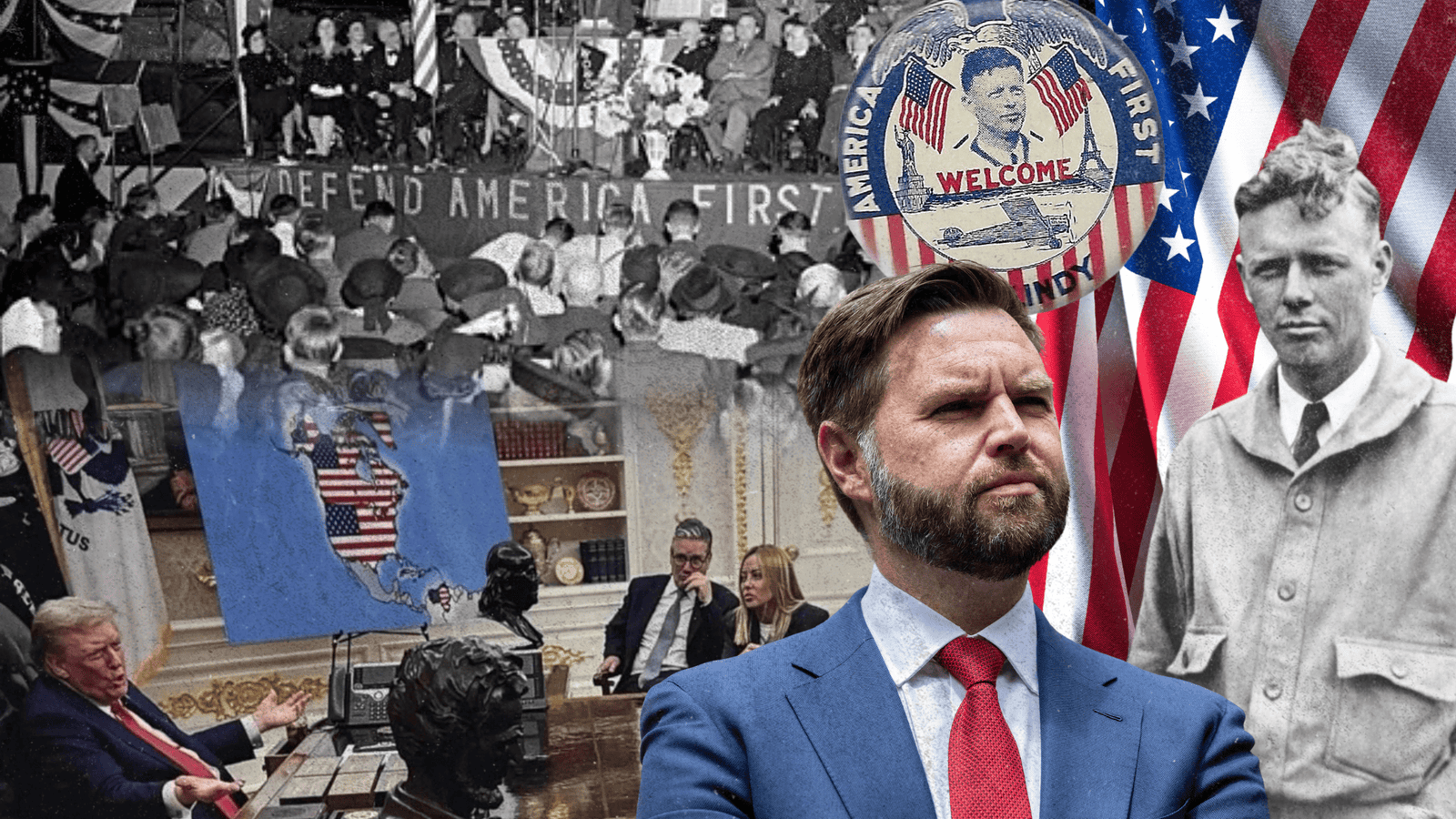
Since its origins, despite the fact that the America First ideological current prefers fewer foreign adventures, it does promote a greater presence in the Western Hemisphere. Image: Guacamaya.
Guacamaya, August 20, 2026. There is a photograph that does not exist but that anyone can imagine. A classroom at Yale Law School, dark wood, tall windows, a handful of students in ties debating whether the United States should bleed again in the trenches of Europe. It is September 4, 1940.
Robert Douglas Stuart Jr., heir to the Quaker Oats fortune, founds, along with classmates such as Kingman Brewster Jr. — then editor of the Yale Daily News — the America First Committee. The committee would go on to gather 800,000 members and 450 delegations before dissolving, immediately after the bombing of Pearl Harbor, in December 1941.
Eighty-four years later, another graduate of that same Law School — J. D. Vance, class of 2013 — would occupy the vice presidency of the United States under the banner of “America First.”
The geographical coincidence does not prove a direct affiliation, but it does illuminate something deeper: Yale, the cradle of the internationalist elite that in the 1940s would forge the postwar liberal order, was also the genesis of its negation. American isolationism was not born in the rural Midwest, as is often caricatured, but in the classrooms of the Ivy League, among young men who viewed with suspicion the imperial commitment that two world wars were about to impose upon them.
The Voice of the Lone Eagle
The public face of the committee was Charles Lindbergh, the aviator who in 1927 had crossed the Atlantic solo and had become, overnight, the greatest cultural hero of his generation — a sort of astronaut before the space race existed, the man who tamed distance with his own hands. That symbolic capital made him the ideal speaker for a cause that needed to appear patriotic and not cowardly.
In April 1941, in a speech before the committee, Lindbergh articulated the idea that would structure 20th-century isolationism: The United States should not get involved in the foreign wars of the Old World, but it was willing to firmly defend its own hemisphere against any external interference. It was not pure pacifism — the committee clarified this again and again — but rather a hierarchization of geographical priorities in which one’s own backyard came first before another’s, the American continent as a natural sphere of authority, and the rest of the world as a problem that Europe should solve without dragging Washington along with it.
That same rhetorical cadence — rejection of “forever wars,” affirmation of the Western Hemisphere as a zone of vital interest — reappears, almost identically, in the campaign and government speeches of Donald Trump. There is no need to force the comparison, for Trump’s own language regarding Greenland, the Panama Canal, or the Caribbean basin evokes that old argument of Lindbergh’s that the true frontier of American security is not on the Rhine or the Dnieper, but in its own neighborhood.
The Eagle and the Women Who Sustained It
The America First Committee had, from its origin, a powerful female face. Names like Alice Roosevelt Longworth, daughter of Theodore Roosevelt himself, were part of its board of directors — a historical irony considering that her father had been the architect of the hemispheric interventionism that the committee partially defended. But it would be decades later, in the second half of the 20th century, when a woman would finish weaving the bridge between that pre-war isolationism and contemporary Trumpism: Phyllis Schlafly.
A lawyer, mother of six, and tireless activist, Schlafly built her political career on two pillars that today are indistinguishable from the ideology of Trump and Vance: the rejection of economic and military globalism, and the vindication of the traditional family as the nation’s moral unit against the feminism of the Equal Rights Amendment, a battle she led and won in the 1970s and 1980s.
Schlafly was not only an ideological precursor; she was a direct political ally. She endorsed Trump from March 2016, co-wrote with him the book The Conservative Case for Trump — published on the same day of her death — and Trump personally attended her funeral in St. Louis, where he called her a warrior who had fought her whole life so that the needs of the American people would come before anything else.
That fusion of economic nationalism, skepticism toward international institutions, and a conservative vision of women’s role in the home is, to a large extent, the ideological DNA that Vance inherits and updates. His own book Hillbilly Elegy and his speeches on family, birth rates, and community are a generational translation of the Schlafly project, now armored with the language of “national sovereignty” in foreign policy.
William McKinley: The Ghost of Ohio in Trump’s Mind
If Lindbergh and Schlafly provide the cultural lineage of “America First,” William McKinley provides its historical justification of hard power. Trump himself said it in his inaugural address in 2025, in which he promised to return to North America’s highest mountain the name of McKinley — taken from Denali by Barack Obama in 2015 — and affirmed that that president, thanks to tariffs and talent, had made the country rich and had given Teddy Roosevelt the money for “many of the great things he did, including the Panama Canal.”
McKinley governed between 1897 and 1901, in the transition between the continental Manifest Destiny of the 19th century and the overseas imperialism of the 20th. Under his mandate, the 1898 war against Spain left Washington with Puerto Rico, Guam, and the Philippines, and consolidated the idea that tariff protectionism and territorial expansion were not contradictory but complementary: first protect domestic industry, then open markets abroad by force if necessary. This is exactly the conceptual pair that Trump has resurrected — tariffs as a tool of geopolitical negotiation, not just commercial — and that his critics, such as economist Douglas Irwin, insist Trump misinterprets, attributing to tariffs a prosperity that actually came from electrification and the railroad.
What is relevant to the Venezuelan thread is another fact, almost anecdotal but decisive. When McKinley was assassinated in 1901 and his vice president, Theodore Roosevelt, inherited not only the presidency but also the expansionist impulse, he would apply it with particular intensity to the Caribbean and the northern coast of South America.
1902: When the Gunboats Arrived at La Guaira
In late 1902, Great Britain, Germany, and Italy blockaded Venezuelan ports to force payment of outstanding debts from the government of Cipriano Castro, even going so far as to bombard Puerto Cabello and sink part of the precarious Venezuelan fleet. Roosevelt, who had barely been president for a year after McKinley’s assassination, watched with alarm the possibility that European powers might establish a permanent military presence in the hemisphere that Washington considered its backyard since the Monroe Doctrine of 1823.
The crisis was resolved, but it left a lesson that Roosevelt would turn into formal doctrine in 1904: the so-called Roosevelt Corollary, which reinterpreted the Monroe Doctrine not merely as a simple warning against European colonization, but as a license for the United States to exercise “international police power” in any American country that, through misconduct or incapacity, gave a pretext for foreign intervention. An argument visible to justify U.S. action in Latin America and the Caribbean under the excuse of combating the presence of extra-regional powers like China — at that time, it was the imperial German influence in Venezuela and other countries that was of concern.
Venezuela was, literally, the laboratory where that doctrine began to manifest itself, later to be applied in Santo Domingo, Nicaragua, Haiti, and Cuba. The country that today once again occupies the center of Washington’s foreign policy was, more than a century ago, the conceptual origin of the formula that legitimized U.S. interventionism on the continent throughout the 20th century.
The plot connects again with our present. On January 3, 2026, Trump announced from Mar-a-Lago that U.S. forces had carried out a military operation in Caracas to capture Nicolás Maduro, accused of narco-terrorism by the New York justice system along with his wife, Cilia Flores. Trump stated that the operation was executed under his direct direction, with overwhelming air, land, and naval power against what he described as a heavily fortified military installation in the heart of Caracas. He declared that the United States would “administer” Venezuela until achieving a “safe, appropriate, and prudent” transition — a phrase that, mutatis mutandis, resonates with the old tutelary language of the Roosevelt Corollary, based on intervening not as conquest, but as a correction of someone else’s disorder.
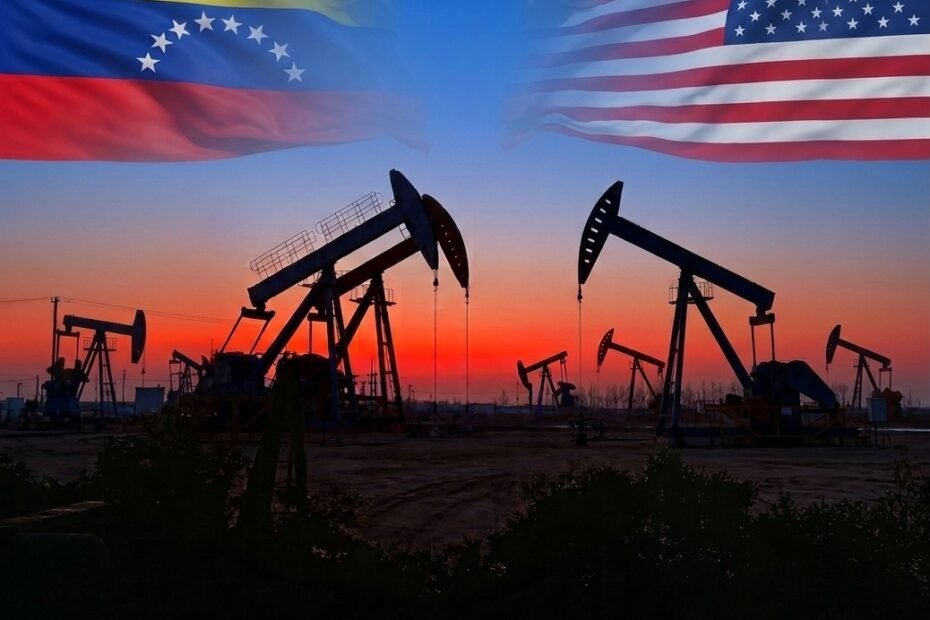
Months later, in August 2026, Trump was still politically capitalizing on the episode, describing it to supporters in Las Vegas as a “48-minute war” whose benefits had far exceeded the investment made, and boasting that Washington had obtained billions of barrels of Venezuelan oil since Maduro’s fall. The logic is purely McKinleyan: first force, then the market; tariffs and cannons as two tools of the same toolbox.
J.D. Vance: The Heir
Vance’s role in this equation confirms, more than contradicts, his Lindberghian inheritance. Unlike the classical neoconservatives, Vance has been reluctant to open interventionism in conflicts outside the hemisphere — he opposed, according to reports, U.S. attacks against the Houthis in Yemen — while firmly endorsing the doctrine that the Western Hemisphere is indeed a legitimate zone of direct Washington action. It is the same distinction Lindbergh drew in 1941: not all the world’s conflicts are ours, but our own backyard certainly is. Venezuela, in this scheme, is not a global war front but the natural extension of the house.
Let us return to the Yale classroom. The students who in 1940 drafted pamphlets against intervention in Europe did not imagine that their ideological offspring would end up governing from the White House eighty-five years later, nor that the same hemisphere they then defended in the abstract — as a limit, as a moral frontier of American commitment — would become the concrete stage of a military operation over Caracas. Lindbergh preached not intervening in the world’s wars but yes in those of one’s own continent; Schlafly gave that idea a family and anti-globalist garb; McKinley provided the tariff-imperial precedent; Theodore Roosevelt made Venezuela, without entirely intending to, the original mold of the doctrine that is being reissued today.
What in 1941 was an aviator’s speech before a war-skeptical crowd, in 2026 is a fleet off the Venezuelan coast and a former president extradited to New York. The independent destiny that Lindbergh claimed for the United States was never, in reality, independence from the world; it was the vindication of one’s own hemisphere, guarded with the same insistence with which Roosevelt guarded the customs houses of La Guaira in 1902. That thread — from New Haven to Caracas, from Quaker Oats to Venezuela’s oil fields — is not a forced metaphor. It is, literally, the political genealogy that today governs Washington’s vision.
Charles Lindbergh’s speech in Des Moines, in September 1941, offers a disturbing precedent of a political rhetoric based on identifying “war agitators”: internal and external actors who, according to him, were pushing the United States toward conflicts contrary to its interests. Lindbergh then pointed to the British, the Jews, and the Roosevelt administration, as well as capitalists, intellectuals, and communists. His argument was crossed by a conspiratorial anti-Semitism that today is inseparable from his legacy.
The Trump administration has recovered, with different language and without necessarily reproducing Lindbergh’s anti-Semitic categories, a similar rhetorical structure, based on the idea that the interests of the establishment, globalists, communists, foreign allies, or interventionists have dragged the United States into wars that do not directly respond to the national interest. Trump, Vance, and sectors of the America First movement have used this narrative to question the foreign policy establishment.
Here a historical tension emerges. The contemporary America First clashes with the neoconservative and interventionist tradition that for decades defended an active U.S. military presence in the world and that today has Marco Rubio as an exponent.
This tension is fundamental to understanding the dispute currently running through the White House on how to approach the Venezuelan case. It is not merely a difference over foreign policy, but two distinct visions of the role the United States should play in the world and how far it is willing to use its power to defend its interests. How that tug-of-war between the America First wing, more reluctant to interventionism, and the neoconservative sectors that maintain a more active vision of U.S. power is resolved will largely determine the framework of Washington’s action regarding Venezuela.
With that, it could also define how the United States intends to relate to a country that holds some of the world’s largest oil reserves, in addition to significant mineral resources and other strategic advantages. In that sense, Washington’s internal dispute may offer some of the keys to anticipating what the United States really seeks in Venezuela and how far it would be willing to go to secure it in the short and medium term.