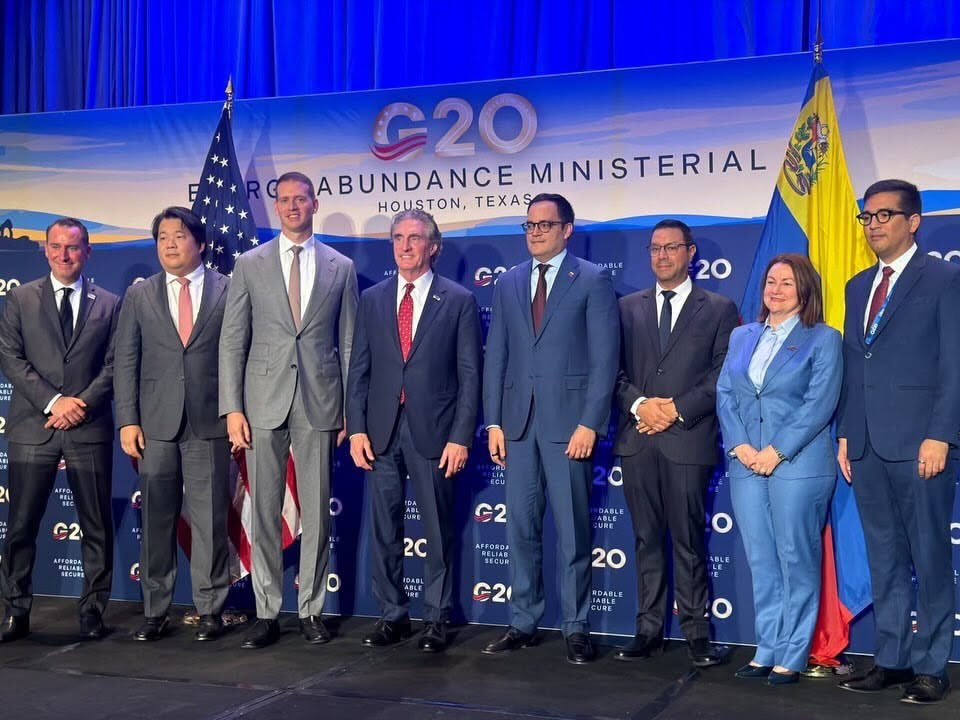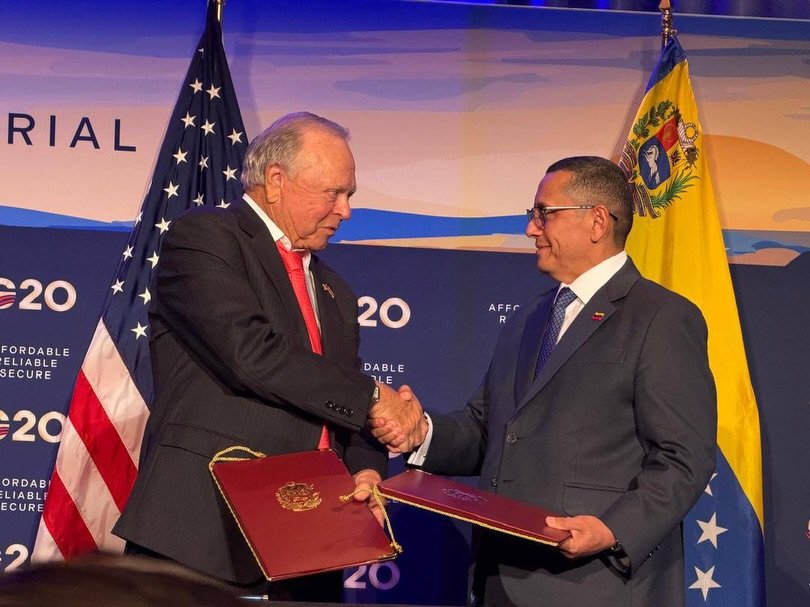
Harold Hamm, founder of Continental Resources (left) and PDVSA executive vice president Jovanny Martínez (right) signing a memorandum of understanding at the G20 summit in Houston, Texas, on September 17, 2026. Photo: Instagram / @petroleosdevenezuela.
Guacamaya, September 19, 2026. Continental Resources, the oil company that Harold Hamm founded in 1967 and that today he controls alongside his family, signed a memorandum of understanding this week with PDVSA to develop Block Ayacucho 2 in the Orinoco Belt.
The agreement, announced in Houston during the G20 Ministerial Summit on Energy Abundance, confirms the arrival in Venezuela of one of the most influential oilmen in Donald Trump’s circle, eight months after Operation Absolute Resolve removed Nicolás Maduro from power.
Although Continental Resources is not among the major multinationals such as Chevron, Shell or ExxonMobil, it does play an important role. It was one of the pioneers of the United States’ “shale revolution,” which drove a rebirth of hydrocarbons in the country through hydraulic fracturing, commonly known by its short English name: fracking.
Hamm, for his part, has been an important supporter of Trump — not without disagreements — in his three campaigns, seeing in the president the best defender of fossil fuels. This support, in turn, may have led to great power: according to various sources, Hamm influenced the selection of Energy Secretary Chris Wright and Interior Secretary Doug Burgum — who regulates the use of natural resources.
An Oklahoma Sharecropper Who Became Owner of the Bakken
Harold Hamm was born in Lexington, Oklahoma, the thirteenth and last child of a family of cotton sharecroppers. He started working at a gas station at age 16 and, in 1971, took out a loan to drill his first well. He founded what would later become Continental Resources under the name Shelly Dean Oil Company in 1967, four years before that first drilling.
His decisive bet came in the 1990s, when he promoted the combined use of horizontal drilling and hydraulic fracturing in the Bakken formation, in North Dakota. That technique — now standard in the industry — turned Continental into the largest producer in that basin and Hamm into one of the architects of the U.S. shale revolution, which allowed the United States to surpass Saudi Arabia and Russia as the world’s crude producer.
Hamm has also demonstrated a preference for family control of his companies rather than listing on the stock exchange, where he can obtain gains but with external controls and scrutiny over his decisions. Continental went public on the New York Stock Exchange in 2007 under the symbol CLR. Fifteen years later, in October 2022, Hamm closed the reverse operation and bought back the 17% of shares not controlled by his family for 4.3 billion dollars, bringing the total valuation to 27 billion dollars.
The Hamm family today controls around 83% of the company’s capital, which operates mainly in the Bakken, the SCOOP and STACK formations in Oklahoma and the Permian Basin, and which in the last two years has extended its international exploration to Argentina’s Vaca Muerta, where both the political networks around Trump and fracking intertwine. And now, it sets its sights on Venezuela’s extra-heavy crude.
Money and Loyalties: How Hamm Earned a Seat at Trump’s Table
The relationship between Hamm and Trump has not been linear. He was Mitt Romney’s energy advisor in 2012 and a donor to Trump’s campaigns in 2016 and 2020, but he distanced himself after the January 6, 2021 assault on the Capitol, when he called for a “blank slate” for the country. The rapprochement was rebuilt when Trump positioned himself as the undisputed Republican candidate for 2024.
For this reason, Hamm organized a fundraising event at Mar-a-Lago in April of that year, where Trump asked the oil industry for 1 billion dollars. It is estimated that Hamm ended up contributing more than 3 million dollars between his campaign, his political action committees and other related causes, according to figures collected by E&E News.
That money translated into direct influence over the design of the energy policy of Trump’s second administration. Hamm co-directed, alongside now-Interior Secretary Doug Burgum, the energy transition team prior to the inauguration, a space where — among other measures — the elimination of the 7,500-dollar tax credit for electric vehicles inherited from the Biden administration was discussed. According to The New York Times, Hamm also pushed for the appointment of Chris Wright, a former oil executive, as Energy Secretary, and Burgum himself arrived at Interior with the magnate’s backing. Burgum’s family, in fact, has leased land to Continental for drilling.
Hamm also appears among the donors to the controversial ballroom that Trump is building at the White House, a project of up to 300 million dollars for which the White House confirmed contributions from more than three dozen companies and individuals. Hamm himself has summarized his role with a phrase that circulated in U.S. media and said he is accustomed “to challenges.”
During Trump’s second inauguration, Hamm occupied a prominent place among the attendees, seated near the platform and in the company of figures of great economic power such as Rebekah Mercer, Steve Wynn, Robert Kraft, Richard LeFrak, Phil Ruffin, Robert Mercer and Carl Icahn.
Hamm has been one of the business figures associated with the development of fracking and the expansion of U.S. shale oil and gas production. Through Continental Resources, he helped drive the exploitation of unconventional formations, particularly in the Bakken basin in North Dakota, through the combination of horizontal drilling and hydraulic fracturing. This model helped significantly expand U.S. hydrocarbon production and consolidated Hamm as one of the main defenders of an energy policy centered on fossil fuels.
He leads the Domestic Energy Producers Alliance, an association without the large corporations that try to feign a preference for renewable energies. On July 1, 2026, it merged with the Independent Petroleum Association of America, creating one of the largest alliances for the promotion and defense of fossil fuels.
His position on renewable energies has been consistent with that vision. In 2016 he founded the nonprofit organization Windfall Coalition to oppose tax incentives aimed at the wind industry in Oklahoma. Since then, the organization has maintained that these credits represent a burden for taxpayers and has linked them to the state’s budget deficits, although its critics have attributed much of those problems to the fall in oil prices and have questioned that interpretation.
Hamm’s position also contrasts with the tax treatment that the oil and gas industry receives in Oklahoma. The sector, including Continental Resources, continues to benefit from important tax incentives and exemptions, estimated at more than 600 million dollars annually, among them reduced rates on production and refunds associated with certain wells.
January 3 as a Turning Point: From Operation Absolute Resolve to the Oil Fever
The watershed that explains Continental’s current presence in Venezuela occurred in the early hours of January 3, 2026, when U.S. forces executed Operation Absolute Resolve: an attack of about three hours against Venezuela’s air defense infrastructure — including La Carlota air base, Fuerte Tiuna and the port of La Guaira — that culminated in the capture of Nicolás Maduro and his wife, Cilia Flores, and their immediate transfer to New York to face charges of narcoterrorism. Delcy Rodríguez assumed the interim presidency days later.
In the following months, Washington completely reconfigured the framework of relations with the Venezuelan oil industry. In August, the United States and the new government announced that Washington would take control of fields with an estimated potential of 65 billion barrels, and in early September Chevron committed more than 7 billion dollars over five years to double its production in the Belt to 600,000 barrels per day. Secretary of State Marco Rubio placed short-term private investment near 100 billion dollars, while Rodríguez spoke of a potential exceeding 200 billion with the Chevron agreement alone.
Here a paradox appears, however. Despite his closeness to Trump, Hamm had remained on the sidelines of the Venezuelan oil opening until now, after a flood of agreements driven by the U.S. government itself, mainly with North American Blue Energy Partners.
Closeness to Trump could be precisely the greatest obstacle, by generating uncertainty about his investments once the same leaves the White House in January 2029. No visits by the oil magnate to Venezuela this year are yet known, while other smaller companies and even ones without experience have rushed to secure concessions. It could be, therefore, that Hamm is now rushing as he sees a race to secure oil fields.
Ayacucho 2: The Terms of the Agreement with Continental
The memorandum signed on September 16 in Houston, initialed by Hamm and PDVSA executive vice president Jovanny Martínez, grants Continental the possibility of exploring and developing Block Ayacucho 2, in Anzoátegui state, within the Orinoco Oil Belt.
According to figures disseminated by the company itself, the area covers about 126,000 acres and would contain an estimated 30 billion barrels of resources in place — a figure that, like any reserve estimate at such a preliminary stage, has not been verified by an independent third party and should be read as a company projection, not as a done deal.
The agreement is, for now, non-binding: a memorandum of understanding that, according to Continental, should lead “in the coming weeks” to a production-sharing contract. The company’s chief executive, Doug Lawler, said he has traveled to Venezuela twice this year and stated that Continental is evaluating possible partners for what he described as a greenfield project. Hamm, for his part, summed up the moment thus: “Our team enjoys challenges,” he said at the Houston press conference, and added that this takes Continental “to a completely new level.”
Continental explained that the decision responded to an “independent evaluation of opportunities” in Venezuela, made after Trump urged U.S. oil companies to invest in the country, and to the reform of Venezuela’s hydrocarbons law, which — according to the company — facilitated the operation.
What Does It Mean for Trump’s Circle to Enter Venezuela?
Continental’s arrival is not an isolated event but the most recent piece of an assembly that mixes foreign policy, private business and the personal biography of Trump’s donors. Unlike Chevron — which operated in Venezuela since before the Maduro government under specific exception licenses — or Eni, with a historical presence in the country, Continental arrives without prior experience in Venezuela or in its particularly heavy crude, contrasting with the light shale of the Bakken and Vaca Muerta.
Continental’s entry constitutes another sign of the incursion of figures linked to Trump’s circle, his financial networks and the power groups that today surround the new U.S. administration in Washington, into the process of opening Venezuela’s energy sector. Beyond a question strictly related to the granting of licenses or energy security strategies, this participation could be interpreted as part of an effort to guarantee that profiles close to the Trump administration have a presence in the Venezuelan opening and, with it, influence over the decisions that will define the country’s course in the coming years.
For now, the only thing formalized is a memorandum without full contractual force. What happens in the “coming weeks” — the deadline that Continental itself has set to convert it into a production-sharing contract — will define whether Ayacucho 2 becomes a real extraction operation or one more of the announcements that, since January, have accompanied the reconfiguration of the Venezuelan oil map under U.S. tutelage.
Elías Ferrer collaborated in the writing of this article.