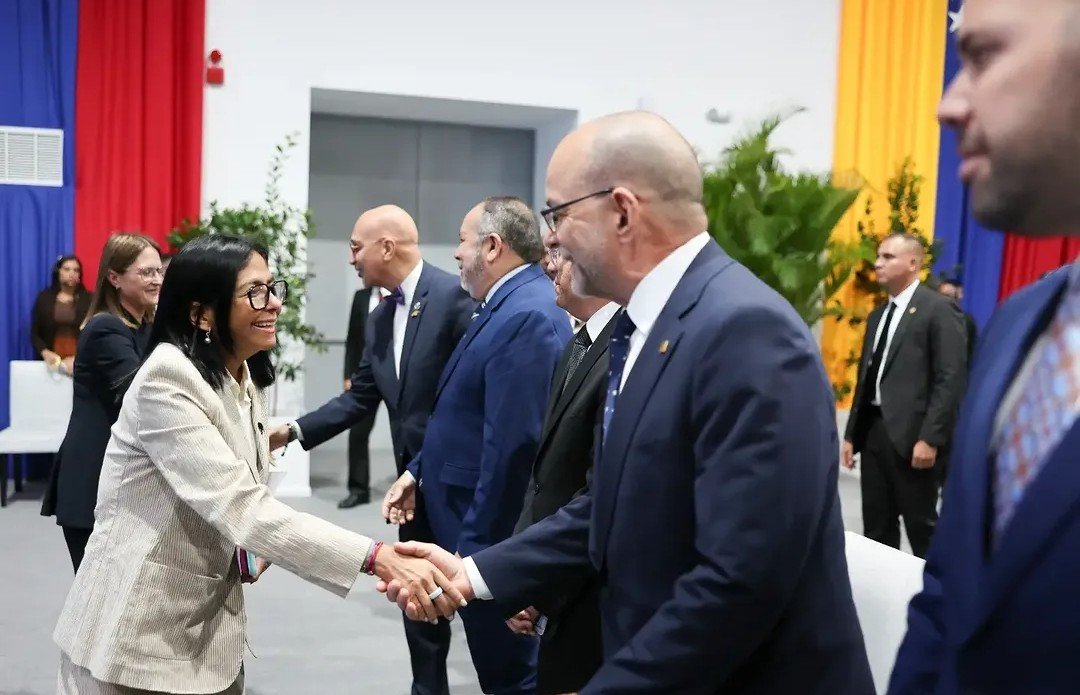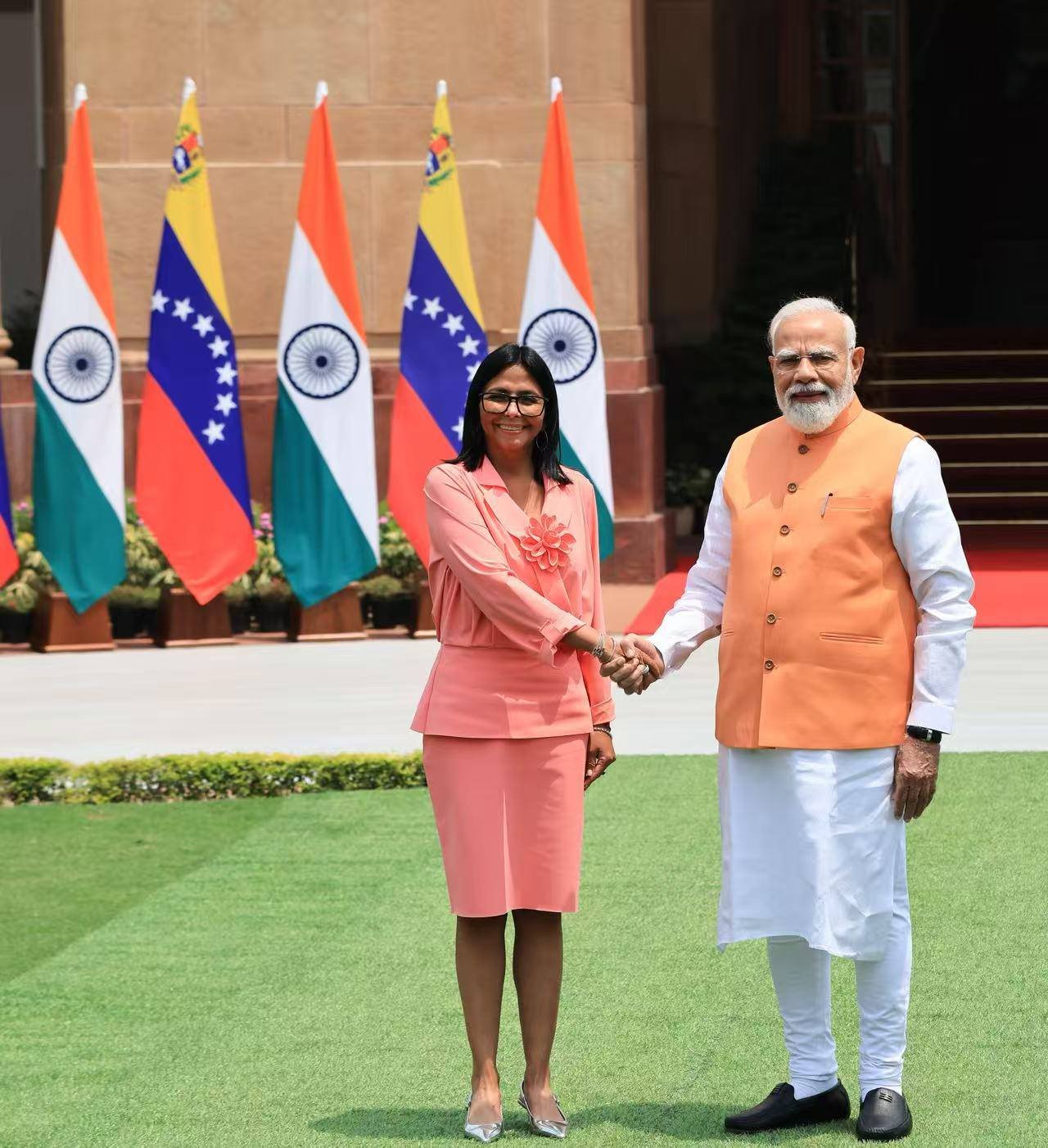
As part of her high-level official visit to the Republic of India in June, the acting president of the Bolivarian Republic of Venezuela, Delcy Rodríguez, held a meeting with Prime Minister Narendra Modi at the iconic Hyderabad House. Photo: Presidential Press Office.
Guacamaya, October 21, 2026. With Russia under sanctions, Iran at the center of escalating tensions, and the Strait of Hormuz serving as a strategic chokepoint, U.S. Secretary of State Marco Rubio toured the world’s largest refinery complex to discuss oil that only a handful of facilities can process: Venezuela’s heavy crude.
U.S. Secretary of State Marco Rubio visited the Jamnagar refinery complex on Wednesday, in the western Indian state of Gujarat. Considered the world’s largest refinery at a single site, it belongs to Reliance Industries, the conglomerate controlled by the Ambani family. The visit was part of a tour of Uzbekistan and India (October 17–22) that included Samarkand and Mumbai, according to the schedule released by the U.S. State Department.
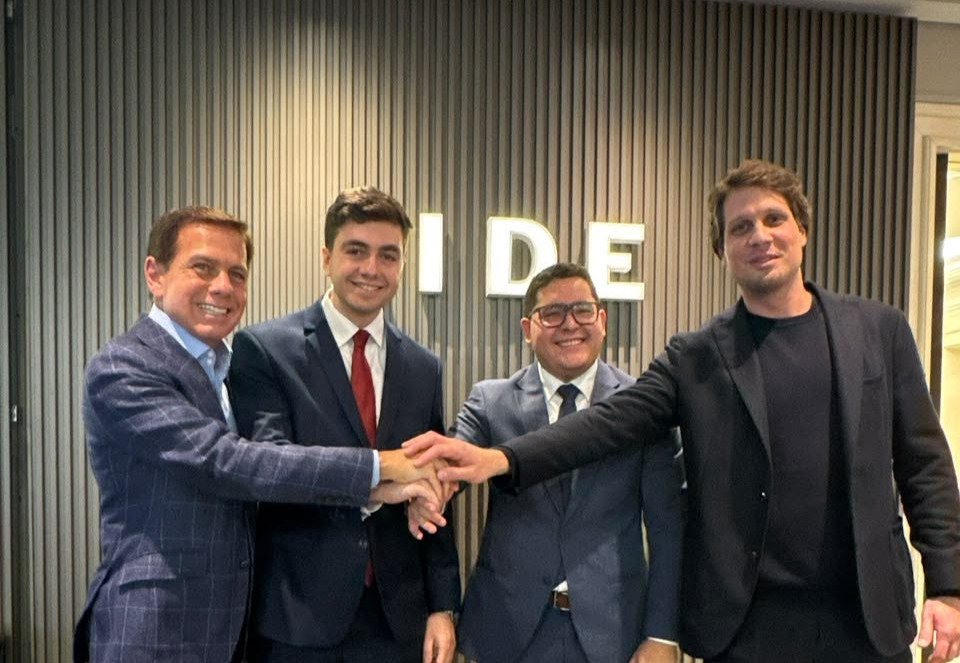
The image was carefully staged: almost the entire family of Mukesh Ambani, Asia’s richest man, led by his son Anant Ambani and his wife, Radhika Merchant, posed alongside Rubio, his wife Jeanette, and U.S. Ambassador Sergio Gor in a photograph that Gor himself shared on X. “It is an honor to join Secretary Rubio at Reliance Industries’ Jamnagar facility,” the ambassador wrote. Gor was also the diplomat with whom Delcy Rodríguez met during her visit to India several months ago.
A day earlier, speaking from Mumbai, Rubio had described India as a “refining superpower” and announced that he would discuss a plan with Reliance to refine more Venezuelan oil. On Wednesday, he was more explicit: “This company has the capacity to refine heavy crude produced in the Western Hemisphere, including from Venezuela.” Before traveling to Gujarat, he met with Gautam Adani, chairman of the Adani Group, and N. Chandrasekaran, chairman of Tata Sons—in other words, the three major centers of corporate power in the country.
Jamnagar: The meeting point between Washington and Caracas
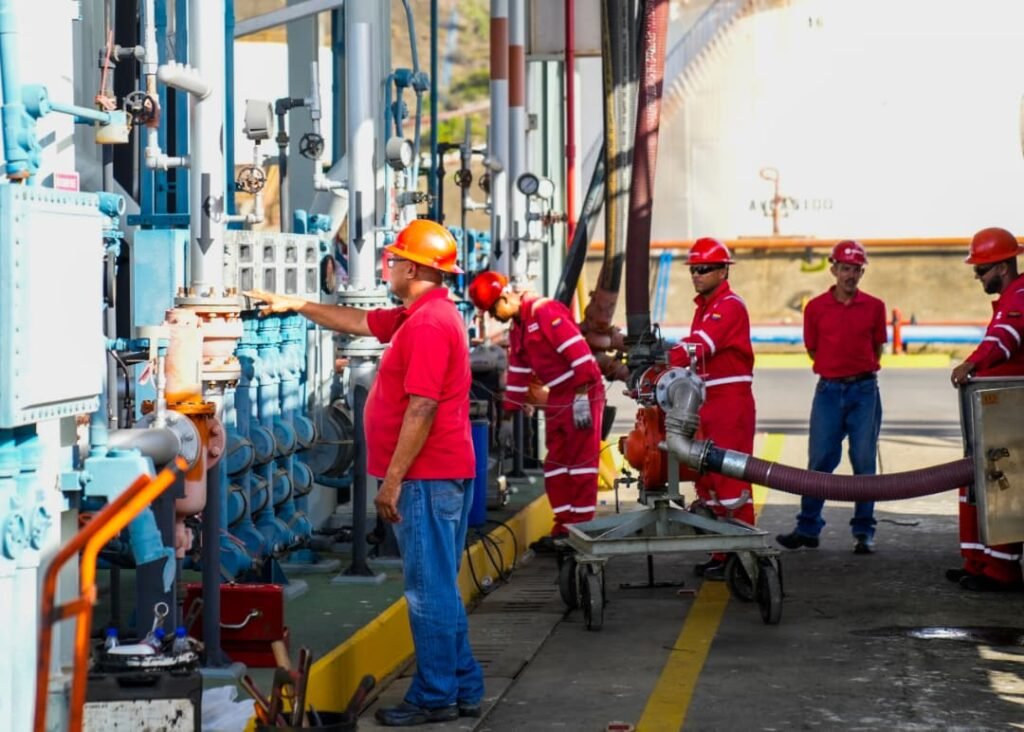
The key is technical. Crude from Venezuela’s Orinoco Oil Belt is heavy to extra-heavy and has a high sulfur content. Merey 16, one of the country’s benchmark crude grades, is difficult to process without deep-conversion units. Jamnagar was specifically designed to handle this type of crude. Reliance signed a term contract with PDVSA in 2012 for up to 400,000 barrels per day and was one of the world’s largest buyers of Venezuelan oil until sanctions cut off the flow.
That advantage explains why the trade is concentrated in a single company. An Energy Intelligence analysis argues that Reliance is the only player capable of consistently absorbing large volumes of Merey crude; for other Indian refineries, Venezuelan oil remains little more than a trial run. Kpler vessel-tracking data support this assessment, as all Venezuelan cargoes bound for India list Sikka, the terminal serving Jamnagar, as their final port of destination.
From Restrictions to reopening: The Timeline
India halted its purchases of Venezuelan crude for nearly a year following the tightening of U.S. sanctions and resumed them in February 2026, when Washington eased restrictions. Reliance received a general license from the U.S. Treasury Department allowing it to purchase Venezuelan oil directly, becoming the first Indian refiner to obtain one.
The results are already visible in the figures. According to Kpler estimates reported by Bloomberg, Venezuelan crude deliveries to India are expected to reach approximately 465,000 barrels per day in October, up from 196,000 in September. If all vessels unload on schedule, that would be the highest monthly level since December 2019. Reliance accounted for around 76% of September shipments. Price is the main factor driving buyers, as Venezuelan crude is offered at steep discounts—a particularly attractive proposition when Russian oil becomes more expensive or carries greater sanctions risk.
The russian factor: Sanctions, tariffs, and a trade agreement
To understand why Washington is facilitating these flows, one must look toward Moscow.
Since 2022, India has made discounted Russian crude a cornerstone of its energy supply. According to CREA, Russian oil went from accounting for less than 1% to nearly 40% of India’s total crude imports. In October 2025, the United States sanctioned Rosneft and Lukoil, Russia’s two largest oil companies, and gave companies until November 21 to wind down their transactions. Reliance, HPCL-Mittal, and Mangalore Refinery subsequently suspended purchases, although other refiners continued seeking barrels from non-sanctioned producers.
Washington also used tariffs as leverage when it doubled duties on Indian imports to 50%, citing New Delhi’s purchases of Russian crude. A subsequent agreement between Trump and Modi reduced those tariffs in exchange for India moving away from discounted Russian oil. This is where Venezuelan crude entered the equation as a substitute. Every Venezuelan barrel replacing a Russian one at an Indian refinery indirectly pressures Kremlin revenues while the war in Ukraine continues.
This does not mean a complete substitution is necessary—or even intended. It is enough for Venezuela to serve as an available alternative, giving New Delhi room to diversify its supply without incurring an excessive political cost in its relationship with Washington. The latest data indicate how much room there may be: according to an OilPrice headline, Russian oil flows to India have reportedly fallen to around 310,000 barrels per day.
The Iran factor and the Strait of Hormuz
The second dimension is the Gulf. India has historically depended on the Middle East, and the U.S.–Iran war, which began around March 2026, changed the calculations. Disruptions in the Strait of Hormuz strained regional flows and drove up freight costs. In this context, according to Kpler, Russia became India’s leading supplier, benefiting from a temporary three-month U.S. sanctions waiver, and Russian imports approached historic highs in June. An interim peace memorandum between Washington and Tehran subsequently raised hopes of normalizing maritime traffic.
For Washington, the logic is twofold: it seeks to reduce India’s exposure to Iranian crude, thereby limiting Tehran’s financial capacity at a moment of acute bilateral tension, while also providing an alternative to Russian oil when the waiver expires. Venezuelan crude, originating in the Western Hemisphere and shipped outside the Strait of Hormuz and the Red Sea, offers a supply route that avoids those chokepoints, although the long journey to Gujarat’s coast and freight costs remain important considerations.
Beyond India: The U.S. strategic architecture
India is not the only customer. South Korea, Japan, and the Philippines have also increased purchases of Venezuelan crude under growing U.S. oversight and coordination. For these countries, a prolonged disruption in the Strait of Hormuz or the Red Sea would pose a major strategic challenge. Japan and South Korea are also key U.S. allies. Securing their energy supplies is becoming an increasingly explicit component of Washington’s Indo-Pacific strategy, alongside the architecture it is building for Europe through liquefied natural gas.
This reveals an underlying paradox. The United States is one of the world’s largest oil producers, but it cannot indefinitely supply European and Asian allies simultaneously without affecting its own planning and reserves. An additional, relatively secure supplier allows Washington to indirectly supply markets it would prefer not to cover itself, projecting energy influence without drawing down its own reserves.
Venezuela, home to the world’s largest proven oil reserves, is the mechanism.
What India brings to the table
India has significance beyond its oil purchases. Its economic and demographic growth implies continuously expanding energy demand, and its position is central to the balance of power vis-à-vis China in the Indo-Pacific. There is also a domestic U.S. dimension: the visit comes amid a renewed rise in diesel prices ahead of the midterm elections. In March, Trump announced that Reliance would partner in building what he described as the first and largest new refinery in the United States in 50 years, in Brownsville, Texas. The relationship with the Ambani family is simultaneously energy-driven, commercial, and political.
For Venezuela, the relationship creates a genuine opportunity to expand export destinations, reduce dependence on traditional markets, regain a foothold in Asian energy trade, and sustain oil revenues. Delcy Rodríguez, Venezuela’s interim president, visited the complex in June, and her meeting with U.S. Ambassador Gor forms part of the same effort.
India has established itself as a strategic market for Venezuelan oil thanks to its refining capacity and the industrial infrastructure required to process heavy and extra-heavy crude, characteristic of the Orinoco Oil Belt. This technical compatibility makes the Asian country a potentially important buyer of Venezuelan hydrocarbons, allowing its refineries to transform dense, complex crude into fuels and other products with greater commercial value.
Beyond its industrial capacity, India’s appeal lies in its expanding energy demand, its strategy of diversifying suppliers, and the international market influence of its leading refining companies. For Venezuela, strengthening this relationship represents an opportunity to expand export destinations, reduce dependence on traditional markets, and regain ground in Asian energy trade. However, realizing this potential depends on factors such as U.S. sanctions, payment terms, transportation costs, commercial discounts, and the availability of Venezuelan crude.
In this context, India represents much more than an export destination: it is a key interlocutor in Venezuela’s strategy to reestablish its place in international energy markets. The relationship between the two countries could help sustain oil revenues and create opportunities for commercial cooperation, provided geopolitical and financial conditions allow stable flows to continue.
The limits of the arrangement
The potential of this strategy depends on variables that Caracas does not fully control. The first is U.S. sanctions and licensing, which can be expanded or revoked; Reliance’s access exists because of a license, not because of a structural change in policy. The second involves payment terms, discounts, and transportation costs. Venezuelan crude’s appeal lies in its discount, and higher freight rates can erode that advantage. The third is supply. Rubio himself acknowledged that Venezuela cannot independently compensate for supply losses caused by international conflicts, although it can provide partial relief in the short term.
There is also a risk of concentration. With only one Indian buyer capable of absorbing the bulk of the supply, the strategy depends on a single company and port. A shift in Washington’s policy, a definitive peace agreement with Iran that eases pressure on energy markets, or a renegotiation of the trade agreement with New Delhi could rapidly reshape the landscape.
Delcy Rodríguez’s visit to India
Four months before Marco Rubio set foot in Jamnagar, Venezuela’s acting president, Delcy Rodríguez, had already toured the same complex. She arrived in New Delhi on June 3 for a five-day visit, ending June 7, which the Indian government described as an opportunity to review bilateral relations in energy, trade, investment, pharmaceuticals, healthcare, transportation, and renewable energy. Upon arrival, she said she expected a “very fruitful” agenda. India’s Foreign Ministry spokesperson, Randhir Jaiswal, spoke of “further deepening the ties between India and Venezuela.”
It is worth recalling that Rodríguez’s visit to India was first announced to the international press by Marco Rubio himself, making clear Washington’s interest in promoting closer ties between Venezuela and the Asian country.
On June 4, she was received by Prime Minister Narendra Modi at Hyderabad House, the venue for high-level bilateral meetings, and held discussions with Foreign Minister S. Jaishankar and Minister of Petroleum and Natural Gas Hardeep Singh Puri. On June 5, accompanied by then-Foreign Minister Yván Gil and Hydrocarbons Minister Paula Henao, she toured the Jamnagar refinery in Gujarat, where she was welcomed by senior Reliance Industries executives and planted a tree as a symbol of friendship. According to Puri, India expressed its support for Venezuela’s energy reconstruction and indicated that Indian companies were ready to expand their presence in the country.
A visit in a different context
This was not Rodríguez’s first trip to India. She had visited in February 2025 as Venezuela’s oil minister, when Caracas was seeking to expand sales to the Asian country.
The difference lies in the nature and purpose of the visit. At the time, she traveled as a minister in a government under sanctions; in June, she arrived as acting president in what economic media described as one of her first foreign trips after taking office following Nicolás Maduro’s capture in January.
The commercial context had also changed completely. According to Kpler, as cited by EFE, Venezuela had gone in just two months from selling no crude to India—since May 2025—to becoming its fourth-largest supplier, behind Russia, the United Arab Emirates, and Saudi Arabia. The war in the Middle East and the de facto blockade of the Strait of Hormuz, through which roughly half of the crude consumed by India had previously passed, pushed New Delhi to seek alternative suppliers. India imports around 90% of the oil it consumes, making every new supply route strategically valuable.
Why does India matter to Caracas’s Foreign Policy?
The June visit offers a way to understand a shift in Venezuela’s external relations. During the years of sanctions, Chavismo’s political and financial support network relied on Russia, China, and Iran. In the new environment, with Washington closely monitoring the destination of every barrel, India offers something different: a large-scale buyer with proven technical capacity to process heavy crude, a strategic partner of the United States, and a country that does not demand ideological alignment. For Caracas, it is a customer that can absorb significant volumes and help restore revenues without conflicting with the U.S. licensing framework.
There is also an investment component. In this regard, it is important to remember that Indian state-owned companies have significant interests in Venezuela’s energy sector, and Rodríguez’s agenda included ONGC Videsh, the international subsidiary of India’s state-owned oil company. India is therefore both a customer and a potential investor for Venezuela—something few of its current buyers can offer.
There is also a symbolic dimension involving diplomatic recognition and legitimacy. An acting president received by Modi, photographed at Hyderabad House, and touring the world’s largest refinery complex projects an image of diplomatic normality at a time when her government is seeking to reintegrate into international economic networks.
The conclusion is that India has ceased to be just another customer and has become an instrument of the U.S. energy strategy, while simultaneously serving as one of the most advantageous outlets for Venezuelan oil. Jamnagar is where these two needs converge.
Taken together, the chronology is revealing: Rodríguez opened the door in June, Reliance received a U.S. license to purchase directly, and imports surged during the summer. In October, Rubio arrived in Jamnagar to turn those flows into a political strategy.
The convergence of itineraries, the same refinery, the same business family, and the same crude suggests that Caracas and Washington are pushing in the same direction, albeit with different interests. Venezuela seeks revenues and markets; the United States seeks to reduce India’s dependence on Russian and Iranian crude.
As trade agreements consolidate and energy ties between Caracas and New Delhi deepen, India is becoming increasingly important as a potential market for Venezuelan crude. The expansion of this relationship could help diversify export destinations, generate additional revenues, and strengthen Venezuela’s ability to gradually recover its oil production. India therefore represents not only a commercial opportunity but also a factor that could influence the economic viability of the U.S.-backed stabilization process in Venezuela.
This dimension becomes particularly important when considering that the U.S. three-phase plan identifies stabilization as a fundamental stage, closely linked to the recovery of oil production, revenue generation, and economic revitalization. Under this framework, Venezuela’s ability to secure buyers willing to absorb increasing volumes of crude is a strategic variable. Given its energy demand and capacity to process heavy crude, India could play a significant role in this process by helping sustain export revenues and improving the prospects for recovery in the sector.
Strengthening energy ties between the two countries could therefore bring about a convergence of interests among Venezuela, India, and the United States. For Caracas, it would mean expanding commercial opportunities; for New Delhi, gaining access to an additional source of energy; and for Washington, fostering the economic conditions needed to advance its stabilization strategy. Nevertheless, this potential will depend on the continuity of agreements, regulatory and financial conditions, the evolution of sanctions, and Venezuela’s ability to increase production. India could thus become a fundamental commercial partner for Venezuela’s oil recovery and an important, though not sufficient on its own, component of the economic sustainability of the stabilization process.