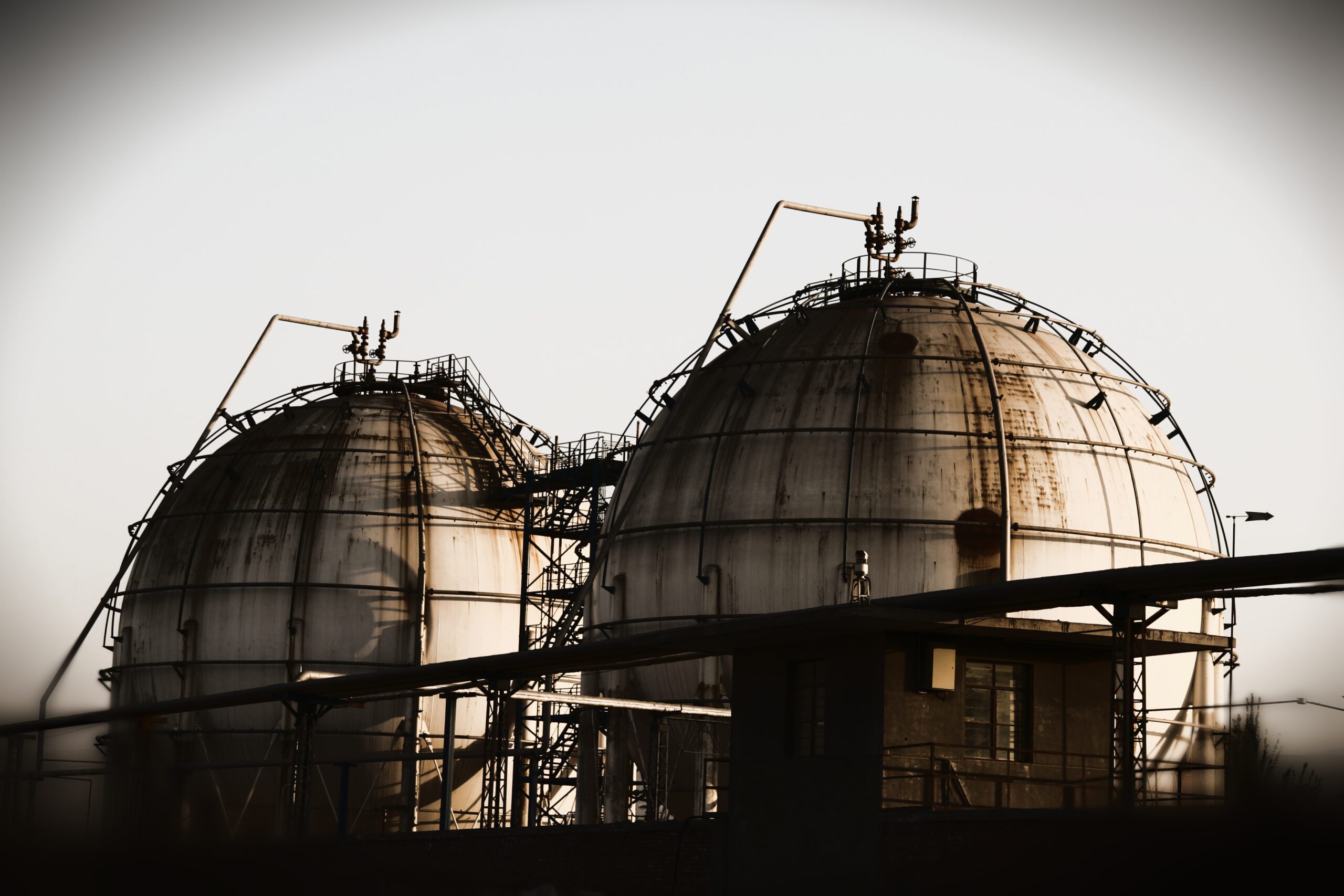
China has achieved a decisive position to influence oil prices in the global market. In the image, spheres at a refinery in northern China. Photo: Adam Cohn.
Guacamaya, July 17, 2026. For decades, the balance of the oil market was determined primarily by OPEC’s capacity to increase or reduce its production. Today, however, the demand of one country is beginning to play an equally important role: China has become one of the actors with the greatest capacity to influence international crude prices.
China’s recent behavior demonstrates that the world’s largest oil importer is no longer merely a passive consumer, but an actor capable of directly influencing the formation of international prices.
During the first months of the conflict in the Middle East, Beijing significantly reduced its crude purchases, moderating global demand and helping to contain an even greater increase in prices, despite the supply tensions arising from the war. Consequently, one of the main unknowns for energy markets is when China will increase its imports again. As long as that rebound is delayed, pressure on prices will tend to be lower; conversely, a sustained recovery in Chinese demand could once again drive up the price of a barrel.
Added to this dynamic is the impact of the war between Russia and Ukraine. Attacks on Russian energy infrastructure and Moscow’s restrictions on diesel exports to protect its domestic market have reduced the availability of refined fuels, causing increases in international diesel prices. This behavior tends to be passed on to consumers, reflecting that the market faces not only challenges in crude supply, but also in global refining capacity.
China as a Regulator of Global Demand
Despite the reduction in its imports, various indicators suggest that China could be preparing to gradually return to the market. The International Energy Agency (IEA) has identified an increase in cargo charters and scheduled deliveries of oil tankers, signals that could anticipate a recovery in purchases. However, the market still does not know precisely how Beijing has managed to reduce its imports so drastically without visibly drawing on its enormous strategic oil reserves.
Part of the explanation lies in the structural transformation of China’s energy matrix. The country has one of the largest strategic crude reserves in the world, has temporarily reduced the activity of its refineries, and has alternatives that reduce its dependence on oil, such as the intensive use of coal in certain industrial processes, the rapid expansion of renewable energies, global leadership in electric vehicles, and the world’s most extensive high-speed rail network. These capacities allow it to manage the pace of its imports with greater flexibility and use oil purchases as a tool for economic and strategic management.
The IEA even estimates that this could be the first year since the oil crises of the 1970s and early 1980s in which oil consumption in China registers a significant decline. If this trend continues, Beijing will retain ample room to delay new acquisitions, consolidating a phenomenon that redefines the balance of the global energy market, since for the first time in decades, the decisions of a large importer can be as decisive for international prices as the production policies of the main exporting countries.
Although the conflict in the Persian Gulf, the security of the Strait of Hormuz, and the disruptions arising from the war between Russia and Ukraine continue to generate volatility in energy markets, China’s recent behavior has shown that the purchasing decisions of the world’s largest importer can cushion or amplify those impacts.
In recent months, Beijing significantly reduced its oil imports, moderating global demand at a time of high geopolitical uncertainty. That lower crude absorption prevented international prices from registering a much more pronounced increase despite tensions in the Middle East. Now, the market remains attentive to when China will increase its purchases again, since a rebound in demand could once again drive up international prices.
China’s capacity to manage its imports responds to several structural factors. The country has one of the world’s largest strategic petroleum reserves, has reduced the processing rate of its refineries, and has an increasingly diversified energy matrix thanks to the growth of renewable energies, the use of coal in certain industrial processes, the rapid expansion of electric vehicles, and the world’s largest high-speed rail network. All this gives it considerable room to delay purchases when it considers that market conditions are not favorable.
This change represents a significant transformation in the governance of the oil market. If for decades the large exporters concentrated the power to influence prices through supply, today an importer of China’s size can exert comparable influence through demand.
What Does It Mean for Venezuela?
For Venezuela, this evolution takes on even greater importance in the context arising after the political changes of early 2026 and the subsequent U.S. intervention in the marketing of the oil sector.
Before that stage, China was the main destination for Venezuelan crude. A significant portion of those shipments was linked to the “oil-for-loans” mechanism, through which Caracas amortized the debt accumulated with Chinese financial institutions. In addition, much of the exports reached independent refineries (“teapots”) through schemes that involved significant discounts due to the sanctions regime.
After the reorganization of the Venezuelan oil sector under Washington’s influence, the United States became the main buyer of Venezuelan crude and established a commercial scheme that prioritizes U.S. and Western markets. Under this new model, sales were no longer made with steep discounts and began to be marketed at prices aligned with international benchmarks.
The U.S. administration itself has indicated that it does not seek to exclude China from the Venezuelan market. Energy Secretary Chris Wright confirmed that Chinese companies continue to acquire Venezuelan cargoes marketed under the new scheme, while President Donald Trump publicly stated that his administration favors Chinese buyers participating in that market as long as they pay international prices and not under preferential mechanisms.
In this new context, whether China reduces or increases its oil imports has implications that go far beyond a simple bilateral commercial relationship with Venezuela. If Beijing decides to increase its international crude purchases, it would increase pressure on global demand and could help raise oil prices, generating higher revenues for exporting countries, including Venezuela, even if a significant portion of its production no longer has the Chinese market as its main destination. Conversely, a prolonged reduction in Chinese purchases would maintain less pressure on international prices and limit potential revenues for producers.
For Venezuela, this takes on a strategic dimension. Although China has ceased to be the dominant buyer of Venezuelan crude under the new commercial scheme, it remains a determining actor because its decisions influence the global value of the barrel, which defines the income Caracas can obtain for each cargo exported. Furthermore, if China again increases its demand, space could reopen for Venezuelan oil to compete for a greater share of that market, but under different rules: without the large discounts of the past and with buyers who must pay prices adjusted to international benchmarks.
Therefore, China’s evolution represents a key variable for Venezuela. The country must not only observe who buys its oil, but also who determines the conditions of the market in which that oil is sold. Currently, Chinese influence on global demand can have as significant an impact on Venezuelan oil revenues as OPEC’s production decisions or U.S. energy policies.
Consequently, the energy relationship between Venezuela and China has ceased to be determined exclusively by financial agreements or by the limitations arising from sanctions. Henceforth, it will depend increasingly on commercial factors and, above all, on the purchasing strategy adopted by Beijing.
If China decides to increase its global imports again, Venezuela could benefit from greater international demand and higher prices, even if a significant portion of its exports continues to be directed toward the United States and Europe. Conversely, if Beijing maintains a moderate purchasing policy relying on its strategic reserves and energy transition, pressure on international prices could persist, reducing the potential revenues of all exporting countries.
In other words, for Venezuela it is no longer enough to observe OPEC’s production decisions or the evolution of geopolitical conflicts. China’s energy and commercial policy has become one of the main variables that will determine the evolution of the international oil market and, by extension, the prospects for revenue, investment, and stability of the Venezuelan energy sector in the coming years.
In this context, Venezuela must pay close attention to the evolution of Chinese oil demand. Although after the reorganization of the oil sector in 2026, the United States displaced China as the main destination for Venezuelan exports and crude began to be marketed under an administered scheme that prioritizes Western markets, Beijing’s purchasing decisions continue to have a direct impact on international oil prices. A sustained increase in Chinese imports could raise crude prices and translate into higher revenues for Venezuela, regardless of the final destination of its exports. Conversely, if China maintains a policy of contained purchases supported by its strategic reserves, its energy transition, and the diversification of its consumption matrix, pressure on prices could persist.
Venezuelan oil, now unsanctioned and following the new OFAC scheme, can compete for a greater share of that market, but under different rules: without the large discounts of the past and with buyers who must pay prices adjusted to international benchmarks.
This does not mean that Venezuela should abandon the Chinese market. Although commercial conditions have changed, China remains one of the world’s largest centers of energy demand and represents a strategic alternative for any oil producer seeking to diversify its export destinations. The experience of recent years demonstrated the risks of depending excessively on a single market or a single marketing scheme. Maintaining a commercial relationship with Beijing allows Venezuela to retain access to a global-scale buyer, especially in a context where competition for energy markets will be increasingly fierce.
Even the United States, despite its geopolitical objectives and its intention to reduce Chinese strategic influence in Latin America, does not appear to seek an absolute rupture between Venezuela and China in oil matters. The reason is mainly economic, because completely excluding China would reduce the number of potential buyers of Venezuelan crude and could affect market stability, while allowing the participation of Chinese companies under transparent conditions and international prices favors a more competitive and predictable market. For Washington, the fundamental change does not necessarily lie in who buys Venezuelan oil, but in how it is marketed: that operations be verifiable, legal, without artificial discounts, and within a framework that reduces the mechanisms previously used to evade sanctions.
From the Venezuelan perspective, this opens an opportunity to rethink the energy relationship with China. The objective should not be to return to the previous model of sales conditioned by debt or financial restrictions, but to build a more balanced commercial relationship, where Venezuelan oil competes on quality, reliability, and market conditions. In a global scenario where China has the capacity to modify international prices through its purchasing decisions, keeping that channel open can be a strategic advantage for Venezuela, even within a new oil architecture where the United States has a more relevant participation.
The Oil Relationship and Debt with China
China’s influence over the Venezuelan oil sector is not limited solely to its capacity as a crude buyer. It is also linked to the financial structure that for more than a decade defined the relationship between Caracas and Beijing: the scheme of loans backed by oil. This connection between debt and energy exports means that any change in the commercial oil relationship with China has direct implications for a possible restructuring of Venezuelan debt.
Although China represents a relatively smaller proportion of Venezuela’s total external debt—estimated at between 10 and 13 billion dollars—its position is particularly relevant due to the nature of its claims. Unlike other traditional financial creditors, a significant portion of the commitments with Beijing is guaranteed through future oil flows, which gives it a direct relationship with the country’s main source of external income.
Under this scheme, China is not simply a creditor waiting for a financial payment, but an actor linked to the performance of the Venezuelan oil sector. While other debt holders depend on a general economic recovery to obtain their resources, Beijing has historically had a mechanism associated with crude supply. Therefore, a comprehensive restructuring of Venezuelan debt must address not only how much is owed, but also how commitments linked to oil shipments are reorganized.
This point becomes more relevant following the transformation of the Venezuelan market in 2026. The fact that the United States has assumed a central role in the marketing of Venezuelan crude and has established new rules for international sales does not eliminate the importance of China as a creditor and potential buyer. On the contrary, it forces a rethinking of the relationship under a different logic: moving from a scheme where oil functioned mainly as a debt payment mechanism to one where it must operate as a commercial asset capable of generating sufficient income to meet multiple financial commitments.
In a possible negotiation backed by international institutions such as the International Monetary Fund, one of the main challenges will be to achieve a balance between the interests of China and those of the rest of the creditors. The principle of comparable treatment seeks to prevent one creditor from retaining preferential conditions while others assume losses or restructure their rights. However, the particularity of the Chinese case is that its rights are directly connected to the oil flow, which may give it greater influence than the size of its debt alone would suggest.
For this reason, Venezuela cannot analyze its relationship with China solely from the commercial perspective of oil. Beijing will continue to be a central actor because it combines three strategic dimensions: first, it is a potential crude buyer; second, it is a financial creditor; and third, it is a partner with experience in Venezuelan energy projects. Venezuela’s capacity to rebuild its oil sector and reorganize its debt will depend, to a large extent, on finding a balance between keeping Chinese participation open in the energy market and establishing a sustainable financial framework that allows attracting new investors and recovering international credibility.
In this scenario, the evolution of Chinese energy policy once again becomes decisive. If China increases its oil purchases globally, it can favor higher prices and increase Venezuela’s payment capacity. But beyond the price of the barrel, the future relationship with Beijing will depend on transforming a relationship historically based on oil-backed financing toward a commercial partnership where both parties find sustainable economic incentives.