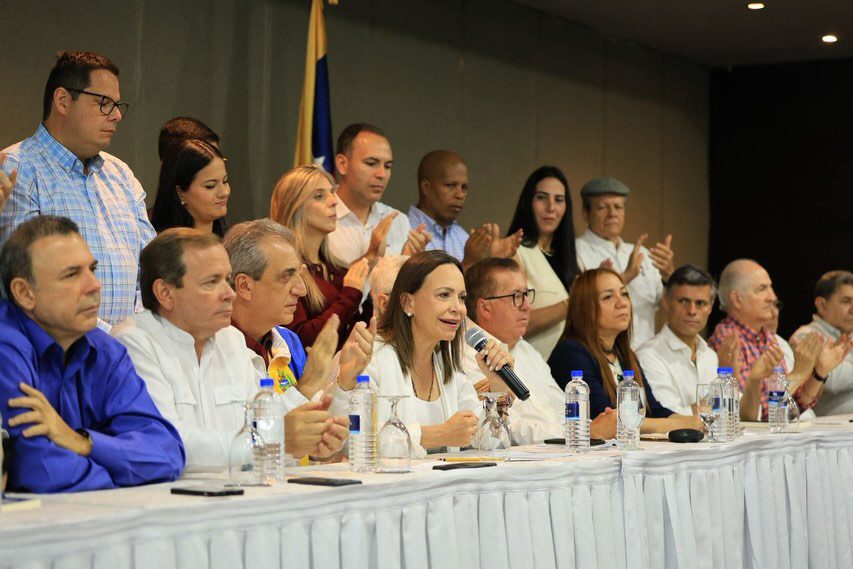
María Corina Machado (center) alongside representatives of the Unitary Platform and other Venezuelan opposition parties in Panama, May 25, 2026. Photo: Instagram / @convzlacomando.
Guacamaya, May 29, 2026. On Thursday, May 28, the summit of opposition forces convened by María Corina Machado released the Panama Manifesto, which proposes “negotiation for the restoration of democracy” and a “great national agreement.”
The manifesto was signed by María Corina Machado, Edmundo González, the Democratic Unitary Platform, and the Con Venezuela Alliance, following a week of meetings of opposition leaders in Panama City that had seemed to conclude without agreements.
The key background is the growing alignment between the Donald Trump administration and the acting government of Delcy Rodríguez, with no clear path toward presidential elections and no established role for María Corina Machado as the leader of a possible transition.
In this context, one of the objectives for discussion was the electoral route the opposition would defend before the United States. While international allies have spoken with the Unitary Platform about starting with local and regional elections, Machado has always pushed to begin with the presidential elections.
The United States has also requested that the national assemblies elected in 2015, dominated by Unitary Platform parties, and in 2025, controlled by the ruling party, work together, although this point remains outside the document.
In the Panama Manifesto, it is agreed that the leader of Vente Venezuela assumes direct leadership and spokesperson duties in the new mechanism for a “democratic transition,” under the Three-Phase Plan proposed by the United States as a framework for action.
However, the document’s proposals directly confront White House plans, which are focused on stability and economic growth without a clear horizon for government changes.
As a central objective, the opposition forces gathered in Panama propose a political route aimed at “organizing a presidential election with real conditions of freedom, sovereignty, and transparency.”
To that end, the manifesto proposes two simultaneous paths of action: direct political negotiation with the government of Delcy Rodríguez and the construction of a “Great National Agreement for the Recovery of the Republic” with the participation of all sectors of civil society, both inside and outside the country.
Nevertheless, the document establishes clear demands before any progress: On one hand, it demands the “full release of political prisoners (civilians and military personnel), the safe return of political exiles, the normalization of the civic-political space, and the dismantling of the repressive apparatus and armed/illegal groups.”
At the same time, it also proposes a key institutional reform, based on the demand for “a new CNE [National Electoral Council] composed of independent figures, with a clear, verifiable, and viable electoral schedule.”
This manifesto was agreed upon following intense high-level meetings over the weekend of May 23–25, 2026, in Panama City. It marks a historic shift in approach for the sector led by Machado, for while it maintains the position regarding the results of July 28, 2024 (favorable to Edmundo González), it recognizes that any political exit requires conversations with Chavismo.
In terms of political significance, the tone this time is more oriented toward negotiation than direct confrontation, although it also begins to reflect tensions between forces once seen as major allies: the Trump administration and the opposition group led by Machado.
Elías Ferrer contributed to the writing of this article.