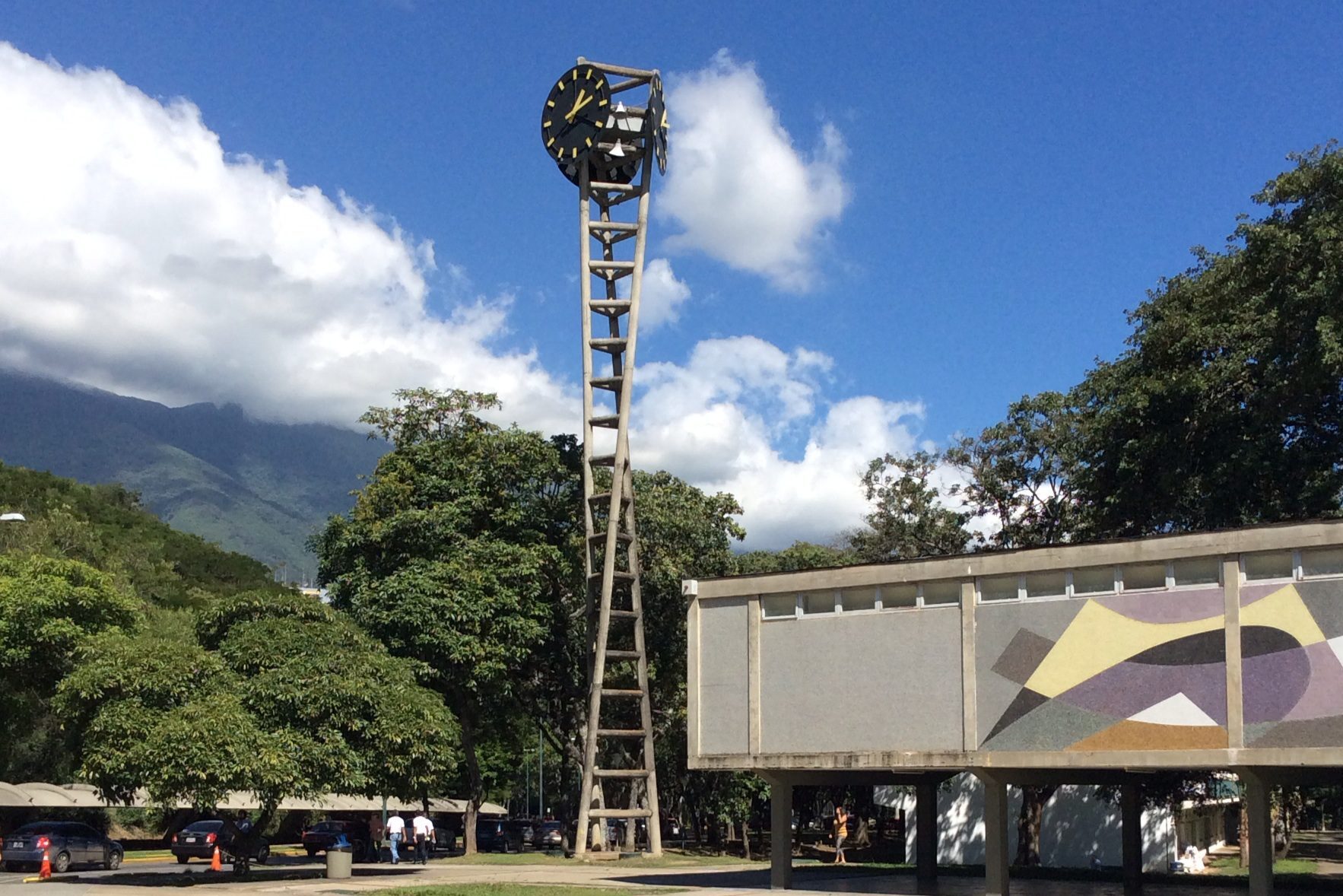
The electoral coalitions reflect a marked influence from national political parties, with figures linked to Vente Venezuela on one side, and other groups backed by the Unitary Platform. | Photo: Rube96pinto / Wikimedia Commons.
Guacamaya, June 8, 2026. The Central University of Venezuela (UCV) is immersed in a scenario of high polarization and dynamism ahead of the 2026 student elections. What was originally planned as a day of democratic renewal for June 26 has devolved into an intense internal struggle following the announcement of a partial rescheduling of the electoral calendar by the Electoral Commission.
The decision to postpone the elections, officially announced on June 4 and ratified by the University Council on June 8, responds to the need to migrate teaching and research assistants—who had been included in the faculty electoral registry—into the student electoral registry, in compliance with instructions from the University Council issued days earlier.
According to sources consulted by Guacamaya, July 10 was being handled as a tentative date for holding the elections—a day that was finally made official by the Council on the morning of June 8. However, the proposal and decision were questioned because various faculties would already be on vacation by that time, which could affect student participation.
The rescheduling and the opposing responses
In 2024, Miguelángel Suárez (current president of the FCU) and Rosa Cucunuba (current vice president of the FCU) won the highest student government body together under the ticket “Salvemos la UCV” (5,571 votes). Today, after two years of administration, the alliances have reconfigured, and they now promote opposing factions, despite both being of opposition leaning in national politics.
On one hand, the ticket “A La Universitaria” (backed by Suárez) nominates Simón Belisario (Law) and Allan Vargas (Political and Administrative Studies). On the other hand, the option “Elecciones Libres” features Rosa Cucunuba herself (Law) and Octavio González (Law) at the top. As a key detail, no tickets linked to Chavismo were reported this year.
Faced with the rescheduling by the Electoral Commission (prior to its ratification by the University Council), the two main forces aspiring to the Federation of University Centers (FCU) reacted with diametrically opposed strategies. While some opted for street protests, others focused their attention within the university campus.
On Friday, June 5, members of the “Elecciones Libres” ticket mobilized to the headquarters of the Electoral Commission in La Floresta—located outside the university grounds—which was closed, an event that their detractors labeled a “media stunt.” Cucunuba demanded that they “not take away the University’s right to express itself” and questioned the “lukewarm stances” of her adversaries.
“A La Universitaria,” for its part, organized a signature collection on campus that same day and gathered nearly 2,500 signatures rejecting the rescheduling. Suárez pointed out that “space needs to be opened for new generations,” in direct questioning of Cucunuba’s running mate, Octavio González, who was confirmed to be 31 years old and began his studies in 2013.
Electoral machinery and the weight of alliances
The registered tickets are electoral alliances composed of “federative factors,” with partisan impulses from national politics. FCU candidates depend on these coalitions to gather “channeled votes” across the more than 40 schools and 11 faculties, since students often only vote for their closest student centers. Likewise, they depend on partisan backing to obtain resources for their electoral campaigns.
“A La Universitaria” groups together movements such as Conexión UCV, Alma UCV, Movimiento UCV, Identidad UCVista, Renovamos UCV (faction), Humanitas, Triada, and other independent school teams. Although they present themselves with an academic focus, they are influenced behind the scenes by tendencies of parties from the Unitary Platform, such as Voluntad Popular, Acción Democrática, Primero Justicia, Encuentro Ciudadano, Proyecto Venezuela, and members of Vente Venezuela, as well as figures promoted by Alianza del Lápiz.
“Elecciones Libres,” for its part, brings together Siempre UCV, Autonomía UCV, A7, Soy UCV, teams stemming from the split of Renovamos UCV, and other independent teams. Its national political influence is marked by Vente Venezuela and Alianza al Bravo Pueblo. Contrary to what one might expect from the national landscape, the alliance also includes figures promoted by Unión y Cambio, Fuerza Vecinal, and Cambiemos.
The challenge of participation
Precisely, a point of criticism in this process is that the student movement’s rhetoric seems more focused on the national political agenda than on student and academic demands. This approach is widely questioned by both the majority of students and the national public opinion, which perceives a disconnect between student leaders and the real needs of the University.
This provides context for a marked disinterest in the process among regular students. In 2024, only about 40% voted (approximately 10,000 out of 25,000 registered). Although it was considered a success after years of apathy, the reality is that the majority do not participate, and many do not even know the FCU candidates, leaving the decision in the hands of the structures mobilized by political alliances.
However, the presidency of the FCU has historically been a springboard for political careers. Emblematic examples of active leaders are Stalin González (term 2004–2007) and Juan Requesens (term 2012–2015), who jumped from UCV student leadership to the national public stage. Another highly relevant case is that of Jorge Rodríguez, current president of the National Assembly, who was president of the student body in 1988.
In summary, the UCV is staking its student renewal on an electoral panorama that does not escape controversy. July 10 is a date that has been questioned because it coincides with the vacation period, which could even motivate legal challenges to the process. Meanwhile, the country’s main university remains the thermometer of a youth trying to resolve its differences under the shadow of national politics.