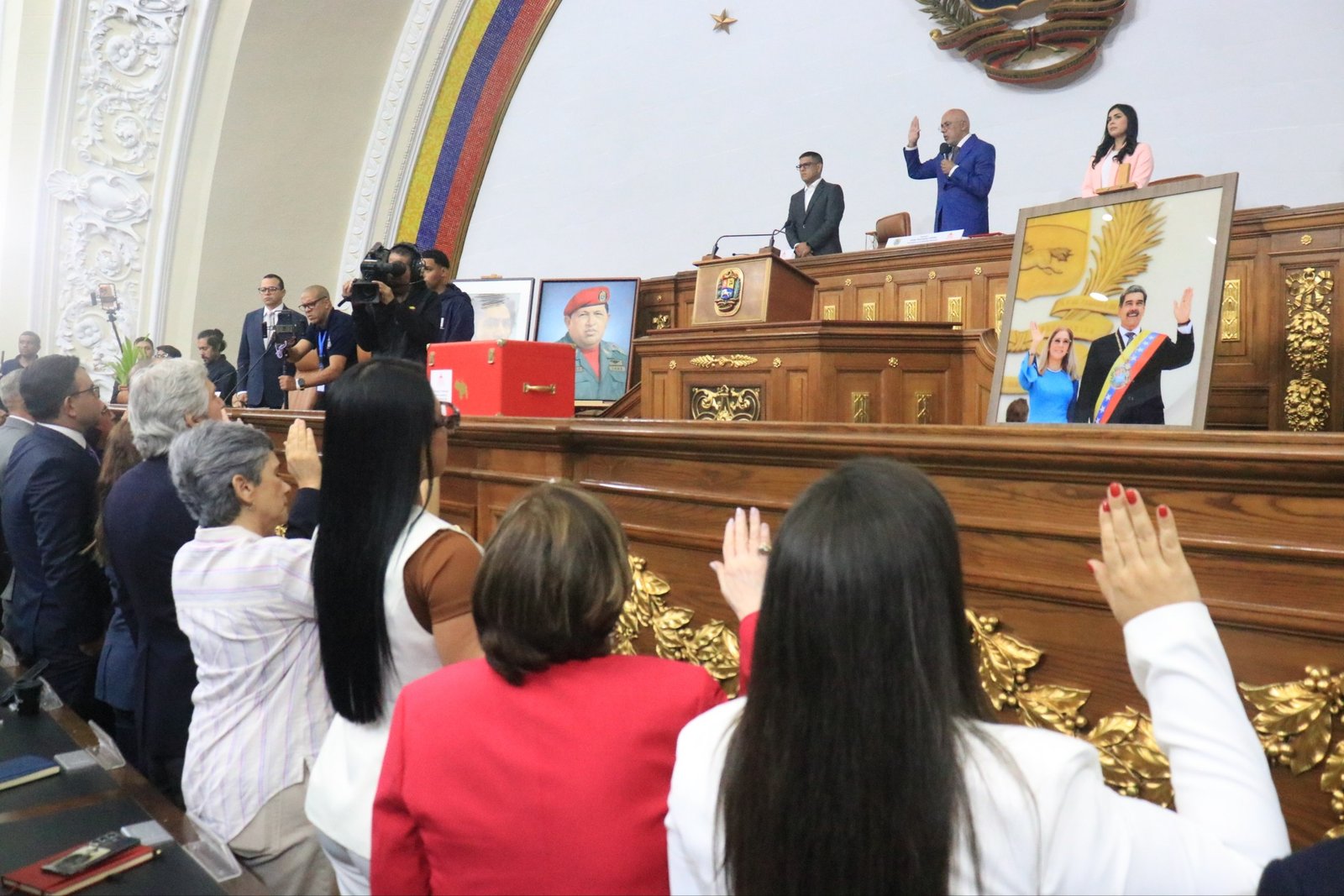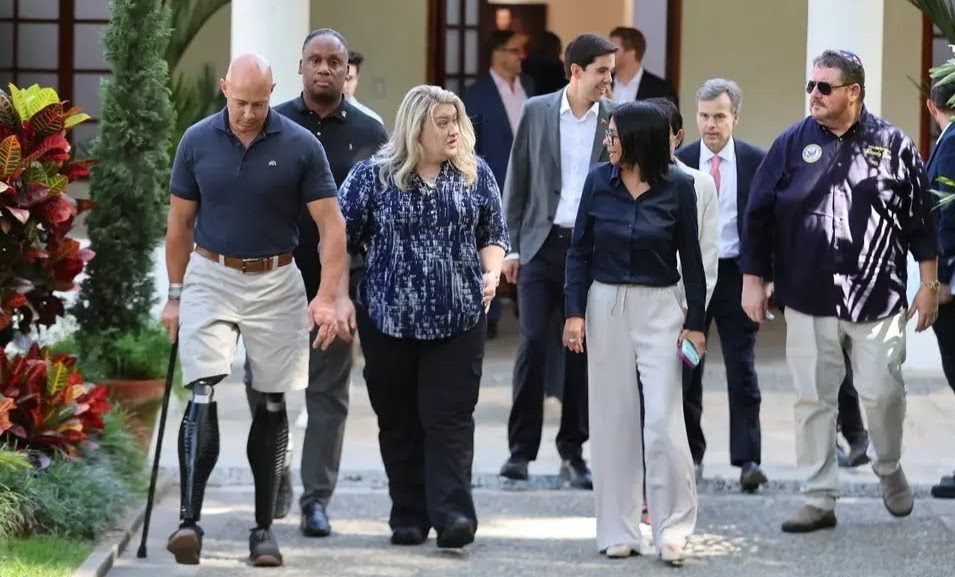
A delegation from the U.S. House of Representatives arrived in Caracas on Friday and met with Venezuela’s interim president, Delcy Rodríguez, to assess the bilateral agenda, with an emphasis on cooperation in security, defense, and border control. The delegation was composed of Republican Representatives Brian Mast, Randy Fine, and Kat Cammack, along with progressive Democratic Representative Jonathan Jackson. Photo: Presidential Press Office.
Guacamaya, July 28, 2026. Four distinct profiles —two Republicans close to the pro-Israel lobby, a veteran political operator, and a progressive Democrat critical of sanctions— make up the first House of Representatives mission to set foot in Caracas since diplomatic relations were restored.
A US House of Representatives delegation arrived in Caracas on Friday, July 24, to meet with Venezuela’s acting president, Delcy Rodríguez, in talks focused on security, defense, and border-control cooperation. It is the first official visit by House lawmakers to the country since March, when both governments restored diplomatic relations following the January 3 military operation that led to the capture of Nicolás Maduro and Cilia Flores.
The delegation, made up of Representatives Brian Mast, Randy Fine, Kat Cammack, and Jonathan Jackson, was received alongside the US chargé d’affaires in Venezuela, John Barrett; Foreign Minister Félix Plasencia; and First Vice-Minister of Foreign Affairs Oliver Blanco.
During their agenda in Caracas, the lawmakers also held meetings with the Ministry of Defense and the National Anti-Drug Superintendency (Sunad), and met with the president of the Parliamentary Friendship Group with the United States, opposition lawmaker Antonio Ecarri; the opposition mayor of Chacao, Gustavo Duque; and members of Venezuelan civil society.
This is a group with markedly different profiles from one another, offering clues about the multiple interests running through the rapprochement between Washington and Caracas.
Brian Mast: The veteran with military and pro-Israel ties.
A Republican representing Florida’s 21st district, Mast led the delegation. Before entering Congress, he served more than twelve years in the US Army, specializing in explosive ordnance disposal within elite special operations units. An improvised explosive device in Afghanistan cost him both his legs, an injury for which he received decorations including the Bronze Star and the Purple Heart. After his recovery he remained involved in national security, first at the National Nuclear Security Administration and later as an explosives specialist at the Department of Homeland Security, before earning a degree from Harvard.
Mast is one of the voices most closely identified with the pro-Israel lobby in Congress, close to AIPAC, and has volunteered alongside the Israel Defense Forces. His security background and experience in bomb disposal and transnational crime make him a natural figure to lead an agenda focused on anti-drug and border cooperation with Venezuela, in line with the current administration’s interests.
Randy Fine: The “Hebrew Hammer” with a regional security agenda
Elected in April 2025 to represent Florida’s 6th district, Fine sits on the House Foreign Affairs Committee —with a seat on the Western Hemisphere subcommittee— and the Education and Workforce Committee. A retired entrepreneur who left the private sector at age 40, he previously served in the Florida state legislature, where he chaired five committees and built a reputation for firm positions on immigration and education.
He is also close to the American Israel Public Affairs Committee (AIPAC).
As the only Jewish Republican in the Florida Legislature at the time, Fine led security initiatives for Jewish communities and has been a public defender of Netanyahu and of Israeli military operations in Gaza, the West Bank, and other fronts. His seat on the Western Hemisphere subcommittee connects him directly to the Venezuela agenda, while his closeness to Israel takes on additional meaning in the current context: Caracas and Tel Aviv have resumed contact after more than a decade of broken relations, following the Netanyahu government’s recent humanitarian mission to Venezuela after the earthquakes and its announced intention to restore relations with Caracas.
What Is AIPAC?
The American Israel Public Affairs Committee (AIPAC) is one of the most influential lobbying organizations in the United States. Founded in 1963, its stated mission is to strengthen the US-Israel relationship by mobilizing political, financial, and legislative support for Israel within the US Congress. AIPAC operates through an affiliated political action committee that backs candidates from both parties aligned with its agenda, and maintains an extensive network of contacts among lawmakers, aides, and donors.
Its influence shows in the organization’s ability to sway votes on military aid to Israel, sanctions on Middle East regional actors, and foreign-policy appointments. Mast and Fine are among the Republican lawmakers publicly identified with positions close to AIPAC, adding another layer to their presence in Caracas at a moment when Venezuela and Israel are resuming diplomatic contact — a development that fits Washington’s interests regarding the new shape of Venezuela’s foreign relations.
Kat Cammack: The political operator with border-security experience
Representing Florida’s 3rd district, Cammack built her career as chief of staff and campaign manager for former Congressman Ted Yoho, with whom she worked on a human-trafficking task force in North Florida. Before entering politics she worked in banking and later founded her own communications and marketing consulting firm.
In Congress she sits on the Homeland Security Committee —as a ranking member of the Emergency Preparedness, Response, and Recovery subcommittee— and the Agriculture Committee. Her background in human trafficking and homeland security ties her directly to the stated goals of the visit: strengthening cooperation against transnational crime and border control, central themes of the meetings held with the Ministry of Defense and Sunad.
Jonathan Jackson: The Democratic and Anti-Sanctions Voice
The son of Reverend Jesse Jackson, he has represented Illinois’s 1st district since 2023. Before Congress, he was national spokesman for the Rainbow/PUSH Coalition and a financial analyst, and from a young age accompanied his father on international mediation missions, including a 2005 visit to Venezuela to meet with Hugo Chávez, amid the controversy sparked by televangelist Pat Robertson’s remarks about the then-president.
Jackson is today one of the Democratic lawmakers most critical of economic sanctions against Venezuela. This month he signed, along with other members of Congress’s progressive bloc, a letter calling for the lifting of sanctions and the unfreezing of Venezuelan assets. His presence in the delegation introduces a different tone from that of his Republican colleagues: while they prioritize security and defense cooperation, Jackson represents a segment of Congress advocating for a less punitive economic relationship with Caracas.
Background: security, energy, and a new geopolitical piece
The visit comes amid a bilateral rapprochement that began after Rodríguez took office, which has already brought Energy Secretary Chris Wright and Interior Secretary Doug Burgum to Caracas. In March, a Senate Foreign Relations Committee delegation made a similar visit as part of what both governments have described as a bilateral “roadmap.”
The diplomatic movement coincides with new signals about Venezuela’s electoral agenda: President Donald Trump said on Friday that the country is still “not ready” for elections, though he acknowledged progress, while the National Assembly and opposition sectors announced the start of talks on August 1 to discuss mechanisms for advancing democracy — a process backed by Washington.
The Israel factor
The mix of profiles in the delegation —two lawmakers with strong ties to the pro-Israel lobby, at a moment of rapprochement between Caracas and Tel Aviv following Israeli humanitarian aid after the earthquakes; a specialist in border security and organized crime; and a Democrat critical of sanctions— suggests that Washington’s agenda toward Venezuela combines at least three layers of interest: security and migration control, a possible normalization with Israel that could open space for investment in critical minerals and defense, and an unresolved internal debate over the future of the sanctions regime.
The Shield of the Americas and a possible reshaping of venezuelan security
The presence of Mast and Fine, both identified with positions close to AIPAC, takes on additional significance when viewed alongside a broader discussion Washington is driving in the region: rising defense spending through initiatives like the Shield of the Americas, launched by the Trump administration in March 2026 with the stated goal of coordinating military and law-enforcement efforts against transnational criminal organizations, particularly drug cartels. Venezuela is not directly part of that framework, but a deeper bilateral cooperation under what both governments have called “stabilization” could lead to a thorough overhaul of the country’s defense capabilities.
After years of technological dependence on Russian, Chinese, and Iranian suppliers, Venezuela would face the challenge of modernizing its military, communications, and intelligence systems to meet Western interoperability standards, particularly with the United States and its allies, including Israel. In that scenario, Israeli defense, cybersecurity, and intelligence firms could find a strategic opportunity: Israel has extensive experience in surveillance systems, border protection, electronic warfare, data analysis, and response to hybrid threats — capabilities that would be relevant to Venezuela both in rebuilding its security institutions and in combating irregular armed groups, such as the ELN, which maintain a presence in border areas.
Under this reading, the visit of a delegation with two lawmakers close to the pro-Israel lobby would not just be a political gesture toward Jewish-American voters or Israel, but also a possible early signal of Washington’s interest in bringing its allies — starting with Israel — into the rebuilding of Venezuela’s security and defense apparatus, amid geopolitical competition with China, Russia, and Iran for influence over Caracas.
The absence of Cuban-American Republican representatives from South Florida from the visit is a key detail; it is important to remember that they are major supporters of opposition leader María Corina Machado in Washington and frequently speak out on Venezuela, yet they were not considered to represent the U.S. Congress at this meeting.