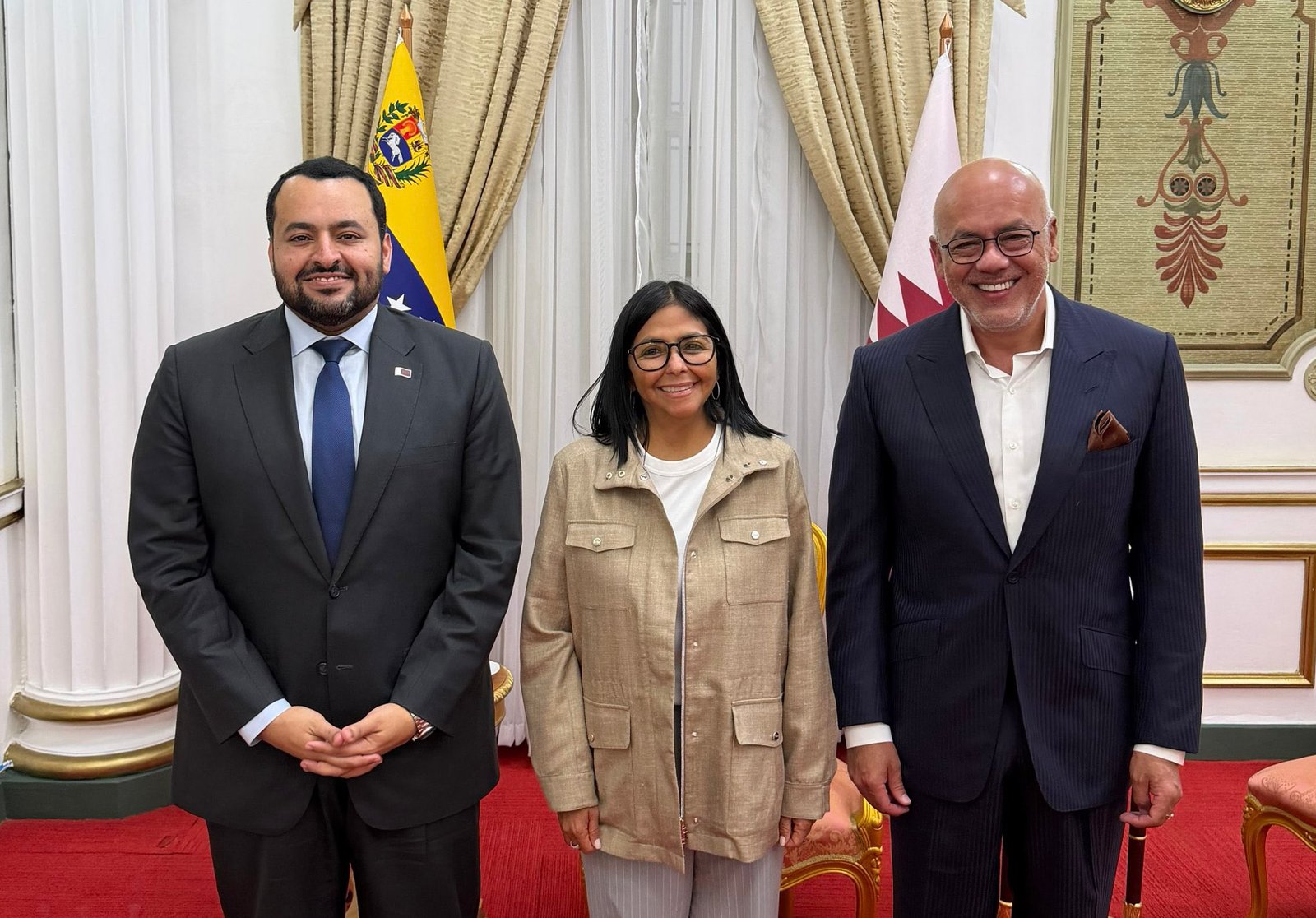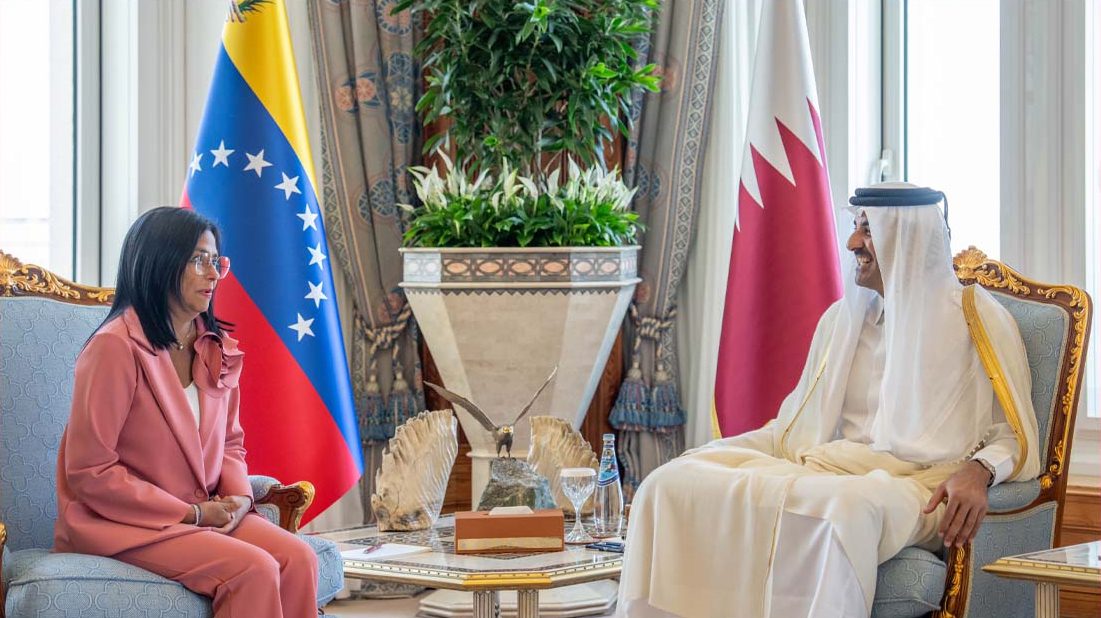
Delcy Rodríguez has maintained a close relationship with the monarchies of Qatar and the United Arab Emirates since her role as executive vice president. Today, this bond is reinforced by investments from both countries in a gas project in Venezuela. In the image, Rodríguez alongside the Emir of Qatar, Tamim bin Hamad Al-Thani, in April 2025. Photo: Qatar News Agency.
Guacamaya, August 15, 2026. On August 13, the multinational BP, together with two companies from the Persian Gulf —XRG and UCC Oil and Gas— secured a license to explore and develop the second phase of the offshore Loran field in Venezuelan waters.
The signing by XRG, the investment arm of the Abu Dhabi National Oil Company, and UCC, linked to the Emir of Qatar, represents the culmination of a long process of rapprochement between Venezuela and the two Persian Gulf monarchies, which began as diplomatic mediation and has now evolved into energy business.
Behind the agreement is also a personal relationship between Delcy Rodríguez and Emir Tamim bin Hamad Al Thani, which, according to what she herself revealed to Time magazine, was decisive during the most critical hours of January 3.
A Truly Multinational Agreement
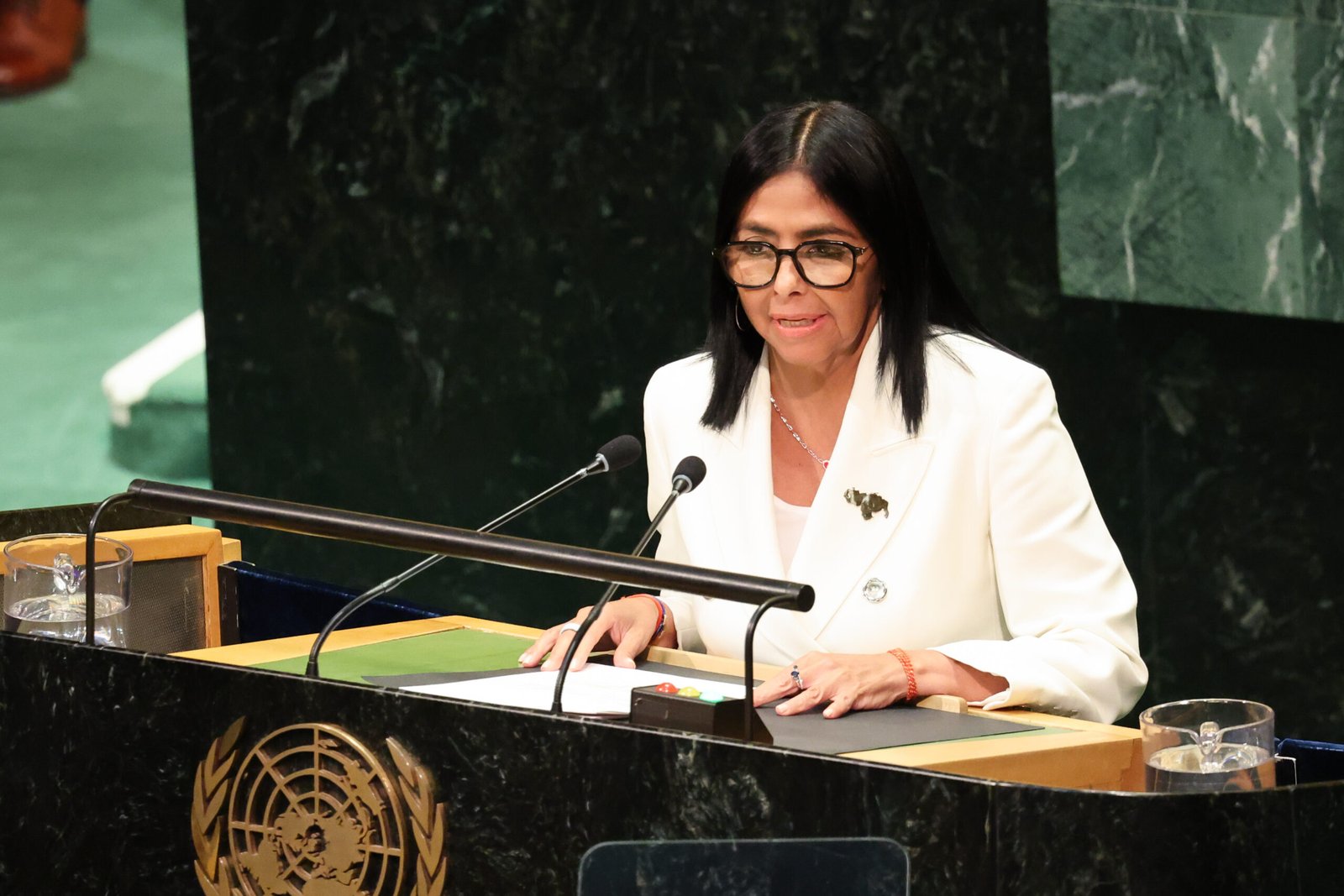
The signing of Phase II of the Loran field was not merely a protocolary act for the gas industry. It was a snapshot of a strategic shift. When Delcy Rodríguez led the signing on Thursday of the agreement between PDVSA, BP Exploration Caribbean (United Kingdom), XRG (United Arab Emirates), and UCC Oil and Gas (Qatar), the acting president deliberately chose the adjective “multipolar” to describe the consortium.
In less than eight months, the interim government has gone from receiving Gulf delegations at Miraflores Palace to integrating them as direct partners in the exploitation of its most coveted fields.
The Loran field, located offshore on the Deltana Platform, encompasses seven gas deposits, six of which are cross-border with Trinidad and Tobago. The license granted to the three partners enables the exploitation of more than four trillion cubic feet of gas. Rodríguez described the concession as a “historic step,” since the field had remained undeveloped for 23 years.
This Phase II complements the license granted last June to Shell for Phase I of the same Loran field. BP’s CEO, Meg O’Neill, participated in the event and called the signing of the agreement an honor, reaffirming the commitment to accelerate operational works to unlock the energy potential of the area.
The gas produced will not be destined for Venezuela’s domestic market, but will go directly to Trinidad and Tobago, where the Atlantic liquefaction plant, operated jointly by BP and Shell, is located.
The liquefaction process allows natural gas to be exported by ship in the form of LNG. Venezuela lacks such facilities, which would require years and significant investments. Under this agreement, the resource will leave Venezuelan waters, be processed in Trinidadian territory, and Caracas will receive royalties for its exploitation and transit.
The agreement also comes at a time when hydrocarbon supplies from the Middle East have been complicated by the conflict between the United States and Iran, which adds an energy security component to the decision by oil companies from both Europe and the Gulf to diversify their exposure toward the Caribbean.
Timeline of a Rapprochement That Has Evolved from Mediation to Investment
Rodríguez’s relationship with the Gulf monarchies did not begin on January 3. Qatar had been acting as a political intermediary for years, cultivating an informal channel between Caracas and Washington at a time of maximum diplomatic tension.
That mediating role —discreet, sustained, and parallel to the official route— allowed Doha to build a relationship of trust with both the late Chavismo and, indirectly, the White House. That accumulated capital proved decisive months later, when the January 3 crisis demanded immediate communication channels between the parties.
From that date on, the rapprochement deepened on three levels. First, on the very day of Maduro’s capture, Qatari officials helped organize the teleconference between Rodríguez and Secretary of State Marco Rubio, a gesture of diplomatic facilitation that confirmed Qatar as a channel of mutual trust between Caracas and Washington.
Second, on January 13, just ten days later, a UAE delegation led by Ali Mohammed Al Shamsi, Secretary-General of the UAE Supreme Council for National Security, met with Rodríguez at Miraflores. Together with representatives of ADNOC —XRG’s parent company— they discussed investment options in Venezuelan hydrocarbons.
And third, on March 2, following the attacks by Israel and the United States against Iran —which included Iranian reprisals against US bases in Bahrain, Qatar, and the UAE— Rodríguez called Emir Tamim to express her solidarity and reaffirm that “only dialogue and diplomacy can pave the way for peace,” without directly mentioning the United States or Iran in her statement.
That sequence —mediation during the crisis, investment outreach ten days later, political collaboration in March, and finally the August gas consortium— draws a straight line. It is not coincidence; it is the consolidation of an axis that began as a diplomatic channel and ended as a structural partner in Venezuela’s new energy model.
After the two earthquakes that shook Venezuela in June of this year, Qatar sent a rescue team to the country to support relief efforts and additionally set up a field hospital to care for the Venezuelan population for one month. For its part, the United Arab Emirates donated $10 million and 70 tons of humanitarian aid to address the tragedy.
Why Qatar and the UAE Matter So Much to Trump’s White House
To understand why Caracas bet on the Gulf, one must first look at Washington. Since his second term, Trump has turned Qatar and the UAE into two of the most favored partners of his foreign policy.
His tour of the Gulf in May 2025 —the first major international trip of his second term— yielded combined investment commitments of more than $2 trillion among Saudi Arabia, Qatar, and the UAE. Qatar committed approximately $1.2 trillion in defense agreements, infrastructure, and a historic order of Boeing aircraft from Qatar Airways, while the UAE accelerated a ten-year investment commitment of $1.4 trillion in the United States, focused on technology, artificial intelligence, and energy infrastructure.
That level of economic and personal closeness —which includes real estate projects linked to the Trump family in both Doha and Abu Dhabi and Dubai— turned both Gulf monarchies into privileged interlocutors for the White House in 2026, with the capacity to influence initiatives that go far beyond the Middle East. Venezuela is one of them.
That XRG and UCC —the latter non-state-owned but closely tied to Emir Tamim bin Hamad Al Thani himself and with prior interests in Venezuelan mining— are the first Gulf firms to invest directly in Venezuelan energy confirms that Doha and Abu Dhabi are using their proximity to Trump to break into a market that until recently was practically inaccessible to them due to US sanctions. It also fits Rodríguez’s strategy of reaching out to the various circles of influence that orbit around the US president to continue gaining ground.
Rodríguez’s link with the Gulf did not begin with the January crisis; it goes back to the Biden administration and the Doha Agreements, in which the easing of sanctions on Venezuela’s energy sector was agreed upon in 2023, a key factor in the return of Western and especially US companies to the country.
At this stage, Qatar had been acting as a political intermediary since at least April 2025, cultivating an informal channel between Caracas and Washington at a time of maximum diplomatic tension. That mediating role —discreet, sustained, and parallel to the official route— allowed Doha to build a relationship of trust with both the late Chavismo and, indirectly, the White House. That accumulated capital proved decisive months later, when the January 3 crisis demanded immediate communication channels between the parties.
The Confession to Time: The Emir Who Reminded Delcy of Her Responsibility
The profile that Time magazine dedicated to Delcy Rodríguez in late July, under the title questioning her transition “from loyalist to Maduro to Trump’s representative,” contains the episode that best illustrates Qatar’s centrality in this story. Rodríguez recounted that, in the hours following Maduro’s transfer to the United States, one of the first calls she received was from Emir Tamim bin Hamad Al Thani himself, with whom —in her words— she had already cultivated a prior relationship. According to the leader, the Emir let her know that the responsibility for preserving Venezuela now fell on her.
In the same interview, when asked who the key figure was in those hours, Rodríguez was direct and mentioned the Emir of Qatar. When Time asked her whether Tamim had maintained parallel contact with the Trump administration, Rodríguez replied that, to her understanding, yes: “the Qatari prime minister held direct conversations with the US government during that same period.”
That testimony is not anecdotal. It confirms, from the acting president’s own mouth, what regional diplomacy had already sensed. Qatar not only collaborated as a channel between Caracas and Washington before the crisis, but also operated as an intermediary in real time during the most delicate moment of January, and that personal bond between Rodríguez and the Emir survived —and deepened— once the new government was consolidated.
The Pattern That Is Solidifying
What is signed today in the Loran field is, in that sense, the economic translation of a relationship built over years of rapprochement and diplomatic mediation.
Qatar cultivated that bond from its role as a facilitator of communication channels in 2023 to the discreet accompaniment of the early days of January 2026, and the United Arab Emirates arrived just ten days after Maduro’s capture, attracted by the business opportunity in a country where much of the West was still moving cautiously. Both also have something to offer: direct and personal access to Donald Trump, something Rodríguez appears to have understood with particular clarity even before January.
Loran’s gas will not reach the Venezuelan market but rather the liquefaction plants of Trinidad and Tobago, bypassing mainland Venezuelan territory almost entirely except for royalties. At its core, it is a project that makes sense both economically and politically, as it diversifies the Gulf’s energy supply amid instability with Iran, consolidates Qatar and the UAE as pioneers of the new era of foreign investment in Venezuela, and reinforces the political capital Rodríguez needs vis-à-vis a White House that, as she herself has acknowledged, ended up defining the course of her interim government.