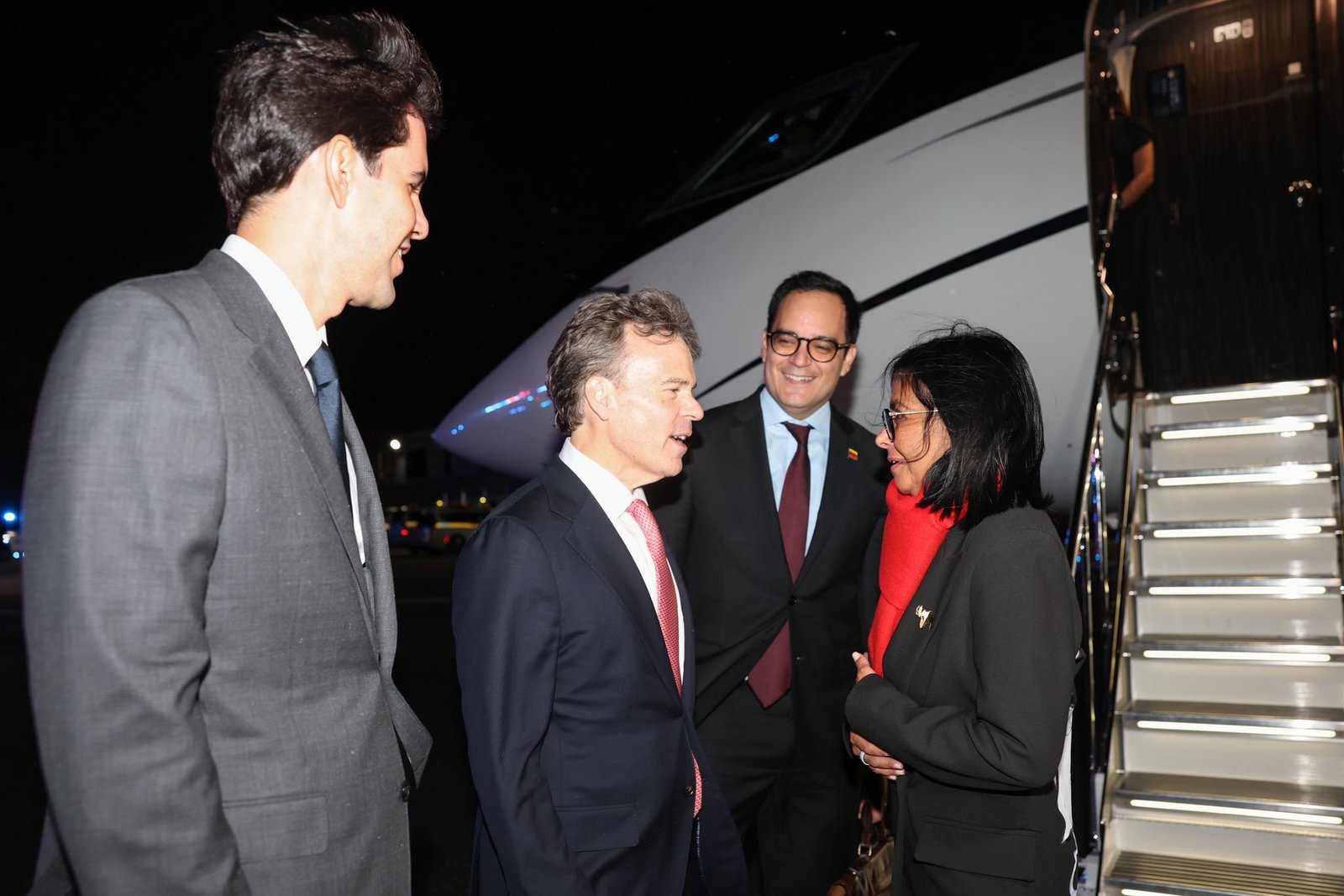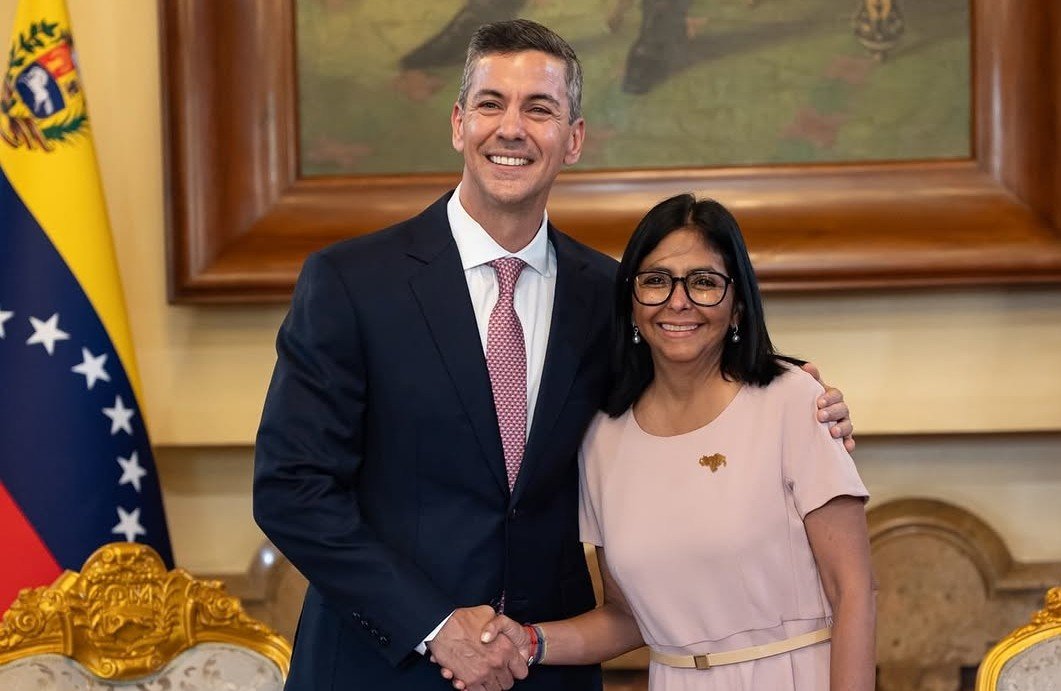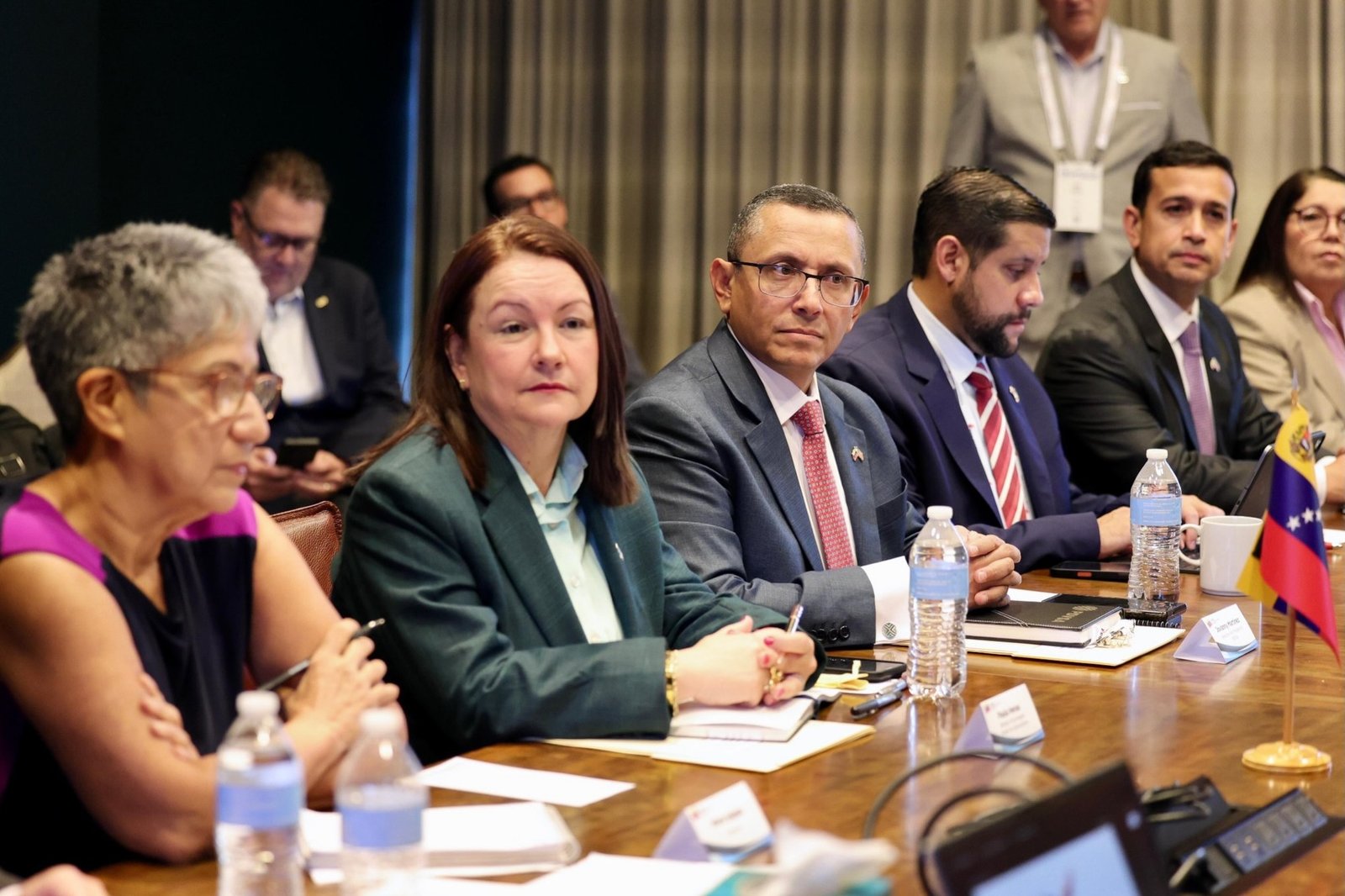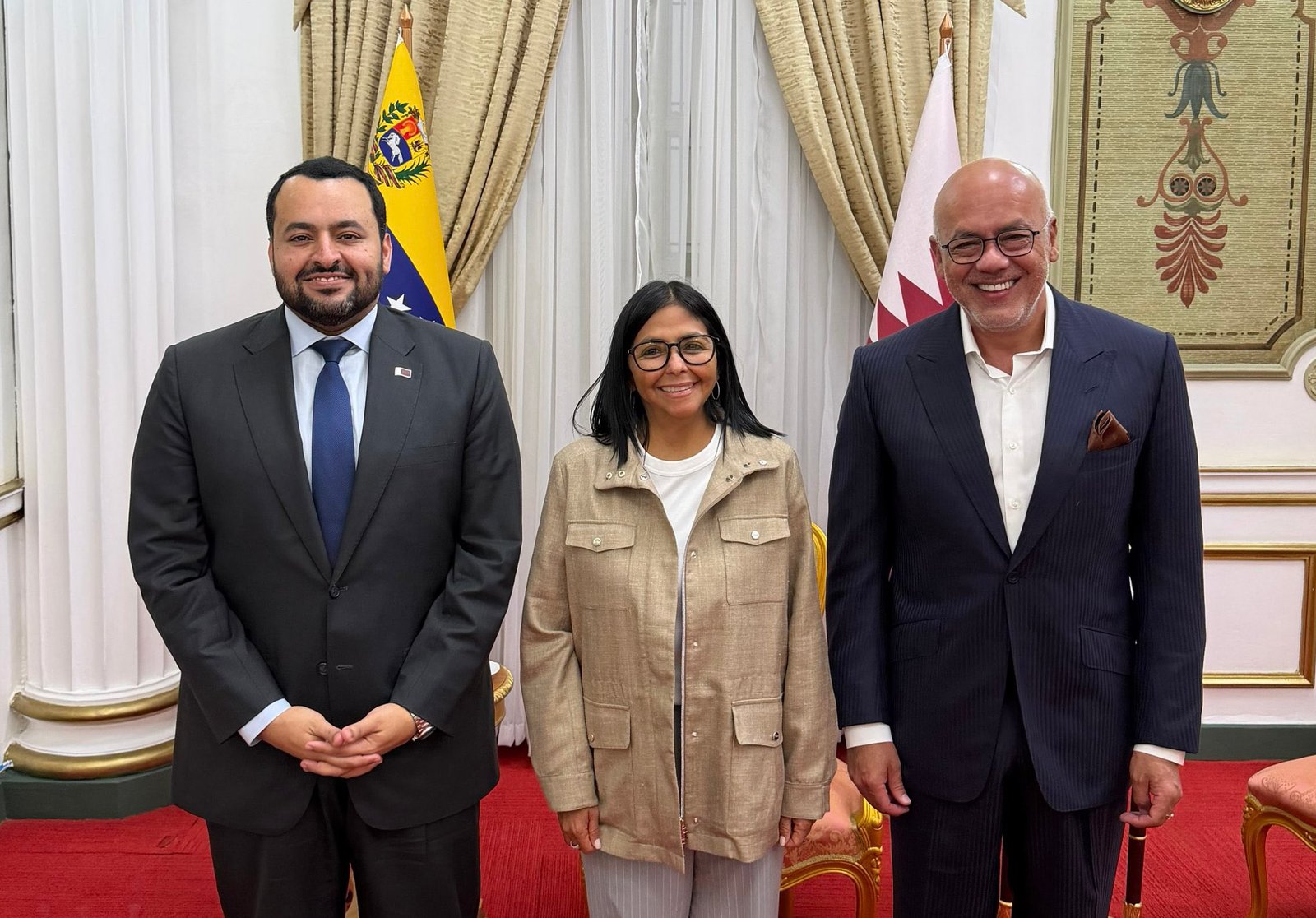
Present at the meeting were Qatar’s Minister of Foreign Affairs, Mohammed bin Abdulaziz Al Khulaifi (center), and the director general of the Qatar Development Fund, Fahad bin Hamad Al Sulaiti, as well as Venezuela’s acting president, Delcy Rodríguez, and the president of the National Assembly, Jorge Rodríguez. Photo: Qatar’s Ministry of Foreign Affairs.
Guacamaya, September 29, 2029. Venezuela’s acting president, Delcy Rodríguez, received Qatar’s Minister of Foreign Affairs, Mohammed bin Abdulaziz Al Khulaifi, in Caracas, on a day in which it also emerged that UCC Oil and Gas Holding, the energy arm of the Qatari conglomerate UCC, is in talks about its possible entry into new oil and gas areas in the country.
Doha, which is already present in Venezuela with humanitarian aid, high-level diplomacy and energy investment, thus consolidates its place among the external actors of Venezuela’s new political and economic cycle.
According to the official statement, Rodríguez and Al Khulaifi reviewed the cooperation relations between both countries, the ways to strengthen them and current affairs in Latin America. The Qatari minister stressed the importance of supporting international efforts in favor of security and stability in the region.
The president of the National Assembly, Jorge Rodríguez, and the director general of the Qatar Development Fund, Fahad bin Hamad Al Sulaiti, attended the meeting.
Why Qatar matters
The previous government of Nicolás Maduro already had ties with Qatar. Jorge Rodríguez negotiated with the United States in Doha in 2023, and then-vice president Delcy Rodríguez met personally with the Emir of Qatar on various occasions, despite her rank. In 2026, however, a marked deepening of the relationship with the Arab monarchy has been seen.
In February, Rodríguez received in Caracas the Qatari prime minister and foreign minister, Mohammed bin Abdulrahman Al Thani, with whom she reviewed a “comprehensive cooperation roadmap”; that same month she accepted the credentials of Qatar’s new ambassador, Salman bin Nabit Al Khulaifi.
After the June 24 earthquakes, Doha set up a field hospital in Caracas. Rodríguez visited it on July 11 and personally thanked the Emir; she said at the time that there were already 13 field hospitals from different countries.
Qatar is also relevant because of its relationship with the United States and, in particular, with the Trump administration. The small emirate hosts the largest United States military base in the Middle East and, according to the Arab Center Washington DC, the two governments signed a security pact in October 2025.
With US$1.5 billion, Qatar’s sovereign fund is one of the main investors in Affinity Partners, Jared Kushner’s firm. Trump’s son-in-law acts both as a private actor and as the White House’s main diplomatic envoy, a role that the Arab monarchies have understood perfectly.
The Emir also gifted a luxurious US$400 million plane to the president of the United States, which Trump now uses more than any other in the Air Force One fleet.
What is the Qatar Fund for Development?
The key name at this high-level meeting is Fahad bin Hamad Al-Sulaiti, the director general of the Qatar Fund For Development. This agency is responsible for carrying out much of Qatar’s international cooperation, with a mandate that covers areas such as health, education, infrastructure, economic development, poverty reduction, climate resilience and response to humanitarian crises.
An important characteristic is that the QFFD does not limit itself to delivering donations. Its own structure contemplates different instruments ranging from grants, concessional loans, guarantees, development investments to blended finance mechanisms. This means that it can participate both in a humanitarian emergency —for example, by sending field hospitals after an earthquake— and in longer-term infrastructure or economic development projects.
To understand it better, let us think in three levels. At the first is immediate humanitarian aid: after the Venezuelan earthquakes of June 24, the QFFD organized an air bridge of six aircraft with family tents, field hospitals and shelter supplies, in cooperation with the Qatar Red Crescent and the Qatari search and rescue group. That is the type of emergency response that falls directly within its mandate.
At a second level is reconstruction and development. The Fund can finance infrastructure, health systems, education, electricity or productive projects. For example, in Ukraine it participated in the reconstruction of a medical complex affected by the war, while in Oman it has participated in financing for electrical infrastructure. This shows that its activity can move from emergency assistance to investments aimed at recovering or strengthening national capacities.
And there is a third level particularly interesting for Venezuela: the financing of economic development and the mobilization of capital. The QFFD explains that it uses instruments such as concessional loans, guarantees, investments and blended finance mechanisms to mobilize additional resources. Therefore, although it is not a commercial bank or an oil fund, it can become a relevant actor when a country needs to rebuild infrastructure, strengthen institutions or attract international financing.
Can the QFFD finance projects in Venezuela?
In principle, the QFFD’s institutional mandate does contemplate instruments that could be used for development projects in Venezuela, provided there are political decisions, technical evaluations and concrete agreements.
There is another especially relevant aspect: its institutional page describes it as a mechanism that articulates different Qatari entities with UN agencies, humanitarian organizations, the private sector and other partners.
Therefore, its presence can be important even if there is no money announced immediately. In reconstruction processes, for example, a development fund can help turn a need identified by a government or by the United Nations into a financeable project. In Syria, precisely, the QFFD brought together national authorities, international financial institutions and other partners to move from a diagnosis of the financial system to a possible implementation roadmap.
A particularly illustrative example is Syria. In September 2026, Al-Sulaiti participated alongside the Qatari minister Mohammed bin Abdulaziz Al-Khulaifi in a high-level roundtable on the transformation of the Syrian financial sector.
The QFFD had commissioned a diagnosis of the Syrian financial system and the discussion later moved toward reforms, state banking, capital markets, insurance, correspondent banking and financial reintegration. That is, the director general can be involved in conversations that go far beyond traditional humanitarian aid.
That allows the visit to be read from two different but complementary dimensions. Al-Khulaifi represents the diplomatic and political component of the bilateral relationship; Al-Sulaiti represents the component of cooperation, development financing and international assistance. It does not automatically mean that Qatar has approved a loan, an investment or a new project for Venezuela —the information published about the meeting does not announce anything of the sort— but it does show that the development component was present in a high-level conversation.
UCC Holding advances in Venezuela
UCC Holding was founded in 2011 by Moutaz and Ramez Al-Khayyat, is a subsidiary of Power International Holding and operates in 25 countries, according to Forbes Middle East. Its activity covers energy, concessions and construction, with an important role in the 2022 FIFA World Cup.
At other times, the company had shown its intention in gold projects in Venezuela, with its sights set on the Gran Colombia mine. In addition, it has announced its participation in the Loran gas block together with the energy giant BP and the state firm of the United Arab Emirates, XRG.
The ties with the Trump family reappear here. The Al-Khayyat brothers are partners of Kushner in his ambitious and controversial hotel project on Sazan Island and the Adriatic coast of Albania.
Their rise has gone hand in hand with projects with political backing. In Syria it signed a US$4 billion agreement to expand Damascus airport and a US$7 billion memorandum for power generation. Energy Intelligence describes it as leading energy projects with United States backing in that country, including a pipeline from Iraq, and attributes to its founders political connections “from Damascus to Washington.”
According to the same publication, UCC has joined a consortium led by the American financier Todd Boehly that is bidding for the international assets of Lukoil, sanctioned by the United States, against a previous agreement by Carlyle.