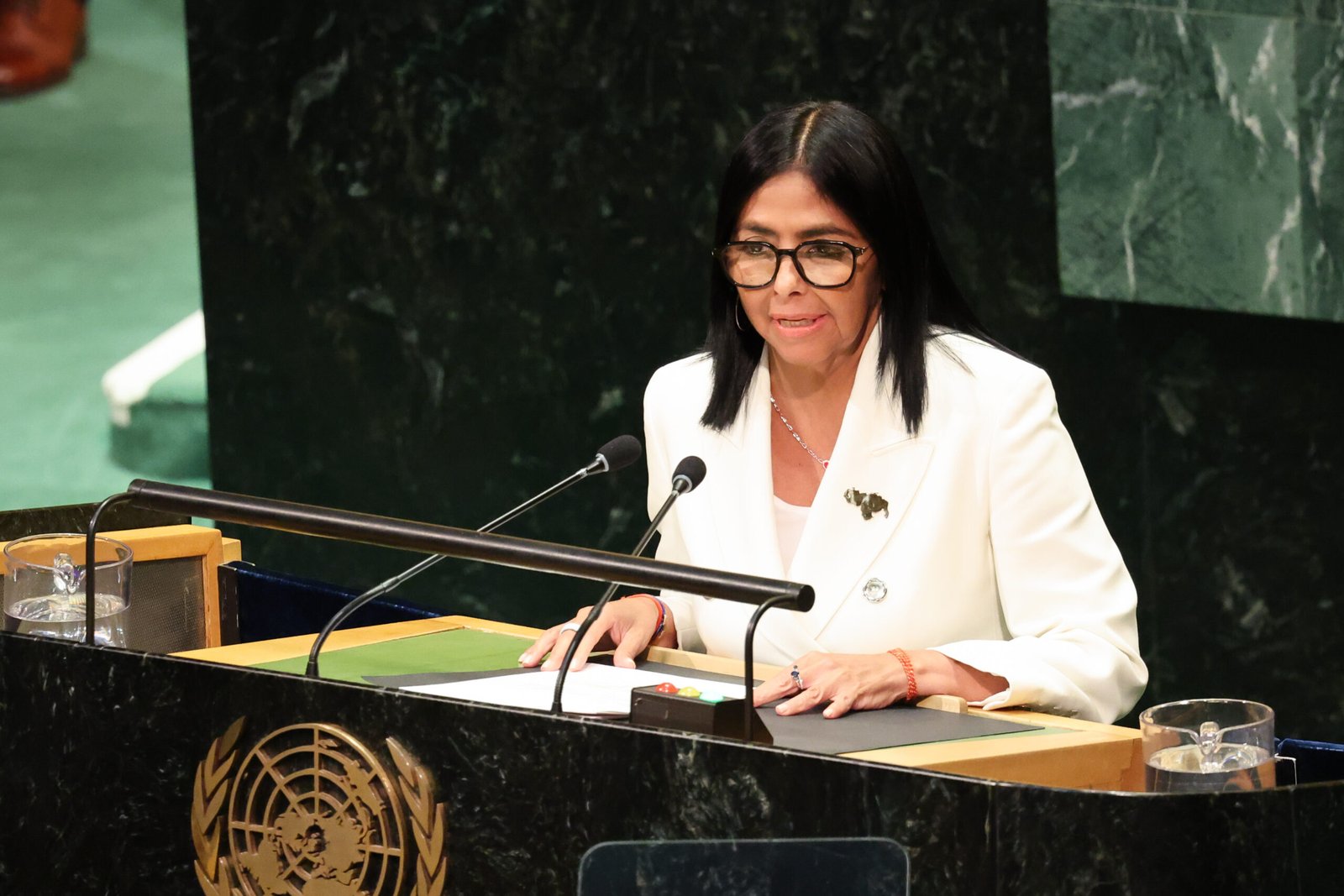
The narrative points to a series of institutional and legal reforms designed to guarantee social justice, economic stability, and electoral transparency. | Photograph: Delcy Rodríguez’s Telegram channel.
Guacamaya, September 23, 2026. In her speech before the 81st UN General Assembly, the acting president of the Bolivarian Republic of Venezuela, Delcy Rodríguez, proclaimed the beginning of a new stage of “rebirth” for the nation. The leader framed her address after two critical events faced by the country in 2026: the heightened political and international conflict and the devastation caused by the double earthquake of June 24.
One of the central announcements of the speech was the ratification of the recently signed bilateral energy agreement with the U.S. administration. Rodríguez highlighted the hemispheric impact of this alliance. “I thus highlight the recently signed U.S.-Venezuela bilateral agreement as one of the largest ever signed and one that will contribute to the energy balance of the hemisphere and the international economy,” she expressed.
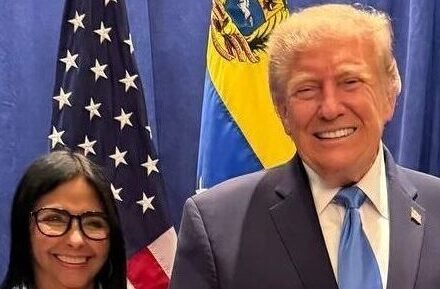
Likewise, the acting president extended a public thank-you to the White House for reactivating diplomatic talks, a level of rapprochement not seen since 2009. “At this 81st UN General Assembly I want to thank President Donald Trump and his Government for their willingness to return to the path of diplomatic relations and cooperation with Venezuela,” she said.
Rodríguez specified that both nations are actively working to “pave the way for energy relations, the promotion of security, the common fight against transnational crime, and economic cooperation.”
Judicial Reform, Democracy, and Electoral Commitment
On the domestic front, Rodríguez set out the foundations of a democratic and institutional transformation, stating that “a nation is not reborn only by rebuilding buildings; it is reborn when it rebuilds trust in its institutions.” To that end, she defined two pillars of reform:
- Legal security and judicial reform: She announced an institutional review process to strengthen the functioning of the State and provide guarantees to investors and citizens. As she emphasized, “the reform of justice and its system cannot be postponed.”
- Electoral guarantees: She confirmed that elections will be held after opening channels of conversation with opposition sectors. Elaborating on the value of representativeness, she asserted.
“I want to say it very clearly at this General Assembly: in Venezuela there will be elections. […] But democracy is not measured by the existence of elections; democracy is measured by the quality of the competition that precedes those elections.”
The Seven Global Axes of Venezuelan Policy
The acting president summarized Venezuela’s priorities in the face of the major challenges of the international community.
- Commitment to peace: A bet on negotiation and dialogue as the only ways out of conflict.
- Inclusive development and rejection of sanctions: Denunciation of the impact of unilateral coercive measures on the Global South.
- Rights of nature: Commitment to environmental preservation.
- Review of global trade: Criticism of supranational schemes that affect national industry.
- Energy security: The search for balance between continuous supply, affordable prices, and non-forced decarbonization.
- Ethical use of artificial intelligence: Collective responsibility to prevent the widening of the digital divide and to harness AI in health and production.
- Sovereignty over the Essequibo Guayana: Reaffirmation of Venezuela’s historical rights and a call on Guyana to negotiate under the Geneva Agreement.
Message to New Generations and National Reconciliation
In the face of the aftermath of the natural disaster and the migratory exodus of recent years, Rodríguez directed an explicit message to young people and to Venezuelans abroad. “To the young people who have grown up seeing a fractured country and who many times decided to leave. This is the moment to build the country to which many want to return, and not only the one from which many wanted to flee.”
To conclude her address, the leader evoked the ideals of Simón Bolívar on the eve of the bicentennial of his 1826 proclamation, recalling that “neither a powerful man, nor a party, nor a faction, but the people are sovereign.”
The Return After Eight Years of Absence
The first address by a Venezuelan president before the plenary took place in November 1976, when Carlos Andrés Pérez used the rostrum to raise the need for a new international economic order that would reduce inequalities between the industrialized north and the developing south. Other presidential appearances followed, such as those of Jaime Lusinchi in 1984 and 1985.
With the arrival of Hugo Chávez, the tone and centrality of the General Assembly changed. His most remembered speech was on September 20, 2006, when he called then-U.S. President George W. Bush a “devil” and called for the refounding of the UN. Nicolás Maduro, first as foreign minister and later as president, maintained that confrontational line until 2018, in his last in-person appearance.
In January 2020, Venezuela lost its right to vote in the General Assembly, under Article 19 of the UN Charter. That provision establishes that a member state loses that right when its arrears in mandatory contributions equal or exceed the amount corresponding to the two full preceding years.
The ambassador at the time, Samuel Moncada, denounced before Secretary-General António Guterres that U.S. sanctions prevented the transfer of funds: “Every single time we have tried to transfer the resources, the transactions have been rejected or returned to our bank accounts —in the best of cases—, while on other occasions they have been frozen or confiscated.”
The outstanding debt amounted to 21 million dollars at that time. Within the Fifth Committee, Venezuela denounced that some members of the Contributions Committee politically used its request for an exemption under Article 19 to prevent its participation with voice and vote. By 2025, the country’s debt to the UN was estimated at approximately 38 million dollars, which kept the suspension of its voting right in place.
In parallel with those financial difficulties, Venezuela has had a significant presence on the Security Council as a non-permanent member in five different periods. The first was in 1962-1963; the second in 1977-1978, when Ambassador Simón Alberto Consalvi came to preside over the body. The third corresponded to 1992-1993. The fourth was for the 2015-2016 biennium, with 181 votes out of 193 members.
During that last membership, then-Foreign Minister and now Acting President Delcy Rodríguez brought the country’s voice to the Council on issues of international peace and security, in a context of growing international questioning of the human rights situation in Venezuela.
The return of a Venezuelan head of state to the plenary of the General Assembly, effective with Delcy Rodríguez’s participation, comes after eight years of absence. Her address coincides with an unprecedented context marked by the restoration of diplomatic relations with the United States, the planned meeting with Donald Trump, and the fact that Nicolás Maduro is being held in the same city of New York.
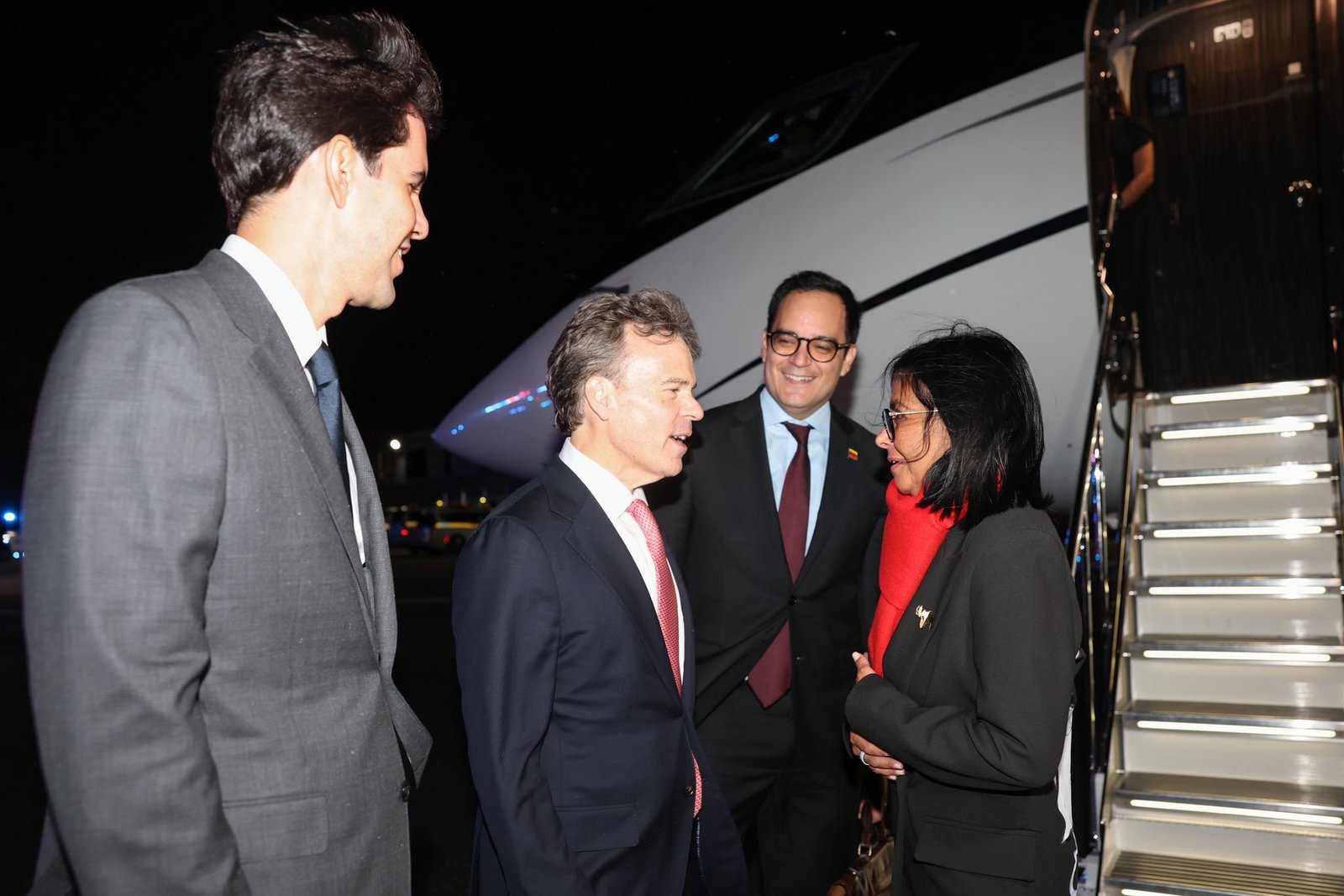
The event, therefore, has not only marked a formal return, but is also inscribed in a realignment of Venezuela’s international position that the General Assembly will help make visible. Rodríguez arrived in the early hours of this Monday at Teterboro Airport, in Bergen County, New Jersey, from where she traveled to New York to begin the activities planned during her visit.
Venezuela’s Agenda on the Day of the Speech
According to a statement from the Venezuelan foreign ministry, a proposal was put forward that is framed within “a comprehensive reform that seeks to strengthen Africa’s representation in multilateral institutions with equity, legitimacy, and historical justice.” Yuri Pimentel, deputy minister for Africa, maintained that in recent years progress has been made gradually in bringing CELAC and the African Union closer together.
The deputy minister, on behalf of President Rodríguez, also thanked African countries for their solidarity after the double earthquake that affected Venezuela on June 24, 2026, and framed the country’s recovery within what the government itself has called “Venezuela Renace” (“Venezuela Reborn”), a slogan that —according to the statement— aims not only to rebuild what was lost, but also to create “new opportunities for development and cooperation.”
The gesture toward Africa comes at a time when Rodríguez has prioritized leaving the international isolation that Venezuela has dragged along since 2018, when Maduro gave the last speech by a Venezuelan head of state at that forum. Rodríguez arrived in New York at the beginning of this week and, according to CNN, is just twenty minutes by taxi from the place where her predecessor remains detained.
Turkey and Venezuela Discussed Energy Cooperation
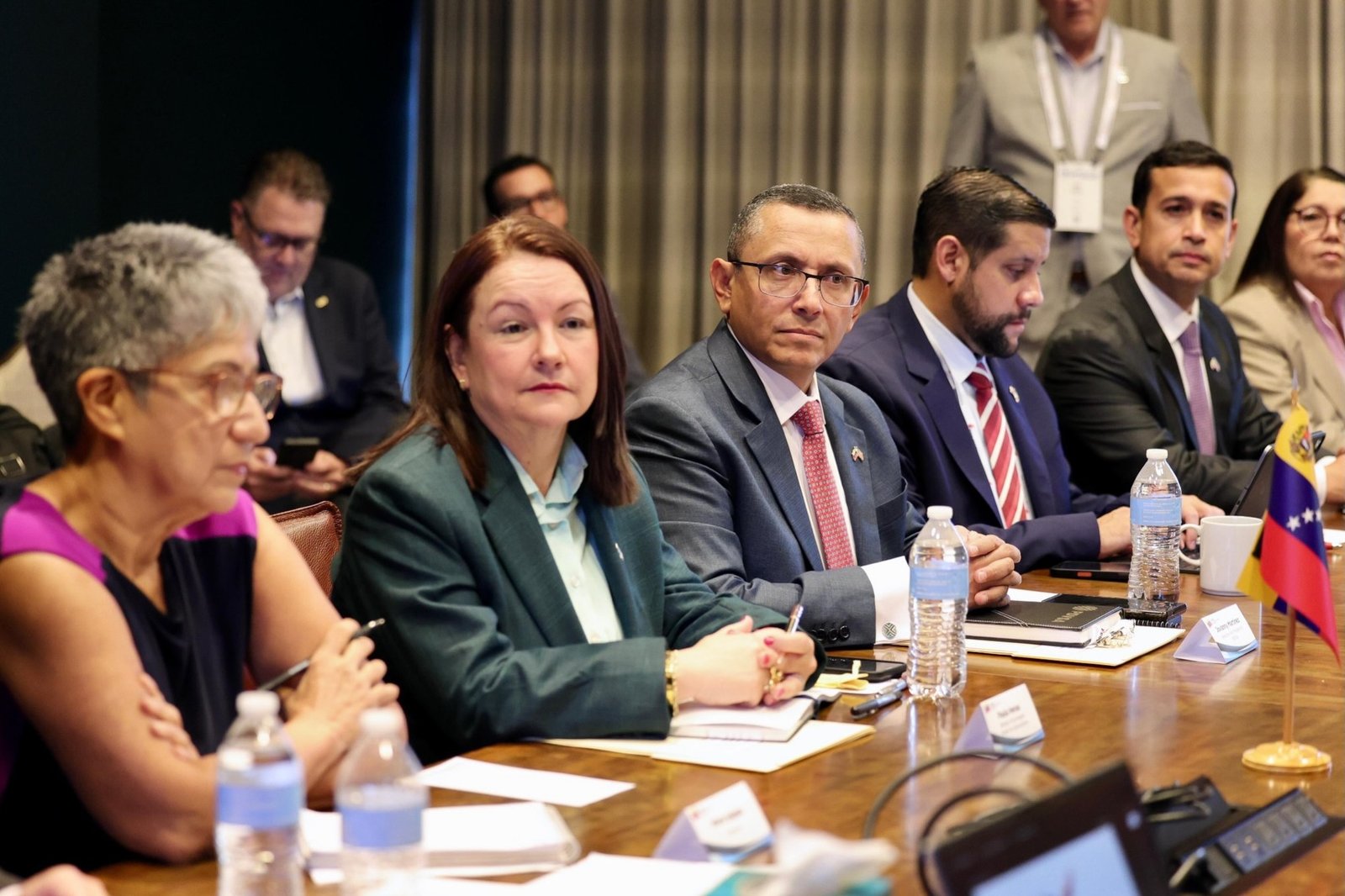
Turkey’s Minister of Energy and Natural Resources, Alparslan Bayraktar, met in New York with Venezuela’s Minister of Hydrocarbons, Paula Henao, within the framework of the United Nations General Assembly activities. Both officials discussed new possibilities for cooperation in oil, natural gas, and mining, with emphasis on concrete measures to expand the participation of companies and projects.
The meeting takes place in a context of deepening energy ties between Ankara and Caracas. Turkey has shown interest in diversifying its international partnerships in hydrocarbons and mining, while Venezuela seeks to attract capital, technology, and new partners to recover its productive capacity. In July 2025, Bayraktar had already indicated that both countries were evaluating opportunities.
Turkish interest also extends to the mining sector. Bayraktar has publicly raised the need to expand international cooperation in minerals and mining, linking it to the needs of the energy transition and the security of supply chains. In Venezuela’s case, this opens a potential space for cooperation that goes beyond hydrocarbons and connects with its mineral reserves.
The meeting also took place a few months after Delcy Rodríguez’s visit to Turkey, where President Recep Tayyip Erdoğan highlighted the intention to deepen bilateral cooperation, particularly in trade, energy, and mining. Bayraktar also took part in that meeting, which shows that the energy component occupies a central place in the bilateral relationship.
For Ankara, Venezuela represents an opportunity to expand its presence in a country with large oil and gas reserves; for Caracas, Turkey can serve as an additional partner at a time when the Venezuelan government is trying to attract international investment and diversify its economic ties. The meeting also takes place while Venezuela is simultaneously negotiating new projects.
Meeting With the Prime Minister of the Netherlands
Venezuela’s acting president, Delcy Rodríguez, also held a meeting this Wednesday in New York with the Prime Minister of the Netherlands, Rob Jetten, as part of her diplomatic agenda during the 81st session of the United Nations General Assembly.
The meeting took place at a time of reactivated contacts between Caracas and The Hague. In August, Rodríguez received the credentials of Carmen Gonsalves as the new Dutch ambassador to Venezuela, an occasion on which both governments expressed their intention to strengthen diplomatic and commercial ties.
The Netherlands also holds particular relevance for Venezuela because of its historical and geographic ties to the Dutch Caribbean and its role within the European Union. In May, Rodríguez traveled to The Hague to participate in the International Court of Justice hearings related to the territorial dispute between Venezuela and Guyana over the Essequibo.
The meeting with Jetten also gains importance because of the role the Netherlands plays within European policy toward Venezuela. The Dutch government has maintained channels of dialogue with Caracas, while Brussels has sought to open spaces for a more constructive relationship and cooperation in areas of common interest.
Jetten took office as Dutch prime minister in February 2026 and, in addition to heading the government, serves as Minister of General Affairs and participates directly in the country’s international affairs. His government includes D66, CDA, and VVD, among other coalition forces.
The meeting in New York thus adds to Rodríguez’s intense international agenda during the General Assembly, in which Caracas seeks to expand its contacts with Western governments and multilateral bodies, while the Netherlands maintains its dialogue with Venezuela both bilaterally and within the European framework.
The Thaw With Trinidad and Tobago
On the margins of the General Assembly, President Rodríguez and the Prime Minister of Trinidad and Tobago, Kamla Persad-Bissessar, held a meeting at Venezuela’s Permanent Mission to the UN, in what both sides described as the beginning of a new stage in bilateral relations. According to the Venezuelan statement, the leaders reaffirmed “the historical ties of friendship.”
The state representatives agreed on a work agenda in trade, energy, security, air connectivity, tourism, disaster risk management, environmental protection, agriculture, and culture. The Venezuelan side also indicated that Persad-Bissessar is now a “persona grata” in the country.
That detail is not minor, if one recalls that the Venezuelan National Assembly had declared Persad-Bissessar persona non grata on October 28, 2025, in retaliation for what it described as a “warlike” stance in allowing U.S. military exercises on Trinidadian territory, amid an escalation of tensions between Washington and Caracas under the Maduro government.
The rupture reached a critical point when Maduro canceled a gas agreement with Trinidad and Tobago after a U.S. warship, the USS Gravely, docked in Port of Spain. In April 2026, Trinidad and Tobago formally recognized Rodríguez as acting president, and since then both governments have rebuilt the relationship with the energy sector as its central axis.
In June, Venezuela granted the British company Shell a license to develop a first phase of the Loran gas field, which has seven deposits, six of them cross-border with Trinidadian territory. At the beginning of September, the foreign ministers of both countries —Félix Plasencia for Venezuela and Sean Sobers for Trinidad and Tobago— had already outlined the work agenda in Caracas.
Geography explains much of the urgency, since only about seven miles separate the two countries at their narrowest point, which makes Trinidadian infrastructure a natural route for processing and exporting Venezuelan gas. Persad-Bissessar has said she has “absolute confidence” that this gas will reach Trinidad and Tobago in the coming year.
Even so, underlying tensions persist, given that the prime minister herself has insisted that her country seeks “the fair share” of the hydrocarbon resources it shares with Venezuela through the state company NGC, and has publicly stressed that Trinidad and Tobago “does not depend on Venezuela and never has.”
Mercosur, the Other Front of the Diplomatic Offensive
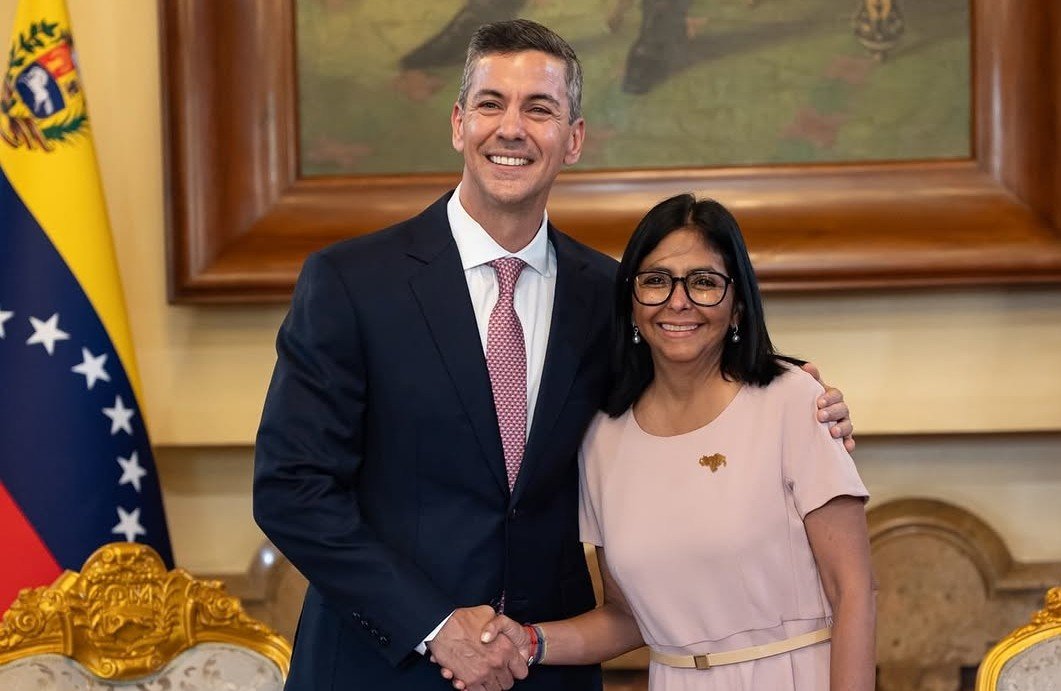
Rodríguez’s multilateral agenda coincided that day with a boost when Paraguayan President Santiago Peña called this Wednesday before the General Assembly for Venezuela’s reintegration into the Mercosur trade bloc, according to Reuters.
Peña’s request adds to a debate that Mercosur formally reopened as of April this year, when Brazilian Vice President Geraldo Alckmin indicated that the bloc would review the suspension imposed on Venezuela because it considered that the country is going through “a different moment” after Maduro’s departure from power.
Venezuela joined Mercosur as a full member on July 31, 2012, and was suspended in two stages: first in December 2016, for failing to incorporate community regulations into its domestic legislation, and indefinitely on August 5, 2017, when the bloc activated the Ushuaia Protocol —the democratic clause— after confirming the rupture of Venezuela’s constitutional order.
A possible re-entry does not depend on a simple political gesture, since it requires consensus among the member states and an assessment of whether Venezuela once again meets the democratic and economic standards that motivated the original sanction. The 68th Mercosur Summit of Presidents, held in Asunción on June 30, 2026, had already put the rule of law and institutional functioning on the table as unavoidable conditions for any review of the Venezuelan case.
In May, a Venezuelan parliamentary delegation traveled to Montevideo to demand its reinstatement before Parlasur, in a debate that —according to regional coverage— divided legislators in the region, particularly in Argentina.
A Diplomacy of Normalization
Taken together, the address on Africa, the thaw with Trinidad and Tobago, and Paraguayan support for a return to Mercosur outline a single strategy: that of an acting government seeking to translate internal political change into external diplomatic capital, in a year marked by the easing of U.S. sanctions, the resumption of ties with the IMF, and openness to Western oil investment.
It remains to be seen whether that image offensive is enough to resolve the conditions —democratic, economic, and of legitimacy— that Rodríguez’s own interlocutors, from Mercosur to Washington, have set as the price of Venezuela’s full reintegration.