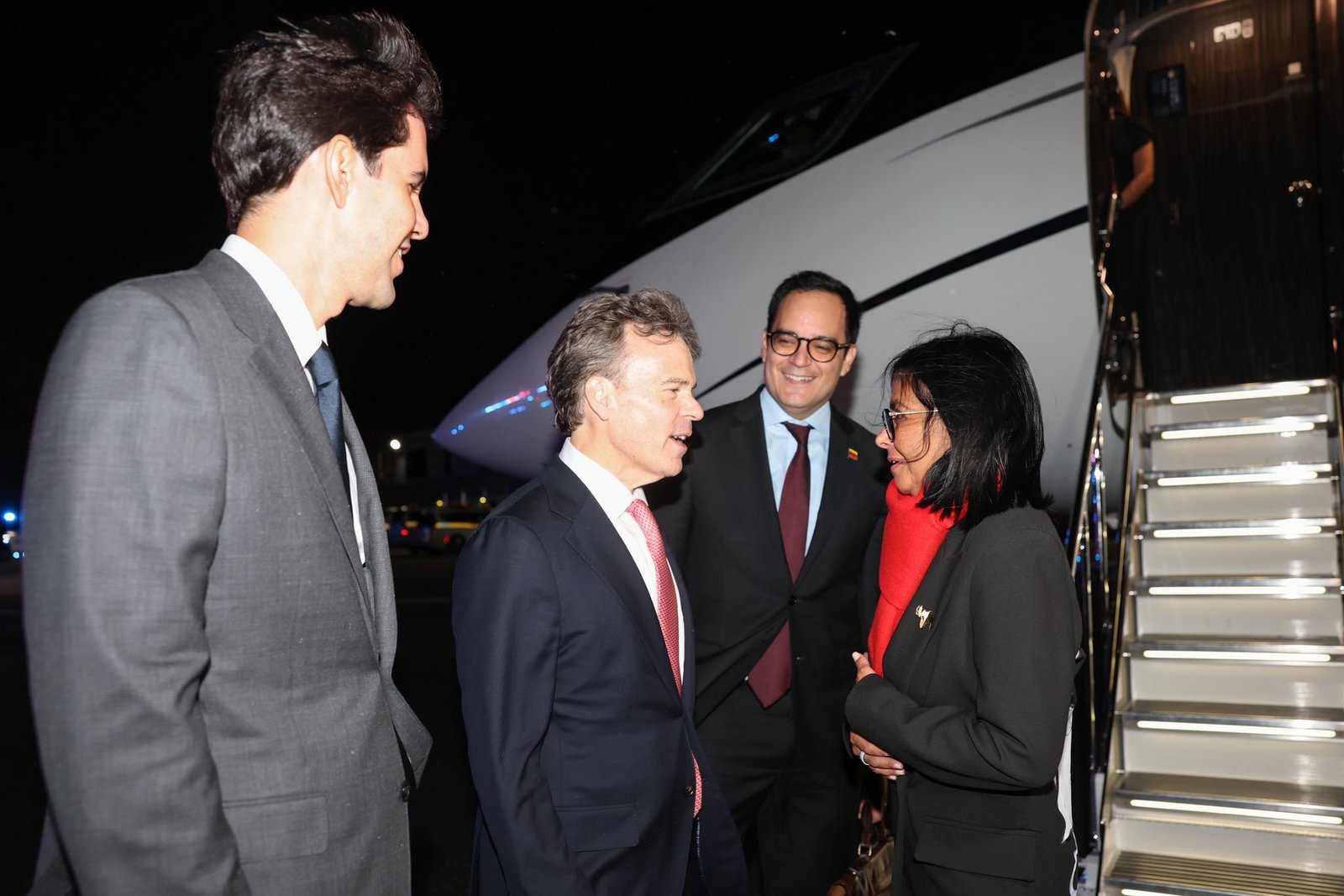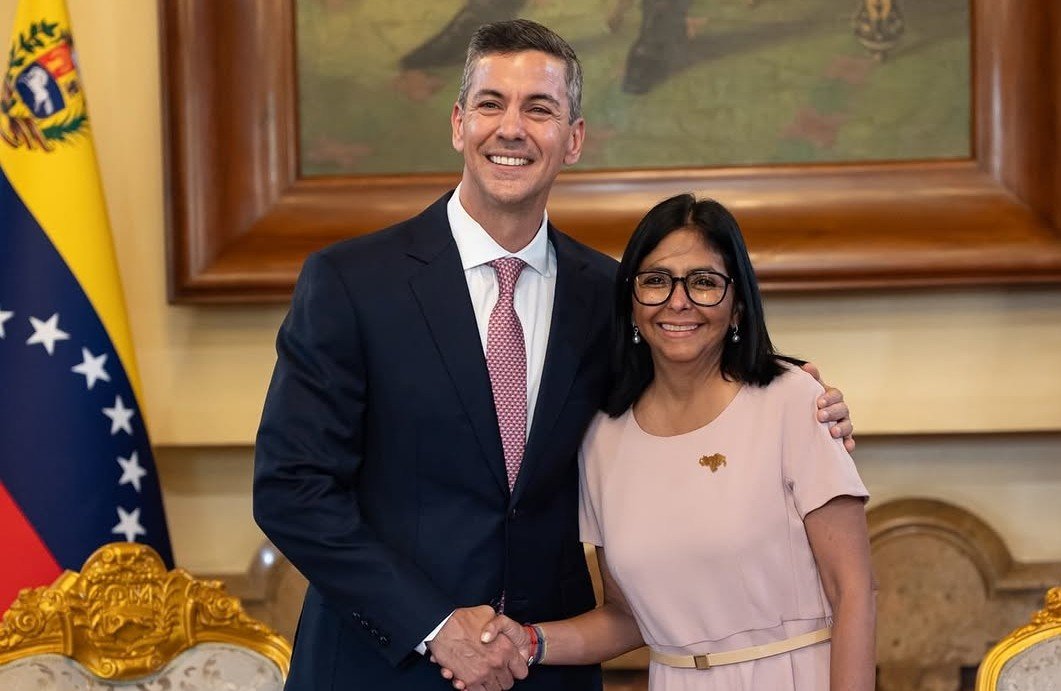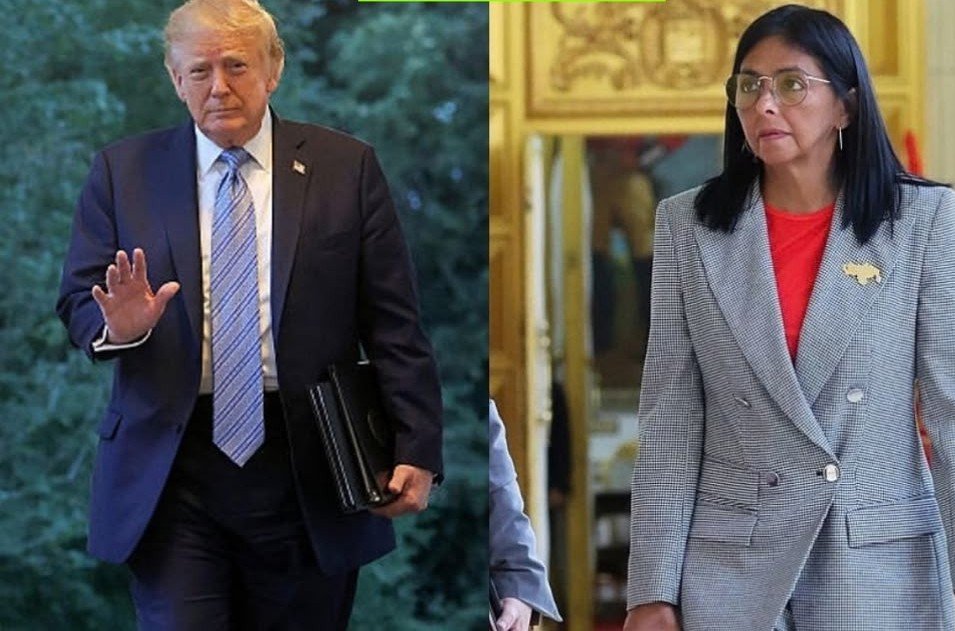
Delcy Rodríguez, Venezuela’s interim president, met with Donald Trump and several senior U.S. government officials on Tuesday, marking their first meeting since January 3. Photo: Guacamaya.
Guacamaya, September 22, 2026. Venezuela’s acting president is wrapping up a busy schedule of bilateral meetings—with the UN, IMF, IDB and World Bank—before meeting with Donald Trump this Tuesday, while Russia maintains parallel contacts with the Venezuelan delegation and Brazil calls for elections in the country.
Venezuela’s acting president, Delcy Rodríguez, and U.S. President Donald Trump met this Tuesday, September 22, at 7:40 p.m. New York time at the Lotte Palace Hotel, on the sidelines of the 81st session of the UN General Assembly. The White House described the meeting as a “pull-aside,” a term used to refer to an informal encounter on the margins of official activities, and confirmed that it was held behind closed doors.
According to the White House, Donald Trump held the previously scheduled private meeting with Venezuela’s interim president, Delcy Rodríguez, in New York on Tuesday, according to information provided by the White House.
Also participating in the meeting were Secretary of State Marco Rubio, Treasury Secretary Scott Bessent, Chief of Staff Susie Wiles, and National Security Advisor Stephen Miller.
The meeting marks the first encounter between a U.S. president and a Venezuelan leader in more than a decade, since the brief meeting between Barack Obama and Nicolás Maduro at the Summit of the Americas in Panama in 2015.
The meeting had been previewed by U.S. Ambassador to the UN Mike Waltz, who also described it as an “informal” exchange between the two leaders.
A bilateral relationship reshaped in eight months
Tuesday’s meeting caps an accelerated rapprochement between Washington and Caracas that began on the same day Nicolás Maduro was captured.
On January 3, 2026, during the U.S. military operation that resulted in Maduro’s detention, Trump announced at a press conference that U.S. oil companies would enter Venezuela to invest in repairing the country’s hydrocarbon infrastructure.
On January 4, Trump told reporters that Washington needed “access to oil and other things” from Venezuela to finance the country’s reconstruction.
On January 6, Venezuela announced the delivery of between 30 and 50 million barrels of unsanctioned crude. U.S. Energy Secretary Chris Wright said Washington would market that volume and subsequently Venezuelan crude on a continuous basis.
During the first months of 2026, Washington gradually eased sanctions to reopen Venezuela’s oil sector to private investment, alongside bilateral meetings such as the one held in Caracas in March between Rodríguez and U.S. Interior Secretary Doug Burgum.
In early August, representatives of the Central Bank of Venezuela and IMF officials met to discuss monetary policy, the exchange-rate regime and technical assistance, as part of the formal resumption of relations between Caracas and the institution.
Between August 28 and 29, Trump and Rodríguez announced what the White House described as the “largest oil deal in history”: majority U.S. participation in more than 65 billion barrels of proven reserves and the development of 17 oil fields, with more than $100 billion in promised investment and around 50 agreements covering 76 areas of the hydrocarbon sector, according to figures provided by Rodríguez. As of September 21, neither the White House nor Caracas had published an official text of the agreement.
Trump: “we are working with the leaders of Venezuela”
In his address to the General Assembly on Tuesday, Trump said his administration “is working with the leaders of Venezuela to create a better future for the Venezuelan people.” He recalled the January 3 operation, saying that “the United States military carried out a huge military operation penetrating deep into the capital of Venezuela, Caracas, and we captured Nicolás Maduro,” and claimed that since then “hundreds of Venezuelan political prisoners have been released.”
The president again referred to the August oil agreement as “the largest in history,” involving “65 billion barrels of oil,” and said it would benefit both countries by “reducing the cost of energy throughout the world.” He also said that combining the production of both countries would represent “more than 60% of all the oil in the world,” and warned that Washington “will not allow any threat against the American nation anywhere in the Western Hemisphere,” using its “military might” if necessary.
The U.S. president, Donald Trump, also highlighted Tuesday during a press conference following his address to the UN General Assembly the growing interest of major oil companies in Venezuela and the capital being directed toward the recovery of the country’s energy industry. “Because now we have the biggest oil companies in the world coming in (…) They’re spending billions of dollars,” Trump said, describing the situation as “amazing.”
Against this backdrop, Tuesday’s meeting comes following confirmation by IMF Managing Director Kristalina Georgieva that the institution will open an office in Caracas around mid-2027.
Rodríguez meets with the UN Secretary-General
Rodríguez arrived in New York early Monday to participate in the opening of the new General Assembly session. That same day, she met with UN Secretary-General António Guterres, with whom she discussed mechanisms to strengthen Venezuela’s social protection system following the technical and institutional response provided by the organization after the earthquakes in the country, according to Venezuela’s Presidential Press Office.
The meeting with Guterres also addressed strategic cooperation between the Venezuelan government and the multilateral system, focused on sustainable development and technology transfer.
Georgieva’s confirmation regarding the opening of an IMF office in Caracas came Monday following her own meeting with Rodríguez. According to the managing director, the meeting continued “the constructive dialogue established in recent months” between Venezuela and the institution. “It will happen,” Georgieva told Bloomberg News, specifying that the opening could take place “at some point in the first half” of 2027, without providing further details.
Georgieva also said that Monday’s meeting addressed Venezuela’s “recovery and reconstruction” following the June 24 double earthquake, and that the IMF reaffirmed its willingness to support the country through capacity building and policy advice. The move comes five months after Venezuela formally resumed relations with the institution under Rodríguez’s administration.
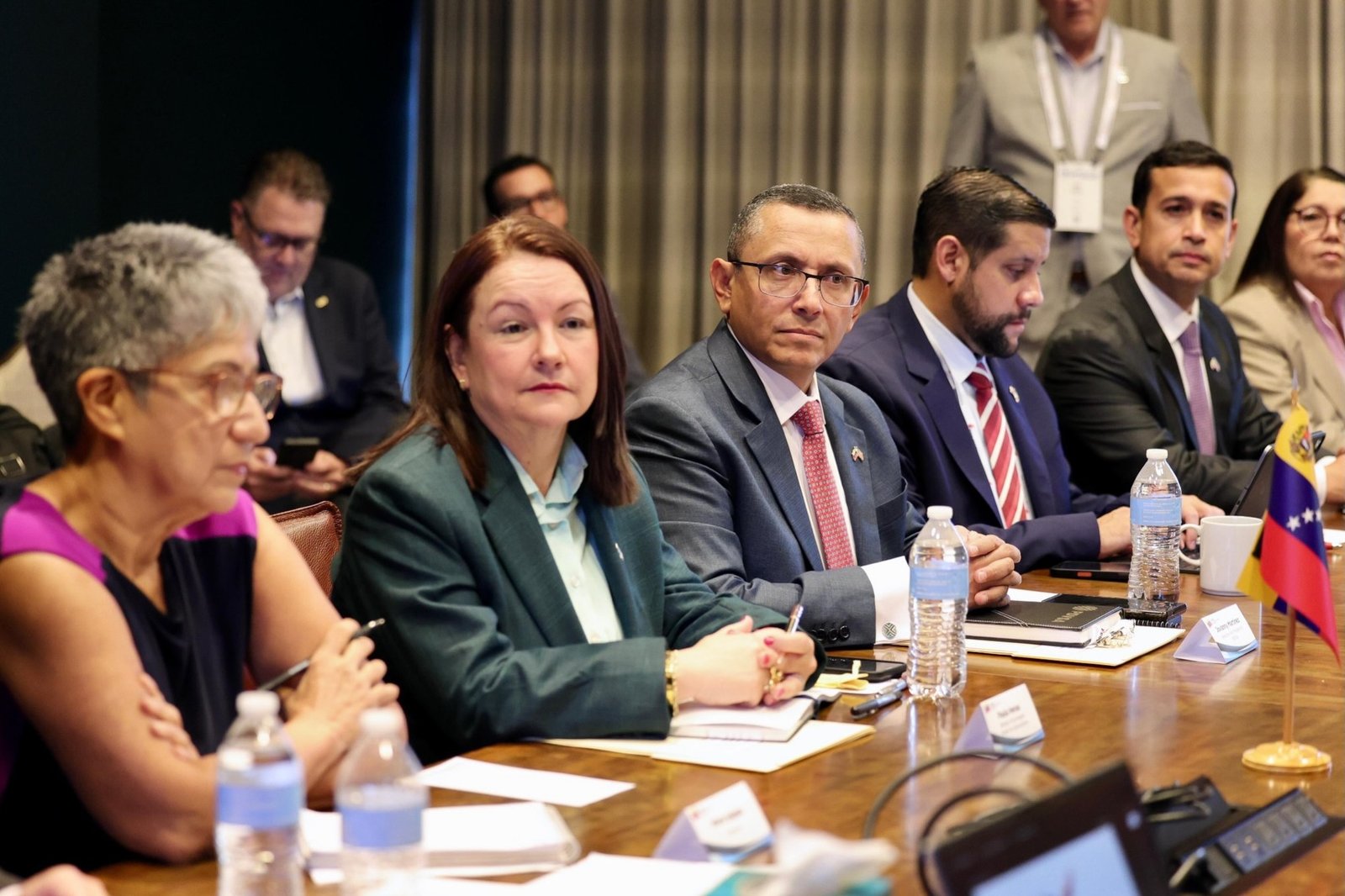
During her stay in New York, the acting president also met with representatives of the Inter-American Development Bank and the World Bank, and has additional meetings scheduled with other officials besides Trump.
Meanwhile, Spanish Prime Minister Pedro Sánchez spoke with Rodríguez on Tuesday during the opening of the General Assembly, in an encounter that took place alongside other meetings between international leaders. According to Spanish newspaper ABC, Sánchez expressed his commitment to Venezuela and the future of the region, while Rodríguez approached the area where her counterpart was seated to propose continuing dialogue on the situation in the country. Sánchez responded that he was willing to maintain that exchange and reiterated Spain’s commitment to the future of the region.
Moscow maintains Its own channel with Caracas
Alongside Venezuela’s diplomatic offensive with Washington and multilateral institutions, the Russian delegation at the General Assembly is also arranging its own bilateral meetings with Venezuela. According to Kirill Logvinov, director of the Russian Foreign Ministry’s Department of International Organizations, cited by the TASS news agency, Foreign Minister Sergey Lavrov is scheduled to hold meetings with representatives of around 20 countries—including Venezuela, Cuba, Nicaragua, Iran and Brazil—“mainly with representatives of friendly countries, as well as other important global actors.”
This would be the first meeting between the Russian and Venezuelan foreign ministers since the oil agreement reached between Washington and Caracas in August, and comes at a time when Russia is recalibrating its position in the South American country. Bilateral relations had deepened significantly in May 2025, when Maduro traveled to Moscow for commemorations marking the 80th anniversary of the end of World War II and signed a Strategic Partnership Agreement with Vladimir Putin establishing a framework for political, energy, military, technological and cultural cooperation, including the deployment of a Russian GLONASS satellite navigation system station in Venezuela.
Venezuela also operates a substantial inventory of Russian-made military equipment—including T-72B1 tanks, BMP-3 and BTR-80A armored vehicles, BM-21 Grad and 9A52 Smerch multiple rocket launchers, Mi-35M2 attack helicopters and Su-30MKV fighter jets—acquired during the governments of Hugo Chávez and Nicolás Maduro.
The U.S. military operation of January 3 strained that relationship. In February, Lavrov denounced alleged attempts to remove Russian companies from Venezuela following Maduro’s capture. Moscow and Caracas sought to ease those tensions in March, when then-Venezuelan Foreign Minister Yván Gil and Russian Foreign Ministry Director for Latin America Alexander Shchetinin met in Caracas to assess progress in “strategic cooperation” despite the pressure. That same month, marking the 81st anniversary of diplomatic relations between the two countries, Gil reiterated Venezuela’s intention to deepen cooperation with Russia in energy, defense, science and technology.
It is against this backdrop that Venezuelan Hydrocarbons Minister Paula Henao’s statement on the continued presence of Chinese and Russian joint ventures in the energy sector despite the new agreement with Washington should be understood: “They are staying. We have agreements with China and Russia, and they are joint ventures with valid authorization to carry out primary activities. We are very respectful of those agreements,” Henao said. She maintained that the agreement with the United States does not entail a transfer of ownership over oil resources, as crude remaining underground continues to belong to Venezuela.
Lula calls for elections and questions venezuelan sovereignty
Brazilian President Luiz Inácio Lula da Silva called Tuesday before the General Assembly for elections to be held in Venezuela: “The Venezuelan people deserve to determine their own destiny,” he said, referring to the role assumed by the Trump administration in the country following the January 3 operation.
In an interview with CNN International on Monday, Lula had already described what the United States did in Venezuela as “very serious” and said that “the country’s sovereignty is over,” which, he argued, is not good for the United States, Venezuela or democracy. The Brazilian president said Rodríguez should call elections so that Venezuelans can decide who should occupy the presidency: “The way the United States treats Delcy, it seems as if it were her boss,” he said.
During his address, Lula also called on the international community to respond to the humanitarian crisis in Haiti and condemned sanctions against Cuba, which he described as “collective punishment imposed on 10 million people through an economic embargo and an illegal energy blockade.”
Kast says new leadership has opened doors in Venezuela
Chilean President José Antonio Kast delivered his first address to the United Nations General Assembly on Tuesday, during the 81st session. His speech focused on three foreign-policy priorities: combating transnational organized crime, promoting trade and investment, and advocating for reforms to the functioning of the United Nations.
Venezuela featured prominently in his remarks. Kast expressed Chile’s support for the process underway in the country and offered backing for its “path toward strengthening democracy.” In that context, he said that “under new leadership, doors have opened that had been closed for many years,” referring to the political process that began following the change of government in Caracas.
Kast said before the General Assembly that Chile would maintain an autonomous position regarding Venezuela’s political transition, neither adopting external positions rejecting the process nor offering unconditional support to the country’s new authorities.
The message is particularly significant given the recent evolution of relations between Santiago and Caracas. Since March, the two governments have advanced a normalization process that began with contacts between their foreign ministries and later led to the reactivation of consular ties. The agenda includes migration, security and bilateral cooperation.
The rapprochement represents a shift from the position Kast had advocated throughout his political career. The program under which he entered government initially proposed breaking diplomatic relations with Venezuela and Cuba and using Chilean foreign policy to promote the restoration of democracy in both countries.
Kast’s address to the UN therefore reflects a current policy toward Venezuela based on dialogue, bilateral normalization and support for institutional reconstruction, while Santiago continues to emphasize democracy and international cooperation.