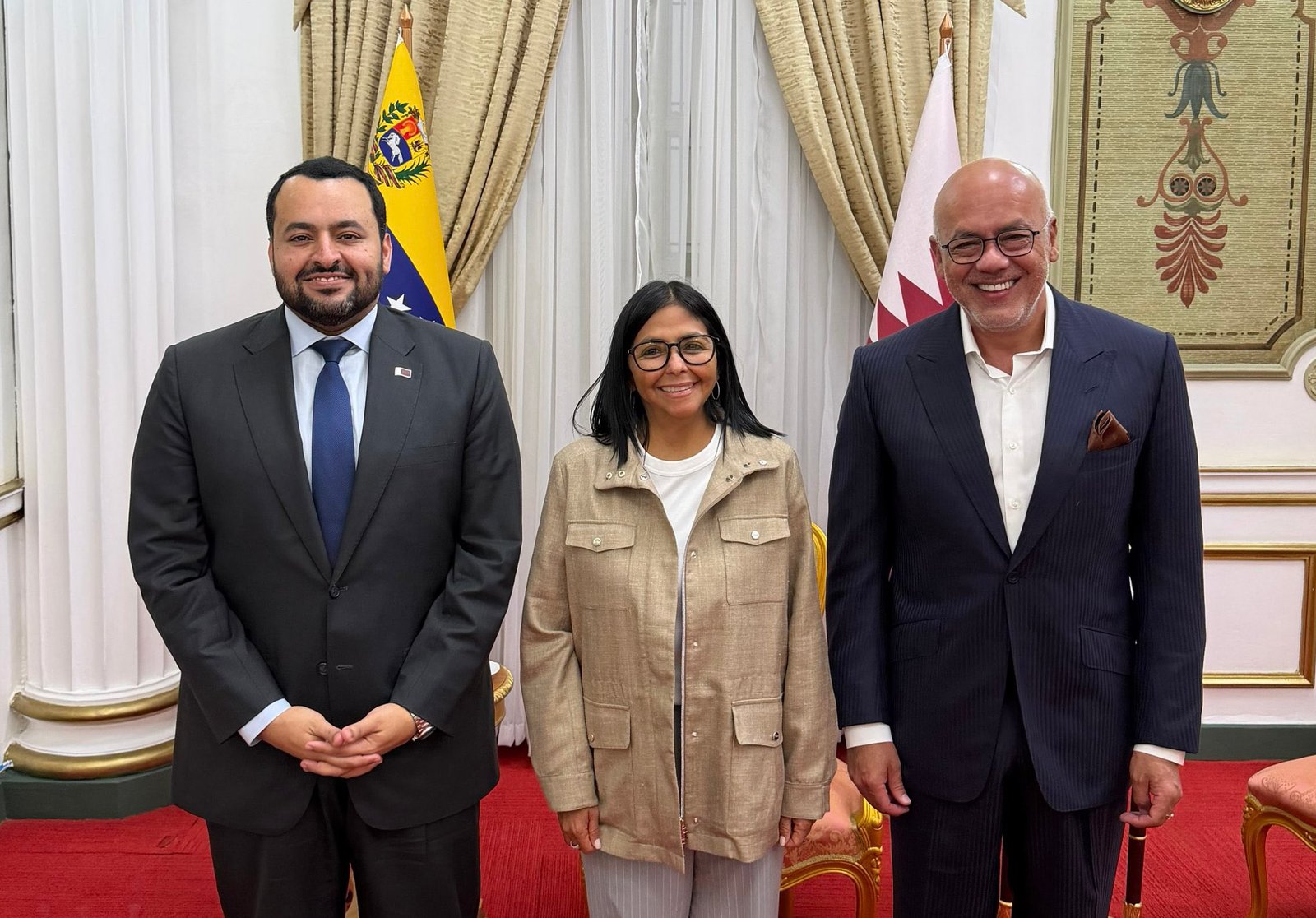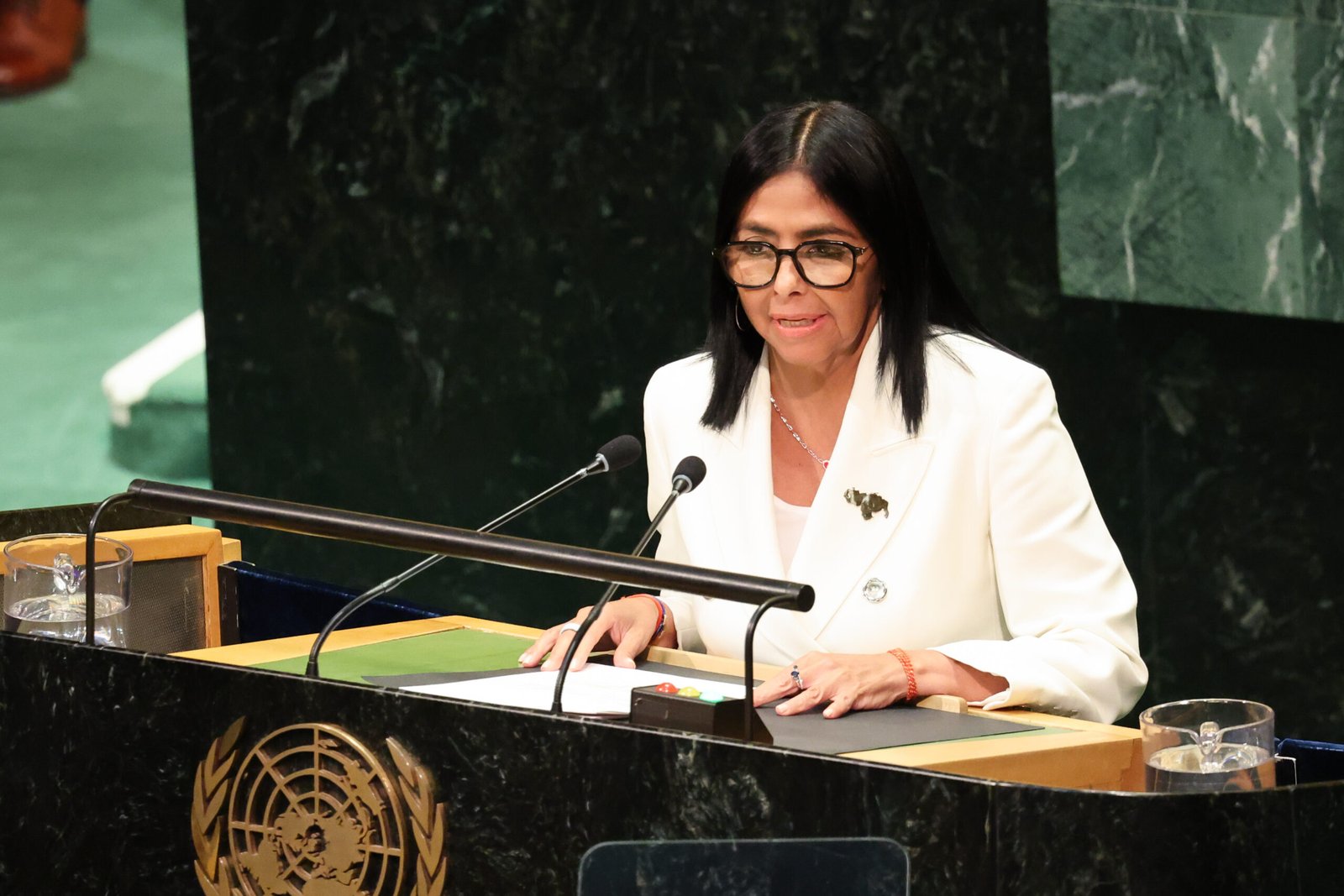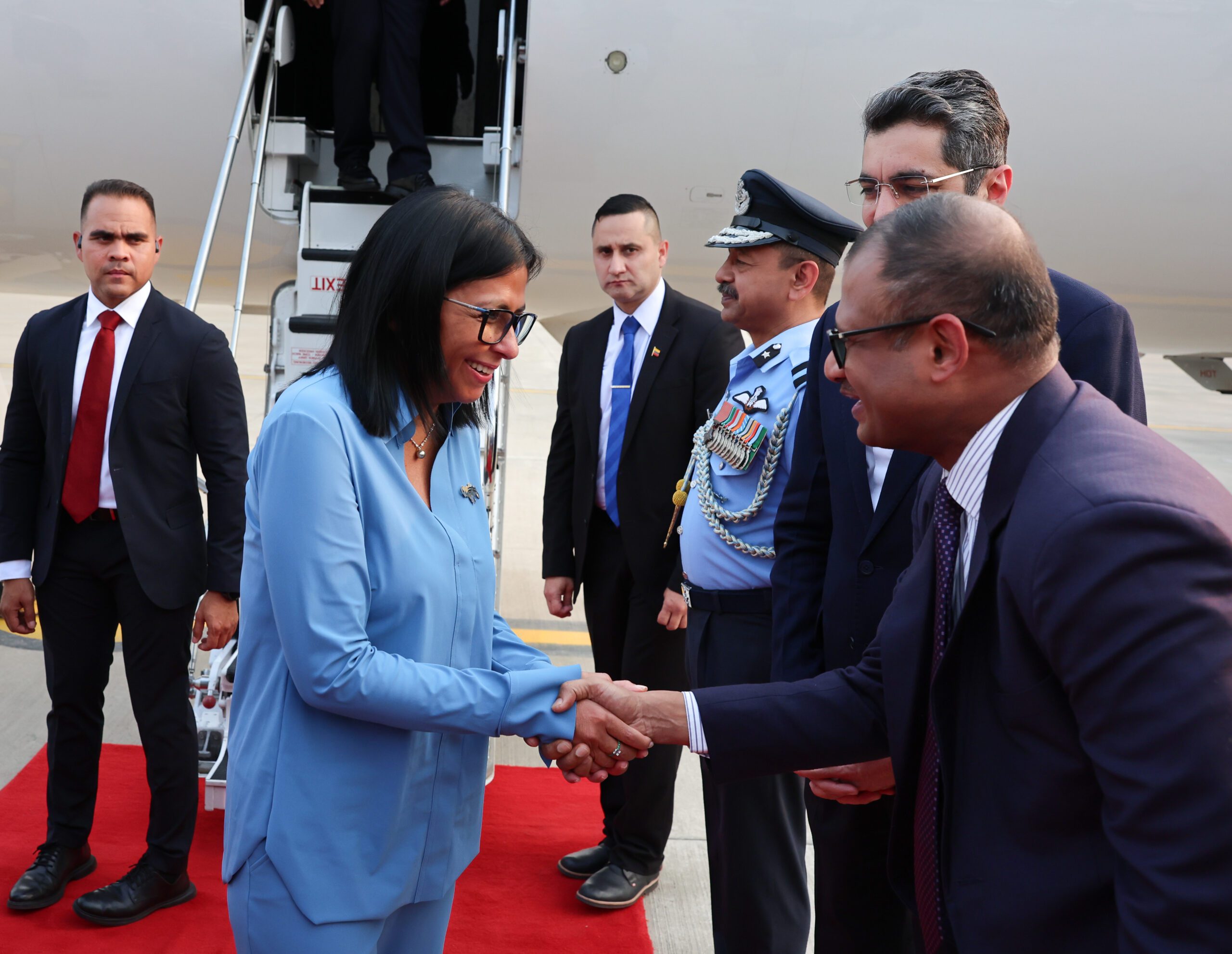
Delcy Rodríguez’s visit to New Delhi reflects an energy realignment where the interests of India, the United States, and Venezuela converge in an increasingly multipolar world. Photograph: Presidential Press Office.
Guacamaya, June 3, 2026. The Venezuelan interim president’s tour comes amid a silent transformation of the global energy market, as New Delhi seeks to diversify its supplies, Washington attempts to reduce Russia’s oil influence, and Caracas reemerges as a relevant player in Asian energy security.
When Venezuela’s interim president, Delcy Rodríguez, landed in New Delhi on June 3, 2026, she did so against the backdrop of one of the most significant transformations of the international energy system since Russia’s invasion of Ukraine.
At first glance, the visit appears to be an economic mission aimed at strengthening bilateral relations. The official agenda includes meetings with Prime Minister Narendra Modi, discussions with business leaders, visits to industrial conglomerates such as Reliance Industries and the Tata Group, talks with the International Solar Alliance (ISA), and parallel working sessions on transportation, healthcare, science, and technology. Yet behind these meetings lies a much broader story: the redefinition of India–Venezuela relations amid great-power competition and shifting global energy flows.
The visit comes at a particularly significant moment. During April and May, Venezuela consolidated its position as India’s fourth-largest oil supplier, behind only Russia, the United Arab Emirates, and Saudi Arabia. At the same time, New Delhi has begun gradually reducing its dependence on Russian crude, driven by Western sanctions, U.S. pressure, and rising costs linked to Middle Eastern tensions and disruptions to energy transit through the Strait of Hormuz.
What is emerging is a new energy map in which Venezuela is reclaiming a position that seemed lost only a few years ago.
A relationship older than it appears
Although energy dominates the bilateral agenda today, relations between India and Venezuela run much deeper.
The two countries established diplomatic relations on October 1, 1959, in an international environment shaped by decolonization and the emergence of new actors from the Global South. India had recently consolidated its independence, while Venezuela was beginning to project itself as an emerging oil power. Both shared a commitment to preserving strategic autonomy amid the dominant blocs of the Cold War.
The opening of the Venezuelan Embassy in New Delhi in 1962 represented an important institutional step toward a stronger relationship. However, the most symbolic moment came in October 1968, when Indian Prime Minister Indira Gandhi visited Caracas during a broader Latin American tour and was received by Venezuelan President Raúl Leoni.
Although brief, the visit carried considerable political significance. It symbolized the convergence of two countries that shared experiences of nation-building, autonomous development, and active participation in multilateral forums such as the Non-Aligned Movement.
For decades, the relationship remained relatively modest. But India’s economic rise and the growing importance of energy security gradually transformed the connection into one of strategic interest.
Venezuela’s return to the energy chessboard
Venezuela’s current importance to India is not determined solely by the volume of oil it can export, but by the nature of that oil.
India’s most sophisticated refineries, particularly the massive Jamnagar complex operated by Reliance Industries in Gujarat, are designed to process heavy, high-sulfur crude. This is precisely the type of oil that characterizes much of Venezuela’s production.
For that reason, Rodríguez’s visit to Jamnagar may prove to be one of the most consequential moments of the entire trip. The facility is not only the largest refinery in the world; it is also a symbol of India’s ability to transform complex crude grades into high-value fuels for domestic consumption and export.
India’s growing demand coincides with a gradual recovery in Venezuelan exports. Although production remains far below the historic levels reached in the early 2000s, Caracas has begun to regain market share thanks to the partial easing of restrictions and the growing interest of Asian consumers in diversifying suppliers.
New Delhi’s strategic logic
From India’s perspective, the rapprochement with Venezuela should be understood within a broader strategy of strategic autonomy.
India remains one of the world’s largest buyers of Russian oil. However, New Delhi recognizes that excessive dependence on any single supplier creates growing economic and geopolitical risks.
Its energy policy therefore does not seek to replace Russia entirely but rather to expand its range of options. The United States, Canada, Brazil, Guyana, the Gulf states, and now once again Venezuela all form part of a diversification strategy designed to reduce vulnerabilities and ensure stability in an increasingly uncertain international environment.
Recent statements by India’s Ministry of External Affairs are particularly revealing. By describing Venezuela as an “important energy partner,” New Delhi implicitly acknowledges that the bilateral relationship can no longer be understood solely through a diplomatic lens.
Energy has become the central pillar of the partnership.
The United States and the new energy architecture
The most interesting dimension of this rapprochement, however, does not involve only India and Venezuela.
Washington views these developments from a complex position. On one hand, U.S. strategy seeks to reduce Russia’s energy revenues and limit Moscow’s international influence. On the other, the United States must avoid sudden supply disruptions that could trigger major increases in global energy prices.
This reality has produced a more pragmatic approach toward certain producers previously marginalized from international markets.
Within this framework, Venezuela has acquired renewed significance—not as a replacement for Russia nor as a new center of global energy gravity, but as a supplier capable of contributing to market stability during a period of transition.
What emerges is a more flexible, yet increasingly politicized, energy system in which commercial flows are shaped as much by strategic considerations as by market dynamics.
Beyond oil
The composition of the Venezuelan delegation offers clues about another important trend.
The presence of ministers responsible for foreign affairs, transportation, healthcare, science, and technology suggests that Caracas is seeking to build a broader agenda beyond energy cooperation alone. Meetings with the Tata Group and the International Solar Alliance point toward potential collaboration in infrastructure, technological innovation, renewable energy, public health, and industrial development.
This aligns with India’s vision of its expanding global role. New Delhi no longer sees itself merely as a buyer of raw materials but as a provider of technology, industrial expertise, and development capabilities.
If current trends continue, the bilateral relationship could evolve from an energy-centered partnership into a broader and more diversified long-term cooperation framework.
A symptom of a world in transition
Delcy Rodríguez’s visit reflects a reality that goes far beyond the signing of agreements or rising oil exports.
It represents the adaptation of two Global South countries to an increasingly fragmented international system. India seeks energy security without sacrificing strategic autonomy, while Venezuela seeks to capitalize on a new opportunity to reintegrate into global markets and attract investment to support economic recovery.
Meanwhile, the United States, Russia, and other actors influence the relationship indirectly through sanctions, commercial incentives, and geopolitical competition.
The true significance of the visit therefore lies not only in the agreements that may be signed in the coming days. Rather, it illustrates how energy has evolved from a simple economic resource into one of the principal instruments of power in the twenty-first century.
In this emerging environment, the relationship between New Delhi and Caracas may ultimately prove far more consequential for the future of global energy markets than many observers currently imagine.
India in Trump’s global strategy
Delcy Rodríguez’s visit must also be understood within a broader reality: for the Trump administration, India has become one of the pillars of its economic and geopolitical strategy.
For years, Washington has viewed New Delhi as an essential partner in balancing China’s rise in the Indo-Pacific. Yet tensions emerged when India became one of the largest buyers of Russian crude following the Ukraine war. In August 2025, the White House even imposed an additional 25 percent tariff on Indian exports in response to India’s purchases of Russian oil.
Strategic logic, however, ultimately prevailed. In February 2026, Washington and New Delhi announced a broader trade framework that included tariff reductions and expanded economic and energy cooperation. The White House presented the agreement as part of a strategy aimed at reducing India’s dependence on Russian oil and strengthening supply chains aligned with U.S. interests.
Within this context, Venezuela acquired an unexpected significance.
If Washington’s objective is to reduce Russia’s share of the Indian energy market without triggering a supply crisis in Asia’s third-largest economy, New Delhi requires alternative sources capable of replacing at least part of the volumes previously supplied by Moscow. The United States can provide some of that oil, but logistical, commercial, and crude-quality limitations remain. Venezuela, by contrast, produces precisely the heavy crude that India’s largest refineries are designed to process.
From this perspective, the partial recovery of Venezuela’s oil industry following the events of January 3 ceases to be merely a Latin American issue. It becomes part of a broader geoeconomic strategy involving Washington, New Delhi, and global energy markets.
The political factor: India and the Republican Party
There is also a less discussed political dimension.
The U.S.–India relationship is no longer shaped solely by government calculations. The Indian-American community has become one of the most economically and politically influential groups in the United States, with growing visibility in both the Democratic and Republican parties.
While Indian-Americans remain politically diverse, recent years have witnessed a growing convergence between certain Indian-origin business sectors and Republican circles, particularly in areas related to trade, technology, and investment.
For Trump, therefore, India represents more than a traditional geopolitical partner. It is simultaneously a market of 1.4 billion people, a strategic counterweight to China, a key node in global supply chains, and a relationship with increasing domestic political relevance.
In recent years, figures of Indian origin have gained unprecedented prominence within Republican circles.
The most notable example is Vivek Ramaswamy, the entrepreneur and politician who emerged as one of the most influential voices within the American conservative movement and a symbol of the growing role of Indian-Americans in Republican politics. He was also a presidential candidate in the party’s most recent primaries and was frequently mentioned as a potential Secretary of State in a future Trump administration.
This influence extends beyond politics. Business leaders of Indian origin head some of the most important technology companies in the United States. Executives such as Sundar Pichai at Google, Satya Nadella at Microsoft, and Arvind Krishna at IBM belong to a generation occupying strategic positions in sectors essential to American competitiveness, including artificial intelligence, semiconductors, and digital innovation.
This reality has reinforced the perception of India in Washington not only as a geopolitical partner but also as an indispensable contributor to America’s economic and technological future.
Against this backdrop, the Trump administration’s pressure on India to reduce its purchases of Russian oil was never intended to weaken bilateral ties. Rather, it sought to gradually redirect Indian energy flows toward suppliers considered more compatible with U.S. strategic interests.
It is precisely here that Venezuela acquires an unexpected relevance. Following the events of January 3 and the subsequent partial reopening of its energy sector, Caracas began to be viewed as a potential alternative source of heavy crude for India’s refining industry.
Delcy Rodríguez’s visit to India is therefore not simply an oil diplomacy tour. It is an indirect consequence of the strategic realignment set in motion by the Trump administration after January 3 regarding Venezuela—so much so that news of the visit first emerged weeks earlier through remarks by U.S. Secretary of State Marco Rubio.