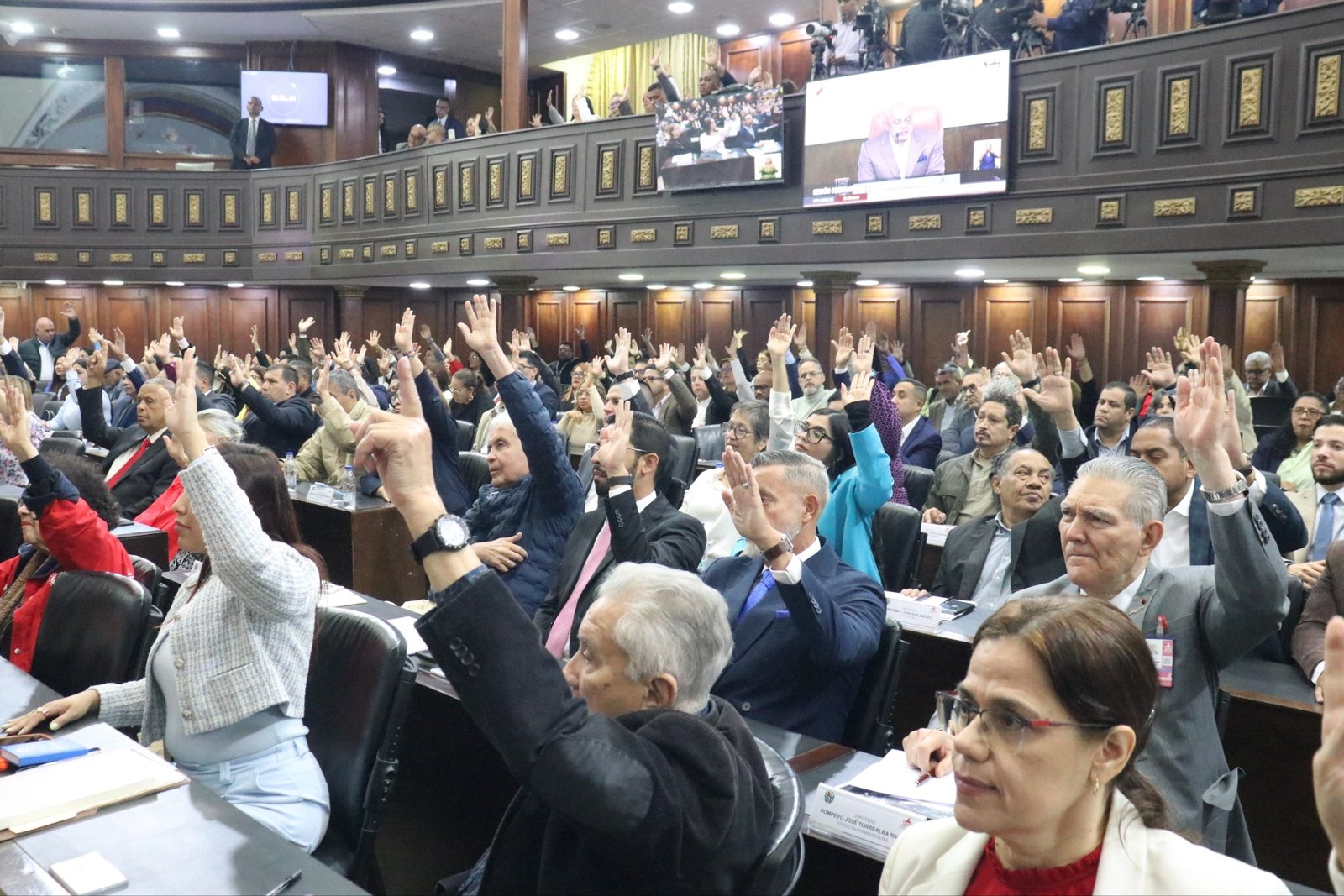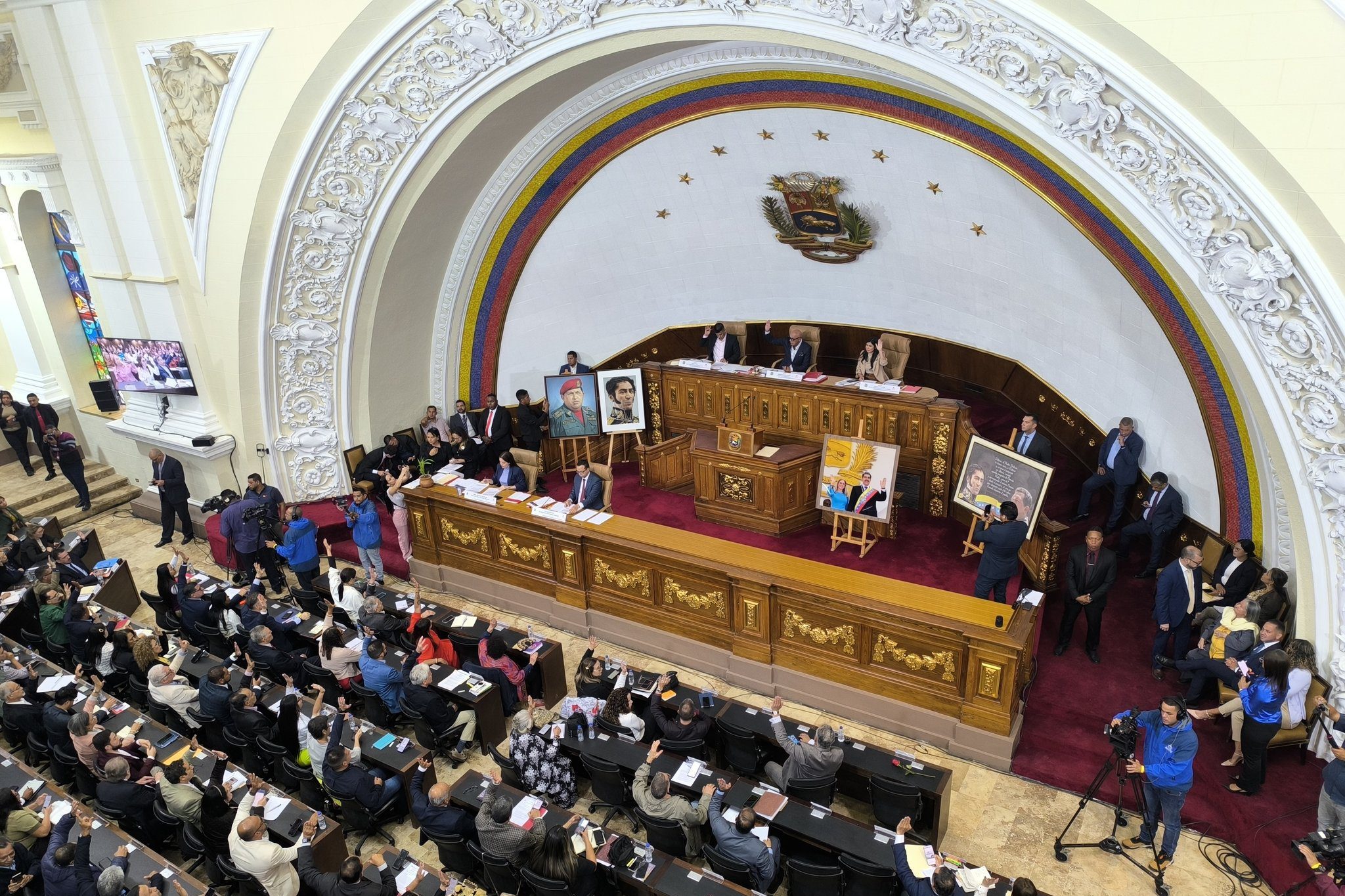
The legislative instrument proposes a reengineering of the aforementioned basic service to overcome its structural limitations through controlled opening that also allows independent self-generation. | Photo: National Assembly.
Guacamaya, June 3, 2026. Venezuela’s National Assembly approved this Tuesday, in first discussion and unanimously, the Partial Reform Project of the Organic Law of the Electric System and Service. The instrument, which was also granted organic status, seeks an “institutional reengineering” that allows the State to attract private capital, for the first time in more than 15 years, although without relinquishing strategic control of the sector.
The project was presented by ruling party deputy Orlando Miranda, a member of the Permanent Commission on Administration and Services. The parliamentarian proposed, under the initiative of acting president Delcy Rodríguez, a diversification of actors in the service chain, which includes generation, transmission, distribution, and commercialization of electric power.
The foundations and novelties of the new legal framework
During his speech, Miranda read fragments of the explanatory statement, emphasizing that the current model “has shown structural and financial limitations to respond with agility and promptness to the demands of the Venezuelan people.” In response, the reform opens the door to investment from mixed companies (with more than 50% state-owned), authorized companies with minority public participation, and national private companies.
As the rules of the game, on one hand, concession terms for mixed companies are established at up to 25 years, with a possible 15-year extension. Meanwhile, upon termination, the “reversal clause” will take effect, in which all infrastructure and assets would transfer to the State at “zero cost” and in good condition, to ensure service continuity.
Regarding self-generation, it also legalizes that large consumers, including oil companies, may operate their own plants independently of the National Electric System (SEN). However, installations of 2 MW or more will require authorization from the Ministry of Electric Power to continue operations within the national territory.
On the other hand, a tariff logic aimed at covering real costs with “reasonable profitability” is introduced, tied to efficiency criteria. Likewise, sanctions are established allowing fines of up to 10% of gross income and investigations directed directly against members of the boards of directors of operating companies in case of violating the Law.
Voices in the chamber demanded better conditions
Despite the unanimous approval, opposition factions conditioned their support on the need for structural changes. Deputy Ezio Angelini (UNT/Zulia) denounced centralism and corruption, stating that this law should work “if and only if” it includes real decentralization to return service management and distribution to states and municipalities.
For his part, José Gregorio Correa (AD/Nacional) defended the creation of the position of “Comptroller and Ombudsman for Electric Efficiency” to serve as a link between the State and citizens who suffer from blackouts. In a more critical vein, Deputy Omar Veracierto (FV/Nueva Esparta) argued that the proposal is insufficient if it does not move from a “controlling State to a promoting and productive State” that provides legal security.
The panorama and challenges of the electric system
The 2025 National Survey on Living Conditions (Encovi) confirmed that electricity remains among the main factors of household precariousness in Venezuela, with continuous interruptions in 9 out of 10 homes. The impact is felt most strongly in the interior of the country and in areas such as Maracaibo and other cities hit by prolonged rationing.
According to Reuters reports, Siemens and General Electric had already advanced negotiations with the Venezuelan State for the recovery of the electric system. However, there is marked distrust based on unresolved financial commitments and the absence of mechanisms to guarantee future payments compliance by the authorities.
Furthermore, according to information obtained by Bloomberg, Venezuela would establish new regulations to force international oil companies to build their own power plants to operate independently. By requiring energy self-generation, authorities aim to protect crude oil and gas production without the activity overloading the fragile system that supplies the population.
In conclusion, the proposed legal reform seeks to modernize the Venezuelan electric system through the integration of private and mixed capital, after more than 15 years of state control. While the ruling party proposes a controlled opening, the opposition and investors insist that the reform must correct centralism and opacity, as well as guarantee legal security.