The restructuring of Venezuela’s debt, made possible by the political process catalysed by January 3, has already sparked controversy due to its speed and the selection of the Government’s advisors. Image: Guacamaya.
Guacamaya, June 14, 2026. After January 3, an opportunity opened up in Venezuela to carry out one of the largest sovereign debt restructurings, with a value estimated between $160 and $180 billion.
On May 13, the Government of Venezuela announced the start of the restructuring process for its external public debt, thus referring to bonds issued in New York, which currently have a nominal value of around $100 billion.
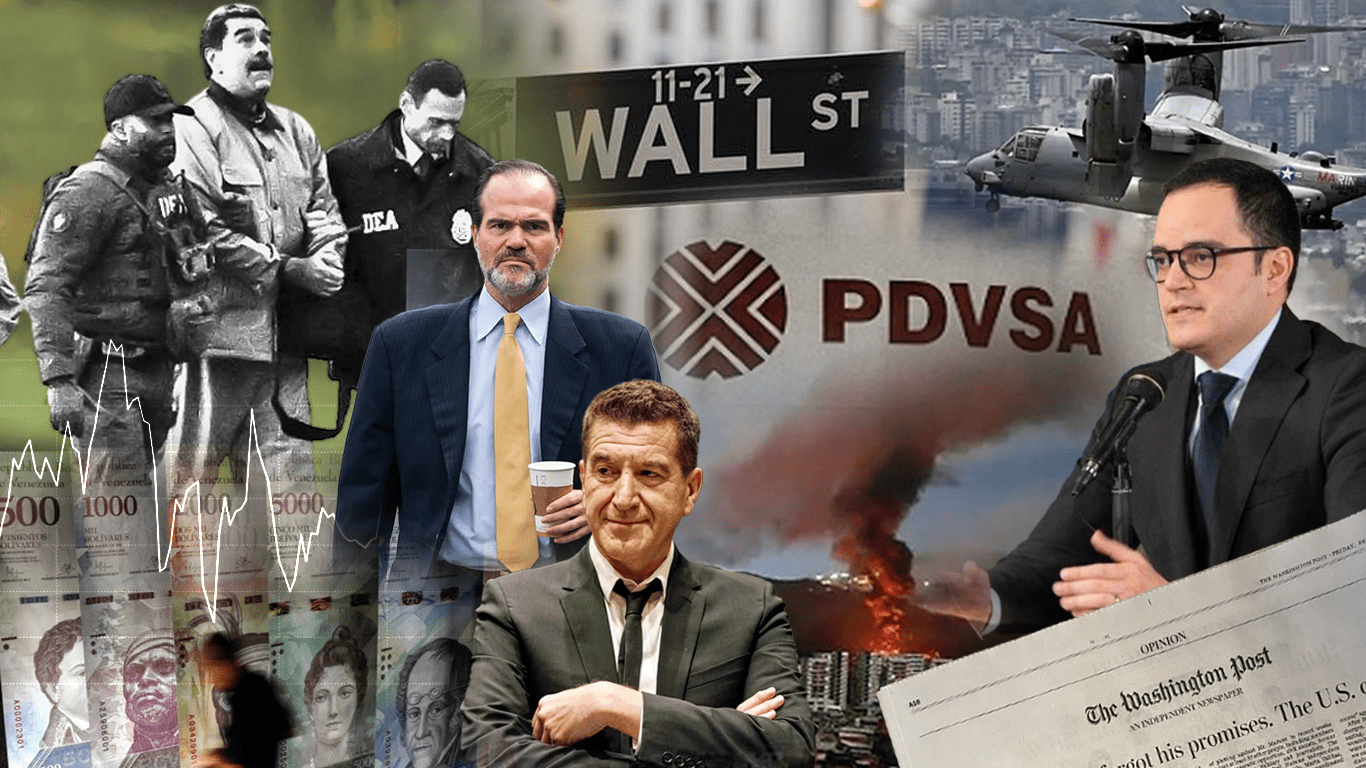
The announcement came a week after the Trump administration introduced General License 58, which allowed the country to hire financial advisors, a vital step in this process. This task fell to the investment bank Centerview Partners, though the hiring process caused a stir in the international press, drawing scrutiny from The Wall Street Journal, The Washington Post, and Reuters.
The Venezuelan bond market has attracted significant interest from international investors, from specialised hedge funds to investment banking giants such as JPMorgan, Jefferies, and Citi. This interest has continued to grow since January, as the market clearly shows: their value has increased by 60% since the beginning of the year, and 220% since May 2025.
The task facing the nation is not simple. While debts have grown, mainly due to accumulating interest, the economy has suffered through one of the worst crises in recent history, with an 75% contraction in GDP. The country is rising again, but the economy remains at less at about a third of the over $300 billion it was 15 years ago.
On the other hand, Venezuela desperately needs to reconnect with the financial system to access capital to make large infrastructure and public service investments. In other words: without debt, public works are hardly possible. To return to the markets is key, but the road is full of risks.
The resolution of the country’s external debt is also severely conditioned by the United States government. Sanctions even block the possibility of negotiating, and it is clear that the timing will be determined by licenses from the Treasury Department’s Office of Foreign Assets Control (OFAC).
Making an offer that is too low can lead to litigation in international courts, while very high payments can suffocate the State, even leading to a new economic crisis and bankruptcy. Moving too quickly and failing to calculate capacities properly can also have devastating consequences for Venezuela. We don’t need to look far: countries like Ecuador and Argentina have had to renegotiate their debts repeatedly in this very century.
The National Academy of Economic Sciences has already issued a statement on this process on June 12, primarily calling for transparency at every stage. It also said that “the IMF’s participation in the restructuring of Venezuela’s external public debt is a necessary condition to ensure the sustainability and credibility of any eventual agreement with creditors.”
One of the largest sovereign debt restructurings in history
What debt are we talking about? For years, the Republic of Venezuela, PDVSA, and Electricidad de Caracas issued bonds with principal values of $30.8 billion, $28.8 billion, and $650 million, respectively. That debt has grown with past due interest, that is, the penalty for not having paid creditors since 2017. So, from an initial debt of $60.2 billion, today it has risen to $103.5 billion, or 72% more, according to own calculations.
It is worth remembering that bonds are the largest piece, but not the only debt. There are bilateral loans with members of the Paris Club for $9 billion — including Western Europe, North America, Brazil, and Russia — and with China for $13.1 billion. Also, with multilateral organisations such as CAF, totalling about $4.5 billion. However, Moscow and Beijing have collection agreements with Caracas, which can be linked to oil shipments.
The nationalisations under the Government of Hugo Chávez also generated large arbitration awards, worth $23 billion, with companies like ConocoPhillips, Crystallex, Gold Reserve, and Koch Industries. It will also be necessary to settle unpaid bills to contractors, such as oil service companies. Total debt could be around $170 billion, while we must consider that the size of Venezuela’s GDP is estimated to be close to $110 billion, according to the IMF.
Divisions and hierarchies among creditors have become points of tension on other occasions and cannot be ignored. Official creditors — such as state-owned and multilateral banks — must receive preferential treatment over private creditors. In Zambia, the former rejected an initial agreement, stating they would otherwise absorb greater losses than the latter, forcing the resumption of negotiations.
Speed as a priority: Is that a good idea?
On May 13, the Government of Venezuela announced the start of the external public debt restructuring process. Interestingly, celerity is one of its stated priorities in this process. This same June, in principle, it will present macroeconomic figures and a debt sustainability analysis (DSA), an estimate of what a new debt value would be that does not overload the nation, leading to another stage of default.
Several creditors have expressed concern, arguing that the government will hardly be able to produce adequate estimates in such a short time and with such limited technical capabilities. Usually, the DSA is produced by the IMF and is a long process lasting several months. In this case, the international organisation is not expected to get involved in the restructuring, although it has re-established contact with Caracas.
International creditors cannot hold conversations with the government at the moment either, due to U.S. sanctions: General License 58 only authorises Caracas to hire its advisors.
Generally, markets expect a faster restructuring to imply a larger haircut or discount. Waiting, on the other hand, would give room for the economy to grow and for the current government to build better technical capabilities. In the Venezuelan case, another key element is clearing the current high level of political uncertainty. Each moment has its pros and cons, a balance between getting paid sooner or getting paid more. The problem, in any case, could be doing it too hastily, without time to take all considerations into account.
Luis Oliveros, Dean of the Faculty of Economic and Social Sciences at the Universidad Metropolitana, argues that “you need to do the restructuring as soon as possible, to return to international financial markets, because you have an electrical system that needs you to take on debt, you need money, and while in default, you cannot get the funds. And it is not true that we will be able to use the IMF’s Special Drawing Rights to start investing in infrastructure.”
Leonardo Vera, economics professor at the Central University of Venezuela, warns that “speed seems much more interesting to creditors seeking a quick solution, with an agreement that favours them, with a not very significant haircut. There is a lot of myopia in the markets.”
The risk, says Vera, would be “accepting the disadvantages this would mean for Venezuela, without even having good macroeconomic statistics to know what the country’s actual payment capacity is for the future. This can be very good for markets at first, but bad for everyone in the end, because it could lead Venezuela to a new default.”
Centerview: The Government’s advisors for the restructuring
In 2024, the government of Nicolás Maduro hired Rothschild & Co to begin the restructuring process, which includes evaluating the country’s debts and payment capacity. However, no negotiations were initiated then, nor was it exactly known what the firm was doing.
With the announcement of the start of the restructuring in May 2026, it was revealed who will advise the Venezuelan government: Centerview Partners. The team for Venezuela within the firm is composed of Matthieu Pigasse, Hamouda Chekir, and Charles Albinet. The three, from the Paris office, previously worked together at Lazard.
This story is only just starting. After the English-speaking press questioned the hiring process that led to Centerview, Bloomberg alleged that it had been promised a fee of 0.1% without a cap, which would represent at least $150 million, along with a monthly retainer of $750,000. A few days later, Lazard undercut its offer with just $25 milllion, the same it took for the Greece restructuring little more than a decade ago—when it still counted on Pigasse. However, this last-minute proposal could be late if its rival has already signed with Caracas.
Let us take a moment for Pigasse, the most mediatic profile of this restructuring, and thus far one of the most important actors for Venezuela’s future. He has already been subject to reports in the English- and French-speaking press, and an interview in Le Figaro following the announcement. In the latter, he even declared presidential ambitions. The headline read: “The radical left banker who dreams of revenge against Emmanuel Macron.”
The Frenchman is no stranger to Venezuela. During the mandates of Hugo Chávez and Nicolás Maduro, Pigasse worked around Caracas for Lazard, at a time when the State could still access international markets. Various versions within the official camp even attributed indirect influence to him in the internal disputes of Chavismo’s economic power.
For years, Pigasse has been developing a deeply critical discourse towards neoliberal recipes, such as those promoted by the IMF. At first glance, his ideology and profession may seem contradictory, although they fit perfectly: his work has focused on defending the interests of states against capital seeking to extract profits and impose austerity policies.
At Lazard, he advised the governments of Evo Morales in Bolivia and Néstor Kirchner in Argentina, at clear moments when they promoted anti-neoliberal and left-wing, nationalist discourses. This positioning is not merely rhetorical. It has direct implications for understanding how he might approach a potential Venezuelan debt restructuring.
Following the 2008 global financial crisis, Europe adopted extremely severe fiscal consolidation policies, especially in peripheral countries like Greece, Cyprus, Portugal, and Spain. The dominant logic held that rapidly reducing deficits through public spending cuts would restore market confidence and allow growth to resume.
Pigasse became one of the most visible critics of that approach within the European financial establishment. In his books, interviews, and articles, he denounced austerity as “barbarity”, arguing that the policies imposed by Brussels, Berlin, and the IMF produced job destruction; increased inequality; weakening of the welfare state; prolonged economic contraction; and loss of democratic legitimacy.
Mauricio Claver-Carone: Trump’s unofficial viceroy?
Several investigative reports have pointed to a disproportionate influence on the part of former Republican official Mauricio Claver-Carone in U.S. policy regarding Venezuela. The Washington Post called him “Trump’s unofficial viceroy.” This influence would have serve to push for the selection of Centerview as Caracas’s advisors without considering other proposals, according to versions reported in these articles.
The newspaper said it reviewed Venezuelan flight records, where Claver-Carone’s business partner Jessica Bedoya, with whom he founded the private equity LARA Fund, travelled to Caracas in the same chartered flight as Matthieu Pigasse and Charles Albinet.
For his part, Claver-Carone stated that although he vouched for Centerview Partners to the Venezuelan government, there is no type of conflict of interest; and that neither he nor LARA have any investments in the country, as it does not fit “the risk profile.”
According to his own statements, he maintains a direct line of communication with both Secretary of State Marco Rubio and the acting president, Delcy Rodríguez. During the first Trump administration, he served on the National Security Council as Senior Director for Western Hemisphere Affairs. He currently holds no public office.
From Caracas, the Sectoral Vice President for Economy, Calixto Ortega, told Reuters that Centerview “distinguished itself through its deep understanding of the situation,” the long relationship its senior banking executives have developed with Venezuela, “impeccable track-record and the thoughtfulness of its approach.”
For his part, a Centerview spokesperson stated that Claver-Carone was “not involved in our pitch for the business and we don’t have any financial or other relationship” with him.
VCC: The Creditors’ Committee
Among the investor community, the Venezuela Creditor Committee (VCC) stands out as the main bondholder group, including funds such as Fidelity, T. Rowe Price, Mangart Capital Advisors, and GMO. They are accompanied by other observer funds, which make up the “VCC Ad Hoc.”
These investors are mostly hedge funds specialised in emerging-market distressed or special-situations, which bought debt at low prices amid the onset of sanctions and the Venezuelan state’s selective default in 2017. For this reason, they enter the battlefield with the experience of a veteran soldier.
The VCC has hired the independent investment bank Houlihan Lokey as its main advisor. Interestingly, its partner in charge of the task, David-Alexandre Gadmer, previously worked at Lazard alongside those now on the opposite side, in Centerview. He has participated in sovereign debt restructurings of countries like Sri Lanka, Zambia, Ghana, Suriname, Sudan, Argentina, Ecuador, and Ukraine.
How will the debt be restructured?
One of the big questions is whether the debt of the State and of PDVSA will be treated equally. There are financial, political, and legal arguments on both sides, but the market mostly thinks not: PDVSA bonds mostly maintain a discount compared to those of the Republic.
Here, applying a haircut would not be unusual. While bondholders assume this will be necessary in Venezuela, the key for them is to find a balance. The haircut must be small enough to maximise their profits, but large enough for the new debt to be sustainable and the State not to go bankrupt again.
In the case of Venezuela, a significant discount is expected, possibly exceeding 50%, and the market value of the debt reflects this. A Republic note maturing in 2027, commonly used as a benchmark, trades at 55 cents on the dollar. Considering that past due interest has inflated it by 76%, it means investors expect to receive 30% of its nominal value.
Creditors, for their part, would seek a mechanism to make the most out of post-restructuring growth: a Value Recovery Instrument (VRI). In the restructurings of Argentina and Greece, they used warrants linked to GDP growth, while in Suriname, they came up with an instrument connected to future oil royalties. In these cases, investors only receive an additional coupon if GDP or royalties reach a minimum threshold.
Hans Humes, CEO of Greylock Capital, was involved in the last experiment, with his next restructuring in mind: “When we designed the Suriname VRI, we were thinking of a precedent for Venezuela.”
Greylock has also participated in sovereign restructurings in Mozambique, Iraq, Greece, and Argentina. “In Venezuela, we could do a VRI not only with oil, but with various industries. Starting from royalties makes everything simpler and more transparent, because in the end, each of these sectors are the inputs that feed GDP.”
In the case of Venezuela, solutions have also been considered where creditors inject fresh capital, which could contribute to economic development, for example if used in infrastructure projects. The inability to access international capital remains, today, one of the main factors behind the scarcity of major public works in the last decade.
The resolution of the debt will be one of the key battles for Venezuela, with implications for the coming decades. While it is necessary to once again seek financing in international markets, the when and how are no minor matters. A poorly executed restructuring can lead the State to bankruptcy, endangering the country’s economic recovery.
For their part, Venezuelan politicians must take into account that a large portion of the creditors have extensive experience and have united around their financial objectives. For this very reason, they should approach the restructuring with national unity, and with the best economic teams behind them. It remains to be seen whether they will rise to such a challenge.
Luis Alejandro Ruiz collaborated with the writing of this article.