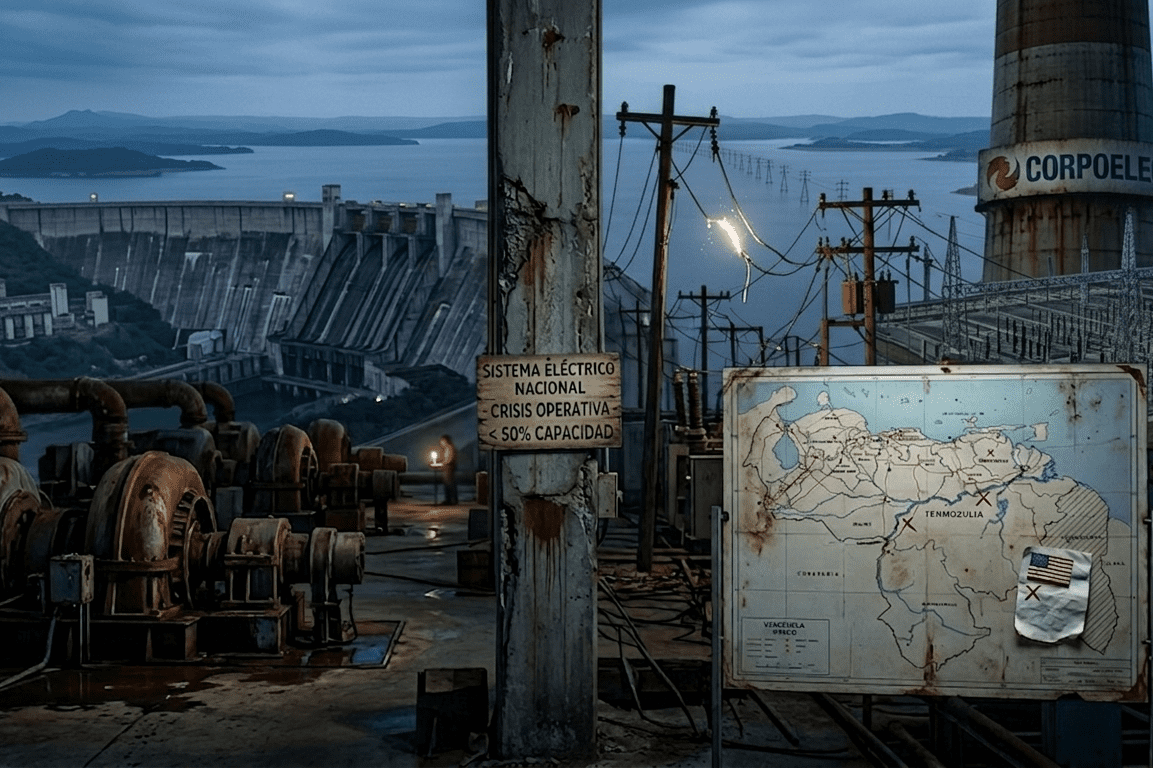
The success of new technical efforts and negotiation initiatives with U.S. companies depends on overcoming an estimated $15 billion investment deficit, according to Reuters sources | Image: Guacamaya.
Guacamaya, May 15, 2026. This Thursday, the U.S. Chargé d’Affaires in Venezuela, John Barrett, held a meeting with the Minister of Electric Energy, Rolando Alcalá. The collaboration seeks to inject U.S. technical expertise and investment into a grid that, precisely during the meeting, once again demonstrated its extreme fragility with a major nationwide blackout that affected Caracas and several states across the country.
The meeting, which took place at the Ministry’s headquarters, was framed, according to the U.S. Embassy in Caracas, within the implementation of the “three-phase plan” designed by the Trump administration to restore electricity supply in the country. If this episode demonstrates anything, it is that the electrical crisis has gone from being just a technical problem to also a diplomatic, economic, and political issue.
The truth is that the National Electric System (NES) remains in a structural emergency, even though the government tries to present it as a period of “recovery” rather than collapse. The conversation with U.S. diplomatic and business representatives, as well as the change of command at the Ministry, point to an attempt to reshuffle the board, although an improvement is not yet evident.
What has changed with the new administration?
Since March 2026, the Ministry of Electric Energy has been headed by Rolando Alcalá, an electrical engineer from Simón Bolívar University, who was presented as a figure to drive a technical turnaround. His management is structured around the NES Recovery and Transformation Plan, presented to the National Economic Council and academic sectors in search of comprehensive solutions.
Under his leadership, priority has been given to inspecting stalled projects such as Tocoma and performing maintenance at the Guri Hydroelectric Complex. He has also led outreach efforts with tech giants like Siemens and General Electric, focusing especially on the recovery of thermoelectric plants such as Termozulia and Ramón Lagunas, in the Zulia region, where the crisis is most severe.
Between “demand milestones” and operational reality
The official narrative has generated much discussion this month. On May 7, the Ministry of Electric Energy issued a statement reporting that Venezuela reached a record peak demand of 15,579 megawatts (MW), the highest figure in nine years. The government attributes this increase to high temperatures and “economic growth.”
However, experts and opposition figures such as Jesús Armas, an industrial engineer, have questioned these figures, pointing to an alarming technical contradiction. While theoretical installed capacity is estimated between 30,000 MW and 36,000 MW, functional capacity or actual availability barely hovers around 14,000 to 15,000 MW.
This situation means the system is operating at less than 40% of its total capacity, which explains why, at any demand peak, cascading failures occur. The crisis, evidenced by at least some 35 blackouts in the first quarter of 2026, according to Reuters sources, is not due to a lack of installed equipment, but to corruption, mismanagement, lack of maintenance, and disinvestment.
The financial challenge and investor uncertainty
Despite the announced cooperation with Washington, the path is expected to be difficult. Reuters reports indicate that Siemens and General Electric, with which conversations have advanced, remain deeply skeptical due to unpaid debts and the lack of payment guarantees from the Venezuelan state.
It is estimated that rebuilding the national electrical grid requires an investment of between $12 billion and $15 billion over three years. The success of Alcalá’s management at the head of the Ministry of Electric Energy and international aid will determine whether it is possible to move from “energy saving” announcements to tangible works that lift numerous corners of Venezuela out of darkness.
The temporal coincidence between the meeting with Washington and the conversations with Siemens and General Electric suggests a strategy of pragmatic openness to seek suppliers, technology, and eventually financing or technical assistance. On the communications front, the government is trying to show initiative, but concretely, no agreements or public execution schedules have been announced.
A chronology of darkness
It is important to note that the crisis is not cyclical but rather the result of nearly two decades of critical decisions that have impacted the system. The nationalization of the sector under Hugo Chávez’s government in 2007 eliminated private investment and centralized control in Corpoelec, but this did not translate into sustained infrastructure improvement.
Shortly thereafter, in 2010, Hugo Chávez himself declared the first “electrical emergency,” making rationing a permanent tool. Between 2011 and 2014, large-scale blackouts and prolonged outages multiplied. The official response oscillated between rationing and political explanations such as “drought,” “sabotage,” or “electrical war.”
Between 2016 and 2018, already under Nicolás Maduro’s mandate, regions like Zulia became trapped in a pattern of recurrent blackouts, while investment in transmission and distribution infrastructure also began to be affected by sanctions. In 2019, the March 7 mega-blackout left the country in darkness for several days, revealing that the system could no longer recover on its own.
From 2020 to 2025, the pandemic, the migration of technical personnel, and the scarcity of spare parts deepened the deterioration. Reports from civil society organizations such as Provea and Transparencia Venezuela began to document a crisis that had become a permanent condition. Chronic rationing became entrenched, with states like Zulia and Táchira suffering 4 to 8 hours of daily outages.
To this reality, from which 2026 has not escaped, is added an increase in energy demand, according to official announcements, though with infrastructure that remains stalled, reigniting the threat of a total collapse. In fact, precisely during the meeting between Barrett and Alcalá, voltage drops and localized blackouts occurred, affecting Caracas and other entities in the country.
What does the current moment reveal?
The current scene reveals a system that tries to distance itself from the language of collapse and enter that of reconstruction, but without yet resolving the underlying problem. The government now speaks of consumption peaks as a sign of economic recovery, while the population continues to experience voltage drops, blackouts, and informal rationing schedules.
In other words, the Venezuelan electrical crisis remains a dispute between technical management and political narrative. Technical management demands sustained investment, transparency, spare parts, qualified personnel, and long timelines, while the official narrative, in contrast, seeks to show control, announce international contacts, and manage public perception.