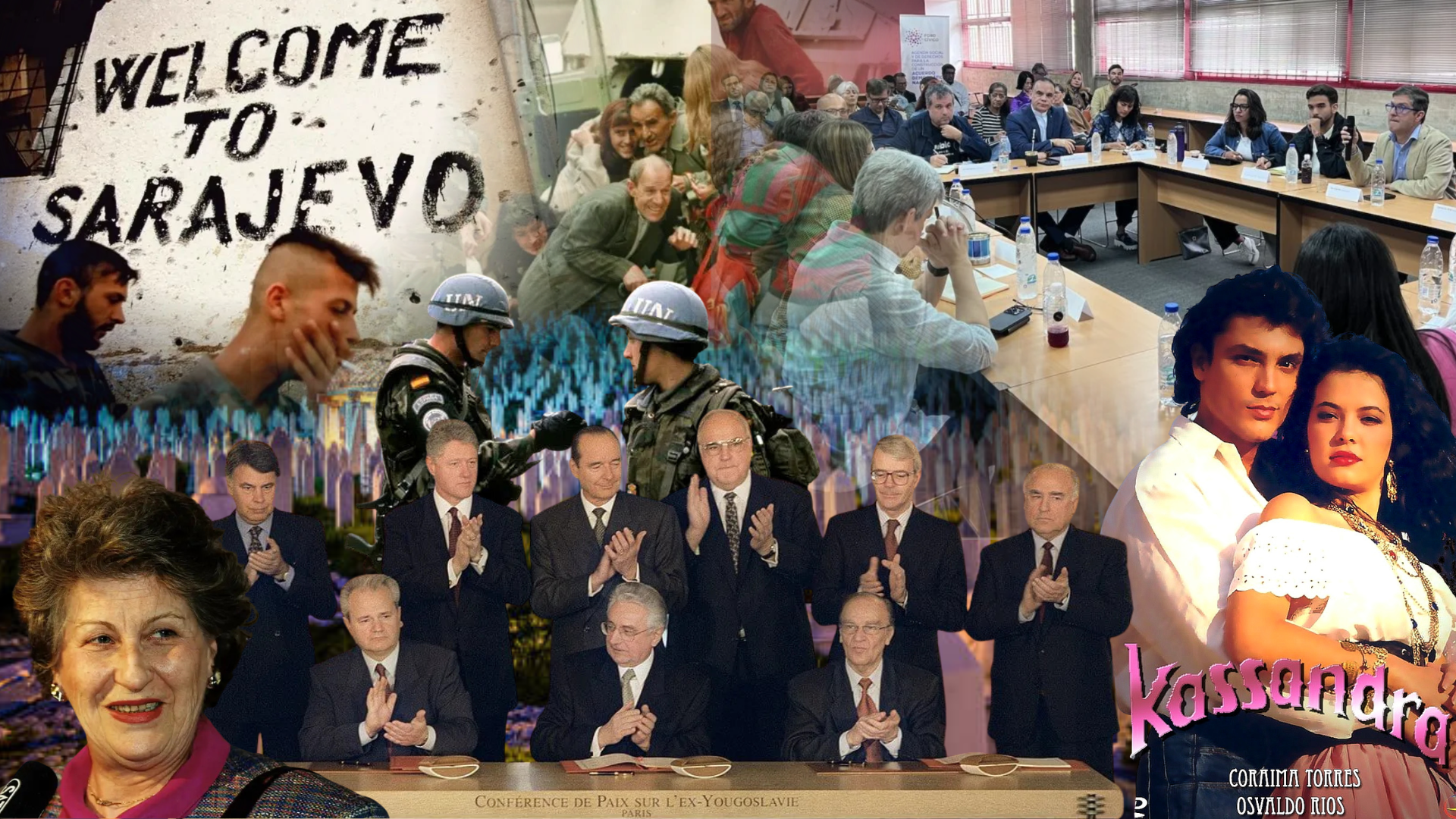
“Peace does not begin when agreements are signed, but when conversations change.”
Guacamaya, April 20, 2026. That phrase, which emerged in one of the Convergence Tables of the Foro Cívico, is not just a fortunate conclusion; it is, in fact, a profound synthesis of what the history of Bosnia and Herzegovina taught us after the Dayton Accords.
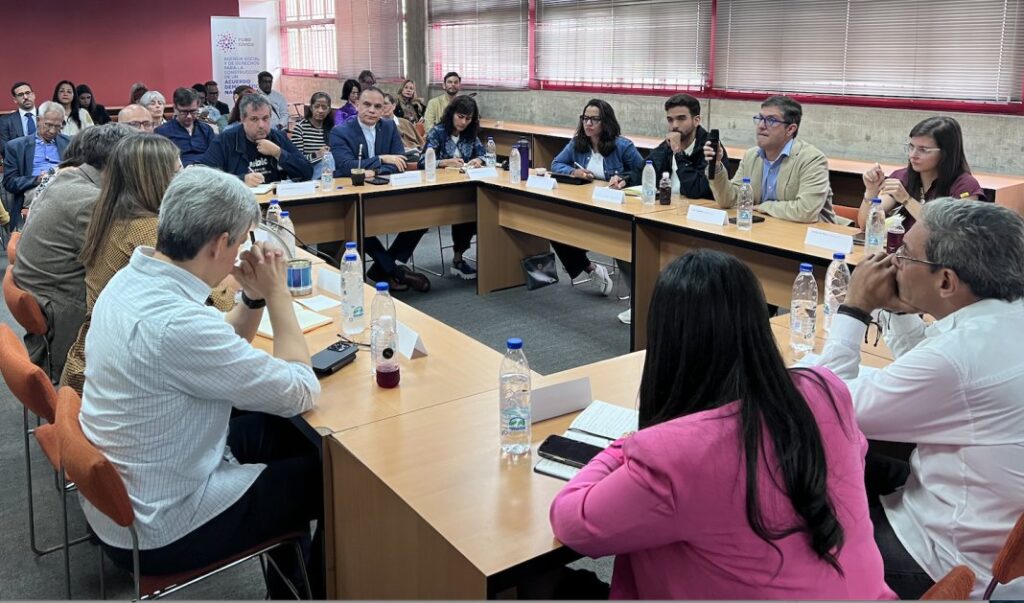
Within the framework of the program “Weaving pathways for dialogue in Venezuela,” different actors—coming from deeply diverse political, academic, and personal backgrounds—sat at the same table to talk about coexistence and peace. This is no small matter. In a country marked by distrust, polarization, and accumulated wounds, the simple act of listening to one another without silencing the other is already a political gesture of enormous significance.
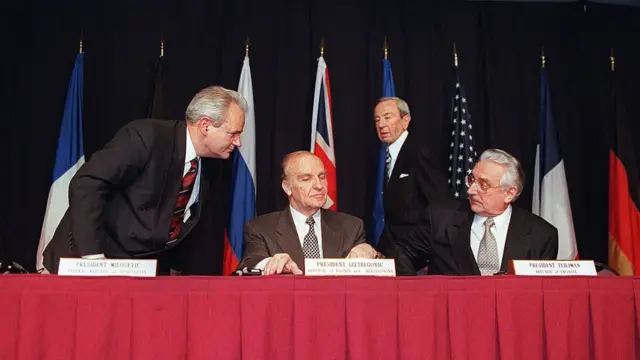
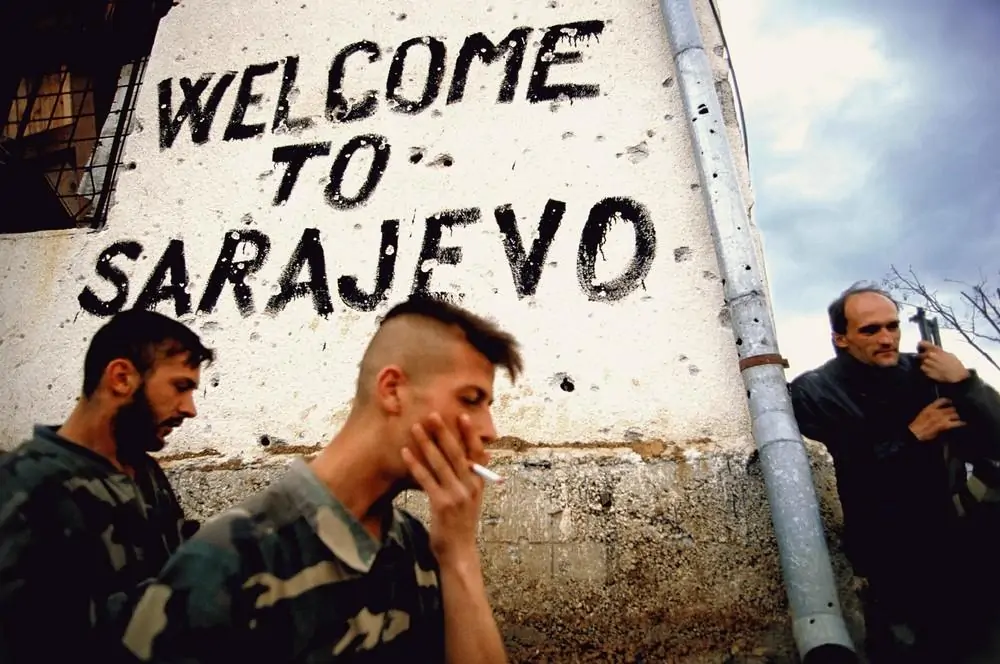
I think of Bosnia, and the connection becomes inevitable. Before there was an agreement signed at a military base in Ohio, there was something more difficult: the slow, uncomfortable, and often painful transformation of conversations. Because in Bosnia, as in Venezuela today, the conflict was not only territorial or institutional; it was profoundly narrative. Words had become weapons. Media had amplified fear. Identities had hardened into exclusion.
That is why what happened in Dayton was only a turning point, not a destination. Real peace began afterward—when journalists had to learn to tell stories without hatred, when communities began to speak to one another, when spaces—very similar to these Convergence Tables—allowed the “other” to stop being an abstract enemy and become, once again, an interlocutor.
In that sense, what the Foro Cívico is promoting today is part of a broader tradition we might call bottom-up diplomacy: processes where civil society does not wait for institutional politics to resolve the conflict but begins transforming it through language, through listening, through the possibility of building a shared narrative. As its philosophy suggests, this involves articulating diversity, rebuilding the social fabric, and committing to peaceful and consensual solutions.
What is interesting—and deeply hopeful—is that these tables do not seek to eliminate differences. On the contrary, they recognize them and bring them into dialogue. As in Bosnia, peace does not mean homogeneity, but the ability to sustain disagreement without resorting to the destruction of the other.
Listening to figures like Elías Jaua, historically linked to the PSUV, and Enrique Márquez, a former political prisoner, in the same space, moderated by a historian like Inés Quintero, is not merely an academic or political exercise—it is, in essence, a rehearsal of the country. It is proof that even in contexts where distrust has been structural, it is still possible to create minimal conditions for encounter.
And this is where Bosnia’s experience shines most clearly. Because if it teaches us anything, it is that agreements are possible even after the worst horrors—but they only endure if there is a communication ecosystem that sustains them. Without new conversations, agreements become hollow; without spaces for listening, peace becomes fragile.
Perhaps that is why these initiatives matter so much. Because, at their core, they are not trying to solve everything immediately. They are doing something harder: changing the tone, the language, the way Venezuelans can look at each other again.
And if Bosnia left us a lasting lesson, it is this:
“Peace begins long before agreements… and also depends on what we are capable of saying—and hearing—after them.”
Sometimes I am struck by how a country as distant as Venezuela could hold such an intimate place in the hearts of people I never met, like the Bosnians.
Changing the conversation in the midst of chaos: Kassandra, a hope from Venezuela to the Balkans
I imagine Nikola, Amina, and Marija sitting in a dark room in Sarajevo, the distant sound of gunfire filtering through the walls. Outside, war; inside, a television. Outside, death; inside, Kassandra, a story about love, injustice, and destiny, but also about the resilience of the Roma people—a community that had endured centuries of persecution and, in the Balkans, the tragedy of the Porrajmos carried out by the Nazis and the Ustaše.
I cannot help but reflect on the paradox this represents. While war propaganda divided communities, constructing invisible enemies and sowing fear, a Venezuelan soap opera united them. Bosniaks, Serbs, and Croats shared a common narrative space. Fiction became a bridge when reality had made communication impossible. Kassandra offered more than entertainment—it offered shared humanity, moments of pause in horror, and proof that even in the midst of barbarity, the human could persist. Conversations could shift from constant arguments and hatred to something shared that connected them, even if those foundations came from a small country across the Atlantic like Venezuela.
Tension reached its peak when supporters of Biljana Plavšić stormed a television station during an episode and announced its cancellation. Violence erupted in Banja Luka, and the situation became so serious that the U.S. State Department contacted the Venezuelan ambassador directly to ensure the broadcast of the missing episodes. It is almost ironic to think that a soap opera had more negotiating power than some diplomats in the early years of the conflict.
In 1997, the Venezuelan telenovela Kassandra became an unexpected phenomenon in Republika Srpska, one of the two entities that make up Bosnia and Herzegovina alongside the Federation of Bosnia and Herzegovina. In a region barely emerging from war, where peace remained fragile, fiction achieved something unusual: it paused, even if only for an hour, the daily tension of a society marked by conflict.
According to executive Antonio Páez, the show “paralyzed the entire region.” The lead actress later recalled that, despite the harsh context, audiences found in the story a space of escape from a “cruel and bloody” reality.

The political context was extremely volatile. After the war, stability in Republika Srpska was threatened by rivalry between factions aligned with Radovan Karadžić—president from 1992 to 1996 and later accused of war crimes—and those of the new leadership headed by Biljana Plavšić, backed by the United States. While the de facto capital consolidated in Banja Luka, Karadžić maintained his stronghold in Pale.
In this scenario, control of the media was crucial. The state television channel SRT, based in Pale and under Karadžić’s influence, broadcast messages against international peacekeeping forces and spread propaganda hostile to the West and the Dayton Accords.
The turning point came in August 1997, when Plavšić supporters seized a key SRT transmitter in Banja Luka and cut the signal from Pale. When broadcasting resumed under the new government’s control, an unexpected problem arose: they did not have the episodes of Kassandra, which audiences were eagerly following.
The interruption was not trivial. In Washington, within the State Department under the administration of Bill Clinton, concern arose over the potential social impact. Officials feared that the suspension of the soap opera would fuel discontent and exacerbate internal tensions, further weakening Plavšić’s fragile authority.
In that context, a U.S. official—who could not even reveal his identity—contacted Antonio Páez to urgently request help. The situation was paradoxical: the channel needed the show but lacked both the rights and the resources to acquire it. In fact, it was discovered that the episodes had previously been rebroadcast irregularly from a signal in Serbia.
After the United States declined to become financially involved, Páez made an unconventional decision: Coral Pictures donated the series. This allowed Kassandra to return to the air.
The result was immediate. Social tension decreased, and programming once again provided a brief sense of normalcy amid uncertainty. For Páez, the episode clearly illustrated the unexpected reach of cultural power: in a post-conflict context, a soap opera could become, even if temporarily, an instrument of social stabilization by changing the conversation.
Even Coraima Torres’ visit to Serbia, invited by Slobodan Milošević, illustrates the complexity of the relationship between culture and politics. What for audiences was a symbol of hope and continuity became, for those in power, a tool of manipulation and legitimization. The same narrative could serve reconciliation or control—it all depended on context and interpretation.
Echoes of Dayton
This concern resonates clearly with the experience of Bosnia and Herzegovina after the Dayton Accords. Although the technological context was different, the underlying problem was similar: a fragmented communication ecosystem filled with exclusionary narratives that hindered mutual recognition. Initiatives such as journalist training, human rights campaigns, and especially multi-local community radio sought the opposite of what often occurs today on social media: to slow down conversation, humanize it, and restore its complexity.
This is perhaps the most powerful connection with Venezuela today: understanding that without transforming the environments where conversations occur, political dialogue risks losing its foundation.
The deterioration of public discourse in Venezuela has become a structural obstacle to peace. Both government and opposition have built echo chambers and propaganda systems, promoting stigmatization and normalizing disqualification. The result is a degraded public debate, where political adversaries are no longer legitimate interlocutors but morally disqualified enemies.
From the perspective of communication sociology, this is not anecdotal but structural. Media do not merely transmit information; they produce meaning, shape identities, and define interpretive frameworks. In highly polarized contexts, language ceases to be a vehicle for deliberation and becomes an instrument of confrontation.
Lessons from Bosnia and Herzegovina
Reflecting on Bosnia evokes both admiration and melancholy: admiration for the awareness that peace requires more than agreements, and melancholy for the fragility of social trust.
Among the most relevant initiatives:
Journalist training by the OSCE: Workshops on ethics, fact-checking, and impartial coverage helped transform media from amplifiers of division into agents of coexistence.
UNMIBH campaigns: Promoted human rights and inclusion, emphasizing that reconciliation must include the most vulnerable.
Community radios (e.g., Radio Mirovna): Created spaces for listening and rebuilding social ties.
The digital dimension and the Citizen Charter
In Bosnia, initiatives like the Citizen Charter on responsible social media behavior—facilitated by the Centre for Humanitarian Dialogue—highlight the need for democratic governance of the digital space. Through participatory processes, citizens helped define norms to reduce hate speech, disinformation, and manipulation.
This offers a crucial lesson for Venezuela: peacebuilding today also requires transforming digital communication environments.
Leveraging Swiss mediation traditions
Switzerland’s role in the Foro Cívico reflects its long-standing tradition of mediation based on neutrality and trust-building. Institutions like the Centre for Humanitarian Dialogue demonstrate how external actors can strengthen local capacities without undermining sovereignty.
Inspired by these experiences, Venezuela could develop a Program on Digital Conflict and Mediation, combining media literacy, citizen deliberation, and responsible communication practices, supported by international expertise.
If there is one lesson Bosnia leaves us, it is that peace is fragile and everyday. It requires a culture of responsible communication. Media and communicators can either deepen conflict or foster reconciliation.
Venezuela, through Kassandra, once helped change conversations in Bosnia. It did not end the war—but it planted a seed. Perhaps today, it is Venezuela’s turn to look toward Bosnia for inspiration.
My hope is that one day Venezuela and Bosnia and Herzegovina establish full diplomatic relations, building a bridge of cooperation and dialogue that honors both societies.
Because peace is the foundation of stability—and stability is the basis for building a shared future of prosperity.