Jorge Barragán is an international analyst. He graduated from the Central University of Venezuela (UCV).
Guacamaya, June 1, 2026. The first round of the presidential election in Colombia has left a country divided into two ideological blocs. For Venezuela, the outcome of the runoff will not be just another external matter: it could redefine the opening of the border, trade, migration issues, security cooperation, and Caracas’s diplomatic margin with Bogotá.
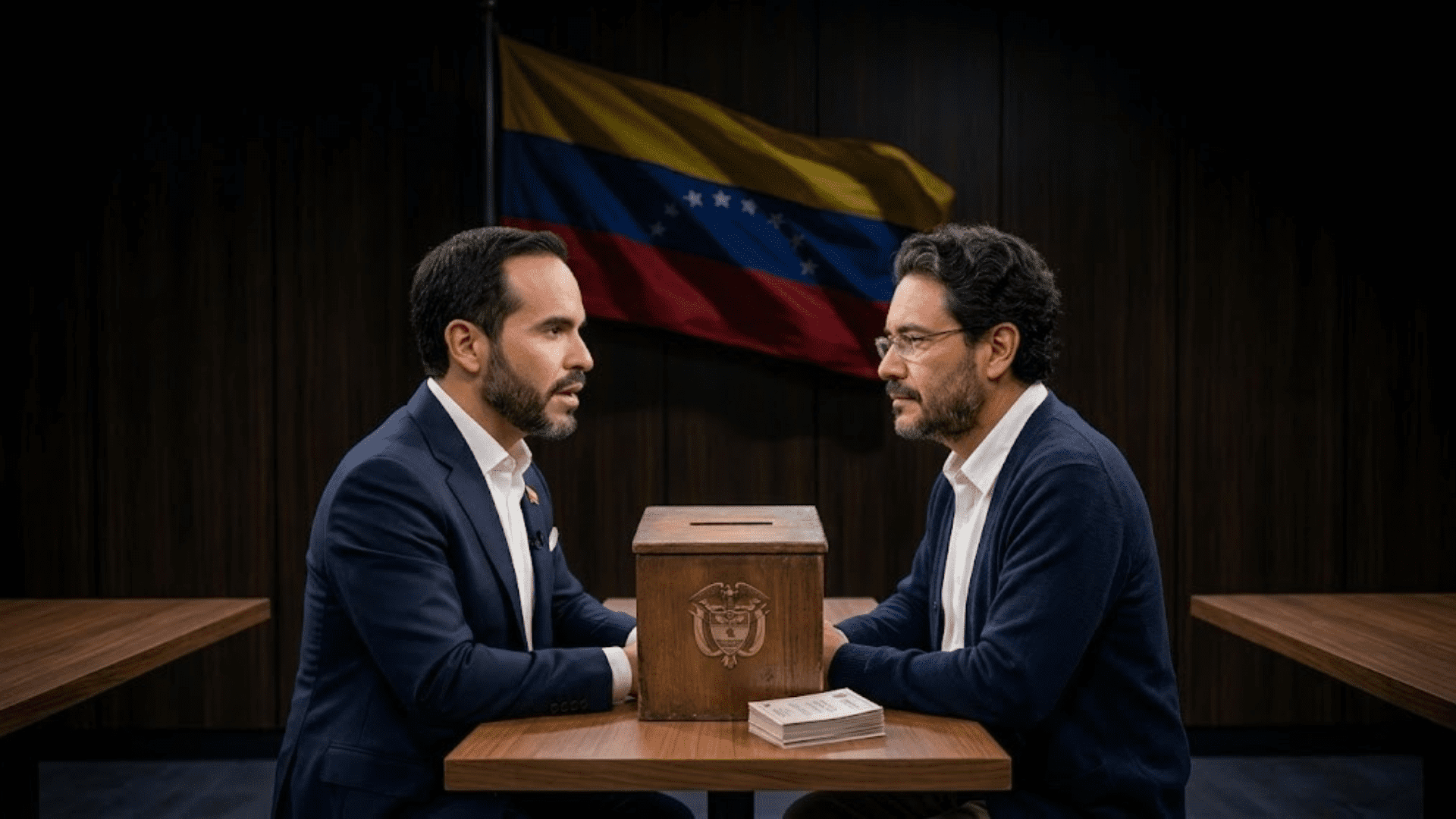
Colombia once again enters a runoff marked by polarization. Abelardo de la Espriella obtained around 43.7% of the vote, while Iván Cepeda reached nearly 41%. Both will face off in the second round scheduled for June 21.
For Venezuela, the Colombian election is not just any neighboring election. Colombia represents border, trade, migration, security, energy, culture, diplomacy, and regional balance. The reopening of relations during the Petro government allowed for the restoration of a bilateral agenda that had been broken between 2019 and 2022. This normalization did not solve all the problems, but it reopened the consular, diplomatic, and commercial channels indispensable for a historically interdependent border.
The economic dimension is concrete. Bilateral trade between Colombia and Venezuela reached US$1.17 billion in 2025, a 4.1% increase compared to 2024, according to the Colombo-Venezuelan Chamber. The trend shows formal recovery since the border reopening. Therefore, the central question is not only who will govern Colombia, but what bilateral architecture will remain after the runoff.
With Iván Cepeda, the most likely scenario would be the continuation of diplomatic, consular, and commercial relations. His government would maintain, with its own nuances, the foreign policy developed by Petro towards Venezuela: recognition of the Venezuelan government, direct channels with Miraflores, and strengthening of bilateral relations. This does not imply an absence of tensions. But, in general terms, Caracas would have a predictable counterpart.
With Abelardo de la Espriella, the scenario changes. His foreign policy vision aims at a break with the current diplomatic framework and alignment with the Trump administration. In that scenario, the Colombia-Venezuela relationship would cease to depend mainly on bilateral channels and would become more conditioned by the United States’ hemispheric policy. This would have direct implications for the border, consulates, and diplomatic and commercial relations between the two countries.
The most sensitive point would be security. The Colombia-Venezuela border is not a simple geographical line; it is a corridor where formal trade, illegal economies, migration, smuggling, armed actors, criminal networks, and communities that depend on daily mobility coexist. A sudden shift in the bilateral relationship could undermine the minimal coordination efforts that were underway. In areas like Norte de Santander, Arauca, La Guajira, and Táchira, diplomacy is a minimum condition for governability.
In politics, inconsistencies matter less when a candidate manages to embody the dominant sentiment of a social sector. De la Espriella was criticized for his past as a lawyer for bandits, including Alex Saab, for his clashes with journalists, and for a style of permanent confrontation. However, these criticisms did not halt his rise. On the contrary, they reinforced his image as an anti-system candidate for a segment of the electorate that was not seeking moderation, but political punishment against Petroism.
The result also confirms a paradox: Uribe was defeated, but not necessarily Uribismo. Paloma Valencia, the candidate for the Democratic Center, fell far short of expectations, with less than 7% of the vote, and ended up announcing her support for De la Espriella. The traditional right lost formal leadership, but its electorate seems willing to regroup behind the lawyer who managed to turn the fear of a continuation of the left into a major electoral force.
On the other hand, Iván Cepeda represents the political continuity of the Historic Pact. His candidacy is neither marginal nor testimonial; it confirms that the Colombian left is today the most organized and consolidated political structure in the country. He managed to become the left-wing candidate with the highest number of votes in history in a first round, with 9.7 million votes. Cepeda inherits Gustavo Petro’s project, with its successes and failures.
The first round left a decisive figure: barely 660,000 votes separate De la Espriella from Cepeda, while more than two million votes were scattered among the defeated candidates. That is where the runoff will be decided. Paloma Valencia’s vote would naturally tend toward De la Espriella, although his vice-presidential running mate, Oviedo, has already distanced himself. In the center, Sergio Fajardo and his one million votes will be decisive; he must decide between his rejection of Petroism and the fear of a radical right.
The Colombian election will not decide Venezuela’s future, but it could profoundly alter its strategic environment. For Caracas, June 21 will not be a foreign date. It will be a neighboring election with national consequences.