New appointments reflect how the Government redistributes trust across sectors where money, power, and political stability intersect. Images: Presidential Press Office.
Guacamaya, July 7, 2026. In what represents the most significant change in Venezuelan fiscal administration in nearly twenty years, acting president Delcy Rodríguez announced this Tuesday the removal of José David Cabello as superintendent of the National Integrated Service of Customs and Tax Administration (Seniat). This replacement marks the end of a historic hegemony over the country’s customs and tax collection.
The departure of José David Cabello from Seniat is not an ordinary bureaucratic move. As the brother of Diosdado Cabello, his figure has been central to the ruling party’s power structure and fiscal discipline for 18 years. Seniat is an institution that today contributes more than 80% of the annual national budget, funding critical sectors such as health, education, and defense.
The End of an Era
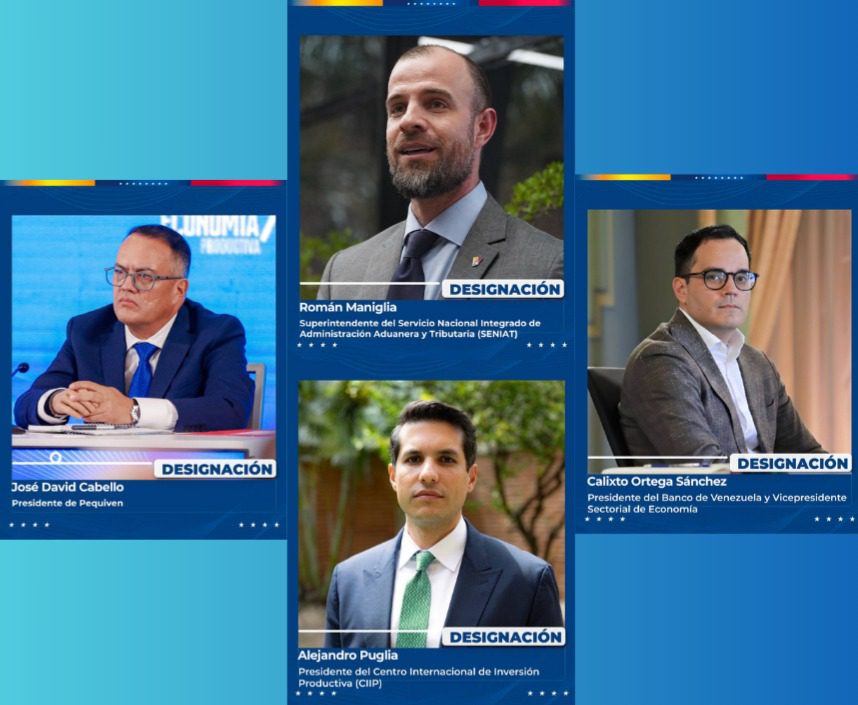
Cabello, who had remained continuously at the helm of the tax agency since 2008, will now preside over Petroquímica de Venezuela (Pequiven). His transfer to this state enterprise is seen as a strategic relocation within the “iron circle” of power to provide some continuity in the administration of positions, ensuring stability and political loyalty.
In April, Delcy Rodríguez announced that she would push for a tax reform as part of a broader economic modernization package. The establishment of the National Council for Productive Economy, at that time, was framed within an agenda that also included streamlining procedures, reducing bureaucracy, and other measures to make the economy more competitive.
When a government prepares modifications in this area, it typically needs to reorganize teams, redefine controls, and redistribute responsibilities. José David loses the most important office in terms of fiscal power, but he does not leave the inner circle. With his appointment at the helm of Pequiven, he is moved to another strategically significant position, suggesting continuity of protection and stability.
Román Maniglia as the New Chief
To take his place at the head of Seniat, the Executive has appointed economist Román Maniglia, who had been serving as president of Pequiven and of the Bank of Venezuela (BDV). Maniglia, who is no stranger to senior public management, takes the reins of the tax agency with the express mandate to implement the “total digitalization” of the system.
A social communicator by profession, with an MBA in Finance and specialization in cryptocurrencies, fintech, and blockchain, Román Maniglia leaves the acting presidency of Pequiven to take over as the new superintendent of Seniat. Maniglia, who also served as president of the Bank of Venezuela, will now have the digitalization of the tax system as his main task.
New Economic Structure for Reconstruction
These changes also shuffled pieces at the Bank of Venezuela and the International Center for Productive Investment (CIIP). Calixto Ortega, current sectoral vice president of Economy, replaces Román Maniglia as president of the state bank and, in turn, hands over the presidency of the CIIP to Alejandro Puglia, who had been serving as its vice president.
Alejandro Puglia emerges as one of the profiles arriving from outside the ruling party, the PSUV. His appointment as vice president of the CIIP was only in June 2026, less than a month ago. In the past, he was a member of Democratic Action, and between 2020 and 2025 he lived in New York, where he worked at investment bank Barclays and as a consultant at Ernst & Young.
This reshuffling occurs in a context in which the government is also trying to project its capacity to respond to the emergency generated by the earthquakes of June 24. Recently, the Executive announced the Great Mission Venezuela Renace as a framework for reconstructing infrastructure, housing, and social assistance in the affected areas.
With these appointments, the ruling party continues to adjust its internal map to sustain governability, revenues, and loyalties at a time of political and social pressure.