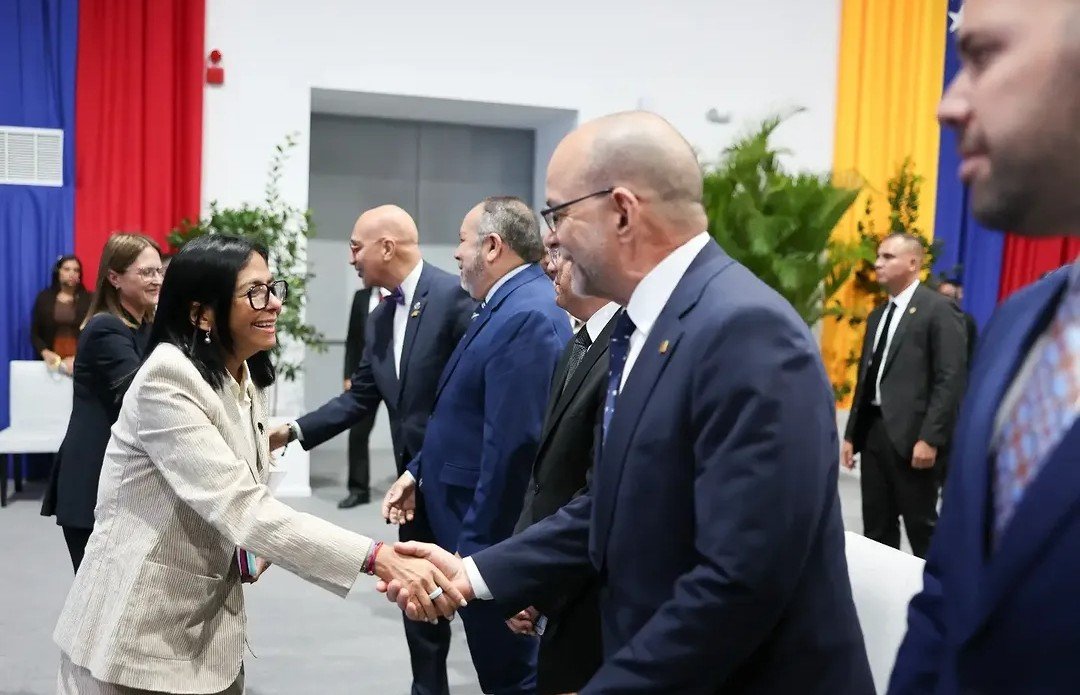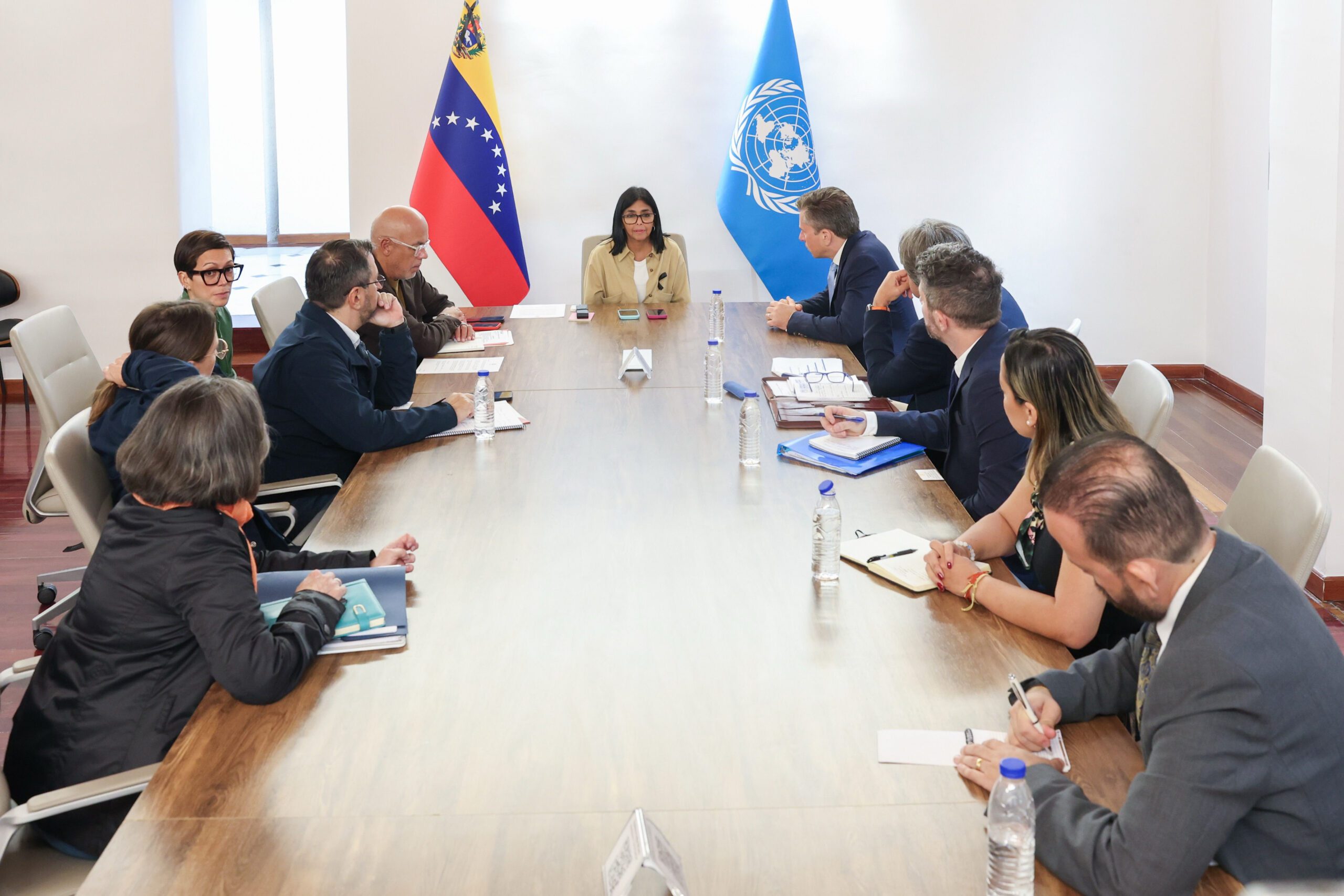
Acting president Delcy Rodríguez, in a working meeting with the United Nations Under-Secretary-General for Humanitarian Affairs, Tom Fletcher, following his arrival in the country to assess the international response to the emergency caused by the earthquakes. Photo: Presidential Press.
Guacamaya, July 9, 2026. Two weeks after the double earthquake that shook north-central Venezuela on June 24, one of the largest recovery and reconstruction operations in the country’s recent history is beginning to take shape.
The CAF development bank estimates that Venezuela will need more than $15 billion, and initiatives to date do not approach that magnitude. However, projects are beginning to be formulated by multilateral financial institutions, United Nations agencies, foreign governments, and the Venezuelan State itself.
The international response combines immediate humanitarian aid with instruments aimed at infrastructure reconstruction, housing recovery, restoration of public services, and strengthening resilience against future disasters.
The Venezuelan government, for its part, announced an initial fund of $200 million to finance the first reconstruction works and is holding conversations with the International Monetary Fund (IMF), the World Bank, the Inter-American Development Bank (IDB), the United Nations Development Programme (UNDP), and other international partners to expand available financing.
Preliminary estimates place the economic cost of the disaster between $7 billion and $10 billion, depending on the methodology used. Although most of the damage is concentrated in La Guaira state and, to a lesser extent, in Caracas and other cities in the north-central part of the country, experts agree that recovery will require a sustained effort over several years and broad international cooperation.
The impact of the catastrophe and loss estimates
The latest official report documents a tragic toll of at least 3,889 dead and more than 16,700 injured. A total of 17,907 people lost their homes, forcing authorities to set up 89 temporary camps.
Officially, 190 buildings have collapsed and another 856 have structural damage. However, in the metropolitan region of Caracas and La Guaira, the total number of properties destroyed or with severe damage is estimated at 1,400. While life is gradually returning to normal in the capital, export hubs remain practically intact, although the earthquakes halted the recovery of the country’s main airport and the aviation sector.
The U.S. risk analysis firm Verisk (VRSK) projects that losses will exceed $10 billion, aggravated by inflation, low insurance penetration, and the complexities of sanctions.
A preliminary UNDP assessment places direct physical damage at about $6.7 billion (between $4.7 billion and $8.7 billion), equivalent to 6% of GDP.
Local economists applying World Bank and ECLAC methodologies estimate the impact between $7 billion and $10 billion (7% to 10% of GDP) when including indirect losses from the paralysis of trade and services.
The United Nations Office for Disaster Risk Reduction (UNDRR) generated an unusually high estimate of $37 billion in direct physical damage alone: $24 billion in buildings (3% of total exposed) and $13 billion in infrastructure (4% of total exposed).
The Government creates a national fund of $200 million
Delcy Rodríguez announced an initial fund of $200 million, financed with resources recovered from the IMF. She also called for the release of other Venezuelan assets abroad and the total lifting of sanctions.
Part of the resources will be deployed through the Great Mission Venezuela Renace, headed by Jacqueline Farías, who recently left the Ministry of Transport.
A reconstruction fund has also been created at the Banco de Desarrollo Económico y Social de Venezuela (BANDES), intended to finance infrastructure, housing, and public service rehabilitation projects. It has already received its first contribution from the private sector: a $2 million donation from the mining company Visco Orinoco.
The first uses for these funds would be direct transfers to those affected for six months, a subsidy of up to 80% for mortgages, and tax exemptions for the purchase, sale, and rental of residential properties.
In addition, she established the Transitional Camps, Housing and Infrastructure General Staff, headed by Jorge Rodríguez, the president of the National Assembly, to coordinate the rehabilitation of the affected areas.
The new structure will be responsible for overseeing both the construction of temporary housing solutions and the planning of the definitive reconstruction of homes, public buildings, road infrastructure, and essential services, in coordination with the various national and international agencies participating in the response.
The resources recovered from the IMF come from the Special Drawing Rights (SDRs) allocated during the COVID-19 pandemic in 2021, but which remained frozen until this year due to the non-recognition of the Venezuelan Government by several countries. They were made available again following the reestablishment of relations with the United States and, consequently, with the IMF.
IDB and World Bank: Development banks launch reconstruction funds
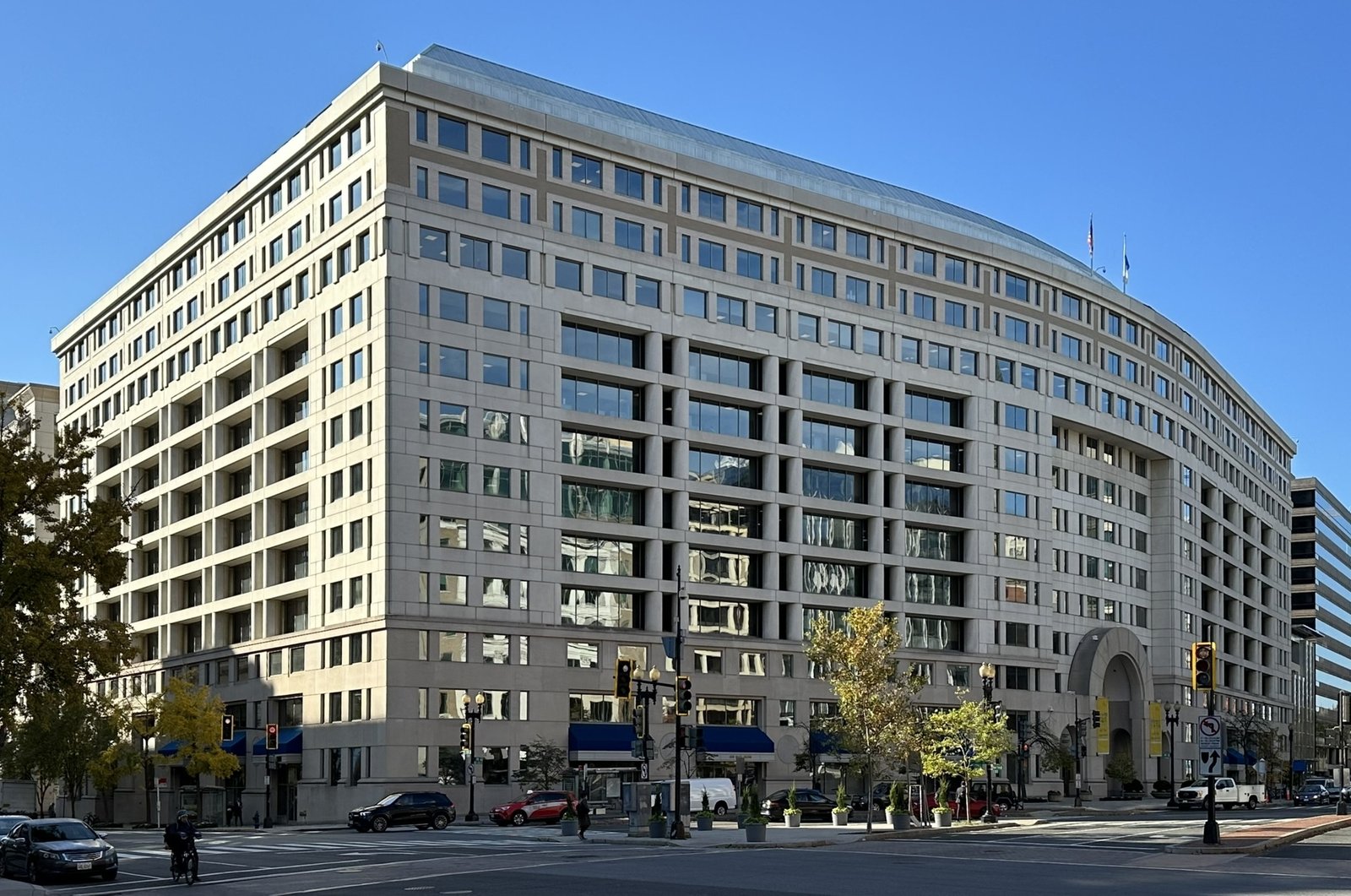
Venezuela’s acting president, Delcy Rodríguez, reported that both the IDB and the World Bank offered non-reimbursable cooperation to support the national reconstruction process, in addition to making available to the country credit lines intended to finance the following stages of recovery.
“They have already offered non-reimbursable cooperation to address the recovery process,” Rodríguez stated during a press conference, in which she also confirmed that both multilateral institutions expressed their willingness to provide technical support for the reconstruction process.
“The IDB Group is with the people of Venezuela in this difficult time,” expressed the organization’s president, Ilan Goldfajn, in an official statement.
The IDB announced an initial assistance of more than $1 million destined to finance immediate humanitarian assistance and the assessment of damage and losses, with the purpose of guiding the first phases of recovery.
The initial package includes $350,000 contributed directly by the IDB; between $300,000 and $400,000 from contributions from member states; between $100,000 and $200,000 raised through the internal solidarity campaign “Everyone with Venezuela,” made up of voluntary contributions from IDB Group staff; and $150,000 specifically allocated to the damage and loss assessment, a tool considered essential for designing reconstruction and restoring priority public services.
CAF creates the Fund for the Recovery and Reconstruction of Venezuela
In parallel to the announcements made by the IDB and the World Bank, the Development Bank of Latin America and the Caribbean (CAF) launched the Fund for the Recovery and Reconstruction of Venezuela, a financial mechanism designed to channel contributions from governments, international organizations, companies, foundations, civil society organizations, and individuals interested in supporting the country’s recovery after the earthquakes.
The Fund seeks to convert the contributions received into concrete projects, under a scheme of transparent administration, traceability, and permanent accountability. As explained by the institution, the resources will be directed toward the priorities jointly defined by CAF and the Government of Venezuela, seeking to respond progressively to the different stages of the emergency.
Guacamaya has learned, through sources consulted at the institution, that various states and private actors have already shown interest in contributing to the Fund.
To launch this instrument, CAF made a seed contribution of $1 million, intended to finance the first priority response actions. Additionally, the institution announced that it will fully assume the administrative and operational costs of the Fund, so that 100% of the contributions made by donors will go directly to emergency response, recovery, and reconstruction efforts.
The Fund’s design contemplates a phased intervention that accompanies the evolution of the emergency. During a first stage, resources will be used to strengthen the immediate response through humanitarian aid, the acquisition of essential supplies, and support for institutions responsible for emergency operations.
In a second phase, the Fund will finance the rehabilitation of essential public services, including health, drinking water and sanitation, electricity, education, telecommunications, and connectivity systems.
Finally, in a third stage, resources will be directed toward the recovery of livelihoods in affected communities, early reconstruction of infrastructure, and strengthening national resilience against future natural disasters.
CAF explained that the Fund’s resources will be administered independently of its institutional assets and may be received in both U.S. dollars and euros. Execution may be carried out through eligible entities or directly by the institution itself when this allows for more efficient project management.
For those interested in contributing, CAF has provided bank account numbers and can be reached via the emails forrvenezuela@caf.com and trustfunds@caf.com.
Response from the United Nations Organization
UN Secretary-General António Guterres reported through his spokesperson, Stéphane Dujarric, that the humanitarian response plan for Venezuela has already raised $274 million, plus more than $32 million contributed by the private sector, in addition to donations in goods and services. This initiative, led by OCHA, seeks to assist 5.5 million vulnerable people and requires a total of $632 million.
Meanwhile, in an interview granted to the newspaper El País, the UN Resident Coordinator in Venezuela, Gianluca Rampolla, stated that the country’s reconstruction will depend not only on immediate humanitarian aid but also on the capacity to mobilize international financing over the coming years.
Rampolla identified four strategic priorities for national recovery: infrastructure reconstruction; access to multilateral financing; unfreezing of financial assets; and lifting economic sanctions that limit the country’s recovery capacity.
In the opinion of the UN representative, these elements will be decisive in transforming the emergency response into a sustained process of economic and social recovery.
Along the same lines, the United Nations Under-Secretary-General for Humanitarian Affairs stated that the organization will insist that sanctions not hinder the emergency response or the reconstruction process of Venezuela following the June 24 earthquakes.
In statements given to EFE from Playa Grande, one of the localities most affected by the disaster, Fletcher noted that the UN considers it essential to guarantee humanitarian exceptions that allow the entry of necessary assistance without restrictions derived from sanctions regimes.
The humanitarian official also warned that the economic impact of the quakes will be significant and could translate into a reduction of several points of GDP. In that context, he explained that the UN seeks to work jointly with international financial institutions, including the World Bank and the IMF, to support a transition from immediate humanitarian response toward a long-term recovery and reconstruction strategy.
Likewise, Venezuela formally requested technical and financial assistance from UNDP to execute housing programs. The request was addressed in a direct conversation between Delcy Rodríguez and UNDP Administrator Alexander De Croo, agreeing to carry out a post-disaster needs assessment.
The plan, coordinated by OCHA, aims to assist 5.5 million vulnerable people and requires $632 million to finance vital operations in protection, food, health, water, sanitation, shelter, and early recovery.
In addition to financial contributions, the UN highlighted that numerous private companies continue to supply equipment, materials, transportation, logistics, and other essential goods that complement the international response.
It should be noted that the international community activated millions in emergency funds distributed as follows in support of UN initiatives in Venezuela:
UN Central Emergency Response Fund (CERF): Allocated $15 million for immediate multisectoral response.
United States: Announced a total of $386 million ($100 million destined for the Venezuela Humanitarian Fund [VHF] and another $100 million in direct bilateral allocations to rescue agencies and organizations).
European Union: Contributed an additional €5 million for the emergency.
Germany: Made a contribution of $5 million to the VHF.
United Kingdom: The DEC committee raised £7 million in 24 hours (including £2 million in government funds from UK Aid Match).
Switzerland: Announced a contribution of 2.5 million Swiss francs.
Sweden: Allocated 25 million Swedish kronor for food, water, and temporary shelter.
Denmark: Allocated 11 million Danish kroner to the humanitarian response through UNHCR and the Red Cross.
Australia: Reported a contribution of $2 million through the IFRC and WFP.
South Korea: Contributed $1.25 million to the VHF.
Norway: Added direct financial resources through the CERF fund.
United States: Geopolitics of the crisis and reconstruction
One of the most significant events in the post-emergency period was the visit to Venezuela of the head of the United States Southern Command, Francis Donovan, who held meetings with acting president Delcy Rodríguez and senior Venezuelan government officials to coordinate U.S. cooperation during the reconstruction phase.
According to information released by Venezolana de Televisión (VTV), both delegations are working on a “new cooperation agenda” aimed at supporting the recovery of damaged infrastructure, especially in La Guaira state, one of the regions hardest hit by the earthquakes.
The U.S. delegation also included the Chargé d’Affaires in Venezuela, John Barrett, and Major General Kevin Jarrard, responsible for coordinating the operations of U.S. search, rescue, and recovery teams deployed in the country.
Participating on the Venezuelan side were the Minister of Interior, Justice and Peace, Diosdado Cabello; the Minister of Defense, Gustavo González; the Vice Chancellor for Europe and North America, Oliver Blanco; and the head of the Venezuelan diplomatic mission in Washington, Félix Plasencia.
The talks seek to expand cooperation beyond the immediate response phase and incorporate projects related to critical infrastructure rehabilitation and institutional strengthening.
China calls for lifting sanctions and expresses interest in participating in reconstruction
China publicly expressed its support for the Venezuelan reconstruction process and requested that the United States lift economic sanctions imposed on the country, considering that these limit recovery capacity after the catastrophe.
Beijing argued that reconstruction requires conditions that allow for more efficient mobilization of financial resources, investments, and materials, directly linking economic recovery to the easing of restrictive measures.
Sources consulted by Guacamaya also indicated that China has expressed interest in joining the reconstruction stage through cooperation with the State and multilateral entities.
In addition to the first $14.7 million in aid, China could contribute through multilateral channels.
The Chinese position adds to the support previously expressed by various multilateral organizations and countries participating in humanitarian assistance efforts.
Israel presents a national rehabilitation plan
In parallel, the Israeli delegation deployed in Venezuela formally presented its National Rehabilitation Plan to President Delcy Rodríguez and senior Venezuelan government officials.
The proposal is part of the work that Israeli teams have been developing since their arrival in the country, initially focused on search and rescue operations and subsequently on structural assessment tasks.
Currently, engineering teams from the Israel Civil Defense Command continue to conduct technical inspections alongside Venezuelan authorities to determine the safety conditions of buildings and infrastructure.
The assessments are especially concentrated on high-rise residential buildings, with the aim of allowing as many families as possible to return to their homes once the structures are verified as safe for habitation.
The plan presented includes technical recommendations for building rehabilitation, resilient reconstruction criteria, and strategies to reduce vulnerability to future seismic events.
Conclusion
The convergence of national resources, multilateral organizations, the United Nations, development banks, foreign governments, humanitarian organizations, and international technical cooperation is beginning to shape the financial architecture that will sustain Venezuela’s reconstruction.
Although much of the response remains concentrated on emergency care, the initiatives announced in recent days show a progressive shift toward a medium- and long-term recovery phase, focused on rebuilding housing, infrastructure, public services, and livelihoods.
The earthquakes also hit Venezuela at a point of economic weakness: GDP is barely 34% of its 2013 level.
The challenge, however, will remain considerable. Beyond the first donations, emergency funds, and announced credit lines, investment needs far exceed the resources mobilized so far.
Coordination between the Venezuelan State, multilateral organizations, the private sector, and the international community will be decisive in transforming immediate aid into a sustained recovery process that allows rebuilding affected areas and strengthening the country’s resilience against future disasters.