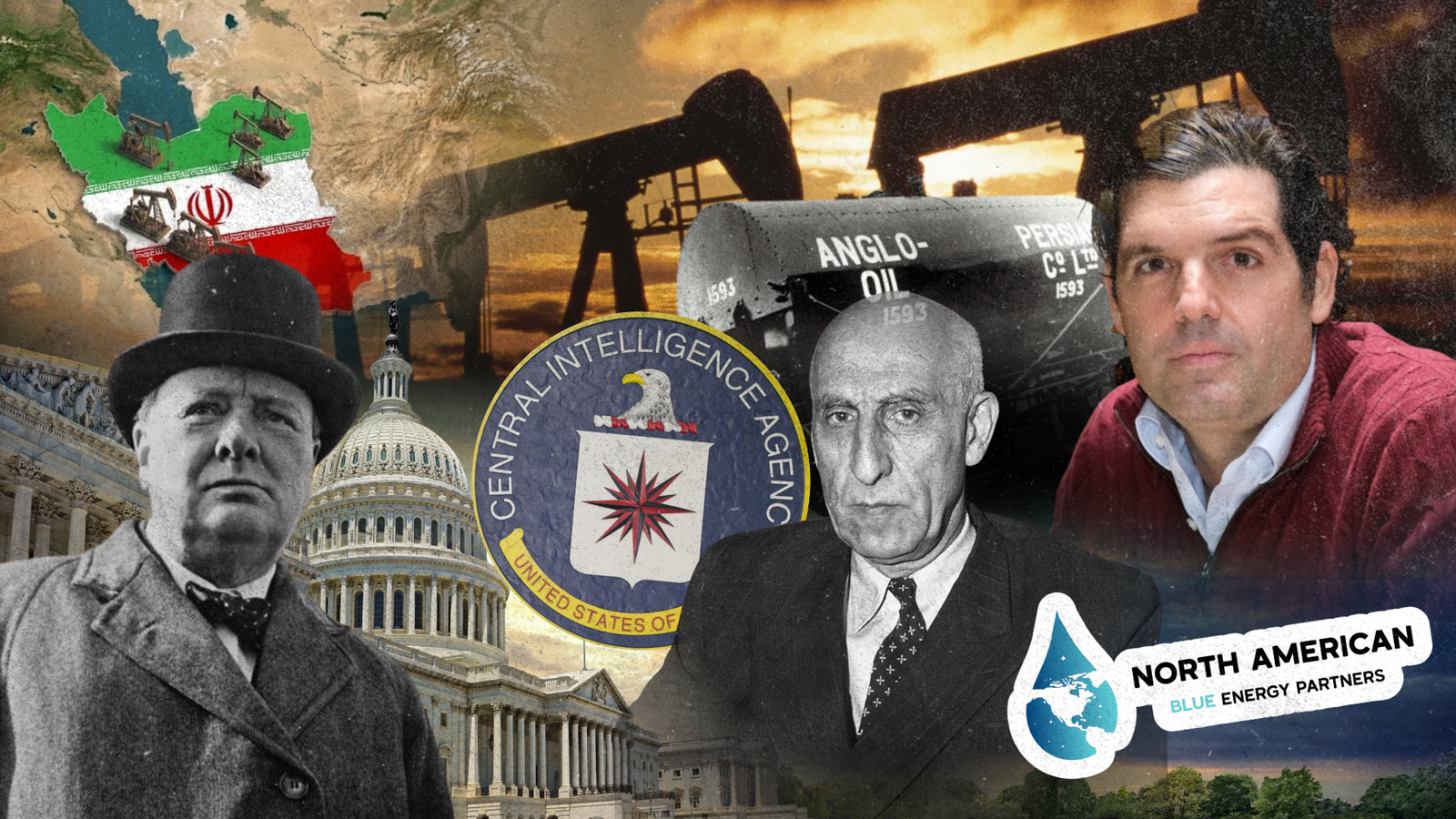
Iran’s 20th-century history leaves two precedents for today’s Venezuela. Image: Guacamaya.
Guacamaya, September 10, 2026. A professor abroad once told me that Iran and Venezuela had much more in common than it seemed. At first glance, it is difficult to imagine two countries so distant, one in the Middle East and the other in the Caribbean. But it is enough to follow the trail of oil to discover a much deeper link. Venezuela’s history inevitably intersects with that of Iran, Libya, Egypt, and other countries whose trajectory was marked by the exploitation of a resource that transformed economies, financed wars, and sustained a good part of the West’s industrial development.
Oil not only changed the wealth of these countries; it also shaped their states, their societies, and their relations with the world. For decades, foreign powers found in their reserves a resource too strategic to remain completely outside their interests. Concessions, international companies, coups d’état, nationalizations, sanctions, and conflicts ended up forming part of the same story, and that story is none other than the dispute over who controls oil and, with it, a substantial part of national sovereignty.
From that perspective, Caracas and Tehran are much closer than their geography suggests. Their histories are not identical, but both allow us to understand how oil can become, at the same time, a source of prosperity, an instrument of power, and the origin of profound tensions with the great powers. This is the story of that parallelism.
One hundred years after London turned the Anglo-Persian Oil Company into an instrument of state, Washington is testing a similar architecture in Venezuela—with a decisive difference: it does not only seek control of the resource, but of the very continuity of the political power that administers it. The Iranian precedent, with its 1914 corporate model, its 1941 invasion, and its failed 1951-53 nationalization, offers an uncomfortable guide to where the current Venezuelan oil arrangement may lead.
Any serious historical comparison between Iran and Venezuela must distinguish two processes that, although intertwined, obey different logics: on the one hand, control of the oil resource—how a foreign power secures access to an asset that has ceased to be treated as a commodity and is treated as a matter of national security—; on the other, the continuity of political power after an intervention—how that same power avoids an institutional vacuum by replacing the deposed ruler with a docile transitional figure, instead of occupying the country or imposing direct administration. Iran offers a clear precedent for both axes, separated by almost three decades: corporate control of oil was built in 1914 and reconfigured in 1954; the replacement of the ruler occurred in 1941. In Venezuela, both processes are developing almost simultaneously, which aggravates—and accelerates—the parallelism.
The Iranian precedent: oil as a security asset moving from shareholder control to corporate governance
The Anglo-Persian Oil Company was born in 1909 from the concession granted to businessman William Knox D’Arcy and the discovery of oil in Masjed Soleiman. During its early years it was an ordinary commercial operation. Everything changed in 1913, when Winston Churchill, as First Lord of the Admiralty, promoted the decision for the Royal Navy to replace coal with oil, which required “securing reliable sources of supply” and not leaving that availability exclusively in the hands of a private company. Parliament approved the British government investing 2.2 million pounds in exchange for 51% of the company’s shares, with representation on the board and veto mechanisms over strategic decisions. The Crown ratified the agreement in August 1914, eight days before World War I broke out.
What is decisive about this episode is not only the figure of shareholder control, but the mechanism chosen, since London did not nationalize the Persian fields nor deploy direct colonial administration over the oil sector. It used a formally private company as a vehicle to achieve a state objective. Power did not reside solely in the physical ownership of the crude, but in the ability to decide who ran the company, what contracts it could sign, and under what conditions production was marketed. That architecture proved durable, since the company, renamed Anglo-Iranian Oil Company in 1935, continued operating under that corporate control scheme for almost four decades, until the 1951 nationalization.
The Venezuelan parallel: Nabep and control without ownership
That same mechanism—strategic control without the need for formal majority ownership—seems to be taking shape around North American Blue Energy Partners, Alejandro Betancourt’s company, in Venezuela. If Washington uses this company as a vehicle to secure access to a strategic part of Venezuelan oil production, while reserving governance instruments for itself—veto power over appointments, the presence of U.S. citizens in the management structure, oversight mechanisms over fundamental decisions—then the parallel with 1914 is not merely rhetorical.
In both cases, a formally commercial company becomes an instrument of an objective that transcends its own profitability: guaranteeing a foreign power secure and permanent access to a strategic energy resource.
Let us not forget that, in the case of the Anglo-Persian Oil Company, the British Empire reserved the right to appoint two directors on the board, with veto power over matters related to Admiralty fuel contracts and over larger political decisions. The House of Commons approved the measure the same day and, in August 1914—let us remember that eight days later World War I broke out—the Crown ratified the agreement. The agreement announced by the United States also implies vetoes over the appointment of the company’s board of directors, which will now be a spearhead in the Venezuelan energy market.
There is, however, a difference in mechanism that should be clarified. In 1914, Great Britain opted for direct shareholder ownership and bought 51%, formally becoming majority shareholder. The scheme surrounding Nabep seems to point, instead, toward a more sophisticated modality and is based on control through corporate governance—veto, oversight, composition of management—without this necessarily implying a U.S. majority shareholding.
The Office of Strategic Capital of the Department of War maintains a guarantee scheme over 35% of Nabep’s shares, without direct participation. It is an evolution of the same concept based on the fact that it is not necessary to own the majority of shares to have decision-making capacity over a strategic company; it is enough to control the fundamental points of its governance structure.
The eventual participation of the Pentagon in designing that scheme would reinforce precisely that reading, because when the defense apparatus intervenes in the architecture of an oil agreement, the resource ceases to be a simple commodity and becomes integrated into the national security planning of the state exercising influence.
When control by governance is not enough: the 1954 consortium
The Iranian case also offers a second moment that should be added to this comparison, because it shows what happens when control through corporate governance proves insufficient and a power decides to directly renegotiate its portion of the business. After the 1953 coup d’état that overthrew Mohammad Mossadegh, the Anglo-Iranian Oil Company demanded the full restitution of the monopoly it had before the 1951 nationalization. Washington, however, calculated that returning that absolute monopoly to a single British company would reignite recently suppressed Iranian nationalism, and took the lead in the distribution. The State Department tasked Herbert Hoover Jr. with assembling an international consortium, going so far as to suspend the application of its own antitrust laws to achieve it.
The result, formalized in the 1954 Consortium Agreement, was an exact fracture of the old monopoly with 40% for the British company—renamed British Petroleum that same December—14% for Shell, 6% for the French CFP, and 40% distributed among five U.S. oil companies newly arrived in the Iranian business. From 100% British control, London went on to retain less than half; Washington, absent until then, entered with an identical portion. The mechanism reveals an underlying logic: Great Britain needed the United States to legitimize and sustain an operation that its own imperial exhaustion no longer allowed it to execute alone, and Washington charged for that mediation with a participation equivalent to that of the one who had summoned it.
It is worth remembering that the former Anglo-Persian, later British Petroleum, went on to become the BP we know today. It ranks among the energy “supermajors” and among the highest-revenue companies in the world, with operations in Asia, Africa, Europe, and the Americas.
The contemporary parallel: displacing China and Russia
That same pattern—Washington unilaterally deciding what portion of the oil business third-party actors retain—is what is observed today in the way the United States is treating Chinese and Russian positions in Venezuela.
Rather than disguising its objective, this is the discourse promoted by the White House: that the agreement with Nabep serves to displace Chinese and Russian operators in several of the projects involved. Among the reassigned fields were two in the hands of China Concord Resources—sanctioned by Washington in 2019 for trading sanctioned crude from Iran—and, presumably, other fields operated by Sinopec, China National Petroleum Corporation, and a Russian company. The latter, however, are said to have stopped participating in the fields now under Nabep’s control years before the agreement.
Paradoxically, Alejandro Betancourt operated in Petrozamora for years through a scheme with the Russian state entity Gazprombank, which appeared as a shareholder partner of PDVSA in the joint venture. In 2022, then Oil Minister Tareck El Aissami ended that agreement, temporarily leaving Betancourt out of the hydrocarbon business. It was in 2024 that he returned hand in hand with Florida businessman Harry Sargeant III, after El Aissami’s fall. The American, however, was pressured to abandon his partnership with Betancourt shortly before the announcement of the agreement with the Pentagon.
The Venezuelan government, for its part, granted Nabep rights for at least 25 years over the seventeen assigned fields, which total 65 billion barrels of crude. Although, according to the White House, the term of the concessions is actually 100 years.
The financial front moves in parallel with the operation. Beijing publicly demanded, through its Ministry of Foreign Affairs, that its interests in Venezuela be safeguarded given the possibility that the new agreement affects the fields where its state companies operate, although no official version has specified in which operations these are being displaced.
A key point in which the agreement between the United States and Venezuela does affect Beijing’s interests is sovereign debt. U.S. Energy Secretary Chris Wright, who confirmed from Caracas that revenues from new oil production will not be used to pay Venezuela’s debt to China, and that his government is “working on restructuring” those financial commitments without yet specifying the mechanism.
It is an almost literal repetition of the 1954 pattern. Back then, Washington decided what part of the business London retained after two decades of extraction; today it decides what part of Venezuela’s debt to Beijing—accumulated over twenty years of oil-for-financing agreements—will be honored and with what crude. That type of agreement gave China enormous veto power over a future restructuring of Venezuelan debt.
The displacement is already visible in trade figures. According to data collected by Reuters, China was displaced as the main destination for Venezuelan crude as soon as U.S. control over exports began—shipments fell to 156,000 barrels per day—while Russia completely lost the monopoly it held as a supplier of naphtha, a key input for diluting the extra-heavy crude of the Orinoco Belt. PDVSA documents cited by Reuters show that part of the cargoes Venezuela informally used to pay interest on its debt to Beijing became “trapped” under the new U.S. oversight of exports.
The difference with the Iranian precedent is one of degree, not nature, given that in 1954 Washington negotiated a partial cession with a formal ally; in Venezuela it unilaterally imposes the terms on a government that depends on its political support to survive, and does so not only over the distribution of profits but over the very architecture of sovereign debt.
The continuity of power after military intervention
Another key aspect is the preservation of power after the intervention of a foreign power, and here it is essential to refer to the Iranian precedent with the 1941 invasion and the rise to power of the heir son and the fall of his father.
The second axis of comparison is not about the resource, but about what the intervening power does with the deposed ruler—and with whoever replaces him. Reza Shah’s rapprochement with Nazi Germany was not a sudden ideological turn, but a balancing strategy against Great Britain and the Soviet Union, two powers that since the beginning of the century had been dividing spheres of influence over Persia.
By 1940, Germany had become Iran’s main trading partner—almost half of the country’s imports came from there—and hundreds of German technicians participated in the Shah’s modernization projects. Unlike London and Moscow, Berlin did not carry a history of direct occupation, which made it, in Reza Shah’s eyes, a less threatening partner for his ambitions to recover sovereignty over the oil that Great Britain had controlled since 1914. To that utilitarian logic was added an ideological vanity, since according to Iranian historians the regime felt flattered by Nazi rhetoric about Aryan superiority, to the point that the country’s name change from Persia to Iran in 1935 became associated with that narrative of common origin.
The pretext that London and Moscow used in 1941 was the Shah’s refusal to expel the German technicians; the real motive was another. Both powers, already allies after the German invasion of the USSR, feared that an Axis advance through the Caucasus would not stop at the Iranian border, and they urgently needed the Trans-Iranian Railway to supply the Soviet front—in addition to protecting, once again, the oil fields under British control. On August 16, 1941, they delivered an ultimatum demanding the expulsion of German personnel; faced with Persian refusal, they invaded the country ten days later with a Soviet force of some 400,000 men advancing from the Caucasus and British troops from Iraq. Iranian resistance collapsed within days.
On September 11, British envoy Sir Reader Bullard demanded that Iranian Prime Minister Reza Shah abdicate in favor of his son Mohammad Reza Pahlavi, considered favorable to London. Five days later, on September 16, 1941, the Shah abdicated and was sent into exile—first to Mauritius, then to Johannesburg, where he died in 1944 without ever being tried—while his 21-year-old son ascended the throne under Allied tutelage. The Allies did not dismantle the monarchy or install direct administration; they preferred to maintain a facade of institutional continuity while real control over the strategic resource remained firmly in foreign hands.
More recent historiography nuances the official account of the time and points out that Reza Shah was, above all, an authoritarian nationalist playing at balancing powers, and the threat of a German “fifth column” was probably exaggerated compared with the Allies’ real strategic objectives, which were above all the supply corridor and the oil fields under British control.
The Venezuelan parallel: the capture and the successor
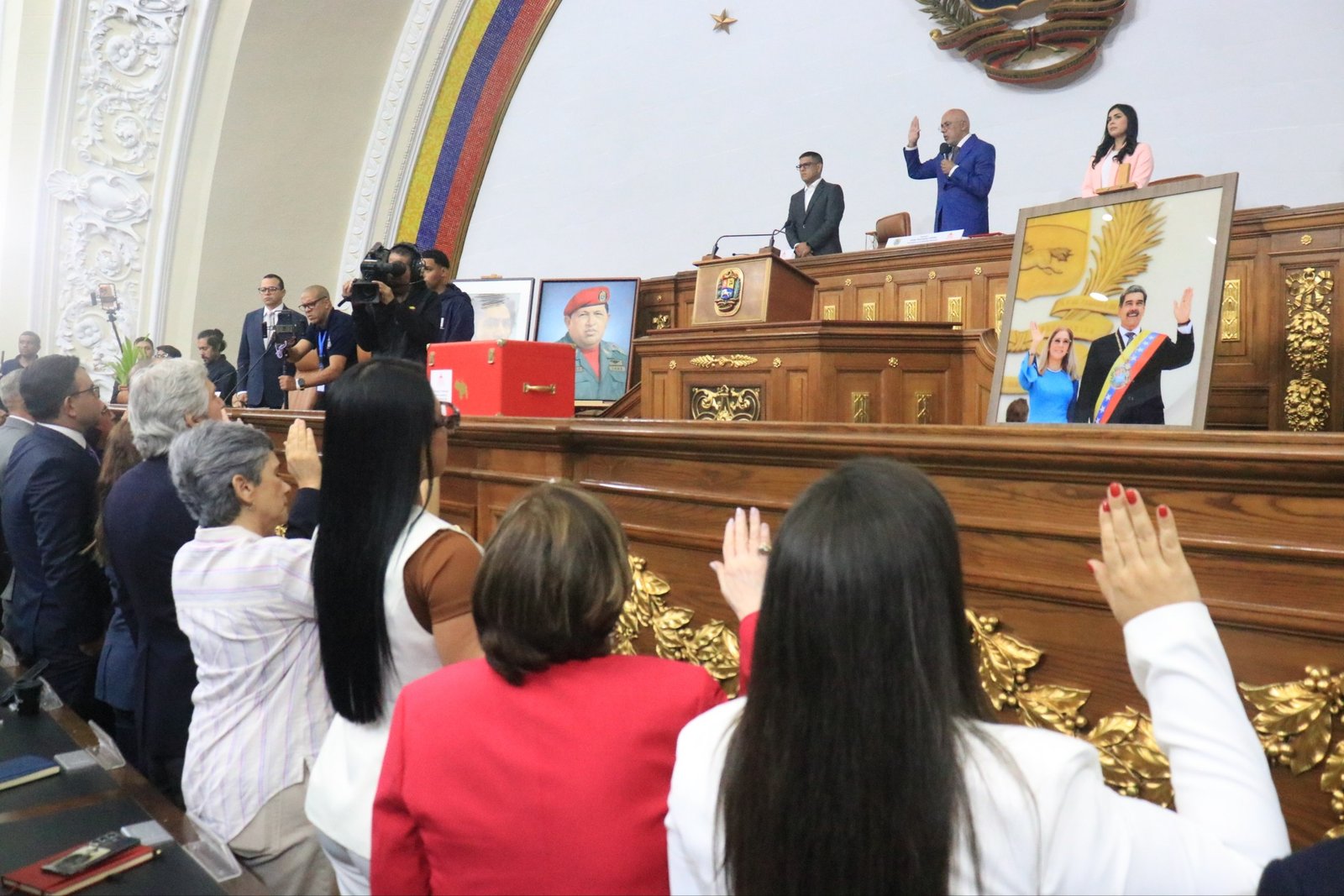
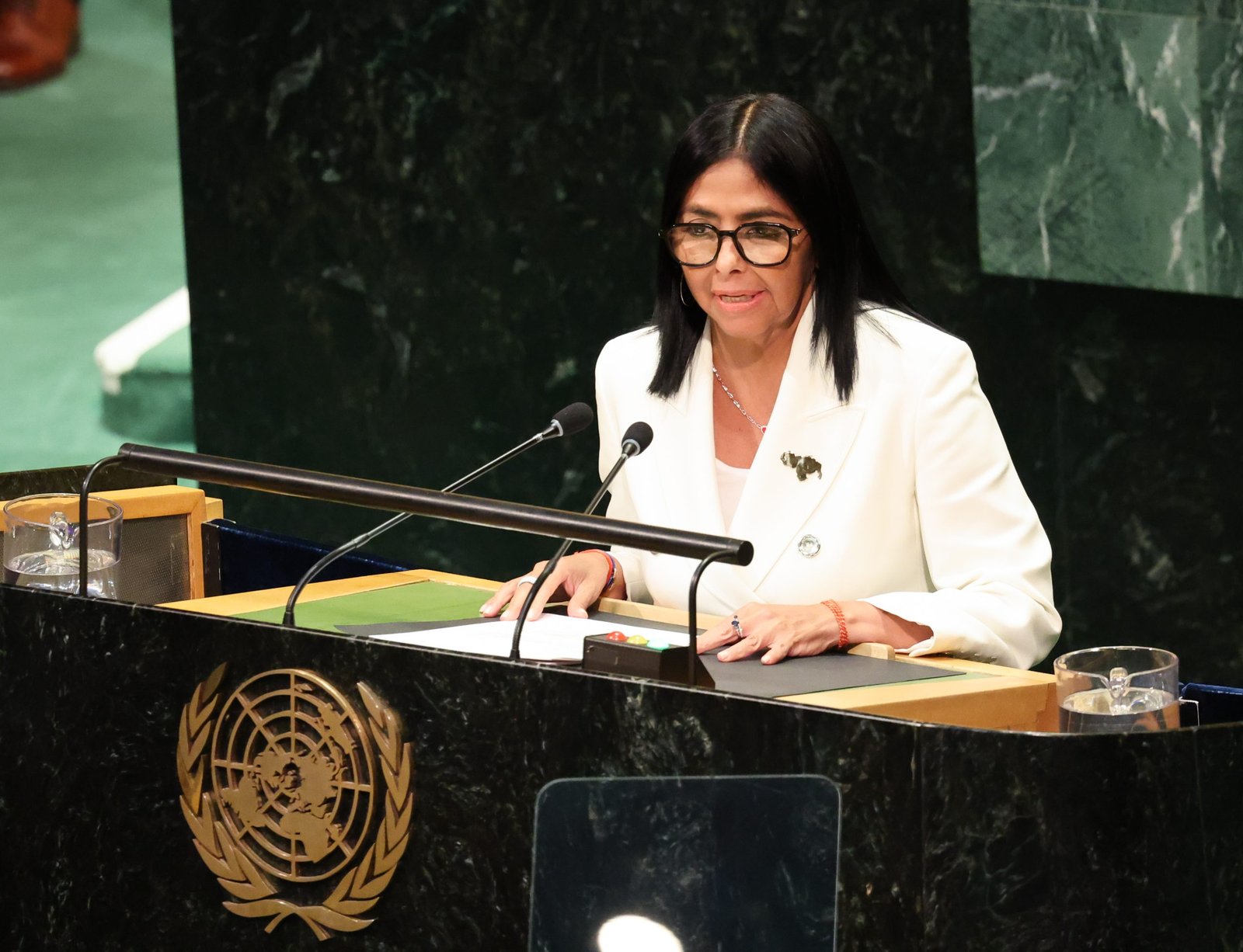
On January 3, 2026, a U.S. military operation captured Nicolás Maduro. Unlike the Persian case, here there was no invasion of an entire territory nor sustained military occupation—the instrument was an operation directed against the head of state—but the structural result is analogous, since Delcy Rodríguez, until then vice president, assumed the acting presidency, immediately backed by Washington as the main interlocutor. The parallel with Mohammad Reza Pahlavi is not forced, given that in both cases the intervening power avoided the power vacuum and complete institutional dismantling, preferring to leave in office a figure of continuity—the son of the deposed monarch, the vice president of the deposed government—whose internal legitimacy is limited but whose usefulness for managing power, stability, and guaranteeing the flow of crude is high.
The subsequent negotiations took place within a plan designed by the United States, structured in three stages—stabilization, recovery, and political transition—a scheme that institutionalizes, with names and surnames, what in Persia was done less explicitly in 1941. Washington also promoted modifications to Venezuelan oil and mining laws to facilitate private participation, partially relaxed sanctions, and assumed a central role in administering the revenues generated by oil sales.
The open question: is there a Venezuelan Mossadegh on the horizon?
The Iranian precedent did not end with the son installed on the throne nor with the oil agreement that sustained him for a decade. It ended in a nationalist reaction that, although defeated in 1953—when Mossadegh nationalized the AIOC and London responded with an international boycott until Washington and London orchestrated his overthrow through Operation Ajax—left a wound that reappeared with much greater force in 1979.
The question that the Persian case forces us to ask about Venezuela is not whether the current arrangement with Delcy Rodríguez is sustainable in the immediate term—the first months suggest that it is, with Trump himself publicly praising her management—but what political force, inside or outside chavismo, can eventually capitalize on the discontent already generated by the oil concessions. Within chavismo itself there are sectors that describe the agreement as “the greatest oil betrayal in history,” a phrase that would not be foreign to the vocabulary with which the Iranian press described the 1933 agreement that sustained the AIOC during the years of the young Shah.
Two axes, one same doctrine
What both episodes share, at bottom, is not only the mechanics of corporate control nor the formula of docile succession, but the doctrine that justifies them, which is based on the fact that oil ceased to be treated as a commodity subject to the ordinary rules of the market at the moment when a power decided that its supply was a matter of national security. Churchill said it bluntly in 1913 when speaking of “reliable sources of supply” for the Royal Navy; today Washington’s language about Venezuela—strategic supply corridors, hemispheric security architecture, direct oversight of the Caracas cabinet—is the contemporary translation of the same principle.
The decisive difference—and the one that explains why the U.S. intervention in Venezuela “goes beyond” the Iranian precedent—is that in Persia both processes were separated by almost three decades and executed by a formally different power in each case. Corporate control of oil was built by Great Britain in 1914; the replacement of the ruler, by an Anglo-Soviet coalition in 1941. In Venezuela, it is the same actor—the United States—that simultaneously designs the corporate architecture over the resource (Nabep) and the political architecture of the nation with Delcy Rodríguez, which suggests a deeper and faster influence over the state apparatus than that exercised over Persia in 1941. If the historical pattern repeats itself, the lesson of Abadan is that this type of control, precisely because of its depth, tends to generate the kind of nationalist reaction that ends up overflowing it.
However, today in Venezuela no political force seems to embody that nationalist thinking with strength. In the Venezuelan opposition there have been expressions of support for the agreement and for the U.S. intervention in the country, and the questions are not about the U.S. presence and influence; they are mainly due to the fact that Washington has chosen Delcy Rodríguez as interlocutor and not María Corina Machado or another opposition figure.
Tehran and Caracas never met. They are separated by an ocean, by a culture, and by more than a century of history. But there is something that unites them, and it is oil.
In Tehran, oil turned Persia into a territory too important to remain on the margins of the great powers. First came the foreign company. Then, the state decided that this resource was too strategic to leave solely in private hands. Agreements, vetoes, interventions, changes of government, and finally nationalization followed.
In Caracas, history seems to begin again, although with other names and in another century. Oil once again becomes much more than a commodity, since it once again becomes a question of power. A company becomes an instrument of a national strategy, while a foreign power participates simultaneously in the reorganization of the energy sector and in the country’s political architecture.
Tehran and Caracas never met. But their oil stages seem to have met on the same battlefield.
And to understand where Venezuela may be heading, perhaps we must first look back, to the streets of a city that was never on the same continent, but that has already traveled a good part of the road that Caracas is beginning to travel.