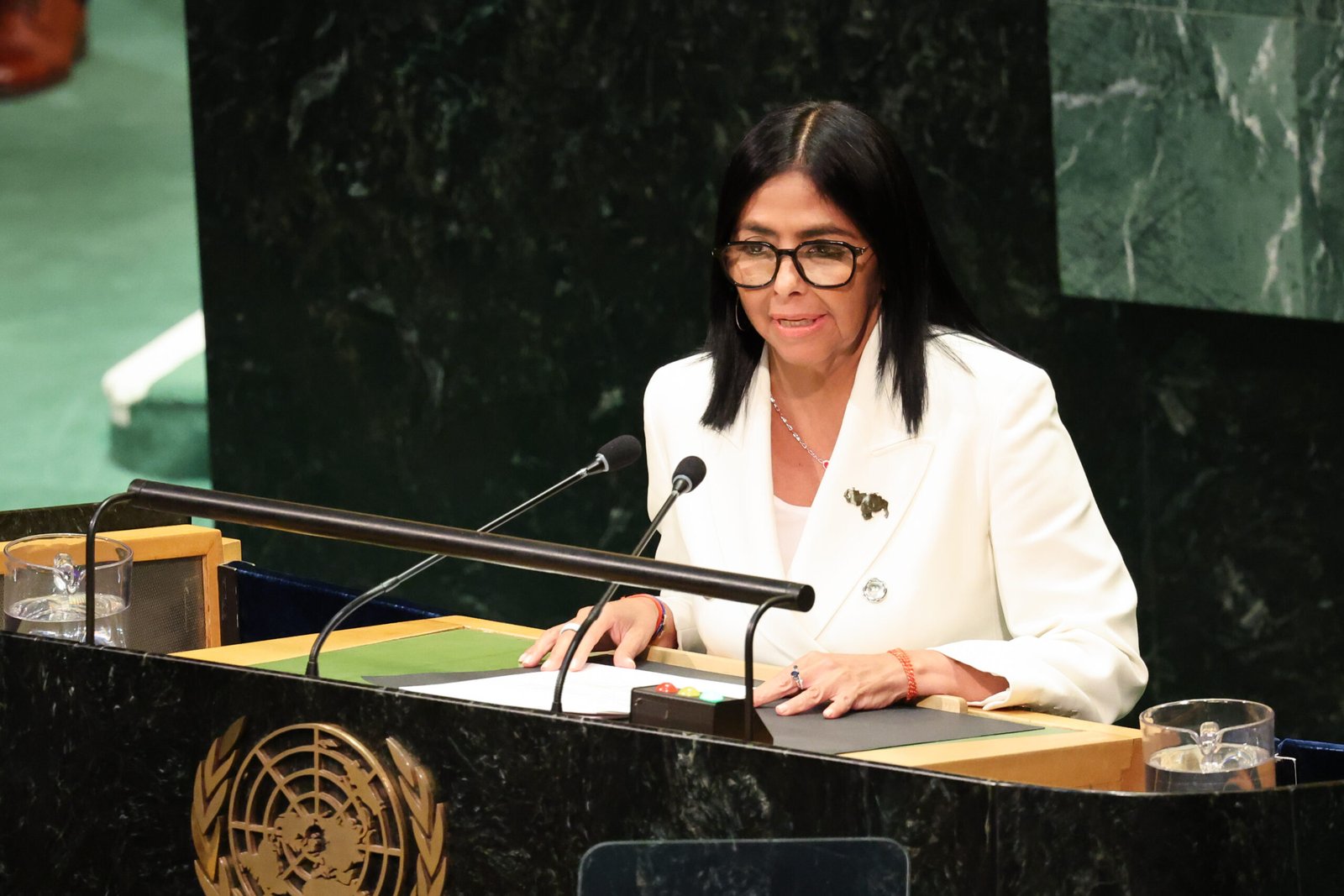
Various cases fall within a broad context of scrutiny and arrests of figures linked to corruption schemes and organized crime | Photograph: The Motion Cloud / Getty Images.
Guacamaya, October 13, 2026. Venezuela’s political and international dynamics took a major turn after January 3, the date on which a U.S. military operation culminated in the capture of then-President Nicolás Maduro and his wife, Cilia Flores. Since then, the administration led by Delcy Rodríguez has maintained an unprecedented agenda of operational and judicial cooperation with Washington.
This collaboration, backed by high-level diplomatic contacts, has included the visit to Caracas of CIA Director John Ratcliffe and a direct meeting between Trump and Rodríguez on September 22 on the sidelines of the 81st UN General Assembly. This context has translated into a sequence of high-profile handovers, deportations, and combined armed operations.
However, the haste and opacity with which the most recent cases have been carried out—especially the handovers of Colombian businessman Álvaro Pulido and the Tren de Aragua cyber-operator—reveal the application of atypical legal formulas that bypass—through apparent pragmatism—Venezuelan constitutional controls.
The Handover of a Key Partner in Oil Corruption
The most recent case was completed on October 11, when U.S. Attorney General Todd Blanche confirmed that Colombian businessman Álvaro Pulido Vargas (62 years old) was placed in federal custody by the National Security Task Force. DEA agents transferred Pulido directly to Florida from the El Rodeo I prison, where he had been incarcerated since 2023 in the Pdvsa-Cripto case.
Pulido, also identified as Alex Saab’s main partner in the triangulation of more than $2 billion through overpricing in the CLAP food boxes and the Gran Misión Vivienda, appeared on Tuesday, October 13, before the Federal Court for the Southern District of Florida to face 13 charges of money laundering and bribery.
What is questionable about the procedure is that Pulido had an open criminal case in Venezuela without a final judgment and, although born in Colombia, various sources indicate that he holds Venezuelan citizenship. Neither Caracas nor Washington offered explanations about the legal figure used to authorize his removal from a national prison.
The Tren de Aragua Cyber-Operator Transferred From Caracas
Days earlier, on October 2, Aníbal Alexander Canelón Aguirre (alias “Prometeo” or “El Ingeniero”), 50 years old, appeared before the Federal District Court in Nebraska after being handed over from Caracas, where he was captured on September 15. The defendant, who pleaded not guilty, became the first fugitive sought primarily for cybercrimes to enter the FBI’s ten most wanted list.
He is accused of leading jackpotting networks (infecting ATMs with malware for mass cash theft) that caused losses of more than $55 million in the U.S., whose funds financed Tren de Aragua operations. Since Canelón is a Venezuelan citizen by birth, his direct transfer to a U.S. court represents one of the most direct clashes against the constitutional text.
The Lethal Armed Operation Against “Niño Guerrero”
Unlike judicial or administrative transfers, the case of Héctor Rusthenford Guerrero Flores, top leader of Tren de Aragua, culminated in his death on June 12 of this year. Guerrero Flores, alias “Niño Guerrero,” was “neutralized” during a tactical incursion in the mining sector of Las Claritas, in the south of Bolívar state.
The event reflected a profound narrative disparity between both nations: while President Donald Trump and the U.S. Southern Command celebrated a “swift and lethal military attack” using technological precision, the official statement from Delcy Rodríguez’s government emphasized that it was a “combined operation” based on intelligence sharing and technical support, without asserting the presence of U.S. military boots on Venezuelan soil.
The Administrative Deportation of Alex Saab
On May 16, the Administrative Service of Identification, Migration, and Foreign Affairs (Saime) reported the handover to DEA agents in Miami of Colombian-Venezuelan businessman Alex Saab. Previously, Saab had been removed in January from his duties as Minister of Industry and held in secret since February.
In September 2026, Saab pleaded guilty to money laundering in Florida, which [included] a cooperation agreement to surrender $189 million in assets and provide evidence against the power elite. His handover was carried out through the figure of administrative immigration deportation, although it avoided the substantiation of an extradition trial before the Supreme Tribunal of Justice (TSJ).
The Legal Labyrinth and the Anomalies of the Handovers
Article 69 of the Constitution of the Bolivarian Republic of Venezuela categorically states that “the extradition of Venezuelans and Venezuelan women is prohibited.” In accordance, Article 6 of the Organic Criminal Procedure Code reaffirms that the extradition of a Venezuelan “may not be granted for any reason,” which imposes on the authorities the strict obligation to prosecute within national territory.
On the other hand, the legal passive extradition procedure in Venezuela requires the intervention of the Public Ministry, a hearing before a Control Judge, and the decision of the Criminal Cassation Chamber of the Supreme Tribunal of Justice. To circumvent this rights-protecting procedure, the Executive resorted with Alex Saab—and in an undeclared manner with Pulido—to expedited immigration deportation via Saime.
Likewise, although Article 271 of the Constitution prohibits denying the extradition of foreigners responsible for crimes of capital legitimization, organized crime, or public corruption, the Magna Carta emphasizes that this procedure must be public, oral, brief, and with strict respect for due process. The clandestine removal of defendants violates the due process enshrined in Article 49 of the CRBV.
In relation to the limits of joint military operations, and especially regarding the lethal operation against “Niño Guerrero,” numeral 11 of Article 187 of the CRBV exclusively attributes to the National Assembly the competence to “Authorize the employment of Venezuelan military missions abroad or foreign ones in the country.”
In the absence of a public parliamentary agreement, the Venezuelan Executive was forced to frame the event as “technical intelligence cooperation” to avoid admitting the unauthorized presence of military forces from a foreign power in Bolívar state.
U.S. Security Officials Who Have Visited Venezuela
Since the events of January 3, 2026, several high-ranking U.S. intelligence, defense, and security officials have made official visits to Caracas to coordinate “cooperation mechanisms,” “regional stabilization,” and “the fight against transnational crime” with the acting administration. Some of the bodies represented are:
- High-level intelligence: CIA Director John Ratcliffe traveled to Caracas in mid-January 2026 on direct instructions from Donald Trump to meet with acting President Delcy Rodríguez and open diplomatic and informational channels.
- Military leadership of the Southern Command: General Francis L. Donovan, commander of U.S. Southern Command (SOUTHCOM), has led delegations to Caracas on multiple occasions (February and July 2026), accompanied by Deputy Assistant Secretary of War Joseph Humire.
- Pentagon and Defense leadership: Visits were also recorded by military commanders such as General Dan Caine (Chairman of the Joint Chiefs of Staff), General Kevin J. Jarrard (Northern Command), and Bradley Hansell (Deputy Under Secretary of Defense for Intelligence).
Talks with authorities in Caracas have focused on dismantling criminal networks, fighting drug trafficking, and stabilizing the country, according to publicly disseminated statements.
The sequence of events initiated on January 3 has revealed a political pragmatism in which the needs for diplomatic alignment and relief from international pressures have dominated over the formalities of the domestic legal order. The replacement of procedural trials before the TSJ by administrative handover mechanisms and tactical executions marks an unprecedented precedent.